
The full moon for the month of April rose a few nights ago. A great tool for these kinds of events is Mooncalc, which not only gives all the when and where the moon will rise, its phase and all sorts of other salient lunar data. Even better, the map feature helps determine the best places to observe the moon’s rise over certain features. It is no surprise that I am after shots of Mount Shasta with the moon. Mooncalc is what I used to determine when the best time to observe the moon coming over the mountain from Truchas Ridge, allowing me to get this shot in June of 2022:

This time, I reckoned the best place to capture the view of moon and mountain was from the southwest side of the Shasta Valley. I headed out well before sunset and got myself in position. There weren’t many clouds in the sky so the sunset wasn’t particularly noteworthy. In spite of this, one can’t help clicking away when the camera is set up facing a 14,000 foot icy spire thrust into the warm spring dusk. What a pleasant way to spend an evening…
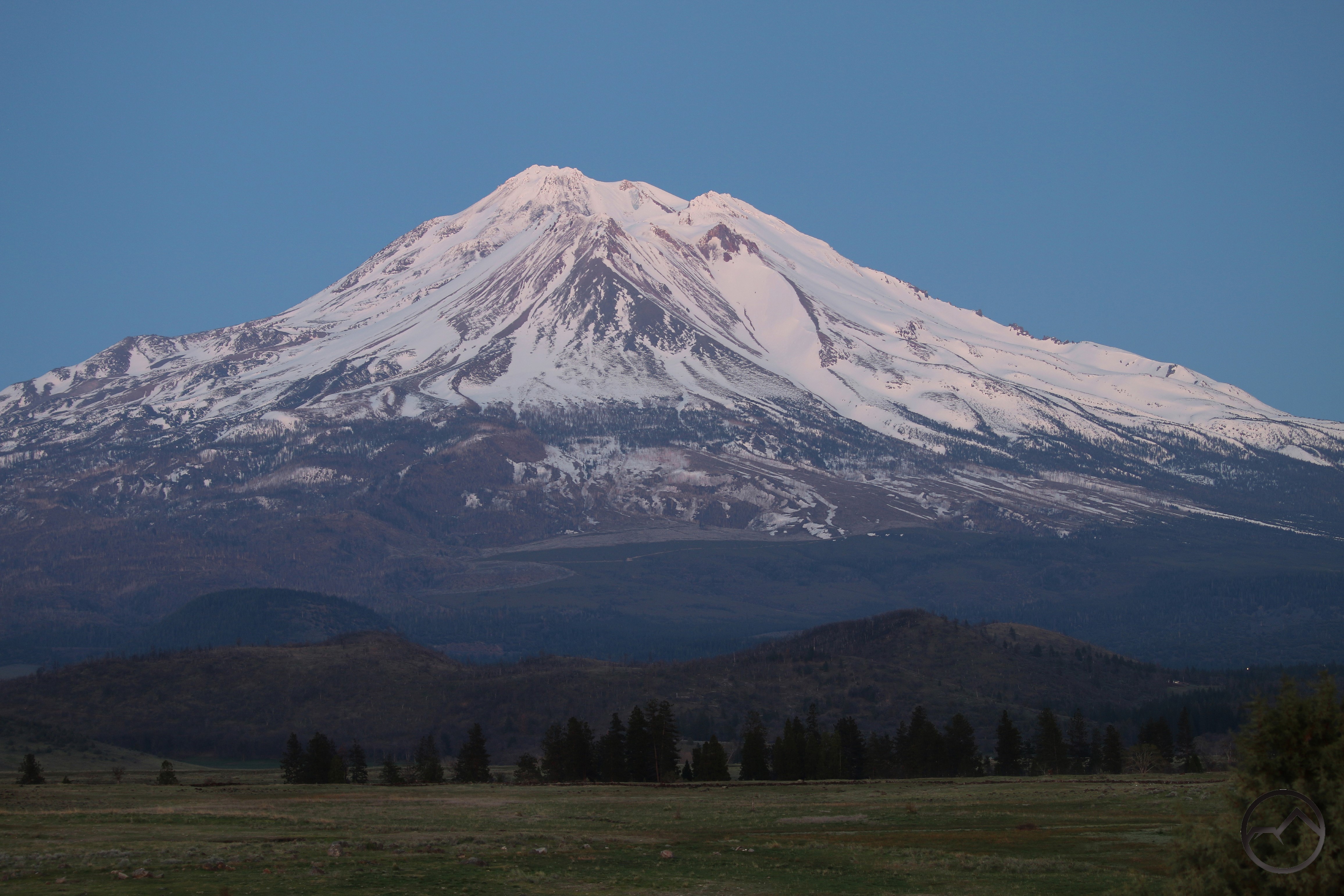
I fiddled with my settings, waiting for the moon to come up over the mountain. Mooncalc stated that the moon would rise at 8:53. However, that is only the time that the lunar body breaks the horizon of the curvature of the earth. This would be useful in Iowa but it does not calculate the additional terrain and Mount Shasta presents unusually large “additional terrain”. Thus I waited an indefinite amount of time for the moon to pass beyond the earth’s curved horizon and to then breach the visible horizon created by Mount Shasta.
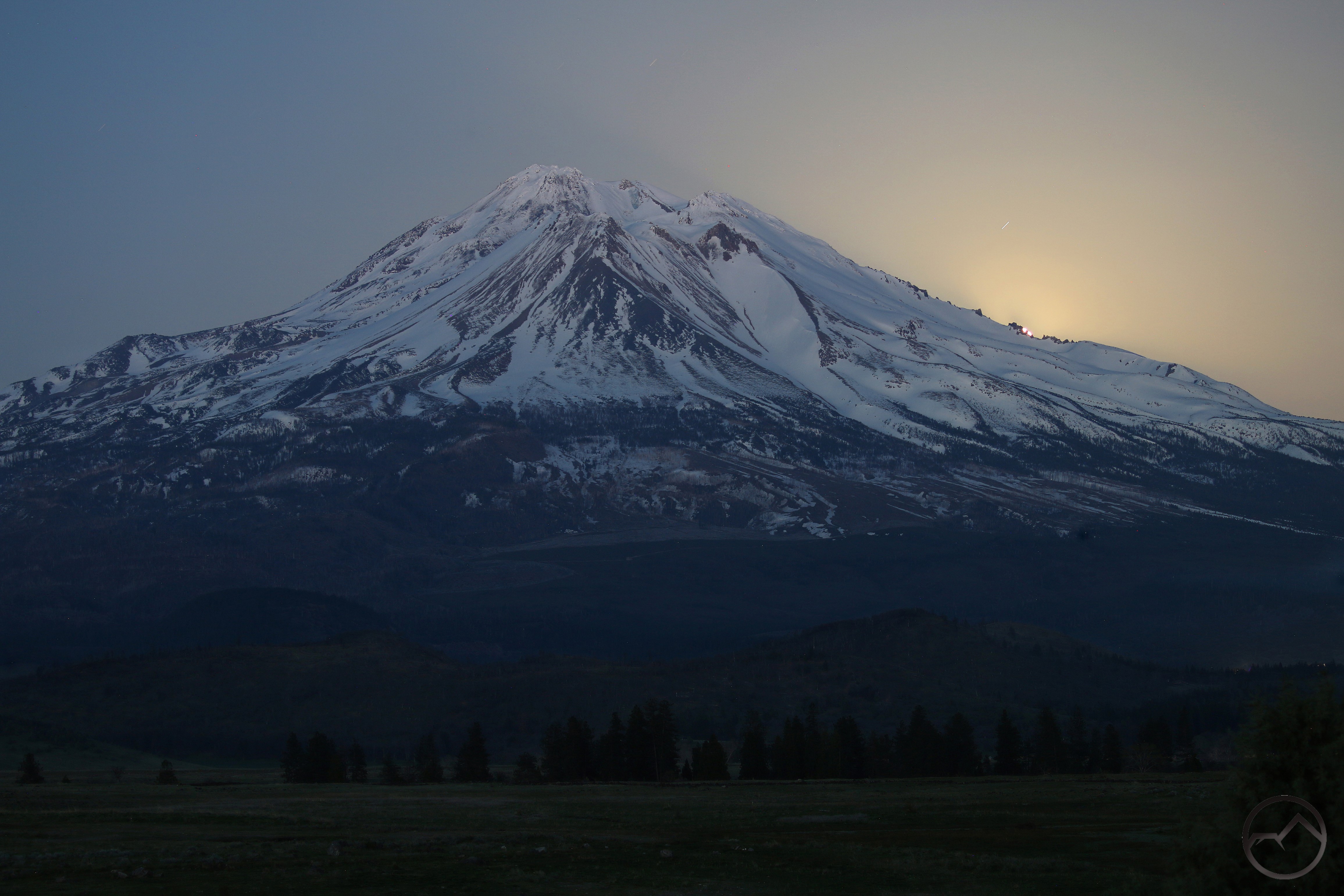
It was only about 15 or 20 minutes, though it seemed like far longer, before a steady glow began to come from beyond Casaval Ridge. Slow in growing, the intensity finally illuminated much of the area around Mount Shasta. Then, just as the moon began to break the crenellated horizon of the ridge, a feature I had never observed over Mount Shasta suddenly became evident. The moon was bright enough and at just the right angle and position that Mount Shasta case a shadow in the moonlight across the night sky.
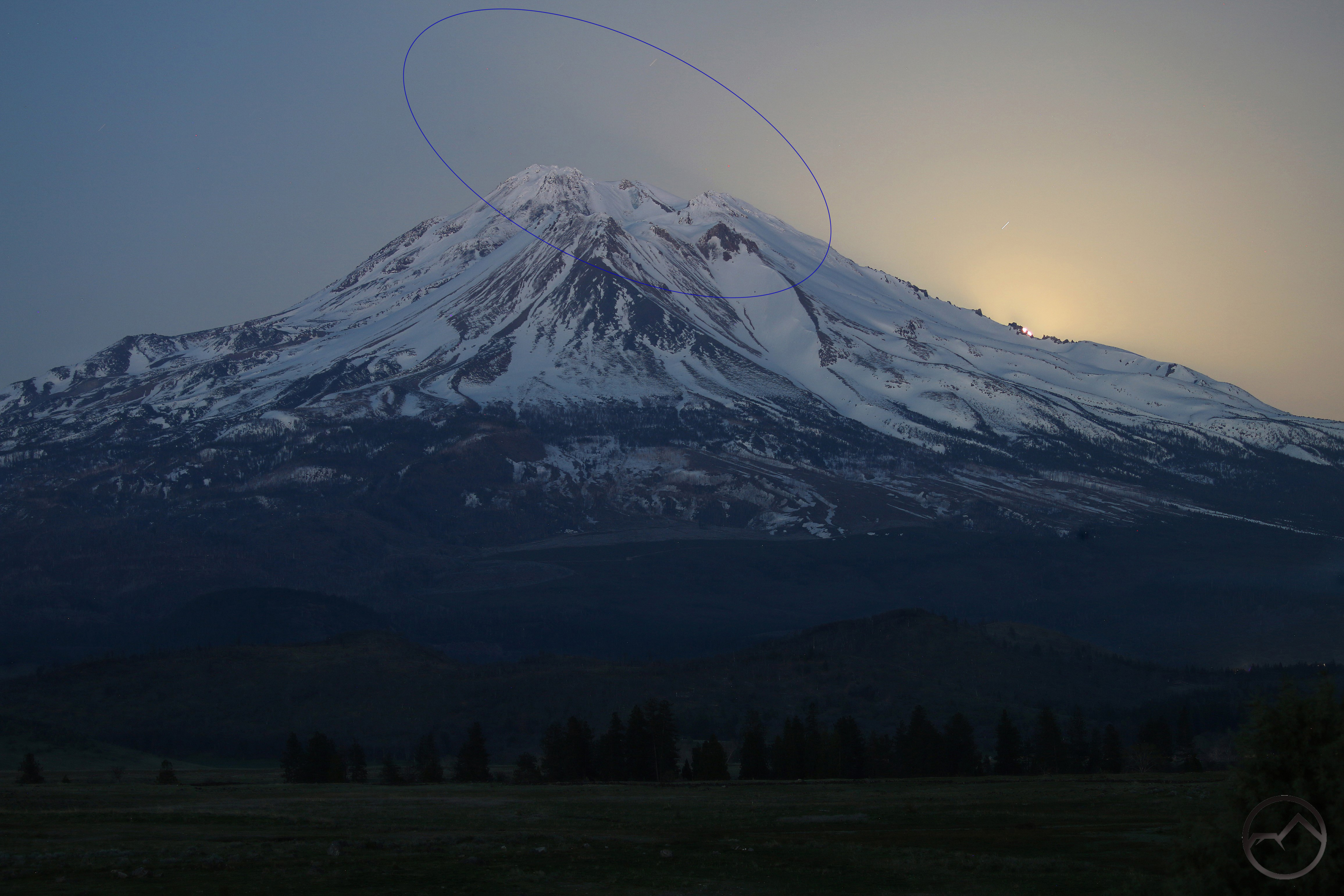
I have seen the mountain cast all manner of shadows at sunrise and a handful of them at sunset but never have a seen it cast a shadow into the night sky in the moonlight. Though it was faint, it was easily visible with the naked eye. If I didn’t know the mountain had an endless bag of wonders it has yet revealed, I would say now I have seen everything (I’ll say that when I finally get an image of lightning striking the mountain!).
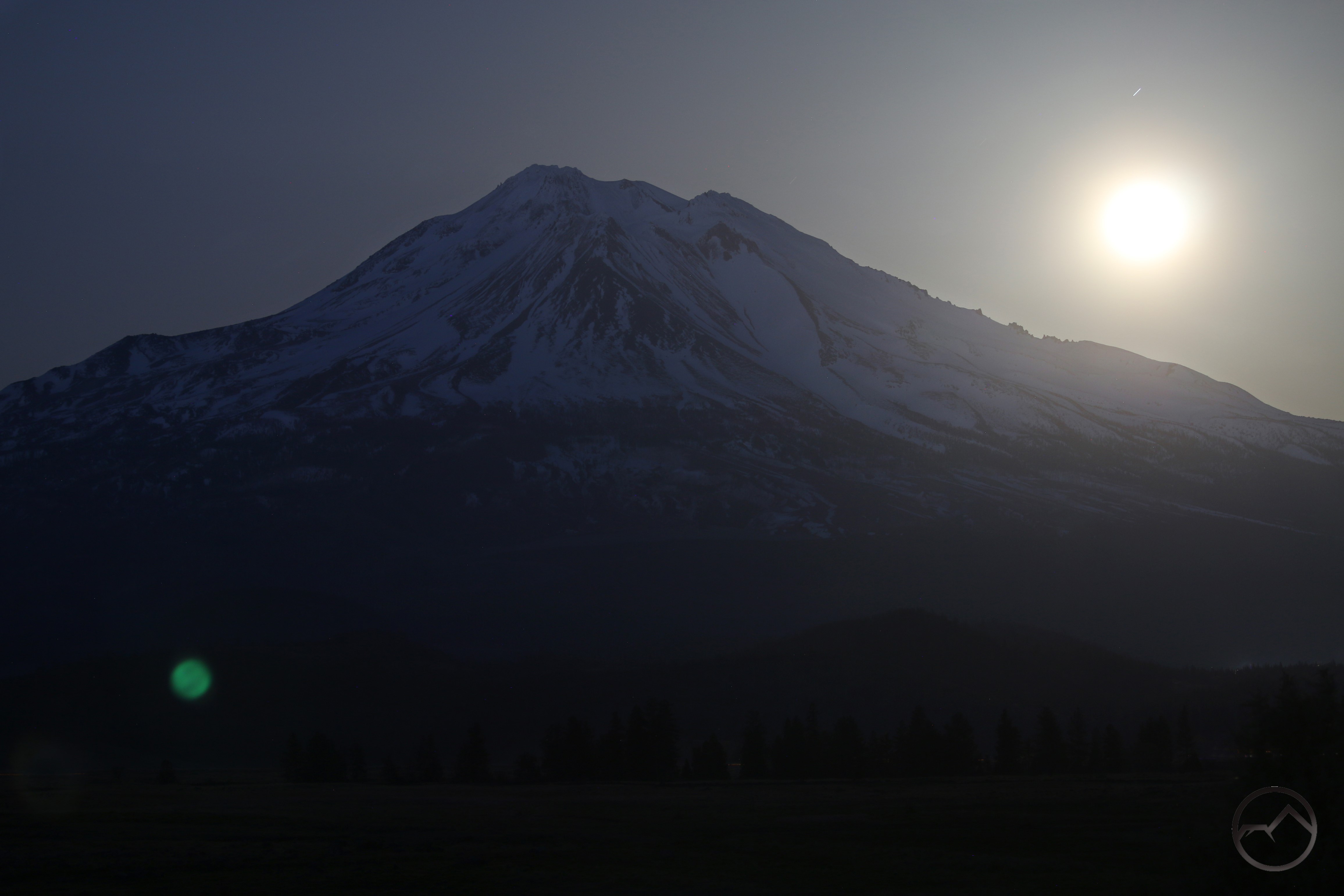
In the end, the moon was as bright as expected and pictures of moon and mountain were had. However, the most interesting was with the sun so bright it looked like the sun itself. Yet, in the amazing way that things work, the moon’s reflection was on my lens and even in the small green spot that wasn’t really there, you could see an ocean of storms and seas of serenity and tranquility…
 Hike Mt. Shasta
Love these moon photos!!
Gorgeous photos! Definitely inspired me to see a moonrise over Shasta.
Great blog! I really enjoyed reading it. The way you explained everything in such simple and clear words made it easy to follow. Sometimes blogs can get too technical or confusing, but this one was straight to the point and very helpful.
Your writing style is also very engaging. It kept me interested from start to finish, and I didn’t feel lost at any point. It’s always nice when a blog teaches you something without making it feel too heavy or complicated.
I’m definitely looking forward to reading more from you. If all your blogs are like this, I’m sure they’ll help a lot of people. Keep up the great work!