Hike Mt. Shasta

Exploring the Mount Shasta Region

  • Home
  • Trails
    • Mount Shasta Trails
      • Brewer Creek Trail
      • Clear Creek Trail
      • Gray Butte Trail
      • Green Butte Ridge Trail
      • Horse Camp Trail
      • North Gate Trail
      • Old Ski Bowl Trail
      • Panther Meadow Trail
      • South Gate/Squaw Meadow Trail
      • Whitney Falls Trail
    • Trinity Divide Trails
      • Blue Divide Trail
      • Castle Lake Trail
      • Castle Lake Shore Trail
      • Cliff Lake Trail
      • Deadfall Lakes Trail
      • Gray Rock Lakes Trail
      • Gumboot Trail
      • Heart Lake Trail
      • Porcupine & Toad Lakes Via Pacific Crest Trail
      • Seven Lakes Basin Via Pacific Crest Trail
      • Sisson-Callahan Trail
      • Soapstone Trail
      • South Mumbo Scramble
      • Tamarack Lake Trail
      • Toad Lake Trail
    • Castle Crags Trails
      • Burstarse Falls Via Pacific Crest Trail
      • Castle Dome Trail
      • Flume Trail
      • Lower Castle Crags Via Pacific Crest Trail
      • Root Creek Trail
    • Scott Mountains Trails
      • Bluff Lake & Cement Bluff via Pacific Crest Trail
      • Caldwell Lakes Trail
      • China Mountain Scramble
      • Cory Peak and Bull Lake via Pacific Crest Trail
    • Cascade Crest
      • Ash Creek Butte Scramble
      • Goosenest Trail
      • Juanita Lake Trail
      • Orr Lake Trail
    • Mount Shasta City Area Trails
      • Black Butte Trail
      • Box Canyon Trail
      • Gateway Trail
      • Lake Siskiyou Trail
      • Mount Shasta City Short Trails
      • Ney Springs Canyon Trail
      • Spring Hill Trail
    • Shasta Valley Trails
      • Black Lava Trail
      • Haystack Trail
      • Lake Shastina Trail
      • Pluto Cave Trail
      • Trout Lake Trail
      • Yellow Butte Trail
    • Sacramento River Trails
      • Dunsmuir Trail
      • Hedge Creek Falls Trail
      • Sacramento River Trail
      • Sims History Trail
    • McCloud River Trails
      • Ash Camp To Ah-Di-Na Via Pacific Crest Trail
      • McCloud River Falls Trail
      • McCloud River Preserve Trail
      • Squaw Valley Creek Trail
      • McCloud River Trail: Algoma Camp to Nitwit Camp
      • McCloud River Trail: Nitwit Camp to Cattle Camp Swimming Hole
      • McCloud River Trail: Cattle Camp Swimming Hole to Camp 4
      • McCloud River Trail: Camp 4 to Upper McCloud Falls
      • McCloud River Trail: Pine Tree Hollow Loop
    • Trails Further Afield
      • Trinity Alps Trails
        • Bear Lakes Trail
        • Billys Peak Trail
        • Boulder Creek Lakes Trail
        • Boulder Lake Trail
        • Canyon Creek Trail
        • Caribou Lakes Trail
        • East Boulder Lake Loop
        • East Weaver Lake Trail
        • Four Lakes Loop
        • Granite Peak Trail
        • Grizzly Creek Trail
        • Gulch Lakes Loop
        • Hidden Lake Trail
        • South Fork Lakes Trail
        • Stoddard Lake Trail
        • Stoney Ridge Trail
        • Tangle Blue Lake Trail
      • Warner Mountains
        • Emerson Creek Trail
        • Highgrade Trail
        • Patterson Lake Via Warner Summit Trail
        • Pine Creek Trail
        • Squaw Peak Trail
  • Articles
    • Trails By Area
      • Mount Shasta
        • Vistas, Meadows And Waterfalls: Three Best Hikes On Mount Shasta
        • The End Of The Road: Three Hikes In The Old Ski Bowl Area
        • Two Trails From Bunny Flat
        • Three Trails On Mount Shasta’s East Side
        • Mount Shasta’s Hummingbirds
      • Trinity Divide
        • Great Lakes: Top Five Lake Basins In The Trinity Divide
        • The Headwaters Of The South Fork Of The Sacramento River
        • Neglected Headwaters: Two Lesser Lake Basins On The South Fork
        • Gumboot Saddle: Two Hikes On The PCT
        • Descent Into Mystery: The Sisson-Callahan Trail
        • Mumbo Basin – Overlooked On The West Side
        • The Headwaters Loop: A Proposed Backpacking Loop In The Trinity Divide
      • The McCloud River
        • The McCloud River Trail
      • Shasta Valley
        • Jewels In The Desert
      • Scott Mountains
        • Great Scott! Two Scott Mountains Hikes On The PCT
      • Trinity Alps
        • Carubou Lakes: Trinity Alps On A Grand Scale
        • Switchbacks To Heaven: The Trinity Alps’ Stoney Ridge Trail and Four Lakes Loop
        • Trinities In Proximity: Two Trinity Alps Trails With Easy Access From Mount Shasta
        • Trails in the Carter Meadows Area
        • Trinity Alps Views of Mount Shasta
        • The Psychological Value Of The Trinity Alps
    • Waterfalls
      • Three Waterfalls On Mount Shasta
      • McCloud River Waterfalls
      • Sacramento River Waterfalls
      • Trinity Divide Waterfalls
      • Trinity Alps Waterfalls
      • Avoiding A Dry Whitney Falls
    • Off Season Trails
      • Three Winter Hikes Near Mount Shasta City
      • Winter Hikes In Shasta Valley
      • Winter Hiking In The Shasta Valley Wildlife Refuge
      • Winter Hikes On The Sacramento River
      • Winter Hikes On The Lake Siskiyou Trail
      • Spring Hikes In The Castle Crags
      • Spring Hikes On the Upper McCloud
      • Spring Hikes On The Lower McCloud River
    • Points Of Interest
      • Mount Eddy: Overshadowed, Underrated
      • Black Butte: Hiding In Plain Sight
      • Castle Dome: Steadfast And Staggering
      • Mount Shasta Hoodoos
      • Sacramento Scrambling
      • The Shasta River
      • The Castle Creek Watershed
      • Mount Shasta East Side Glacier View
      • 5 Fantastic Mount Shasta Vistas
      • 5 Highest Peaks Around Mount Shasta
      • 5 Best Hikes On Creeks And Rivers
      • 5 Interesting Footbridges
      • Three Spectacular Drive-To Sunset Vistas
    • North State Geography
      • Introduction
      • Seven Major Regions
      • The California Cascades
      • Klamath Mountains Pt. I
      • Klamath Mountains Pt. II
      • The Great Canyons Of Mount Shasta
      • Mount Shasta, Timberline, And The Relative Size Of Cascade Volcanos
      • Four Eruption Cones Of Mount Shasta
      • Mount Shasta’s Medial Moraine
    • Northern California Review
      • North Table Mountain
      • Lakes Basin Recreation Area
      • Eastern Sierra Fall Color
      • Sonoma County
      • Central Sierra Nevada
      • Orland Buttes
    • Seldom Seen
      • Ash Creek Falls
      • Mud Creek Canyon
      • Lower Mud Creek Canyon
      • Diller Canyon
      • Lower Cascade Gulch
      • The Grey Rocks
      • Castle Creek
      • Upper Wagon Creek
      • Fawn Creek Canyon
      • Confluence of the Sacramento River and Castle Creek
      • Upper Klamath River Canyon
      • Hole In The Ground Geologic Area
      • Ash Creek Butte Fossil Rock Glacier
    • Mount Shasta History
      • Vantage Lost: The Everitt Memorial Vista
      • A Yosemite-Mount Shasta Connection
      • Whitney – What’s In A Name?
      • Mount Shasta Area and the 1838 Exploring Expedition
      • A 19th Century Engraving Of An Epic Mount Shasta Vista
      • Vintage 1907 Color Photos
      • A Misleading Painting
      • A Mysterious Painting
      • A Mysterious Painting Pt. II
      • Stereographic Mt. Shasta
      • Year One Of Hike Mt Shasta
      • Year Two Of Hike Mt Shasta
      • Year Three Of Hike Mt Shasta
      • Year Four Of Hike Mt Shasta
      • Year Five Of Hike Mt Shasta
      • Year Six Of Hike Mt Shasta
      • Year Seven Of Hike Mt Shasta
    • Image Galleries
      • Mount Shasta Trails Gallery
      • Mount Shasta Sunrise Gallery
      • Mount Shasta Sunset Gallery
      • Lenticular Cloud Gallery
      • Mount Shasta NON-Lenticular Clouds
      • Mount Shasta Reflection Gallery
      • Telephoto Gallery
      • Mount Shasta Area Fall Color
      • Castle Crags Gallery
      • Waterfalls Gallery
      • Trinity Divide Lakes Gallery
      • Mount Shasta Area Rivers Gallery
      • Shasta High Desert Gallery
      • Mount Shasta GIF Gallery
    • Random Notes
      • Revew: Three Mount Shasta Trail Maps
      • A Mount Eddy Wilderness?
      • New Land Additions For The Castle Crags
      • Book Plug: Mount Shasta Area Rock Climbing
      • Exile: How I Came To Love Wilderness
  • Mt. Shasta Trail Map
  • Blog
  • About/Contact
  • Links
  • Truchas Ridge

Trinity Alps Views of Mount Shasta

Posted by bubbasuess on May 10, 2015
Posted in: Hiking, Mount Shasta, Trinity Alps. 2 Comments
Mount Shasta highlights the horizon from Billys Peak.

Mount Shasta highlights the horizon from Billys Peak.

While the Mount Shasta region has a significant amount of wild, primordial land, its proximity to populated areas, lines of transportation and agricultural areas has had its effect and much of the land has felt civilization’s touch. That is why I find it comforting that a place like the Trinity Alps is so close. This subrange of the KIamath Mountains is vast and spectacular. Here it is possible to enter the wilderness amidst staggering mountains and roaring rivers and not emerge for weeks at a time. It is like having that vaunted Sierra Nevada tucked away behind the Trinity Divide (the mountain range immediately west of Mount Shasta), waiting to embrace those seeking wilderness immersion.

However, for all of its vastness, the Trinity Alps is not entirely separated from Mount Shasta. More than any other set of mountains beyond the great volcano’s immediate vicinity, the hikes in the Trinities feature prominent views of Mount Shasta. It is a constant reminder of how close the mountain is and just how big it really is. One particularly neat aspect of observing Mount Shasta from the Trinity Alps is to see it surrounded by all of the mountains in its vicinity. Unlike other views nearer the big cone, you can witness towering above not only the mountains to its east, but also Mount Eddy and the Trinity Alps. This really drives home just how massive it is and how far above all of its neighbors Mount Shasta soars.

Most of the trails where Mount Shasta is prominently visible are those along the east and northeastern ends of the wilderness area. These trails wind through mountains that loom high above the Trinity River, which forms the divide between the Trinity Alps and the Trinity Divide (I know it is confusing!). The paths climb through beautiful canyons to high lake basins surrounded by towering peaks of granite and peridotite. The scenery here is an excellent complement to Mount Shasta vistas. Towering granite cliffs and turrets loom high above glittering alpine lakes. Expansive meadows and deep forests blanket the area and teem with wildlife. Some of the best examples of trails that boast good views of the monarch mountain are the Bear Lakes Trail and the Pacific Crest Trail, as it weaves along the crest of the northeast corner of the Trinity Alps. The trails deeper in the interior of the Trinity Alps travel through taller mountains and much more rugged terrain, which obscure views from all but the tallest peaks where no trails reach. The only exception to this is the route which reaches the summit of Monument Peak, though the view of Mount Shasta from here is not quite as good. Still, those places where Mount Shasta is visible have exceptional beauty of their own and are worthy of exploration.

Click to enlarge:

Bear Lakes Trail
Billys Peak Trail

East Boulder Lake Loop
On the horizon from Tapie Lake.
Mounts Shasta and Eddy from the Trinity Alps.
Peeking out from behind Granite Peak.
Mount Shasta Rockfall

Posted by bubbasuess on May 8, 2015
Posted in: Hiking, Mount Shasta. Tagged: Avalanche Gulch, Casaval Ridge. 3 Comments
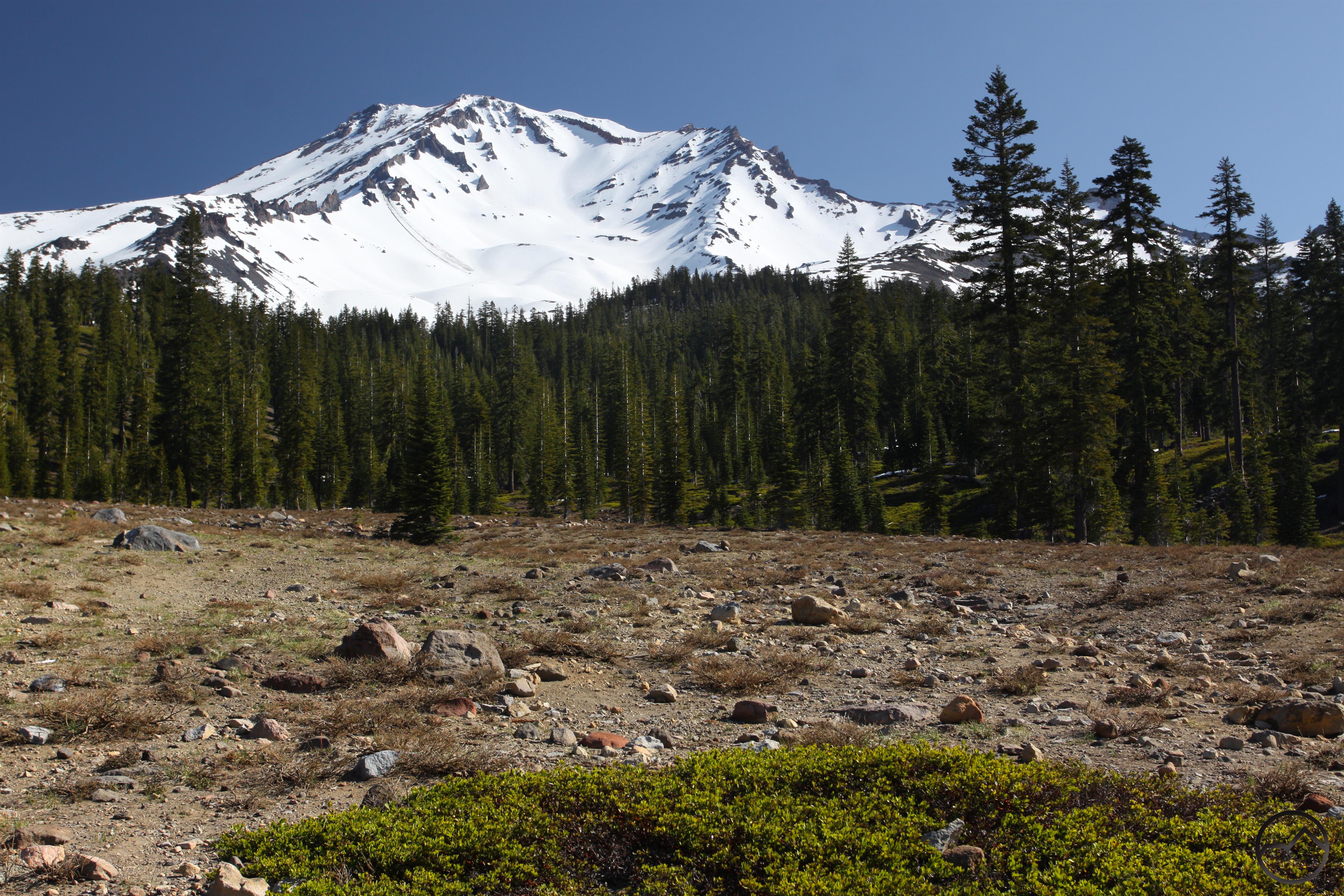
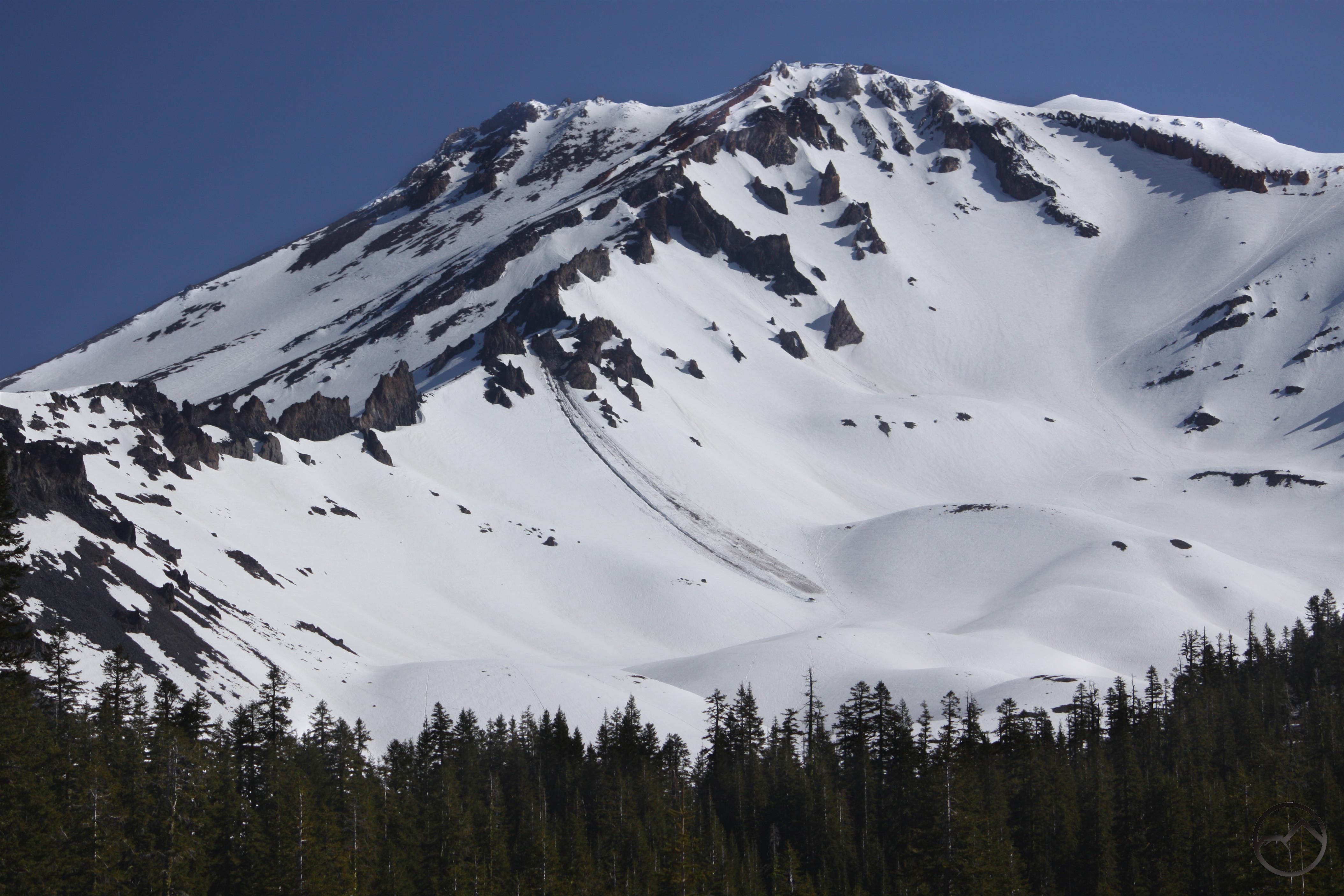
The rockfall is visible from Bunny Flat.

Rockfall visible from Bunny Flat.

The landscape, which often seems so static from a human perspective, is constantly evolving. This was put in evidence recently by the changing of the Sacramento River’s course at the inlet to Lake Siskiyou (read about it here and here). Nature’s power to alter its appearance is not something that is limited to rivers. Mount Shasta also experiences this process and exhibits the raw power of the natural world. On April 30th, a massive rock broke off of one of the many large outcroppings on Casaval Ridge and tumbled into Avalanche Gulch. The enormous rock presumably gave way after being split off from the main block of rock after countless freezing and thawing cycles. After breaking away from Casaval Ridge, it cut a deep trough through the loose scree and snow below, eventually coming to rest close to the climbers trail just below Helen Lake. The impact of the rock was so powerful it registered on seismographs. Needless to say, the climb up Avalanche Gulch now has a new landmark.
The rock and its trail down the mountain are plainly visible to the naked eye from down in Mount Shasta. It is worth the drive up to Bunny Flat to get an even better perspective on the incredible scene. The rockfall is a powerful reminder of the energy and danger that is part of the warp and woof of a landmark like Mount Shasta, as well as how awe-inspiring and beautiful it can be. Like the changes wrought by the Sacramento River, observing how easy the landscape can change is humbling.
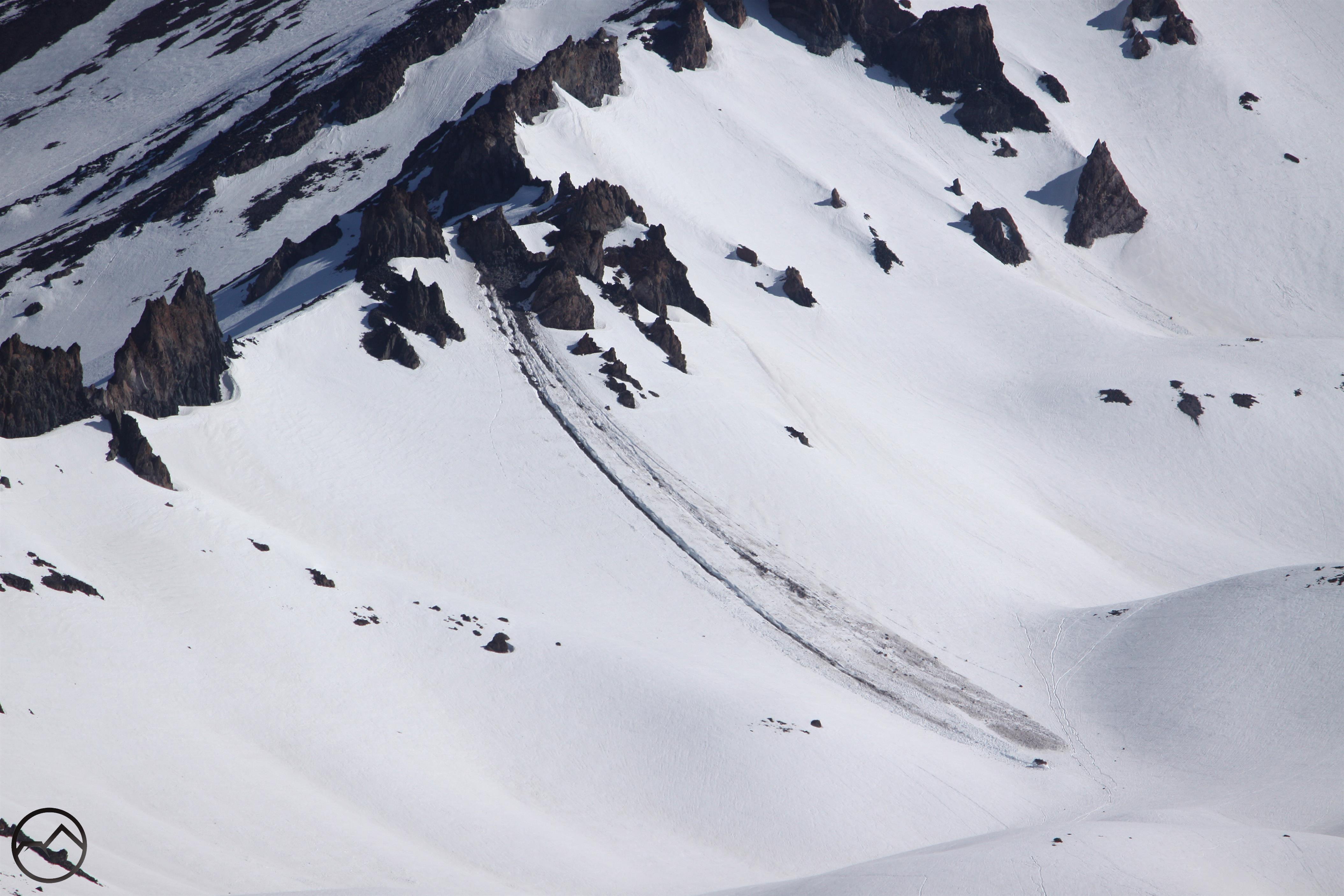
Cascades, Mt Shasta - May2015 026 (Custom)The rockfall’s debris trail cuts an impressive gash into the side of Avalanche Gulch. The huge rock fell about 1,000 feet before coming to rest near the route used by climbers to reach Helen Lake.

Cascades, Mt Shasta - May2015 045 (Custom) Click to enlarge this image for lots of detail. Note how the large rock was not the only piece of the ridge to come tumbling down. It also seems to have triggered a modest avalanche, the dirty snow is littered with other, smaller rocks.

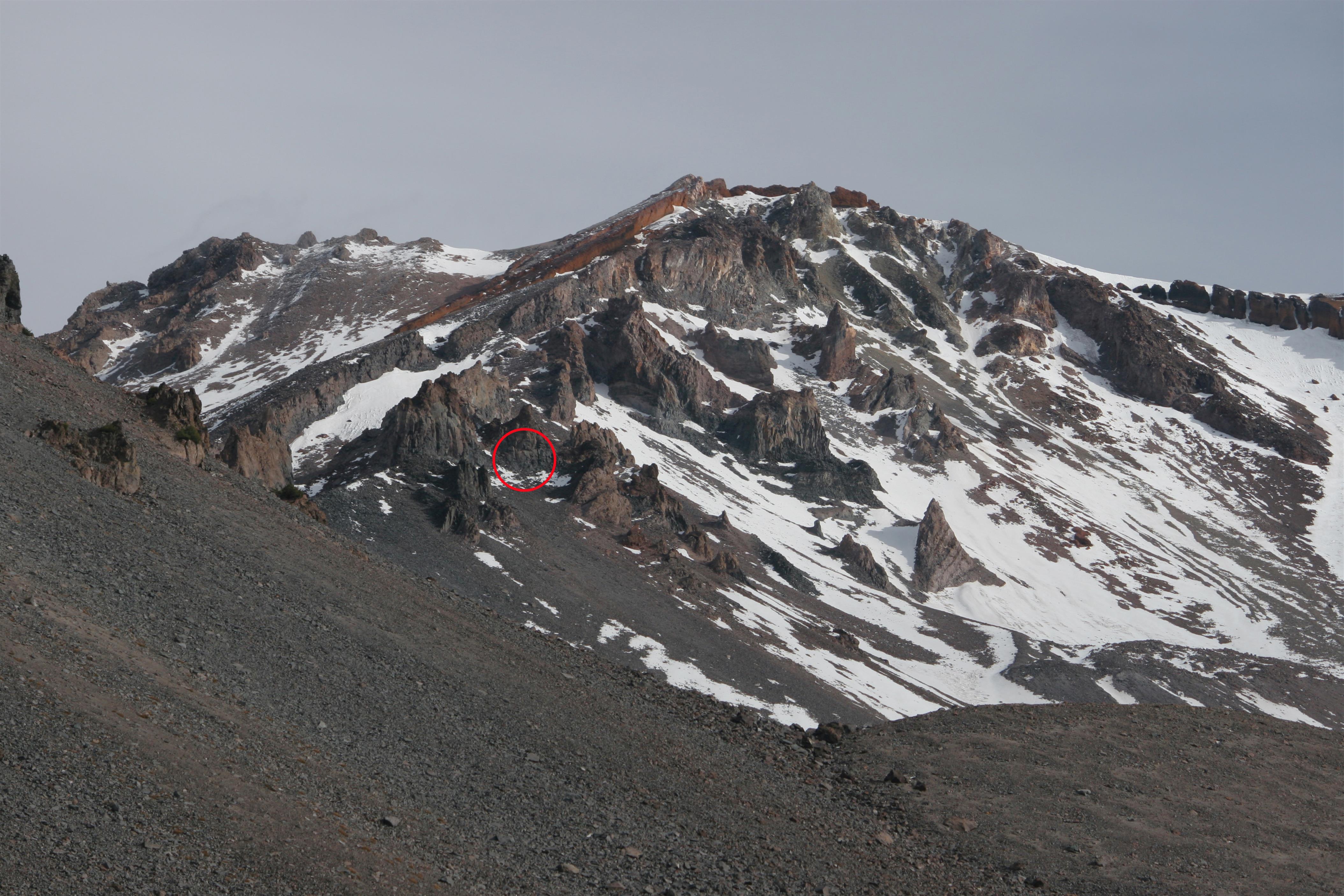
Cascades, Mt Shasta, Horse Camp - Nov2012 019 (Custom)The encircled area is the section of Casaval Ridge that broke away and fell into Avalanche Gulch.

Castle Crags Gallery

Posted by bubbasuess on May 1, 2015
Posted in: Castle Crags, Hiking, Mount Shasta. 6 Comments

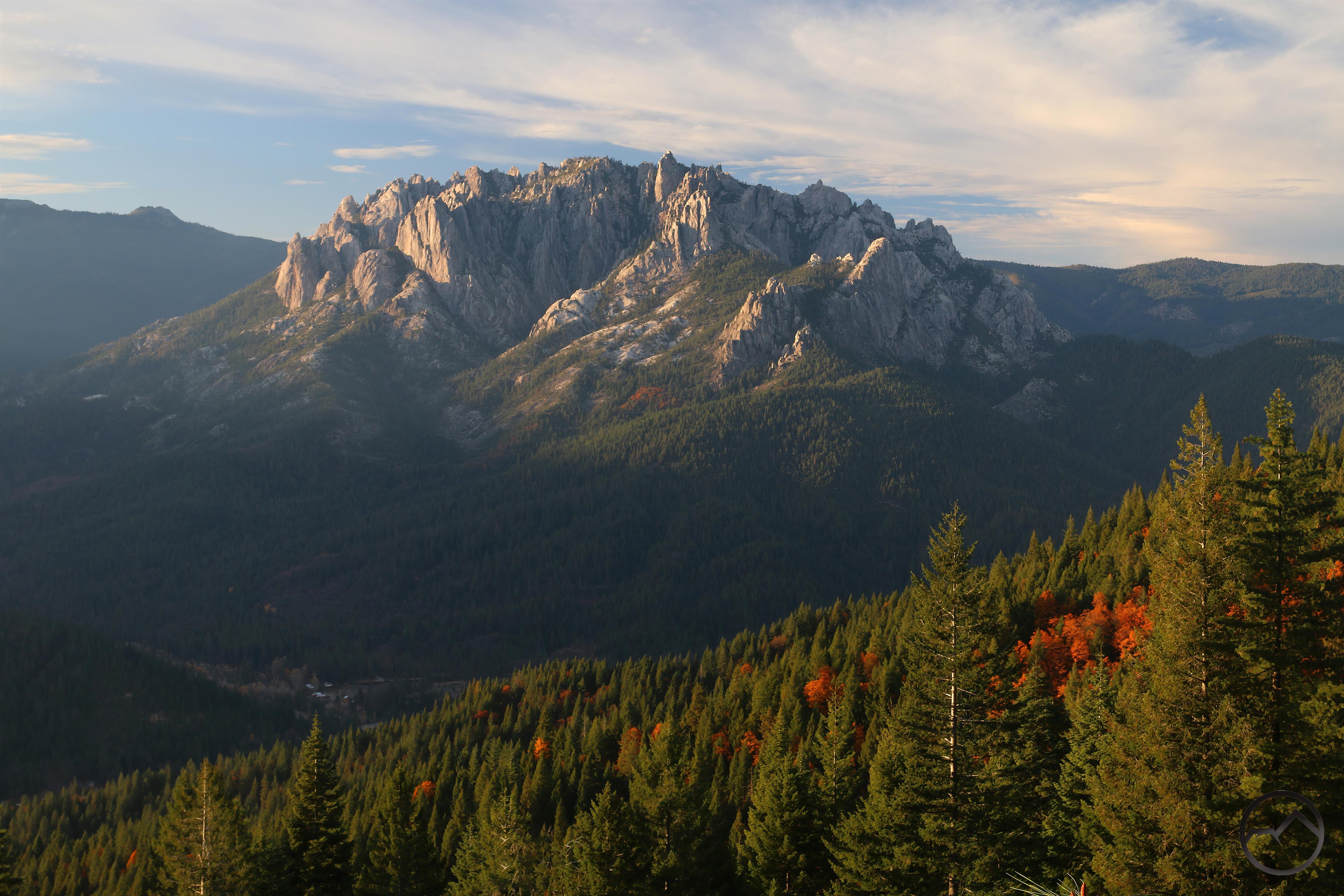
The Castle Crags are the Mount Shasta region’s other unforgettable landmark. Mighty granite towers, seemingly transported from the Sierra Nevada, erupt from the vast forests of the Sacramento River Canyon. The Crags are foreboding, looming ominously above the surrounding landscape. They are also nearly impenetrable. The inner core of the formation is the domain of intrepid scramblers and rock climbers. Hikers are relegated to trails that skirt the periphery of the massive spires. Hikers in most parts of the country should be so lucky to be able to enjoy trails at the feet of such incredible majesty! While the interior of the Castle Crags is difficult to access, they feature prominently in vistas from other trails in the Mount Shasta area, especially those of the Trinity Divide. Some trails boast staggering views of the granite jumble while other hikes tease nature lovers with the tips of the towers peaking out over ridges. Wherever you hike, any view of the Castle Crags is rewarding and a powerful reminder that Mount Shasta is not the only magnificent landscape in the area!

Click to enlarge:

South Fork headwaters
The Castle Crags are an isolated granite pluton. Castle Dome is on the center right.
Castle Crags from the PCT, near the Soapstone Trail
The back side of Castle Dome (far right) is visible from the summit of the Grey Rocks.

Winter at the confluence. Castle Dome on the far right.
The confluence of the Sacramento and Castle Creek. Castle Dome on the far right.
Summer at the confluence. Castle Dome on the far right.

Spires of the Crags
Mount Shasta seen from the Castle Crags
Castle Dome looming large.
Classic view of Mount Shasta and Castle Dome.

Lower Burstarse Falls

Cliffs of the Crags
Castle Crags from the PCT.

Looking down on the saddle at the head of Little Castle Creek.
Ridge top view of Battle Rock.
Vista Trail view of Castle Dome.
Gazing up at Battle Rock.

Mount Hubris.
Crags towers.
Battle Rock from Mount Bradley Ridge.
Castle Crags.

Panther Meadow view of the Castle Crags.
Gray Rock Dome perspective on the Crags.
The Crags peek over the rim of the Seven Lakes Basin.
Looking down on the Trinity Divide from Mount Eddy.

Crags dawn.

Jewels In The Desert

Posted by bubbasuess on April 26, 2015
Posted in: Desert, Hiking, Mount Shasta. Tagged: Lake Shastina, Orr Lake, Shasta River, Shasta Valley, Trout Lake. Leave a comment
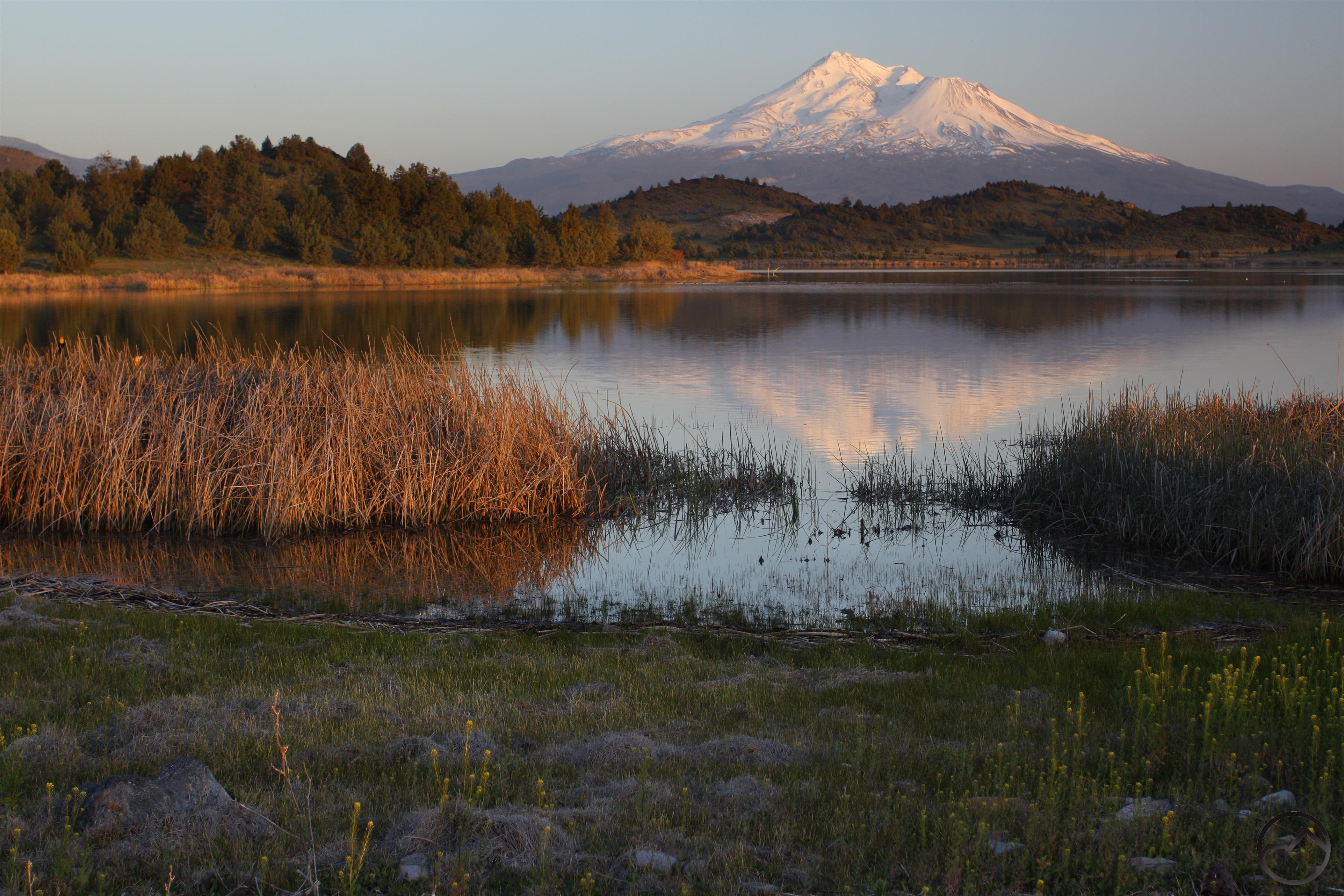
Mount Shasta reflects in the water of Trout Lake.

Mount Shasta reflects in the water of Trout Lake.

The high desert is one of the most ubiquitous of American landscapes. Though there are four great deserts in America, the Mojave, Sonoran, Chihuahuan, and Great Basin Deserts, aridity remains a distinct trait of the rest of the West. The mountain regions climb high enough to absorb moisture from passing storm systems and the runoff and snowmelt from these mountains are what nurture and sustain civilization throughout western half of our country. However, below the mountains aridity remains and these dry regions are usually referred to as high deserts, as opposed to the vast thirsty lands and distinct ecosystems of the four great deserts. Although not omnipresent, the high desert areas are often identified by the presence of sagebrush, juniper and in the southwest, pinyon pines. These plant communities are hearty and well suited to living in dry lands. Some travelers do not find beauty in the lands of dryness, seeing bleakness instead of beauty. But for those who have unlocked the mystery of desert beauty, the high desert maintains a strong and deep draw.

Lake Shastina seen from the Lake Shastina Trail.

Lake Shastina seen from the Lake Shastina Trail.

The region to the north of Mount Shasta lies in the mighty mountain’s rain shadow. The towering volcano stabs deep into the heart of passing storms and wrings the water from them, feeding the hungry glaciers and subterranean reservoirs. There is little left for the land to the north and it is left bereft of much precipitation. This dry area is mostly contained in the Shasta Valley. Like other western landscapes, this area is home to juniper and sagebrush, which are stark apposition to the lush alpine forests that cover the surrounding mountains. However, the Shasta Valley is not the only area where high desert holds sway. East of Mount Shasta and the Cascade Crest the rain shadow persists, but the elevation is a little higher so the high desert mixes with other environments, the juniper and sagebrush coexisting beautifully with ponderosa pines and aspens.

These arid areas make particularly great places to hike in the winter and spring. The Shasta Valley has a few noteworthy hikes that highlight the great diversity of Mount Shasta’s rain shadow. However, the most surprising feature is the presence of the water jewels of Trout Lake and Lake Shastina. Neither lake is natural, but both are glittering oasis in the land of dryness. Lake Shastina is formed by impounding the Shasta River, a ribbon of life that waters the Shasta Valley. Trout Lake is a bit different. There is originally a small natural pond, fed by springs. A pair of short levees bottle up the small valley and the springs have inundated it, enlarging the pond to the lake’s present size. Both lakes are beautiful in their way, contrasting the cool blue water against the rocky, hardscrabble, high desert land.

Trout Lake

Mount Shasta dominates the view from Trout Lake.

Mount Shasta dominates the view from Trout Lake.

The Shasta Valley Wildlife Refuge is not well known and is a no-frills type of park. Three lakes are found here: Trout Lake, Bass Lake and Steamboat Lake. Of the three Trout Lake is the prettiest. The lake is graced with incredible views of Mount Shasta and hiking along its shores means the constant presence of the enormous mountain. The terrain is a classic high country environment, including juniper trees, sagebrush, lots of exposed rock and expansive grasslands. Spring and fall are the nicest times of year to enjoy this area. In the spring, flowers bloom, the grasses are colored green and red and the weather is perfect. In the fall, the color gold is nearly overwhelming. The grass is gold and the reeds that ring the lake seem to glow with gold light. The hike along the edge of the lake highlights the high desert and offers plenty of opportunities to enjoy the beautiful views of Mount Shasta and the high peaks of the Cascade Crest, including the Goosenest and Willow Creek mountains.

Lake Shastina

The Eddy Range looms beyond Lake Shastina.

The Eddy Range looms beyond Lake Shastina.

The Shasta River flows northward through the Shasta Valley from the flanks of Mount Eddy until it joins the Klamath River. Most of its journey passes through private land and access is limited. However, there is a public access area at Lake Shastina, where the river’s swift flow is temporarily stilled. Although no official trails are maintained, there is a well established route up an unnamed butte that is nearly an island in the lake when water levels are high. Despite the nearby presence of large stands of ponderosa pine, the butte is part of a distinctly high desert environment. When the lake is full (it is drawn down at times) it is a glittering gem in the midst of the high desert. The hike up to the summit of the butte is never out of sight of Lake Shastina. There are also great views of Mount Shasta, Mount Eddy and the Trinity Divide.

Mount Shasta Merch!

Posted by bubbasuess on April 18, 2015
Posted in: Hiking, Mount Shasta. 1 Comment

DSC_0255 (Custom)After being online for a couple of years, I am finally expanding Hike Mt Shasta’s purview a little bit. Hats are the first thing I plan to offer and I made a small order for some recently. The hats feature Hike Mt Shasta’s logo as well as the site’s URL. The initial run was done on a unique style that combined a camouflage bill and waxed canvas hat. I appreciate older ways of doing things and tend to be a Filson kind of guy, so the waxed canvas in particular was a big draw. It prevents water from soaking through the material. While I am planning a run of more traditionally colored hats with the same embroidery on them in the near future, I do have a few of the current style available for purchase if anyone is interested. Shoot me an email if you would like one. I should have the other hats soon!

Click to enlarge:


Altered Earth At Lake Siskiyou Trail Wash Out

Posted by bubbasuess on April 16, 2015
Posted in: Hiking, Mount Shasta. Tagged: Lake Siskiyou, Lake Siskiyou Trail, Sacramento River. 8 Comments

LakeSiskiyouInlet (2)

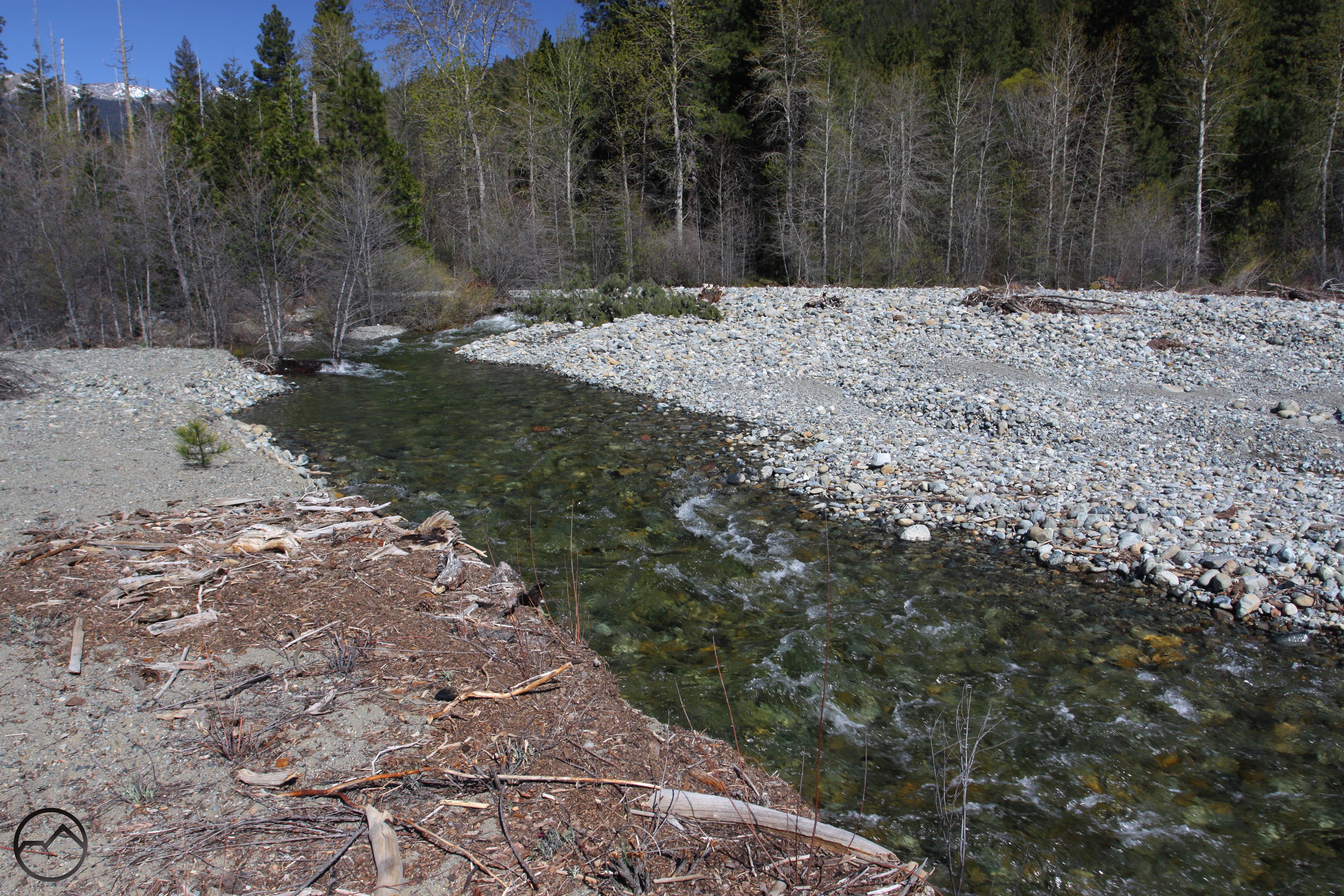
The fact that the Lake Siskiyou Trail had been washed out at the lake’s inlet came as a surprise. I planned on taking my kids to the bridges and letting them spend time throwing rocks and sticks in the river and generally enjoying a morning with the river. While they did enjoy the intended activities, we made it no further than the north shore of the Sacramento River. As it reached the lake, the river ran deep and swift and attempting a crossing was not an option with two little kids. However, once I had ascertained what had happened, I was extremely curious to determine the condition of the seasonal bridge that crossed over the river’s main south channel. Upstream from the waters of Lake Siskiyou, the river splits into two primary channels. The seasonal bridges are installed to cross over both of these channels. Not being able to cross the north channel at the time, I knew that investigation would have to wait for a later date.

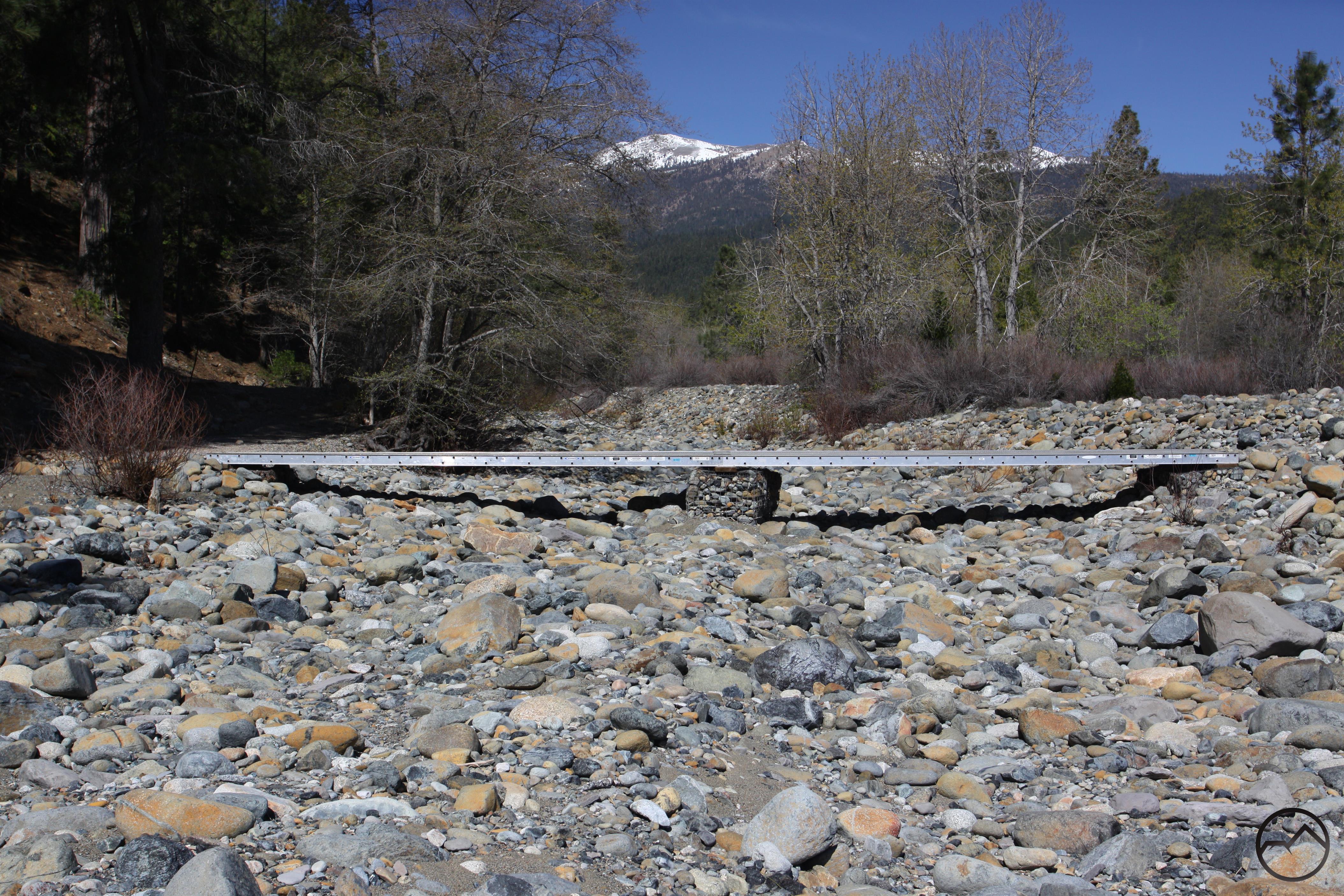
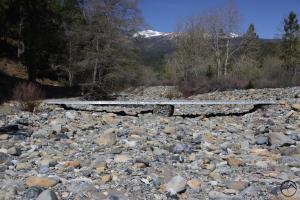
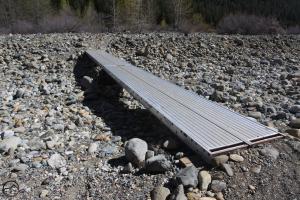
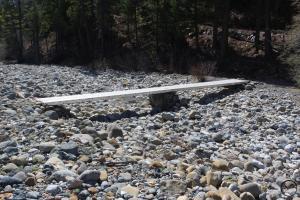
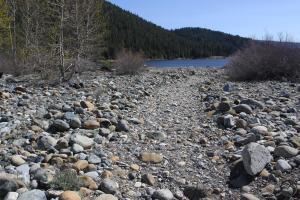
Today, I had the opportunity to make the shore hike down to the river from the southern approach. What I found completely defied my expectations. Rather than an area similarly washed out like the Sacramento’s north channel, I found the bridge intact. However, the channel through which the river normally flows was completely dry. This was shocking considering that the south channel had always seemed to be the primary course of the river, usually containing more water than the branch to the north (click here to see the channel with water flowing through it, albeit later in the year when volume is low). Not only was the bridge and channel intact, but the Lake Siskiyou Trail was untouched by whatever massive flood had devastated the bridges and section of the trail a few hundred yards to the north.

Click to enlarge all images

South channel, April 2015
The surprisingly intact seasonal bridge.

The bridge spans the mysteriously dry south channel.
The Lake Siskiyou Trail remains intact.

LakeSiskiyouInlet (3)

The new primary channel flows past the site of the washed out bridge.

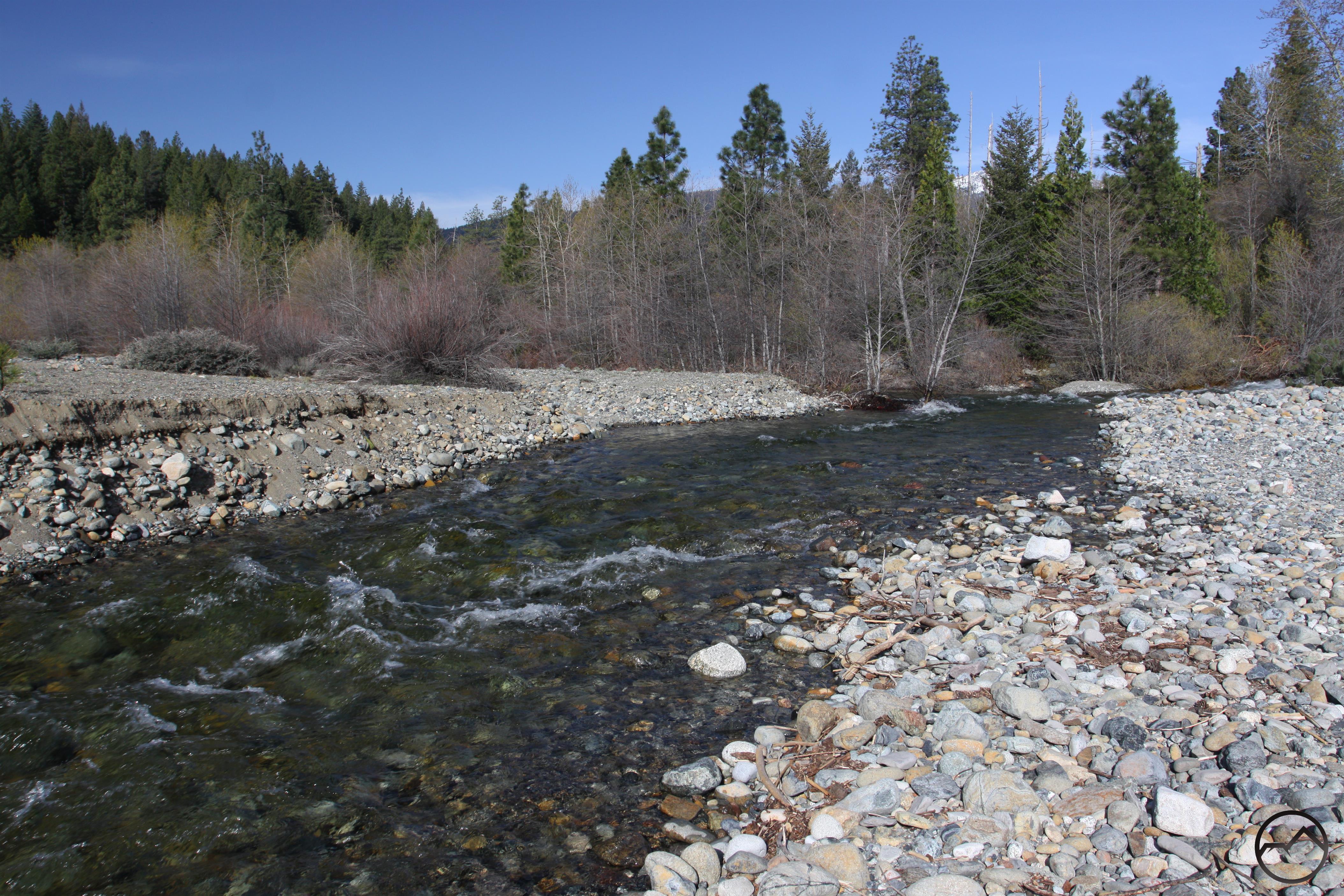
I walked across the bridge and followed the trail over to the site of the northern crossing. As it had the day before, the Sacramento was running swift and deep, carving a new channel out of a broad expanse of river rock and sediment. On the first visit, the landscape had changed so much that it was hard to even guess where exactly the bridge had been located. This time it was possible to follow the trail right to the old crossing. Of course, the wire cages full of rock that had anchored the bridge were gone, as was any other trace that the aluminum span had been there. It was now evident that the southern branch of the river had somehow been stopped up and the full volume of the Sacramento was now being funneled through the north channel.

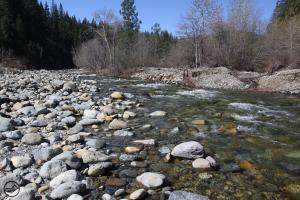
I returned to the dry southern channel, intending to follow it upstream and find the blockage that had caused the river to radically alter its course. Surprisingly, about 70 or 80 yards beyond the seasonal bridge, I found that water still flowed through the rocky channel. The volume was not great and the water disappeared beneath the rocks before reaching the seasonal bridge. I was equally surprised (though by this point I should not have been) to find that the water did not directly connect to the river but instead followed a subterranean course and emerged from the rocky channel a bit downstream from what turned out to be the old, now defunct split in the river.

Surprising water flowing through the south channel.
The water emerges from the rocks below the dry south channel.

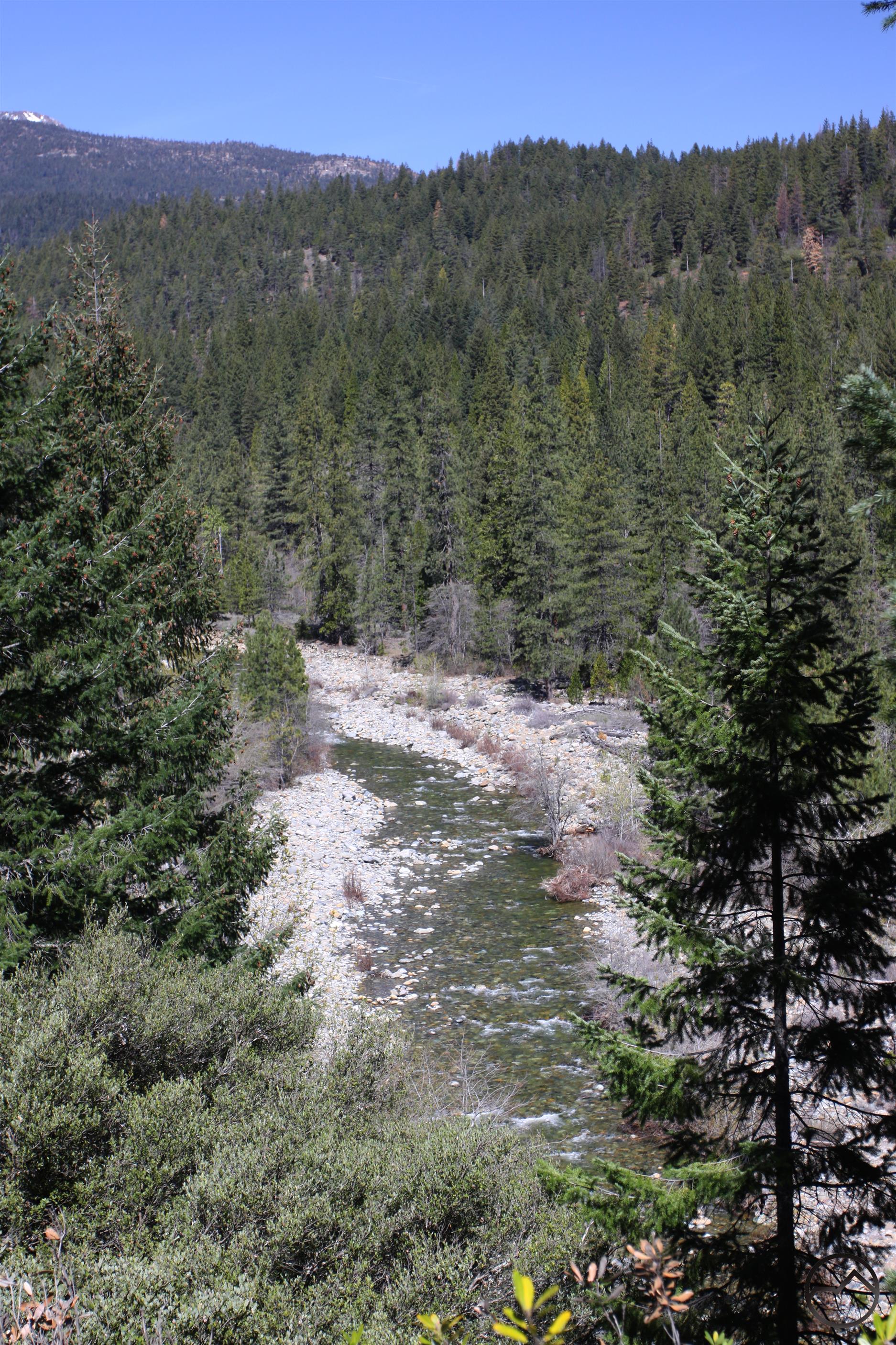
The former fork in the Sacramento, where the river was divided into northern and southern branches also revealed more surprises. I was expecting to find a large log jam or other obstruction that had forced the water to abandon the southern branch and to overwhelm the northern channel. Instead, any evidence that the river had split at the site was seemingly erased. The water flowed swiftly through a rocky channel, surging into the northern channel with no opportunity to divert into the southern channel. Where I had expected the log obstruction I found only a low, embankment composed of a vast pile of multicolored river rock. This was somewhat anti-climactic given the destruction the plugging of the southern channel had wrought at the inlet. However, what caused it was certainly mysterious.

The river runs alongside the rock embankment where the split was located.

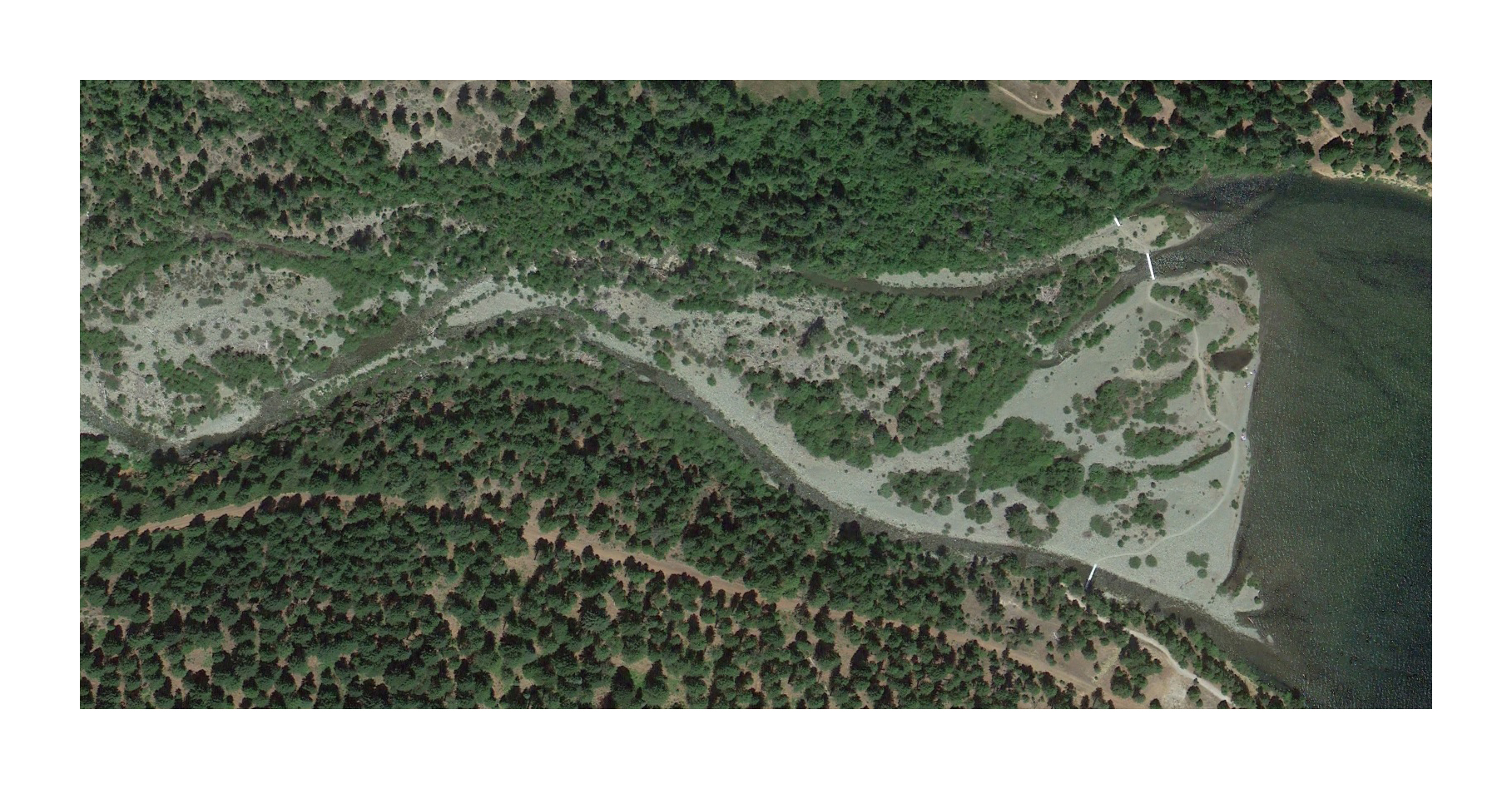
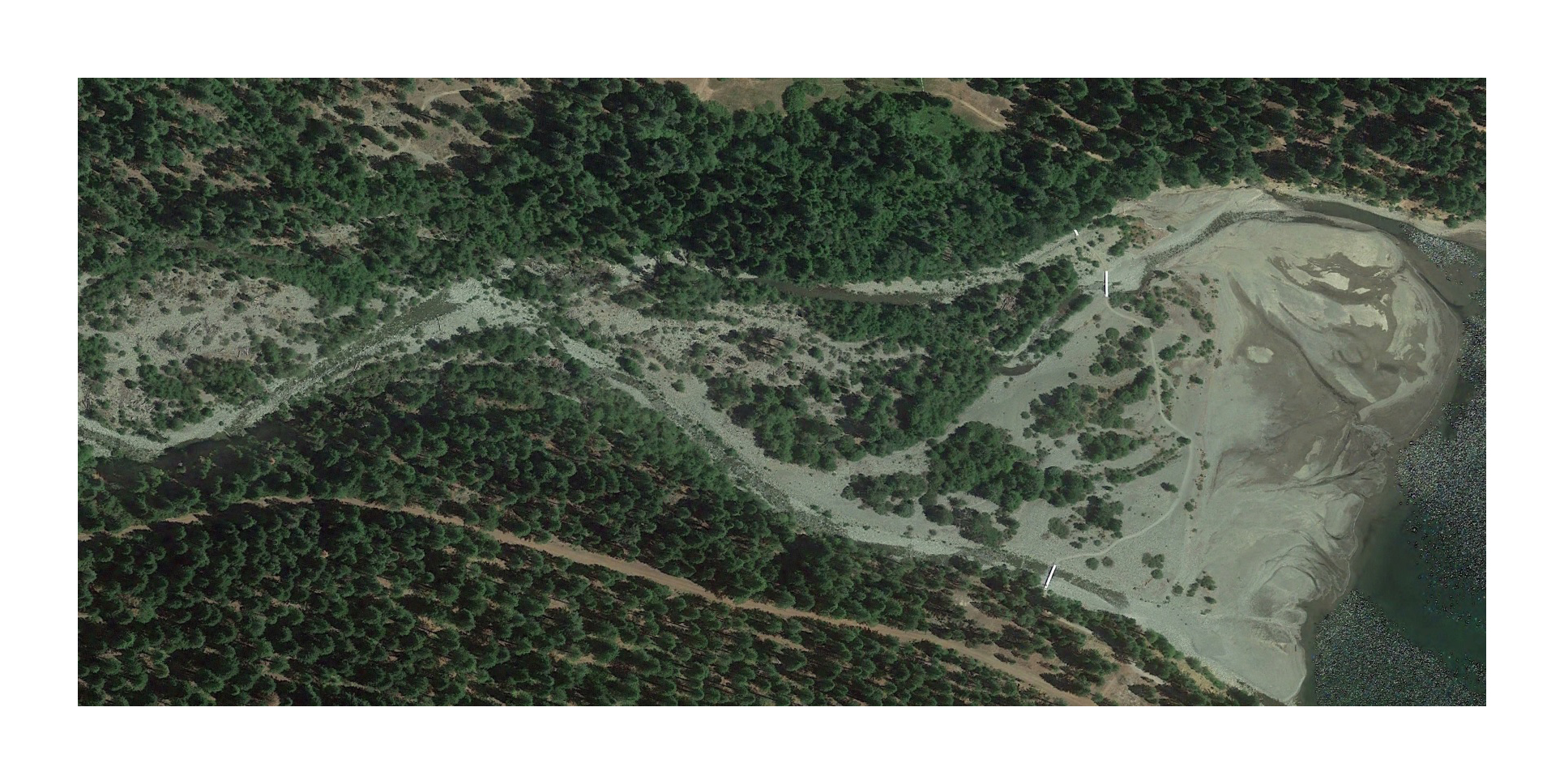
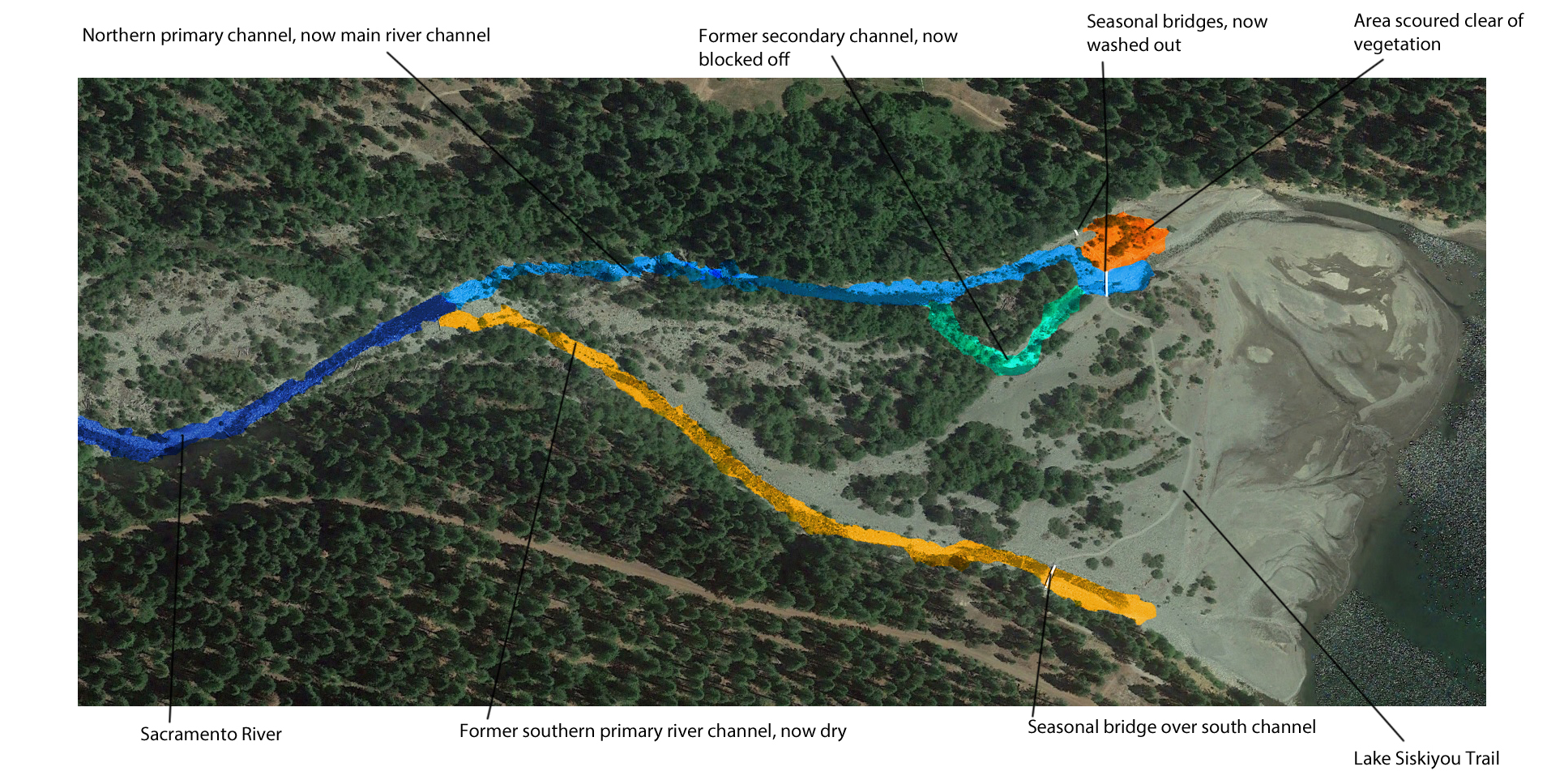
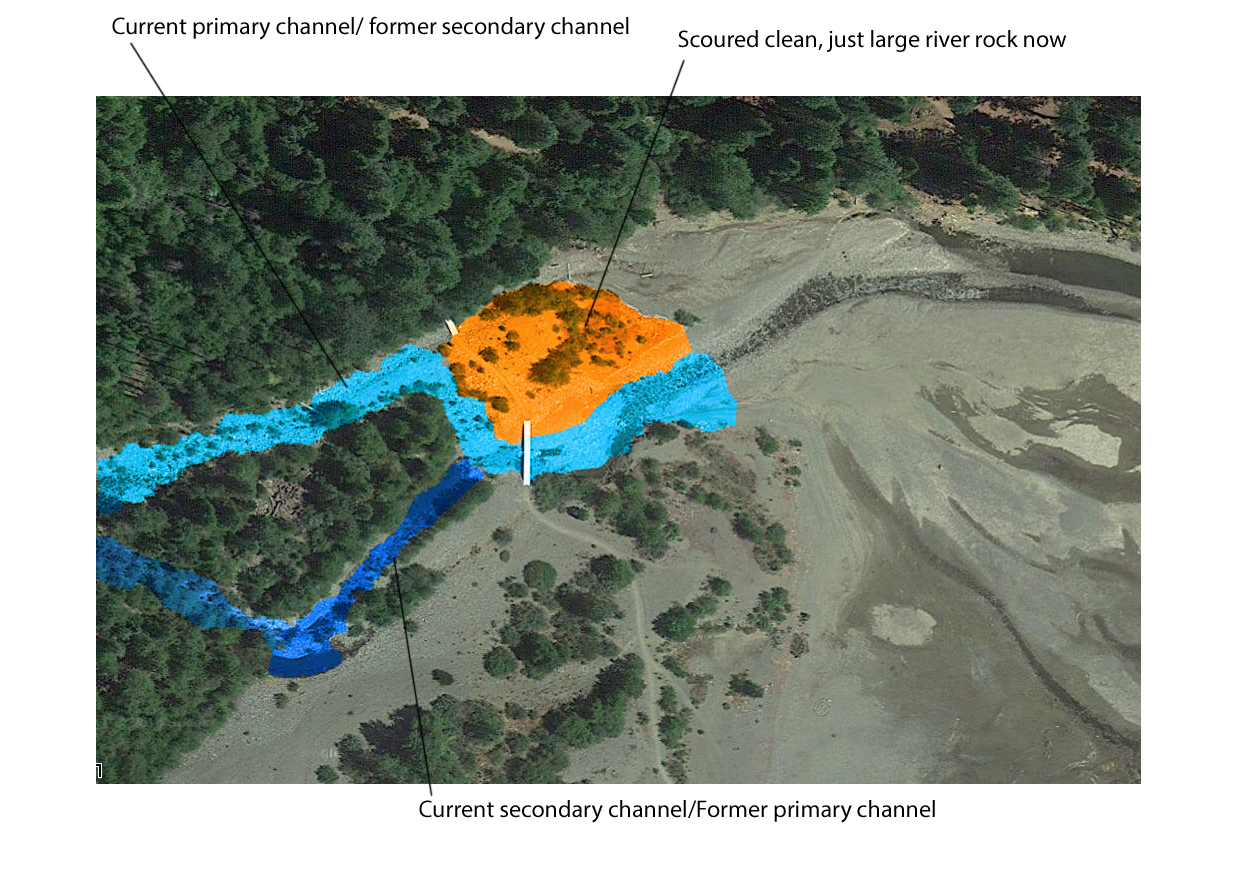
It may be difficult to visualize what has occurred. I prepared a few more maps to help illustrate what I have discovered. The first two maps show the area in 2012 when the water level was high and in 2014, when the drought had taken its toll on the river’s flow.

The Sacramento River and Lake Siskiyou in 2012:

The Sacramento River and Lake Siskiyou in 2012.

Note the heavy flow through the southern channel.

The Sacramento River and Lake Siskiyou in 2014.

The southern channel, though reduced, still retains good flow.

The southern channel, though reduced, still retains good flow.

The altered landscape after the washout:

Inlet2014_edited-2

Though this is speculation, I think that the initial obstruction of the south channel occurred earlier in the year, during one of the torrential rainstorms that we had. With the seasonal bridges removed, the result of the southern branch’s obstruction would not have been obvious. The drought then took hold and the river’s flow reduced enough for the seasonal bridges to be installed. Then the snow fell and began to melt. This increased the river’s flow and it was all funneled into the northern channel. This then wiped out the bridges across the north branch of the river. Whatever the order of events, seeing the Sacramento River change its course in such a short amount of time is humbling. Even in this drought ravaged season the river is able to summon up enough strength to alter the landscape dramatically. If nothing else, we should take note of the power inherent in earth in upheaval.

The Sacramento River, just upstream from the former split.

The Sacramento River, just upstream from the former split.

Lake Siskiyou Trail Washed Out

Posted by bubbasuess on April 13, 2015
Posted in: Hiking, Mount Shasta. Tagged: Lake Siskiyou, Lake Siskiyou Trail, Sacramento River. 8 Comments
A surging Sacramento River flows past the former site of the seasonal bridge.

A surging Sacramento River flows past the former site of the seasonal bridge.

It was recently reported that the Lake Siskiyou Trail’s seasonal bridges over the Sacramento River at the lake’s inlet had been installed. This was earlier in the year than normal and it appears that the installation may have been premature. At some point in the last couple weeks the water level rose high enough that it dramatically reshaped the landscape at the lake’s inlet and the river’s course has been altered. Channels that once carried overflow water or ran dry are not the main path of the river as it hurtles swiftly toward Lake Siskiyou. Areas that were once covered in trees and brush have been scoured clear, leaving only an expanse of large river rocks. That this happens is not entirely surprising. The evidence that the river has changed its course in the past is visible in the dry, rocky channels and in the layers of rock and sediment visible in places where the river has cut away small slopes.

The affected area.

The affected area. The image was made when Lake Siskiyou was drawn down. Most of the sandy area on the right is inundated.

One of the most dramatic results of this most recent rearrangement of the Lake Siskiyou inlet area is the apparent destruction of the seasonal bridges that complete the loop around the lake. When approaching from the north shore, the first indication of the damage is a large wooden bridge over what is normally a very small stream. The bridge is visible 10 to 15 yards away from where it should be, washed away by what must have been a furious torrent. Beyond the stream is another, wider creek. This would normally be the location of the first of the three seasonal bridges. Not only is the bridge gone but the wire cages filled with river rock, structures that served as foundation piers for the bridges, are completely gone. Crossing this creek without wet feet requires some tricky maneuvering but once across, the fullness of how much has changed is evident. Any trace of the old trail, the second, larger bridge, and most of the vegetation that flanked the lake’s inlet are all gone. All that remains is a large, rocky area and the swift moving Sacramento River.

The washed out wooden bridge.
What was once a dry channel now houses the Sacramento River.

The rerouted river intersects the old river channel.
A surging Sacramento River flows past the former site of the seasonal bridge.

I had no idea the bridge and the portion of the Lake Siskiyou Trail around inlet had been wiped out when I took my kids there this morning. I had planned on letting them float sticks down the river and throw rocks. It was a surprise to find the wooden bridge dislodged and the metal bridges non-existent. Nonetheless, once I got my son and daughter across the smaller creeks, they had an excellent time along the river, with or without the bridges.


Given the drought conditions, this kind of damage may come as a bit of a surprise. However, there has been more precipitation this winter than it seems. While the damage is unfortunate, it is heartening to know that so much water has been poured out on the Mount Shasta area. Hopefully the spans will be rebuilt soon and the Lake Siskiyou Trail will be enjoyed throughout the coming summer.

Shasta Spans: 5 Interesting Footbridges

Posted by bubbasuess on April 11, 2015
Posted in: Hiking, Mount Shasta. Tagged: Big Springs Creek, Lake Siskiyou, Sacramento River, Squaw Valley Creek, Wintun Creek. 7 Comments

Cascades, Hedge Creek Falls - June2013 012 copy (Custom)

Many of the trails around Mount Shasta follow the area’s rivers and creeks. The swift mountain waters race through rocky channels and meander about in lush meadows and these are the images that usually come to mind when contemplating outings past. One essential feature of trails in proximity to water is often appreciated while hiking and often overlooked while reminiscing. Bridges are typically a means to an end, getting from one side of the water to the other. The usual highlight are  the rivers and mountains but, once in a while, there are structures that capture the imagination and draw our attention. They linger in our minds, having enhanced our outdoor experiences by their beauty, uniqueness and integration into the natural setting (or contrast against it!). Though there are no footbridges on Mount Shasta itself, the paths that course through the canyons and mountains boast several interesting spans.

Although the paths around Mount Shasta boast many interesting bridges, there are five that are particularly noteworthy for their engineering, construction, uniqueness or beauty. A few just missed being included on this list. Perhaps they will be the subject of a sequel (especially if the proposed project to Mossbrae Falls ever crosses the Sacramento River)!

5. Big Springs Creek

20140218_155500 copyThe Elsa Rupp Preserve is probably not the first place that comes to most people’s minds when thinking of interesting footbridges. Yet, the humble span across Big Springs Creek always seems to capture the imagination. Consisting of a series of small planks nailed to a log that extends across the creek and augmented by a rustic handrail, it integrates beautifully with the surrounding scene. The creek is wide and boisterous and invites hikers to pause and enjoy the serene setting. Like many other structures, this bridge enhances the natural setting and seems more like an artifact from medieval history or a fantasy tale.

4. Wintun Creek

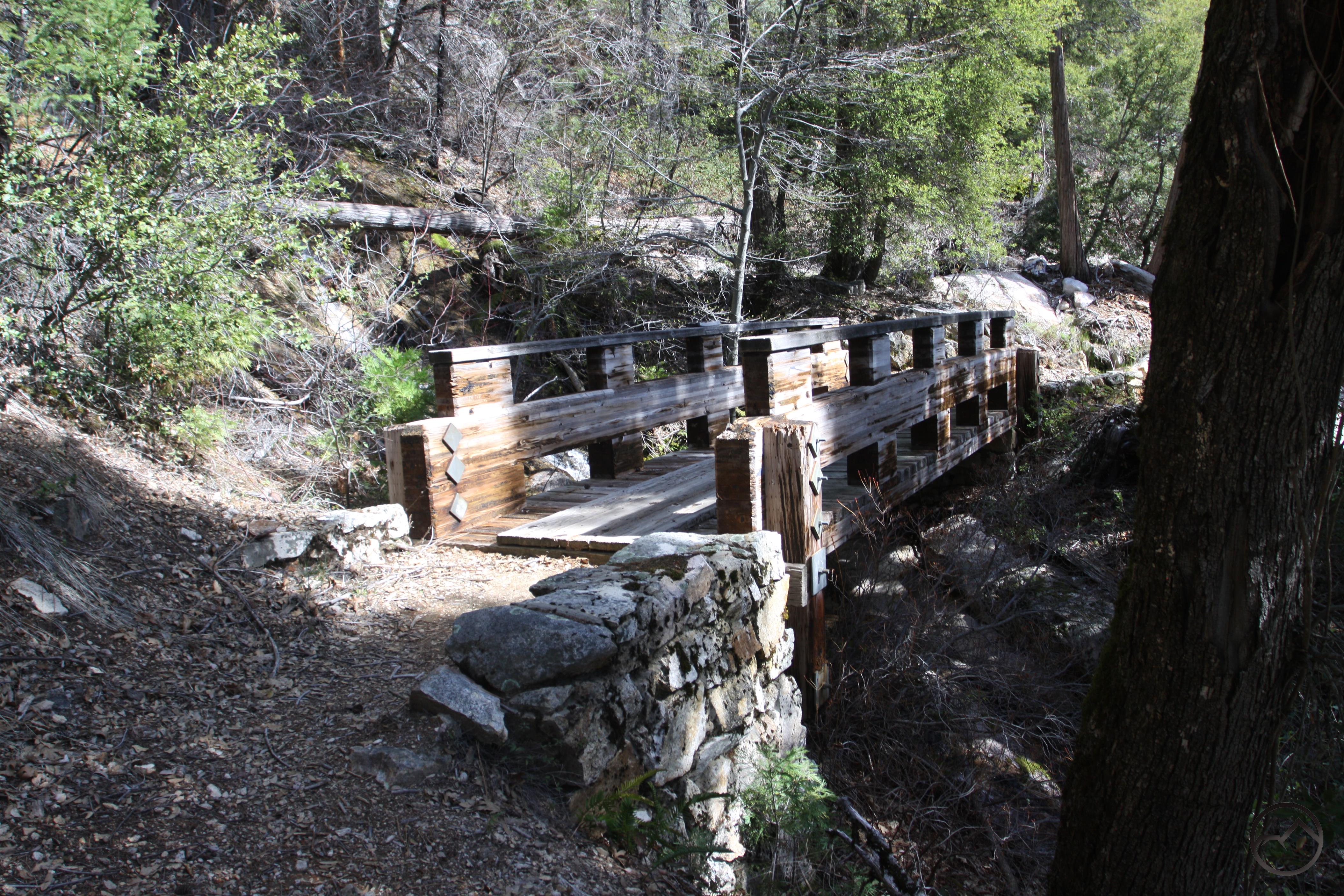
Trinity Divide, Castle Crags - March2014 044 (Custom)The small bridge across Wintun Creek is seemingly modest and unassuming. Yet this bridge, located on a remote section of the Pacific Crest Trail deep in the Castle Crags Wilderness, is an intriguing engineering feat. Wintun Creek is not large but it flows steeply through a narrow channel below Wintun Canyon, a notable chasm on the south side of the Castle Crags. Since there is not much clearance between the platform and the creek, it seems that it was designed to afford the largest possible opening beneath the span. This would ensure any debris flowing through the creek during storms would not hit the structure. To achieve this, large, heavy beams were used as supports for the handrails. The deck is then suspended from the rails. This negates the need to have any structural support on the bottom, essentially making it a suspension bridge. Considering how few people hike this area, it is unlikely that many notice the thought that went into it (the unique engineering was first noticed by Cole Engineering, who accompanied me on this hike.)

3. Squaw Valley Creek

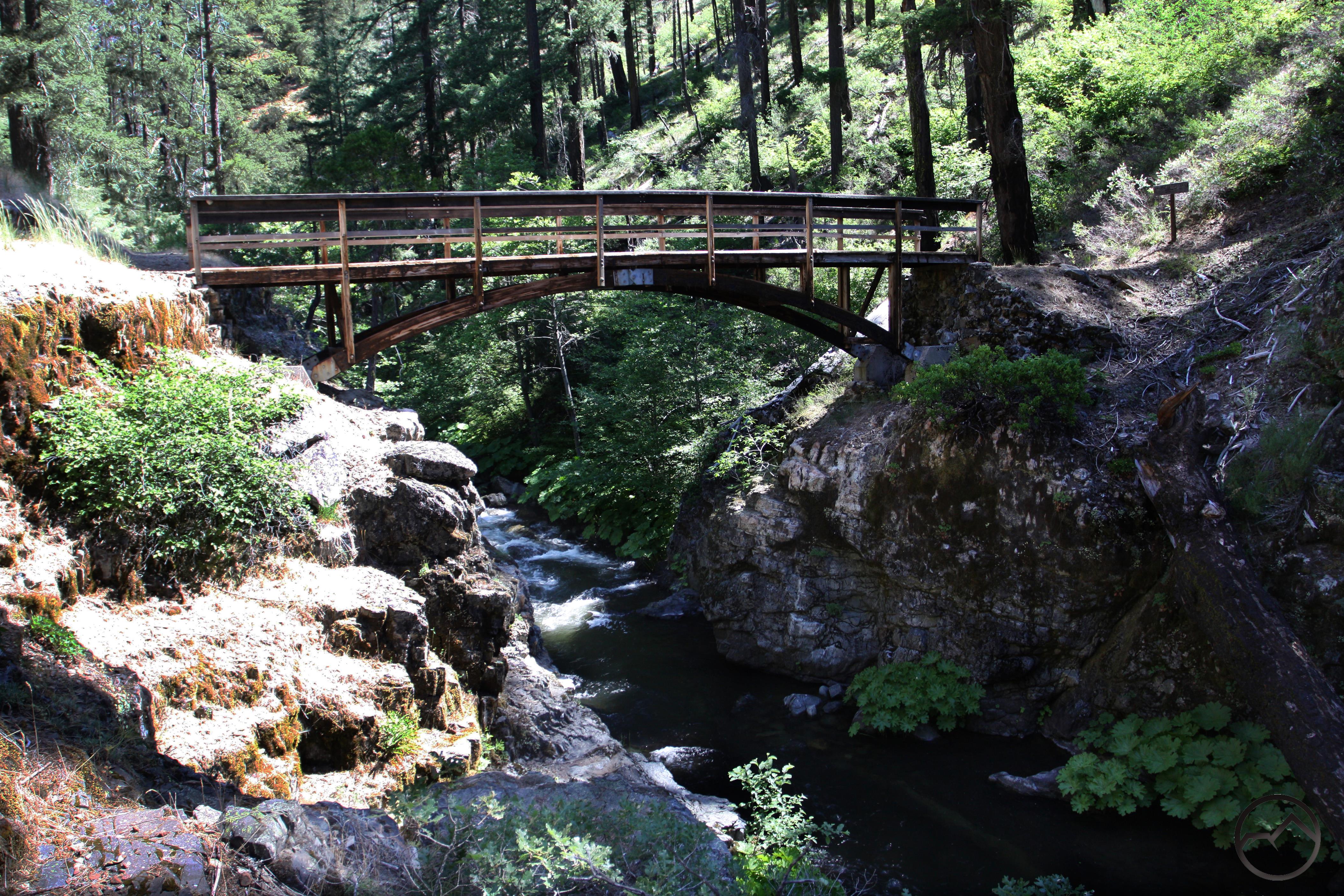
Cascades, Squaw Valley Creek - June2013 090_edited (Custom)Another fascinating specimen found on the Pacific Crest Trail, the span across Squaw Valley Creek is another example of the construction enhancing the natural setting rather than burdening it. At the location of the bridge, the creek races through a picturesque, rocky gorge. Indeed, this is one of the prettiest spots on the Squaw Valley Creek Trail. The gorge is not wide but it is deep and this provided engineers with the opportunity to use a design where clearance beneath the bridge was not a concern. What makes the structure noteworthy is the arched supports on the bottom of the construction. Essentially a wooden arch-under bridge, it is an unusual design for a footbridge. The graceful lines of the arch seem perfectly placed to enhance the scene as the water rushed below.

2. Sacramento River

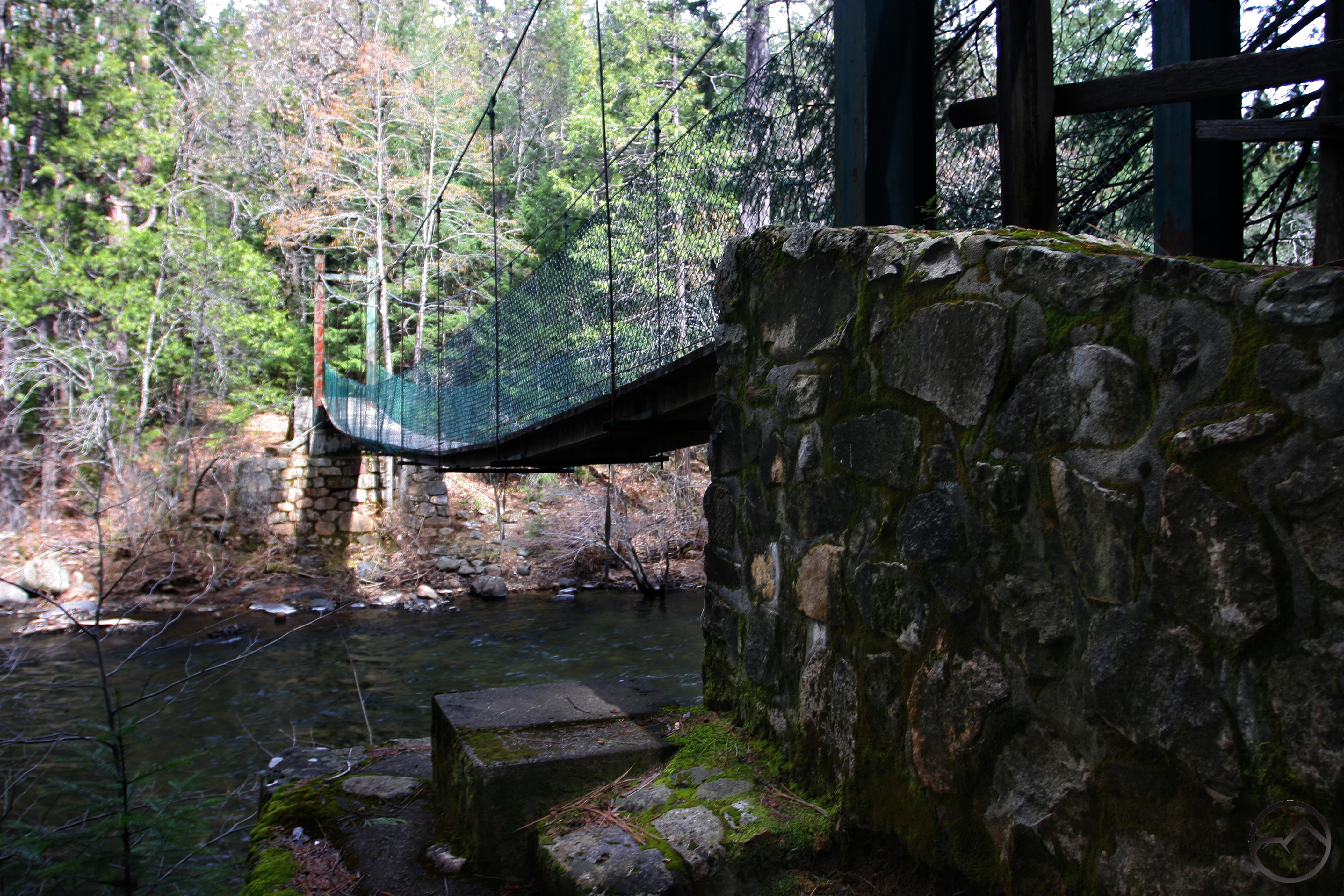
Trinity Divide, Sacramento River - March2013 (Custom)Tucked away in a little used corner of Castle Crags State Park, the Sacramento River Trail is a delightful path that follows the Sacramento River for about a mile. While the scenery is fantastic along its entire length, it is the beginning of the hike that still stands out as the real highlight. To reach the trail, it is necessary to walk across the Sacramento River on a swinging footbridge. Long and narrow, the span is a classic suspension bridge with rock piers at either end that are surmounted by steel towers from which the support cables are suspended. With great views of the river and its bouncy nature, this bridge hearkens back to a bygone era where this design was more typical.

1. Lake Siskiyou

Cascades, Mt. Shasta - Feb2014 008 (Custom)The massive footbridge that crosses the Wagon Creek arm of Lake Siskiyou is the undisputed champion of hiking bridges in the Mount Shasta area. A large suspension bridge, the span is one of the iconic structures in southern Siskiyou County. Prior to construction, it was not possible to hike the entire Lake Siskiyou Trail. With the completion of the bridge, the loop was closed and the trail is now one of the most popular in the region. The span consists of a wood and steel deck that is suspended by cables from a massive arch. It is simply an impressive structure by any measure and is an attraction unto itself.

Snow in Mount Shasta: The Day After

Posted by bubbasuess on April 8, 2015
Posted in: Mount Shasta. 2 Comments
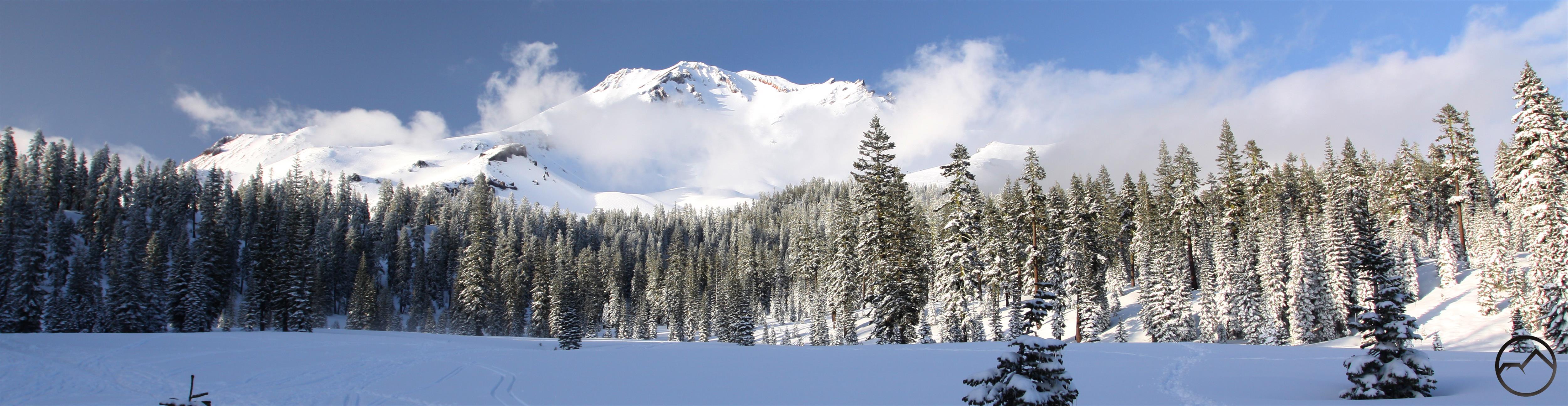
Mount Shasta, blanketed in fresh snow, rises above Bunny Flat

Mount Shasta, blanketed in fresh snow, rises above Bunny Flat

It feels a little foolish to be so excited about a single, moderate storm and a few inches of snow. After the disastrous winter last year and the snowless season this year, it is refreshing to see things through a wintery lens, even if only briefly. The snow that fell Tuesday was destined to be fleeting but it was a blessing nonetheless. As I went about my business in town, I maintained an eye tuned to the winter scene. It was evident that it was going to be fleeting because things were already starting to melt. At least it felt like there was a real winter for one morning. So, it does seem a little odd to be so excited about a storm like the one just past. Even though I try to make this blog about the Mount Shasta area and not about me personally, I only ask your indulgence since I (and the rest of my family and, well, the rest of the community too) really enjoyed the snow!

There wasn’t as much snow in town as there was at my house and things were already starting to melt by Wednesday morning. Despite the more modest snow level, it was nice to see the town in its frosty finery. Sadly, by the end of the day, there was hardly a trace of it left in Mount Shasta City.

Snow covers a ranch near Rainbow Ridge
Lake Siskiyou at capacity

Higher up on Mount Shasta, things were in much better shape. Even though it is April, it seemed to be the peak of winter at Bunny Flat, where there were lots of people enjoying snowmobiles, skiing, snowshoeing, sledding, and just enjoying the beautiful scene of the mountain. There was even a group of skiers who were flying a drone. It was wonderful to feel the energy that comes at the convergence of all of these different winter activities. My wife and I took the kids sledding and just generally enjoyed the snow.

Snow off of Everett Memorial Highway
Winter scene at Bunny Flat

The surprising truth is that this winter has not been that bad, in terms of precipitation. The Mount Shasta area is only off the average by a few inches and the water table is noticeably higher this year than it has been the last few years past (a pond develops in a gully in my backyard when there has been a lot of precipitation and the water table rises above the bottom of the gully). Things are dire now because last winter was so bad and this year has not produced much snow. Without much snow pack and it will be difficult during the summer months when the reservoirs are drawn down with little to replenish them. If precipitation has been normal the last three years, the water situation now would not feel so urgent. All that being said, it was nice to get some snow.

Cascades, Mt. Shasta - April2015 055 copy (Custom)

Snow in Mount Shasta: About Dern Time!

Posted by bubbasuess on April 7, 2015
Posted in: Mount Shasta. Tagged: Snow. 7 Comments
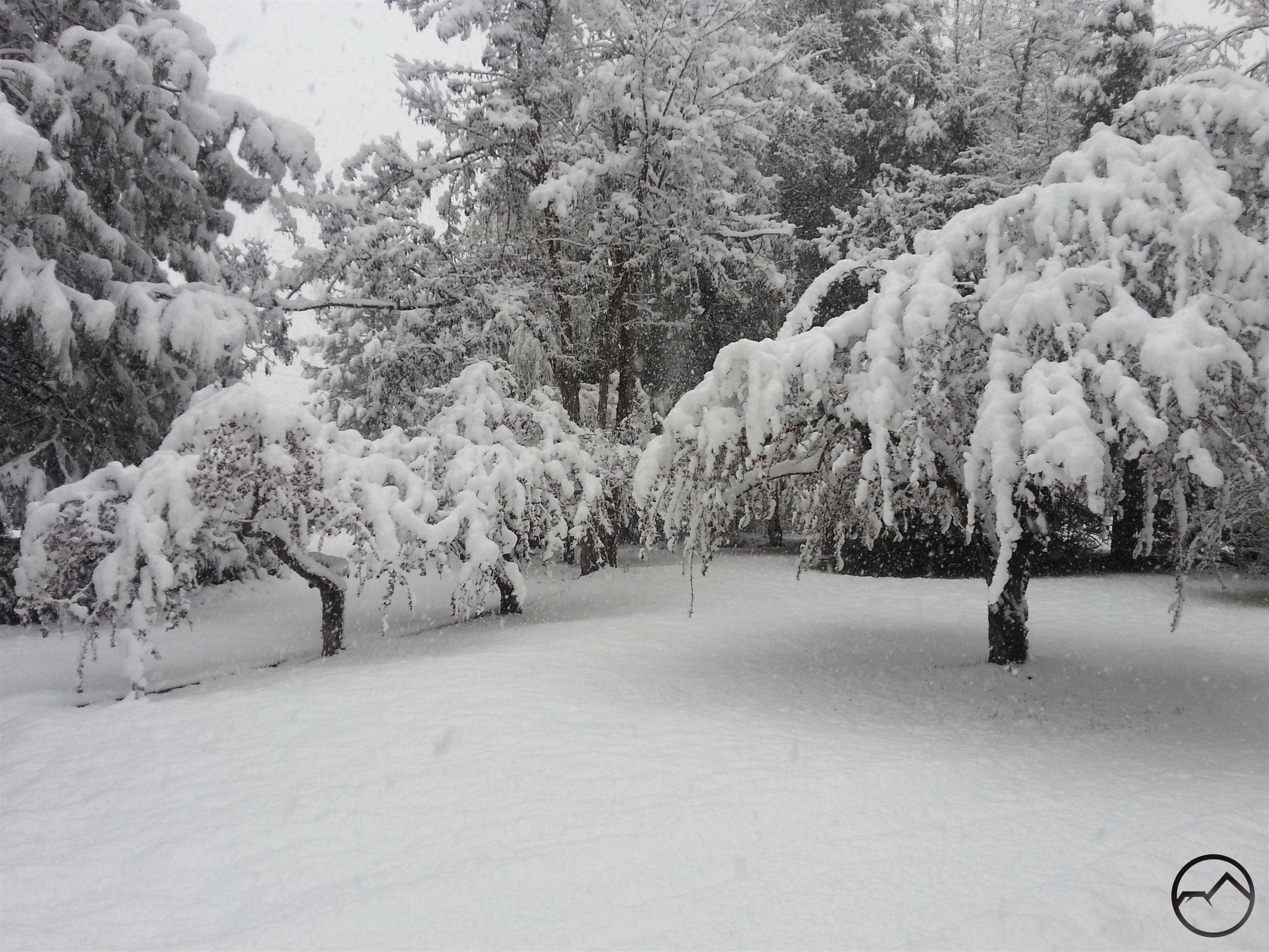
Snow in Mount Shasta!

Snow in Mount Shasta!

Well, it hasn’t exactly been a dry winter up until now but it has been snowless. We had fairly copious amounts of rain but it looked like we would go the whole winter season without at least one respectable snowfall. Thank the Lord that that has not come to pass. The forecast for this storm was optimistic and after two days of no snow despite the forecast for a major dump, it seemed this storm was going to be a giant tease. However, overnight what was a fizzle has turned out to be a reasonably good storm. So far, we have 6-8 inches, depending on where you stand with more still falling.

The front yard
The backyard

The “back 40”.
The guest house

As I write this, my kids are going nuts, eager to get outside and play. My daughter, who is 2.5, is young enough that she has no real knowledge of snow, having lived through last year’s nearly snowless winter. It should be a fun morning with a fair amount of snow-frolic. My son is 5 and he remembers some good storms from when he was younger but he hasn’t had too much experience with it as a “big boy”. Right after he was born, we had an epic storm back in January of 2010. It knocked out the power for almost a week and downed a bunch of trees. While I certainly would not look forward to storms of that magnitude, it certainly puts our current dry spell into perspective. You can see some images of that storm from around my house here, here and here.

Posts navigation

← Older Entries
Newer Entries →
    • Recent Posts

      • Winter Shows Up When It Will
      • January Rolled By With Mud, Then Very Dry
      • Mount Shasta 2025 – A Year In Images
      • Mount Shasta On Either Side Of Christmas
      • Adrift In An Ocean Of Fog
      • December Has Been Spectacular Thus Far Pt. II (A Magnificent Lenticular)
      • December Has Been Spectacular Thus Far Pt. I
      • Lenticular Interrupted
      • A Stormy Wave And A Truchas Sunset
      • Aurora Lenticularis
    • Enter your email address to follow Hike Mt Shasta and receive notifications of new posts by email.

    • Archives

      • February 2026
      • January 2026
      • December 2025
      • November 2025
      • October 2025
      • September 2025
      • August 2025
      • July 2025
      • June 2025
      • May 2025
      • April 2025
      • March 2025
      • February 2025
      • January 2025
      • December 2024
      • November 2024
      • October 2024
      • September 2024
      • August 2024
      • July 2024
      • June 2024
      • May 2024
      • April 2024
      • March 2024
      • February 2024
      • January 2024
      • December 2023
      • November 2023
      • October 2023
      • September 2023
      • August 2023
      • July 2023
      • June 2023
      • May 2023
      • April 2023
      • March 2023
      • February 2023
      • January 2023
      • December 2022
      • November 2022
      • October 2022
      • September 2022
      • August 2022
      • July 2022
      • June 2022
      • May 2022
      • April 2022
      • March 2022
      • February 2022
      • January 2022
      • December 2021
      • November 2021
      • October 2021
      • September 2021
      • August 2021
      • June 2021
      • May 2021
      • April 2021
      • March 2021
      • February 2021
      • January 2021
      • December 2020
      • November 2020
      • October 2020
      • September 2020
      • August 2020
      • July 2020
      • June 2020
      • May 2020
      • April 2020
      • March 2020
      • February 2020
      • January 2020
      • December 2019
      • November 2019
      • October 2019
      • September 2019
      • August 2019
      • July 2019
      • June 2019
      • May 2019
      • April 2019
      • March 2019
      • February 2019
      • January 2019
      • December 2018
      • November 2018
      • October 2018
      • September 2018
      • August 2018
      • July 2018
      • June 2018
      • May 2018
      • April 2018
      • March 2018
      • February 2018
      • January 2018
      • December 2017
      • November 2017
      • October 2017
      • September 2017
      • August 2017
      • July 2017
      • June 2017
      • May 2017
      • April 2017
      • March 2017
      • February 2017
      • January 2017
      • December 2016
      • November 2016
      • September 2016
      • August 2016
      • July 2016
      • June 2016
      • May 2016
      • April 2016
      • March 2016
      • February 2016
      • January 2016
      • December 2015
      • November 2015
      • September 2015
      • August 2015
      • July 2015
      • June 2015
      • May 2015
      • April 2015
      • March 2015
      • February 2015
      • January 2015
      • December 2014
      • November 2014
      • July 2014
      • June 2014
      • May 2014
      • April 2014
      • March 2014
      • February 2014
      • January 2014
      • December 2013
      • November 2013
      • October 2013
      • September 2013
      • August 2013
      • July 2013
      • June 2013
      • May 2013
      • April 2013
      • March 2013
      • February 2013
      • January 2013
    • Categories

      • Boy Scouts
      • Cascade Range
      • Castle Crags
      • Desert
      • Echo Point
      • Glaciers
      • Hiking
      • How things came to be…
      • Klamath Mountains
      • Konwakiton Outdoor Designs
      • Lakes
      • Lenticular Clouds
      • Maps
      • Marble Mountains
      • Meadows
      • Mount Eddy
      • Mount Shasta
      • Mount Shasta History
      • Napa County
      • Off Season Trails
      • Pacific Crest Trail
      • Peaks
      • Rivers
      • Rock Climbing
      • Scott Mountains
      • Seldom Seen
      • Shasta Valley
      • Sierra Nevada
      • Siskiyou Mountains
      • Sonoma County
      • Spring Trails
      • sunrise
      • sunset
      • Trinity Alps
      • Trinity Divide
      • Truchas Ridge
      • Uncategorized
      • Water
      • Waterfalls
      • Wilderness
      • Wildflowers
      • Wine Country
      • Winter Trails
      • Yosemite
    • Meta

      • Create account
      • Log in
      • Entries feed
      • Comments feed
      • WordPress.com
    • Copyright © 2013-2024 by Bubba Suess

      DISCLAIMER: Any use of the information contained in this site by any and all persons is done at their own risk. The operator of this site shall be held harmless from any and all alleged claims, demands, causes of action, liability, loss, damage and/or injury to property or persons whether brought by an individual or other entity. This indemnification applies, without limitation, to all actions by an individual or other entity as a result of their use of information contained in this site.

    Blog at WordPress.com.
    Hike Mt. Shasta
    Blog at WordPress.com.
    • Subscribe Subscribed
      • Hike Mt. Shasta
      • Join 985 other subscribers
      • Already have a WordPress.com account? Log in now.
      • Hike Mt. Shasta
      • Subscribe Subscribed
      • Sign up
      • Log in
      • Report this content
      • View site in Reader
      • Manage subscriptions
      • Collapse this bar
     

    Loading Comments...