
There has been a run of magnificent sunsets around Mount Shasta the last few days. It is fairly unusual to get a cluster of beautiful days that yield great sunsets this time of year. Summer is often the most boring season of the year to photograph Mount Shasta. With the exception of its annual snowpack, the mountain is unchanging and, as grand as it is, it is the conditions around the mountain that really make the scene memorable (this is said with full knowledge that seeing the mountain every day can make one complacent). Thus, summer and its high temperatures, often clear skies and harsh light, can be a season of lower expectations when it comes in interesting meteorological circumstances.

This is not necessarily a bad thing, since summer is the time to be on the mountain, rather than looking up at it. Either that, or over in the Trinity Divide’s high country, hiking the trails there and enjoying the awesome views. This is made even better now that Independence Day is past and the Old Ski Bowl has opened up. I headed up there Saturday morning to check the conditions. The temperature was perfect, the grass was green and the lupine was just starting to come out. In a week or two, it is going to be spectacular. It’s time to start heading up to the springs…
The sky that morning was filled with the kind of gauzy clouds that I really like. Other than lenticulars and big thunderheads, these are my favorites since break up the blue sky with interesting shapes and catch the light well. I knew I had to catch the sunset and little did I know this was just the beginning of a four day run of incredible summer sunsets.
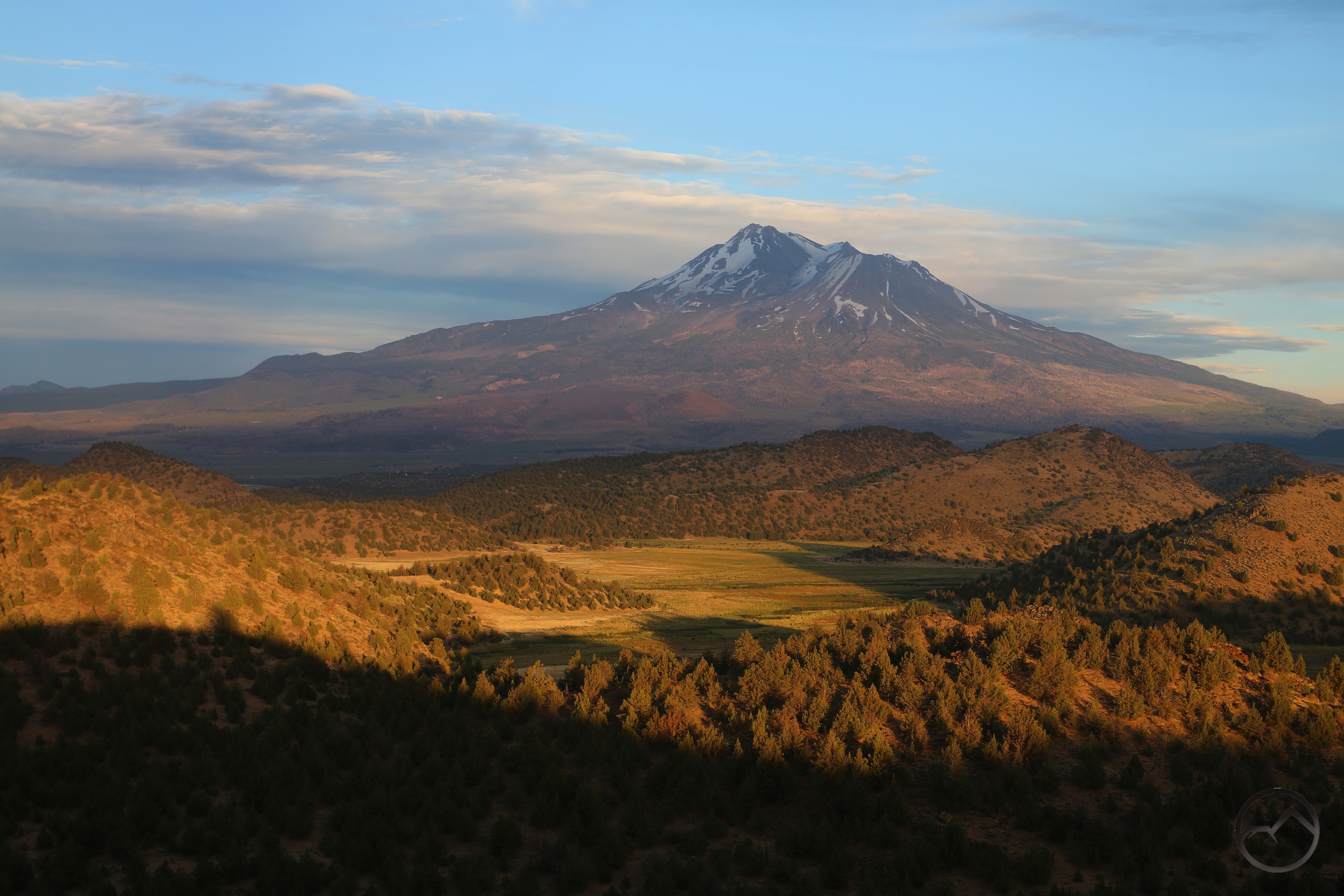
My family accompanied me to Truchas Ridge hoping to catch a great show. The clouds had not persisted the way I had hoped but the light was interesting and partially filtered by layers of haze to the west. While the vale beneath us was brightly lit, the mountain itself was in shadow. This was not dismaying, since this permutation of illumination often sees the light move to, and then up, Mount Shasta as the sun sets.
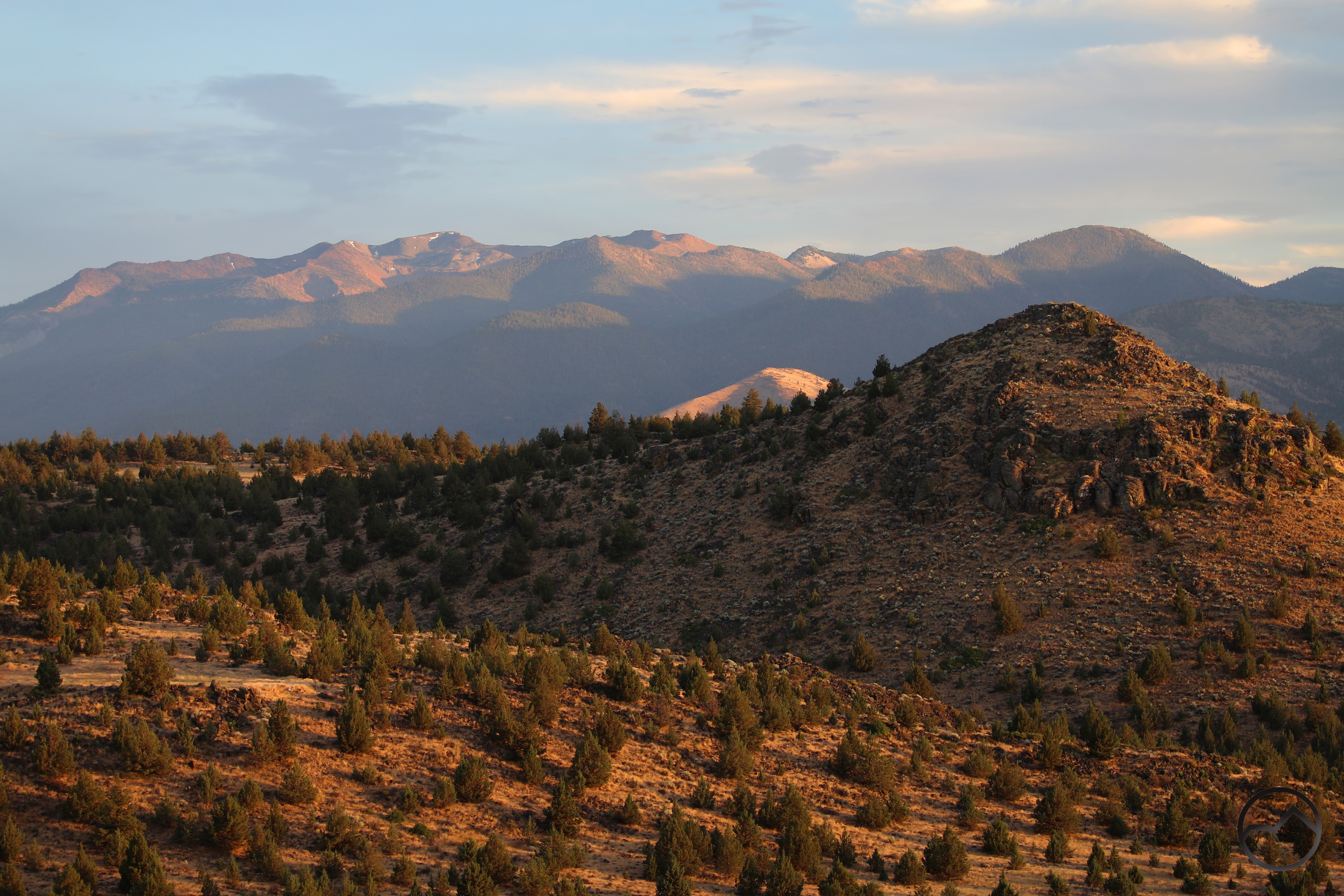
In the meantime, the large massif of Mount Eddy was getting great evening light. While spectacular (especially when hiking on it) Mount Eddy can be frustratingly difficult to capture in photographs because its lines often block the most interesting parts. From Truchas Ridge, it does present an appealing visage but still fails to impress like it does when actually on it.
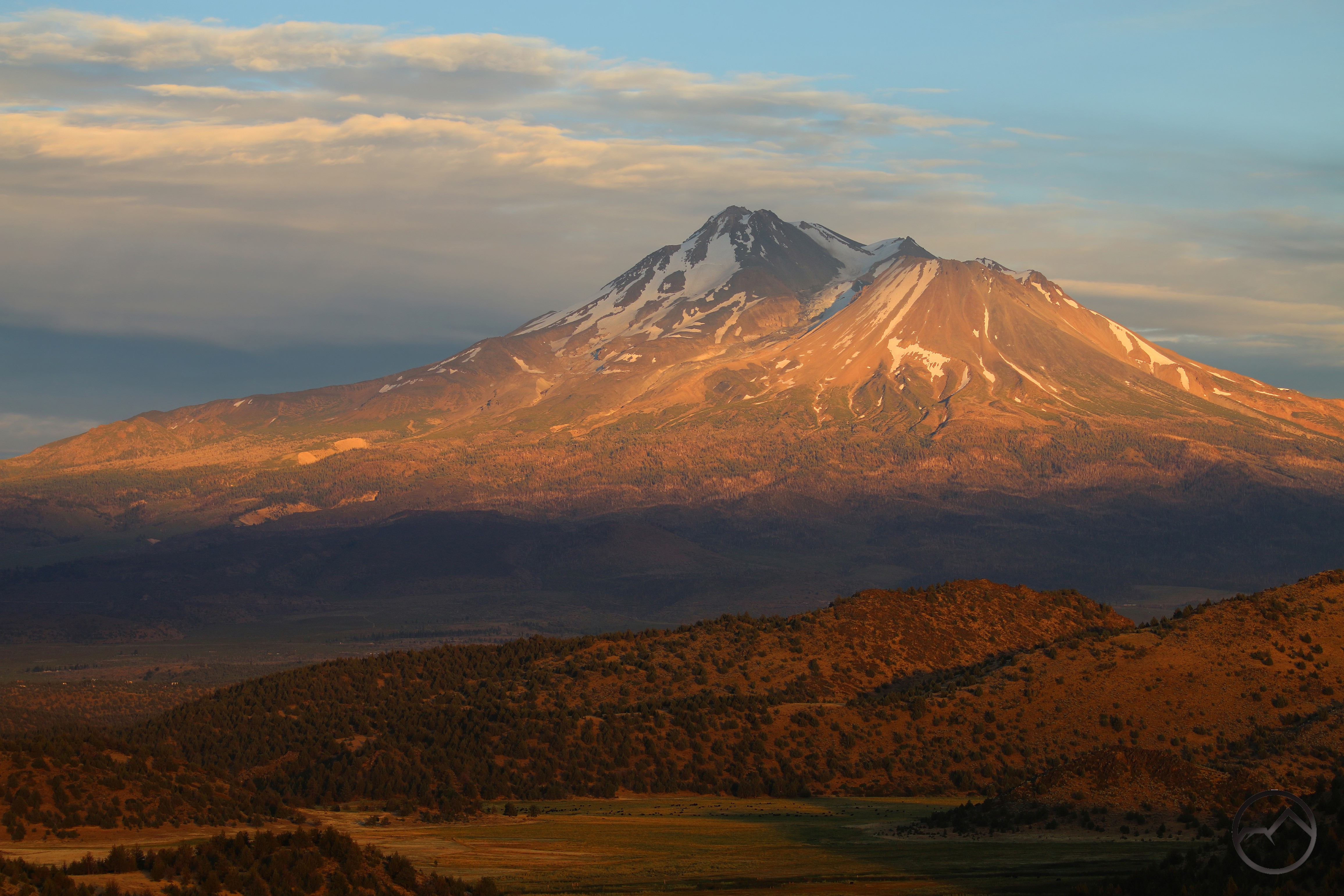

The light finally crept its way over to Mount Shasta, lighting it up with the evening light. However, this did not last long before the alpenglow set in. What was bright with hints of gold light suddenly turned bright red. Set against the dark landscape below the mountain, the alpenglow was particularly intense. It seemed particularly intense contrasted against the dark hills of the valley and the un-illuminated sky.

The clouds finally picked up some color, but they had sailed south, beyond Mount Shasta, leaving the overarching scene a little underwhelming. Nonetheless, this had been a fantastic sunset. Little did I know it was the first of a run of four!
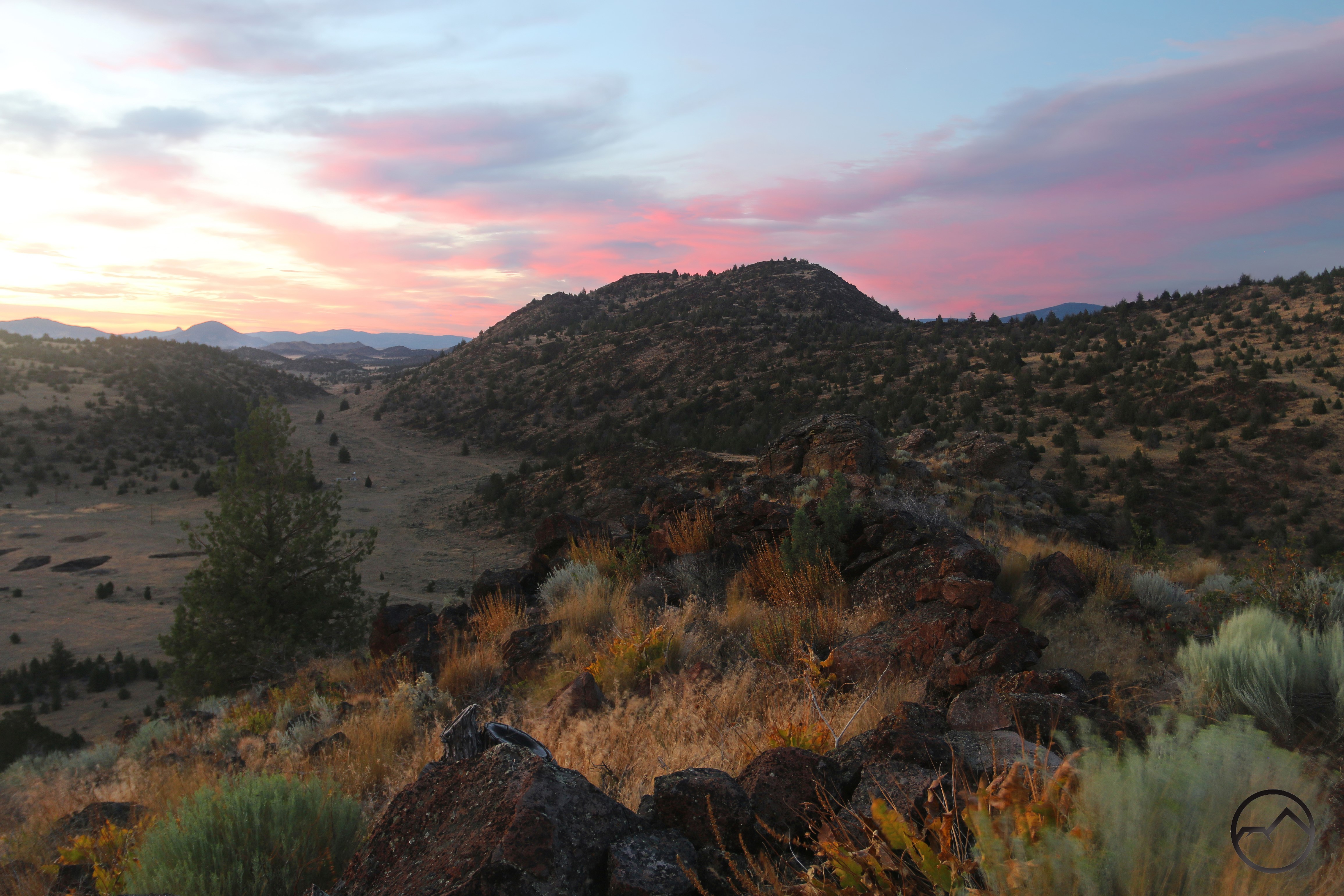
Before leaving the ridge, I made the short jaunt to the summit of Truchas Ridge. The wind was blowing powerfully and the sky still had color in it to the north and west. Far to the north on the horizon, Black Mountain and the Oregon summits Pilot Rock and Soda Mountain were visible. The 360 vista from the summit is top tier and a great final spectacle to end a great evening.

The following day the clouds had a similar form so I headed out to Truchas Ridge again. This time, however, I ended up at Echo Point. The lake in Echo Basin has dried up, which it does in years following a light winter but the view is still awesome. However, rather than going to the highest point, I made my way to a lower bench below the spot where we are going to build a campsite. It’s not a bad view to have from the opening of a canvas tent! The point’s shadow was already stretching across the basin by the time I got there. I anticipated the conditions would improve as the sun sank to the west.


While I waited for the sun to set, I enjoyed views other than that of Mount Shasta, in particular the view east, toward the Goosenest. The rocky hills the surround Echo Point make great foreground and offer excellent exploration potential. The crags are great for scrambling and each ridge and summit has a slightly different perspective on Mount Shasta and other landmarks. The Goosenest is a criminally underrated mountain. Boasting a great summit crater, loads of black lava and a chance to observe the exceedingly rare Baker Cypress. It is also the sixth highest summit in the Mount Shasta area and would be the 28th tallest peak in the state if it were located in Oregon. It also features a seldom hiked trail to its summit!


The sun finally set and the sky erupted into a burning panoply of fiery clouds radiating out from Mount Shasta. This was the kind of sunset I was hoping for the previous night. Truth be told, it was the best sunset I had seen in quite a while. Though the basin was in shadow, the fiery sky more than made up for it and the alpenglow on the mountain wasn’t too shabby either! As the light faded, I reckoned that was it and the summer weather would bring clear skies once again. Little did I suspect it was only halfway through an incredible series of spectacles.


The next day was another beautiful day in Mount Shasta, with small lenticulars scattered across the northern sky. When sunset neared and I had finished all my tasks for the day, I headed out once again, since it seemed Mount Shasta wasn’t done with it’s pyrotechnics. This time, however, I headed up toward Castle Lake. It seemed a better perspective to capture the lenticulars than Truchas Ridge would have been. By them time I got up there the lenticulars had mostly faded but the light was great. The sunset was more than ample compensation for missing the lenticulars, as the sky once again scorched by the sunset and pulsed with pinks and purples. Mount Shasta itself radiated warm light as the sun made its final descent.
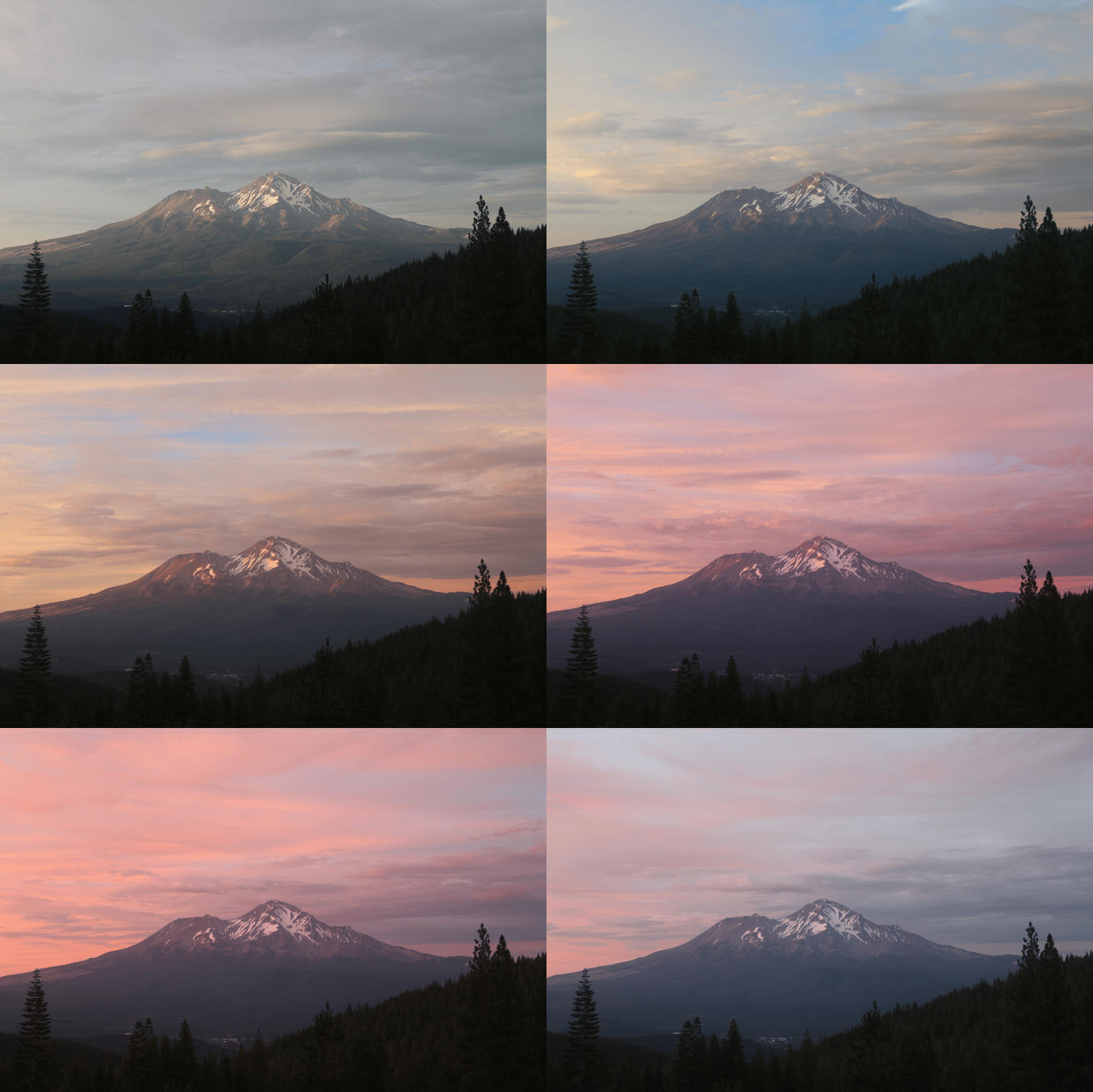
One thing about this perspective that always effects me is the sight of Mount Shasta City lying at the foot of the mountain. I am always struck by what an incredible location for a town it is. Indeed, all the communities around the foot of the mountain are in enviable positions. Another things that is striking about this perspective is the town’s elevation, which is approximately 3,500 feet above sea level. At 14,179 feet, Mount Shasta rises over 10,500 feet above the city. This is over 1,000 feet more of vertical relief than it is from Yosemite Valley to the top of Mount Lyell, the highest point in Yosemite National Park. That is dramatic topography!
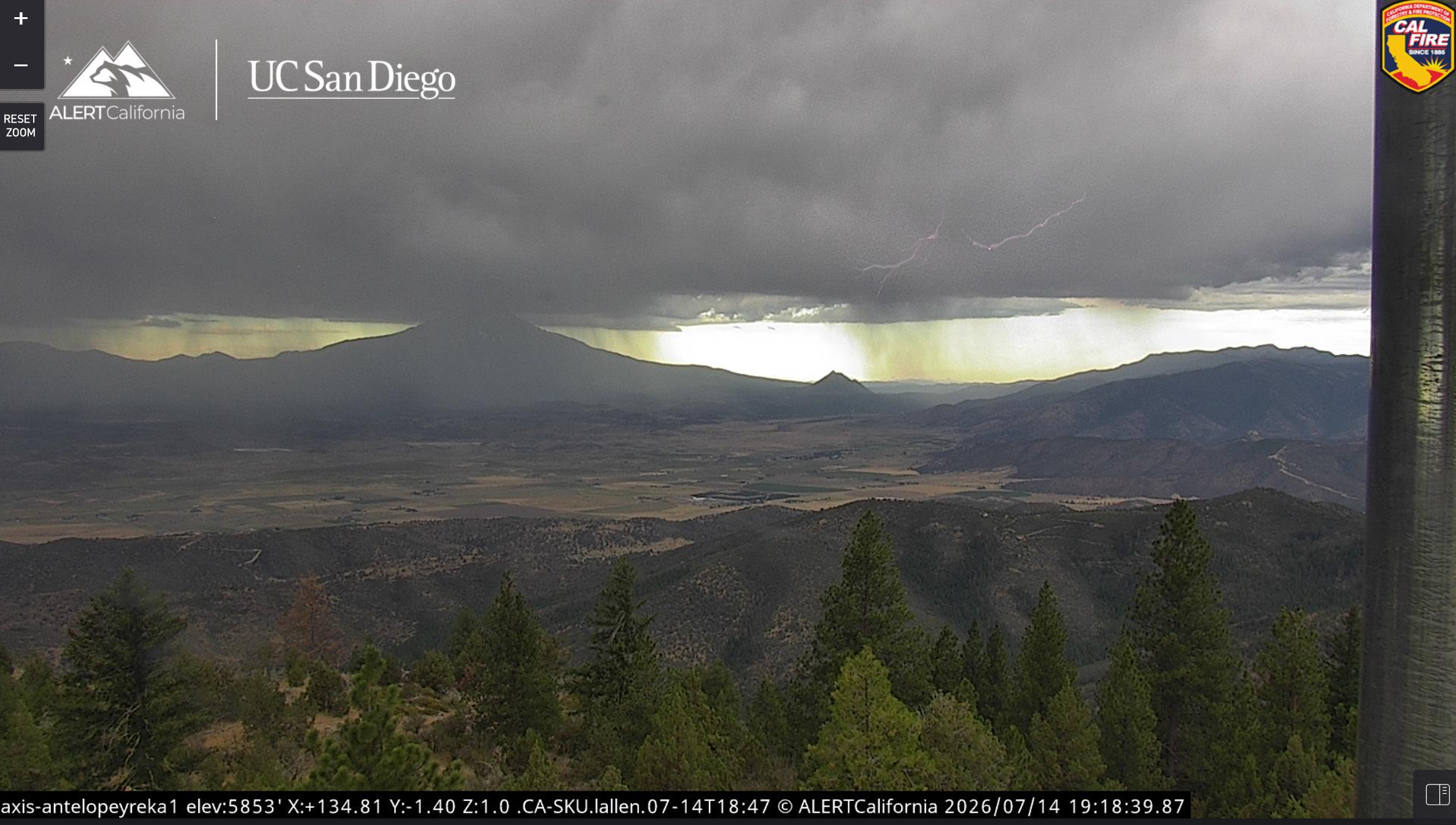
After three days in a row of great sunsets, I would have been right to assume that the weather system had sun its course but, in fact, it saved the best for last. All through the day I saw thunderclouds building over Mount Shasta and by evening I could hear distant thunder. I checked the webcam to see the situation in the valley and as it updated (every minute or so), the newest image featured a bolt of lightning ripping through the sky. What timing! On the webcam it was evident that rain was pouring down throughout the Shasta Valley. That was definitely the place to go!

My wife and I met at the Ridge and we hiked out to one of the vista points. Much of the valley was in shadow as the sun sank behind clouds to the west. It didn’t seem like there was going to be much light for a sunset but I was hopeful. I have found that during the thunderstorms, if the clouds are heavy, there are times when the sun sinks just below the cloud layer as it sets and for just a minute or two the whole landscape lights up. I was hopeful that would be the case on this occasion. The first indication that my hope was not in vain was off to the west, where Mount Eddy was bathed in warm sunset light.

Further to the south, a very faint rainbow appeared directly over Black Butte. It was difficult to make out but the color strata were just discernable against the dark clouds. The summit of Black Butte was picking up a little light as well. While this was nice, I have seen (better) rainbows in this area before around sunset and nothing really came of it.

Suddenly, the base of Mount Shasta was aflame with a deep red glow. This was the sun’s light hitting the mountain as it sank into the clouds to the west. Just a narrow plane of light was able to make it through the clouds but it was rich and awesome. I knew that as the sun got lower and dropped behind the horizon the light would travel upward on Mount Shasta. I didn’t know what the overall conditions would be but I was certain the mountain itself was going to get lit up.

Suddenly, as Mount Shasta was enveloped in alpenglow, the rainbow over Black Butte burst across the sky. I have seen a lot of rainbows around Mount Shasta but this was by far one of the best, in the best conditions and from the best perspective. Now this was an awesome sunset! Soon the rainbow was joined by a fainter twin. I could not believer my fortune, catching a double rainbow from this perspective!

At this point, a fantastic sunset became an epic one. The alpenglow on Mount Shasta, the light in the clouds and the rainbow all intensified. The second rainbow grew a little fainter but was still visible. Now the hills of the Shasta Valley, indeed the land and rocks I was standing on, all now glowed as the sunset’s light reflected off the clouds and the whole area seemed to hum red. It was absolutely incredible but even on top of this dazzling sight, the sounds of the blowing wind, occasional peels of thunder, howling coyotes and the peent and “sonic boom” of the diving nighthawks. This was one of the richest pallets my senses had experienced. It was one of the greatest sunsets I have ever seen.

Eventually the strong light began to creep away from Mount Shasta. Even so, the mountain retained a vestige of alpenglow. The rainbow hung on tenaciously in the still illuminated clouds. The ground was still red as well. The contrast of the lighted areas with the light and dark of the unlit areas was actually quite beautiful and made the fading grandeur of the rainbow sunset a little easier to endue. We hung on to soak as much of the magic up as we could. Even though it is “never enough”, we were satisfied.

Looking north, I could see the light still hanging on so I hurried over to a vista point where Mount McLoughlin, southern Oregon’s tallest peak, is visible. Across the valley from Truchas Ridge, the Hawkmoon Tree made an odd silhouette against the red sky. This tree is one of the most interesting junipers in the Shasta Valley and is home to one of the largest hawk nests I have seen in the area. The light finally faded away completely and my wife and hiked back to the trailhead at our picnic area. We were thrilled with the magnificent experience we had just had.
Thus ended the run of four beautiful summer sunsets. The thunderstorm broke the weather system and the clouds retreated from the sky. Now, a few days after the final, glorious scene, I am still energized by the entire series but the final, greatest one in particular. I have been blessed with many amazing sunsets but that ranked among the most amazing I have experienced. Thank you Lord for that profound opportunity.


Some Mordor looking shots on some of those
That’s interesting. In what way?
Wow, those are beautiful! Especially the last one, with the band of orange around the base of the mountain. I’ve never seen anything like that. Stunning photos!
Pingback: Snow Starts Semptember | Hike Mt. Shasta