Hike Mt. Shasta

Exploring the Mount Shasta Region

  • Home
  • Trails
    • Mount Shasta Trails
      • Brewer Creek Trail
      • Clear Creek Trail
      • Gray Butte Trail
      • Green Butte Ridge Trail
      • Horse Camp Trail
      • North Gate Trail
      • Old Ski Bowl Trail
      • Panther Meadow Trail
      • South Gate/Squaw Meadow Trail
      • Whitney Falls Trail
    • Trinity Divide Trails
      • Blue Divide Trail
      • Castle Lake Trail
      • Castle Lake Shore Trail
      • Cliff Lake Trail
      • Deadfall Lakes Trail
      • Gray Rock Lakes Trail
      • Gumboot Trail
      • Heart Lake Trail
      • Porcupine & Toad Lakes Via Pacific Crest Trail
      • Seven Lakes Basin Via Pacific Crest Trail
      • Sisson-Callahan Trail
      • Soapstone Trail
      • South Mumbo Scramble
      • Tamarack Lake Trail
      • Toad Lake Trail
    • Castle Crags Trails
      • Burstarse Falls Via Pacific Crest Trail
      • Castle Dome Trail
      • Flume Trail
      • Lower Castle Crags Via Pacific Crest Trail
      • Root Creek Trail
    • Scott Mountains Trails
      • Bluff Lake & Cement Bluff via Pacific Crest Trail
      • Caldwell Lakes Trail
      • China Mountain Scramble
      • Cory Peak and Bull Lake via Pacific Crest Trail
    • Cascade Crest
      • Ash Creek Butte Scramble
      • Goosenest Trail
      • Juanita Lake Trail
      • Orr Lake Trail
    • Mount Shasta City Area Trails
      • Black Butte Trail
      • Box Canyon Trail
      • Gateway Trail
      • Lake Siskiyou Trail
      • Mount Shasta City Short Trails
      • Ney Springs Canyon Trail
      • Spring Hill Trail
    • Shasta Valley Trails
      • Black Lava Trail
      • Haystack Trail
      • Lake Shastina Trail
      • Pluto Cave Trail
      • Trout Lake Trail
      • Yellow Butte Trail
    • Sacramento River Trails
      • Dunsmuir Trail
      • Hedge Creek Falls Trail
      • Sacramento River Trail
      • Sims History Trail
    • McCloud River Trails
      • Ash Camp To Ah-Di-Na Via Pacific Crest Trail
      • McCloud River Falls Trail
      • McCloud River Preserve Trail
      • Squaw Valley Creek Trail
      • McCloud River Trail: Algoma Camp to Nitwit Camp
      • McCloud River Trail: Nitwit Camp to Cattle Camp Swimming Hole
      • McCloud River Trail: Cattle Camp Swimming Hole to Camp 4
      • McCloud River Trail: Camp 4 to Upper McCloud Falls
      • McCloud River Trail: Pine Tree Hollow Loop
    • Trails Further Afield
      • Trinity Alps Trails
        • Bear Lakes Trail
        • Billys Peak Trail
        • Boulder Creek Lakes Trail
        • Boulder Lake Trail
        • Canyon Creek Trail
        • Caribou Lakes Trail
        • East Boulder Lake Loop
        • East Weaver Lake Trail
        • Four Lakes Loop
        • Granite Peak Trail
        • Grizzly Creek Trail
        • Gulch Lakes Loop
        • Hidden Lake Trail
        • South Fork Lakes Trail
        • Stoddard Lake Trail
        • Stoney Ridge Trail
        • Tangle Blue Lake Trail
      • Warner Mountains
        • Emerson Creek Trail
        • Highgrade Trail
        • Patterson Lake Via Warner Summit Trail
        • Pine Creek Trail
        • Squaw Peak Trail
  • Articles
    • Trails By Area
      • Mount Shasta
        • Vistas, Meadows And Waterfalls: Three Best Hikes On Mount Shasta
        • The End Of The Road: Three Hikes In The Old Ski Bowl Area
        • Two Trails From Bunny Flat
        • Three Trails On Mount Shasta’s East Side
        • Mount Shasta’s Hummingbirds
      • Trinity Divide
        • Great Lakes: Top Five Lake Basins In The Trinity Divide
        • The Headwaters Of The South Fork Of The Sacramento River
        • Neglected Headwaters: Two Lesser Lake Basins On The South Fork
        • Gumboot Saddle: Two Hikes On The PCT
        • Descent Into Mystery: The Sisson-Callahan Trail
        • Mumbo Basin – Overlooked On The West Side
        • The Headwaters Loop: A Proposed Backpacking Loop In The Trinity Divide
      • The McCloud River
        • The McCloud River Trail
      • Shasta Valley
        • Jewels In The Desert
      • Scott Mountains
        • Great Scott! Two Scott Mountains Hikes On The PCT
      • Trinity Alps
        • Carubou Lakes: Trinity Alps On A Grand Scale
        • Switchbacks To Heaven: The Trinity Alps’ Stoney Ridge Trail and Four Lakes Loop
        • Trinities In Proximity: Two Trinity Alps Trails With Easy Access From Mount Shasta
        • Trails in the Carter Meadows Area
        • Trinity Alps Views of Mount Shasta
        • The Psychological Value Of The Trinity Alps
    • Waterfalls
      • Three Waterfalls On Mount Shasta
      • McCloud River Waterfalls
      • Sacramento River Waterfalls
      • Trinity Divide Waterfalls
      • Trinity Alps Waterfalls
      • Avoiding A Dry Whitney Falls
    • Off Season Trails
      • Three Winter Hikes Near Mount Shasta City
      • Winter Hikes In Shasta Valley
      • Winter Hiking In The Shasta Valley Wildlife Refuge
      • Winter Hikes On The Sacramento River
      • Winter Hikes On The Lake Siskiyou Trail
      • Spring Hikes In The Castle Crags
      • Spring Hikes On the Upper McCloud
      • Spring Hikes On The Lower McCloud River
    • Points Of Interest
      • Mount Eddy: Overshadowed, Underrated
      • Black Butte: Hiding In Plain Sight
      • Castle Dome: Steadfast And Staggering
      • Mount Shasta Hoodoos
      • Sacramento Scrambling
      • The Shasta River
      • The Castle Creek Watershed
      • Mount Shasta East Side Glacier View
      • 5 Fantastic Mount Shasta Vistas
      • 5 Highest Peaks Around Mount Shasta
      • 5 Best Hikes On Creeks And Rivers
      • 5 Interesting Footbridges
      • Three Spectacular Drive-To Sunset Vistas
    • North State Geography
      • Introduction
      • Seven Major Regions
      • The California Cascades
      • Klamath Mountains Pt. I
      • Klamath Mountains Pt. II
      • The Great Canyons Of Mount Shasta
      • Mount Shasta, Timberline, And The Relative Size Of Cascade Volcanos
      • Four Eruption Cones Of Mount Shasta
      • Mount Shasta’s Medial Moraine
    • Northern California Review
      • North Table Mountain
      • Lakes Basin Recreation Area
      • Eastern Sierra Fall Color
      • Sonoma County
      • Central Sierra Nevada
      • Orland Buttes
    • Seldom Seen
      • Ash Creek Falls
      • Mud Creek Canyon
      • Lower Mud Creek Canyon
      • Diller Canyon
      • Lower Cascade Gulch
      • The Grey Rocks
      • Castle Creek
      • Upper Wagon Creek
      • Fawn Creek Canyon
      • Confluence of the Sacramento River and Castle Creek
      • Upper Klamath River Canyon
      • Hole In The Ground Geologic Area
      • Ash Creek Butte Fossil Rock Glacier
    • Mount Shasta History
      • Vantage Lost: The Everitt Memorial Vista
      • A Yosemite-Mount Shasta Connection
      • Whitney – What’s In A Name?
      • Mount Shasta Area and the 1838 Exploring Expedition
      • A 19th Century Engraving Of An Epic Mount Shasta Vista
      • Vintage 1907 Color Photos
      • A Misleading Painting
      • A Mysterious Painting
      • A Mysterious Painting Pt. II
      • Stereographic Mt. Shasta
      • Year One Of Hike Mt Shasta
      • Year Two Of Hike Mt Shasta
      • Year Three Of Hike Mt Shasta
      • Year Four Of Hike Mt Shasta
      • Year Five Of Hike Mt Shasta
      • Year Six Of Hike Mt Shasta
      • Year Seven Of Hike Mt Shasta
    • Image Galleries
      • Mount Shasta Trails Gallery
      • Mount Shasta Sunrise Gallery
      • Mount Shasta Sunset Gallery
      • Lenticular Cloud Gallery
      • Mount Shasta NON-Lenticular Clouds
      • Mount Shasta Reflection Gallery
      • Telephoto Gallery
      • Mount Shasta Area Fall Color
      • Castle Crags Gallery
      • Waterfalls Gallery
      • Trinity Divide Lakes Gallery
      • Mount Shasta Area Rivers Gallery
      • Shasta High Desert Gallery
      • Mount Shasta GIF Gallery
    • Random Notes
      • Revew: Three Mount Shasta Trail Maps
      • A Mount Eddy Wilderness?
      • New Land Additions For The Castle Crags
      • Book Plug: Mount Shasta Area Rock Climbing
      • Exile: How I Came To Love Wilderness
  • Mt. Shasta Trail Map
  • Blog
  • About/Contact
  • Links
  • Truchas Ridge

PCT Spotlight – Porcupine And Toad Lakes

Posted by bubbasuess on July 18, 2018
Posted in: Cascade Range, Hiking, Klamath Mountains, Lakes, Mount Shasta, Pacific Crest Trail, Trinity Divide. Tagged: Porcupine Lake, Toad Lake. 1 Comment

Porcupine Lake

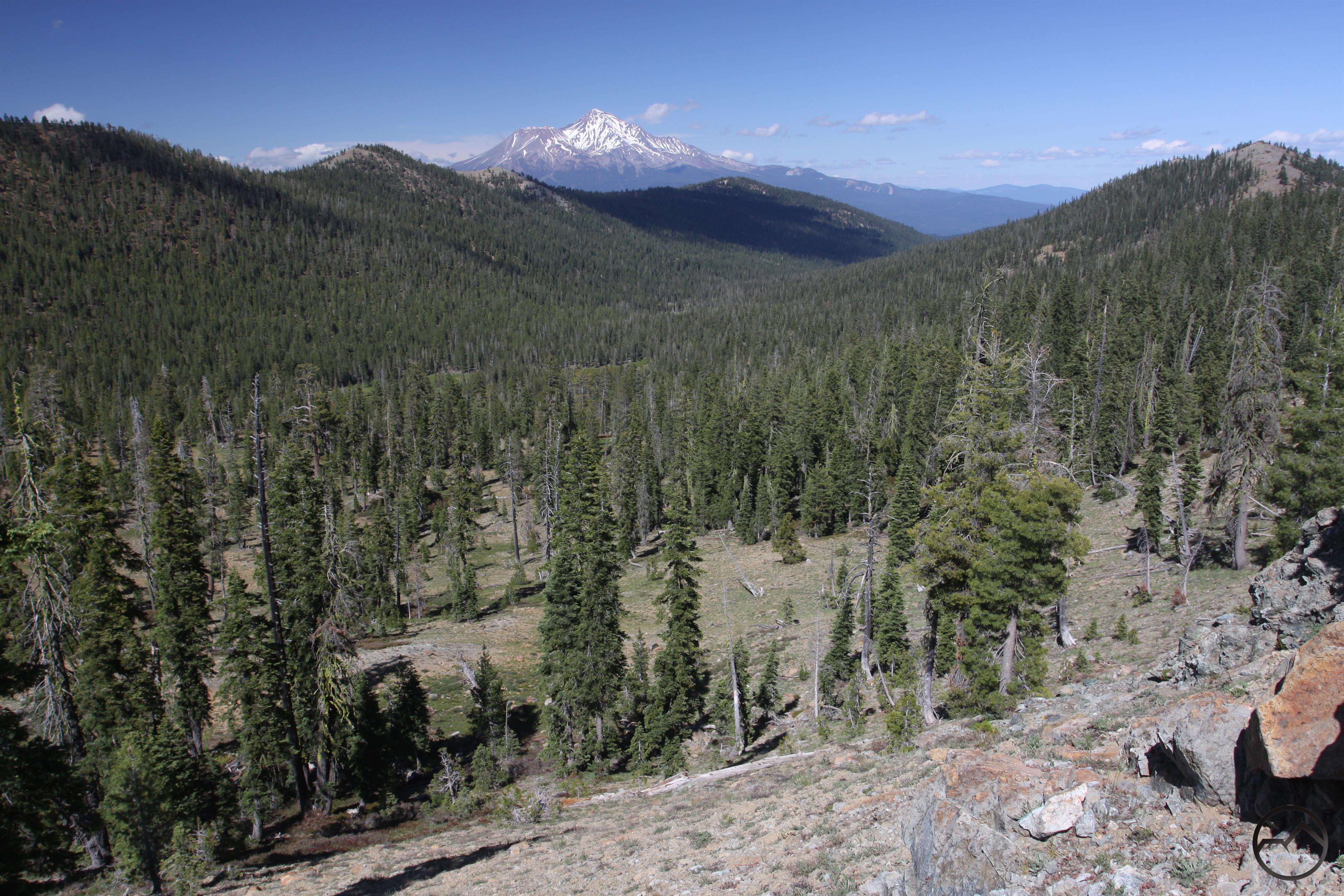
It seemed natural for the third installment of the PCT Spotlight to feature a trail that began at the Gumboot Trailhead. There are two great options here. First is the trip south to the Seven Lakes Basin. The other is the hike north, to Porcupine and Toad Lakes. I ended up choosing the latter, for a couple of reasons. One reason is that the trails sees a little less use. The main destinations are further away than the hike to the Seven Lakes Basin, so more people tend to head to the south. The second reason is that this section of the PCT features more views of Mount Shasta than just about any other part of the long trail. That is tough to argue with!

Toad Lake

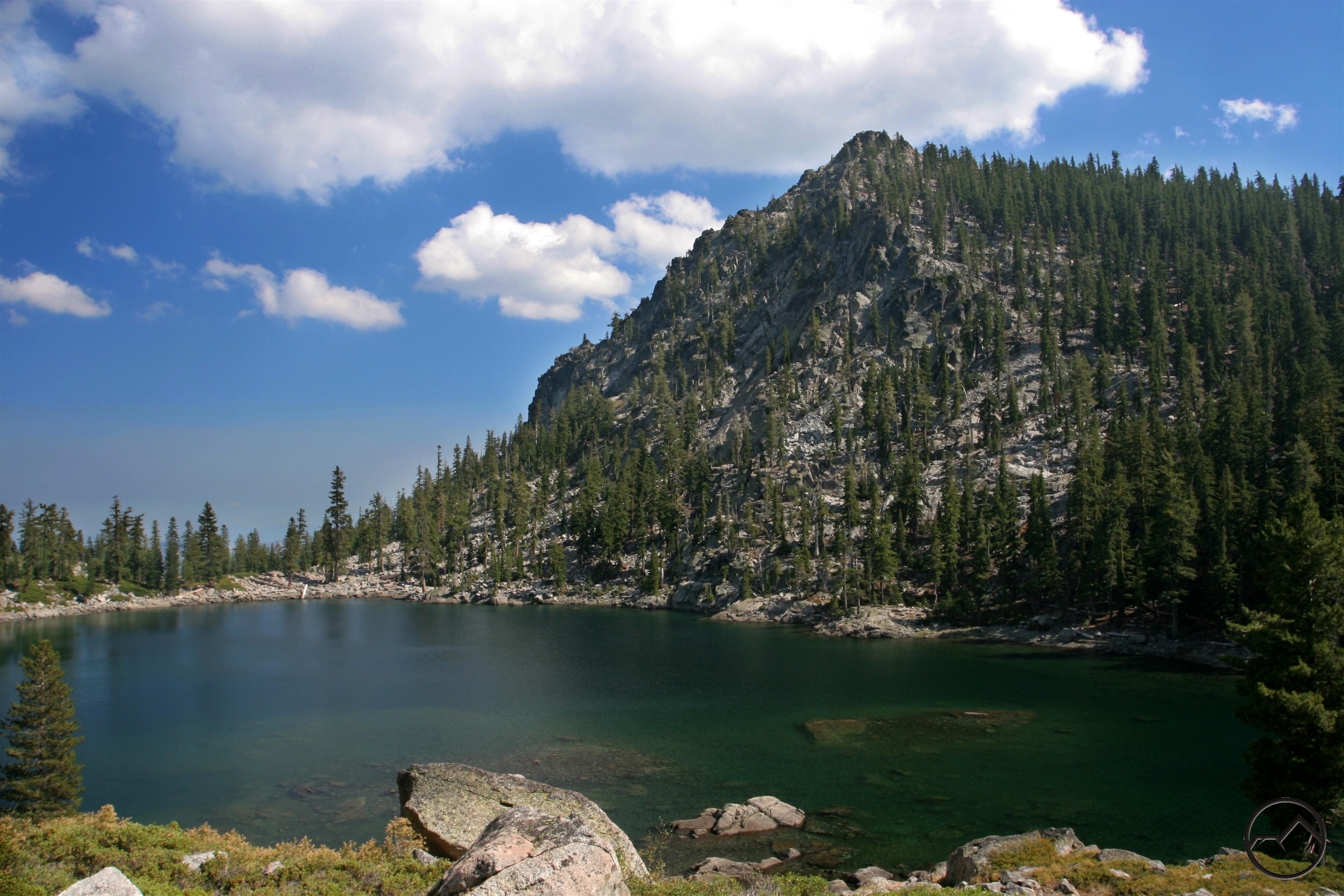
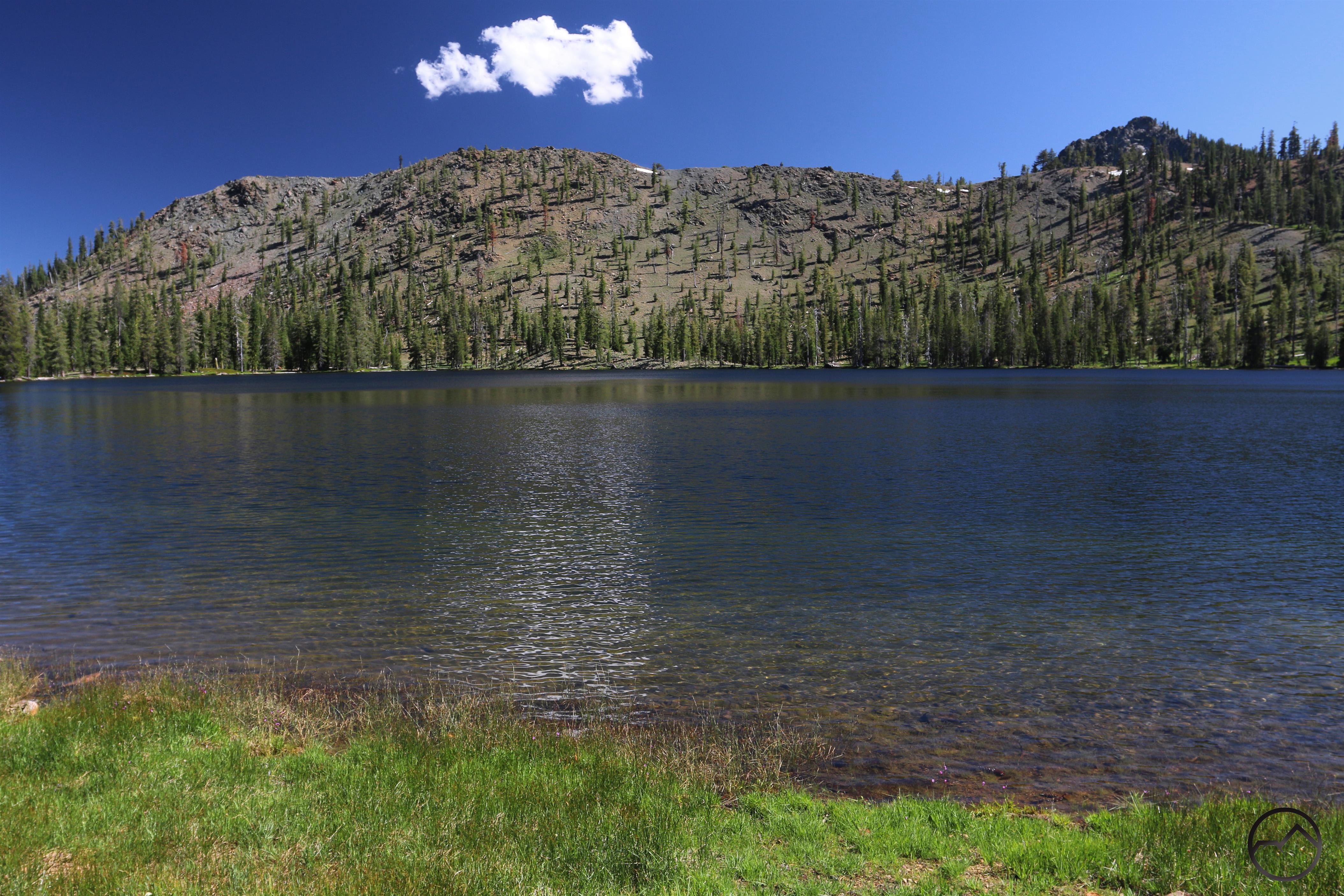
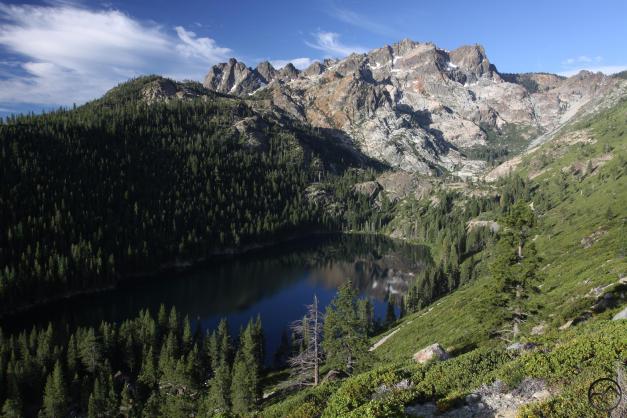
The hike to Porcupine and Toad Lakes is the longest hike to be featured on the HikeMtShasta PCT Spotlight. It is 11.5 miles to Porcupine Lake and 13 miles to Toad Lake. Of course, if one braves the road up the Middle Fork of the Sacramento River, it is possible to shorten the hike considerably by starting at Toad Lake. In spite of the length, the hike is well worth the effort. It is one of the prettiest trails in the region, with views of Mount Shasta, and the Trinity Dividen as well as vistas of the Trinity Alps to the west. The hike’s destinations are are the two lakes, which are quite different in character. Porcupine Lake occupies a rocky basin right at the base of beautiful Porcupine Lake. Toad Lake lies in a bowl cut into a vein of peridotite rock, which results in sparse vegitation on some parts of the ridge above the water. Both are quite beautiful.

Fawn Creek Canyon from the PCT.

This is a great section of the PCT. After some gradual climbing over the first couple of miles, the trail reaches the crest of the Trinity Divide and levels off. It then begins a very easy traverse along the top of the Divide, weaving back and forth between the east and west sides of the divide. The trail also passes through some very remote sections of the Trinity Divide. Fawn Creek Canyon, part of the South Fork of the Sacramento River is visible from the trail, as is the large basin that forms the headwaters of the Middle Fork. Geologically, the trail passes through some varied terrain, with large outcroppings of gabbro and peridotite, both of which are typical of the Trinity Divide. There are a few springs and lush meadows along this great section of trail as well. More fascinating geology and great views lie beyond Toad Lake too, for those willing to push further.


Gumboot Lake and the Cliff Lake Basin.
Picayune Lake
Fawn Creek Canyon from the PCT.

Meadow along the PCT.
Porcupine Peak and Mount Eddy.
The Castle Crags Wilderness from the PCT

Newly acquired peaks behind Porcupine Lake
Porcupine Lake
Toad Lake from the PCT junction.

Toad Lake
The trail wraps around Toad Lake.

PCT Spotlight – Burstarse Falls

Posted by bubbasuess on July 17, 2018
Posted in: Cascade Range, Castle Crags, Hiking, Klamath Mountains, Mount Shasta, Pacific Crest Trail, Trinity Divide, Waterfalls. 1 Comment

Burstarse Falls is a great destination on the PCT.

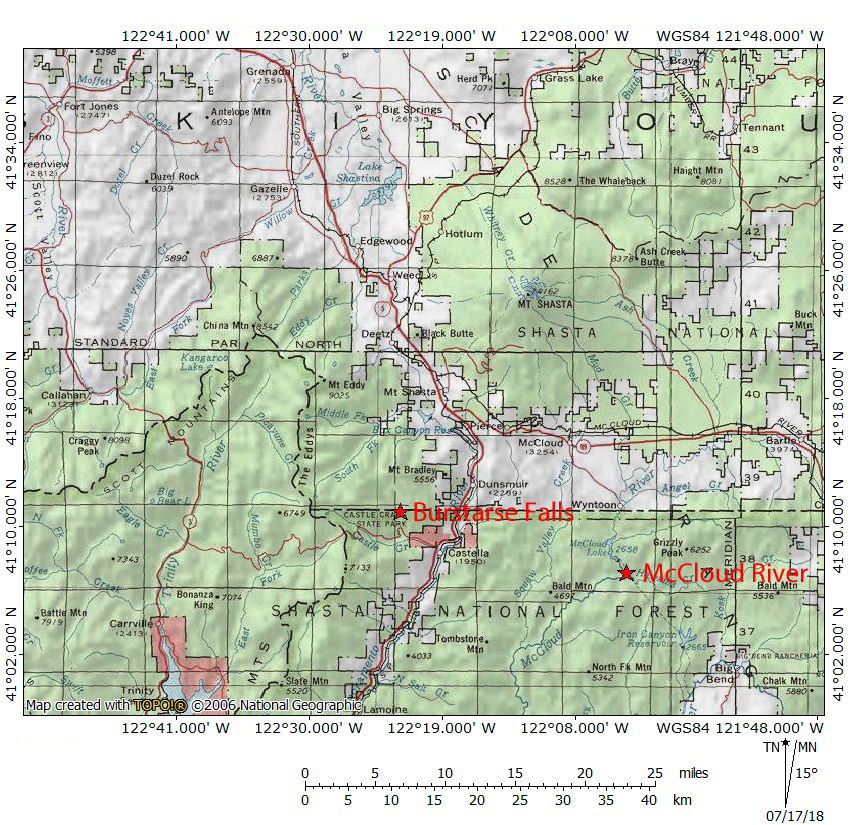
I was torn about which hike on the PCT to feature today. Naturally it had to be somewhere in the Castle Crags, but there are a few good choices. Considering that I have 5 days to feature trails before the Trail Town kick off and the first was dedicated to the section along the McCloud, I thought it was important to focus the next selection on the Castle Crags. There are a few good choices for this section but in the end, I selected the trip to Burstarse Falls.

Burstarse Creek cascades

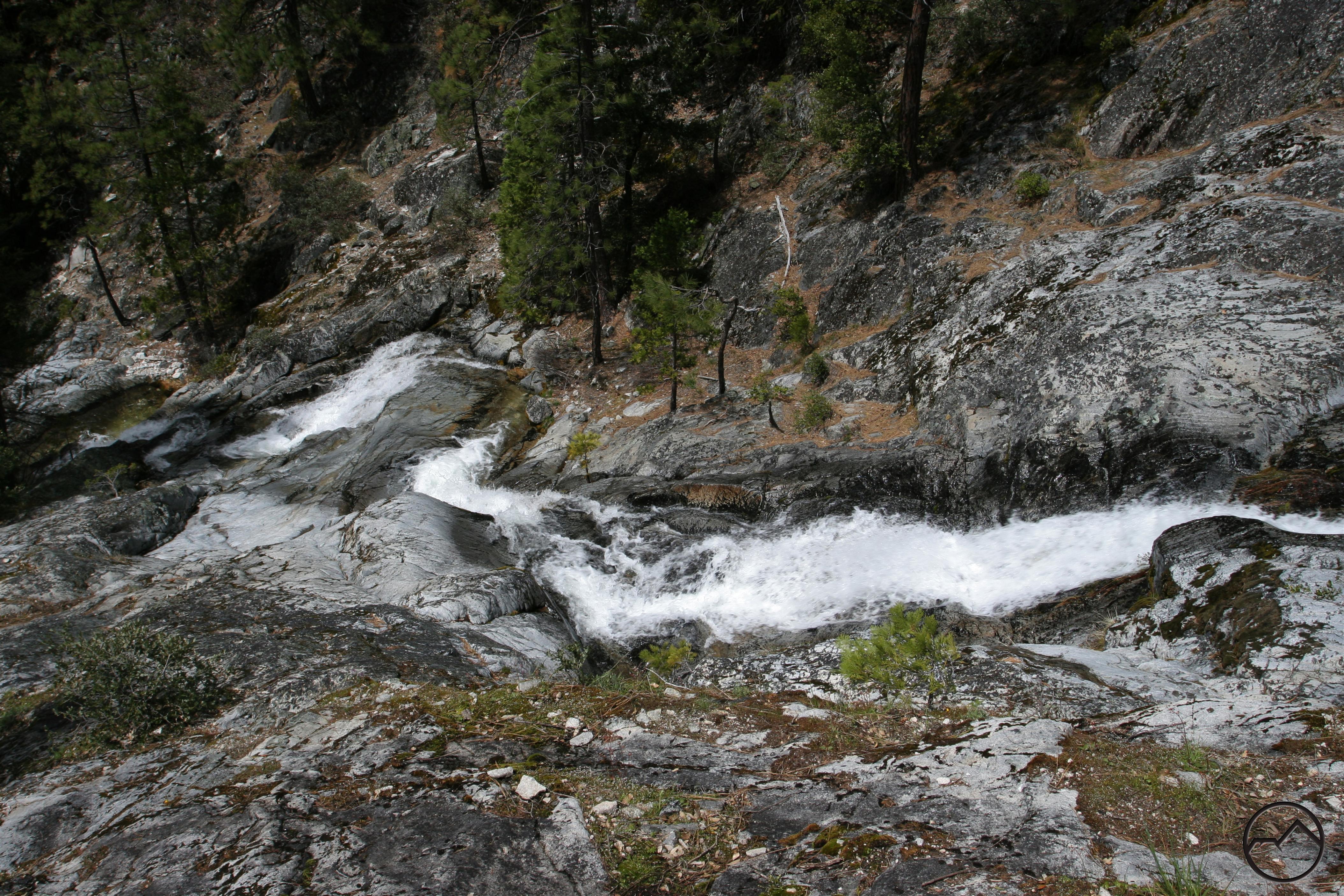
The hike to the falls is a fantastic but relatively easy hike to a great waterfall. It also features some great views of the granite towers of the Castle Crags, which can be frustratingly hard to come by, consider their epic size and how much trail crosses them. The real delight of the hike, however, is Burstarse Creek. Naturally the falls is the culmination of this, but the creek itself is a highlight reel. Upon arriving at the creek, it tumbles down an attractive 10 foot waterfall before flowing across the trail and then pouring into a narrow granite gorge. Following the use trail upstream, hikers are presented with a chance to walk to the bottom of Lower Burstarse Falls, which is a pretty 25 foot plunge. Above this, the creek races through a series of granite chutes. These are very reminiscent of creeks in the Sierra Nevada. Burstarse Falls itself lies a little further up the creek. It shoot off a tall granite cliff before hammering the rocks below, where it explodes into numerous small cataracts. These recombine and continue the creek’s journey down to Castle Creek. It is a wonderful spectacle.

Castle Crags from the PCT.

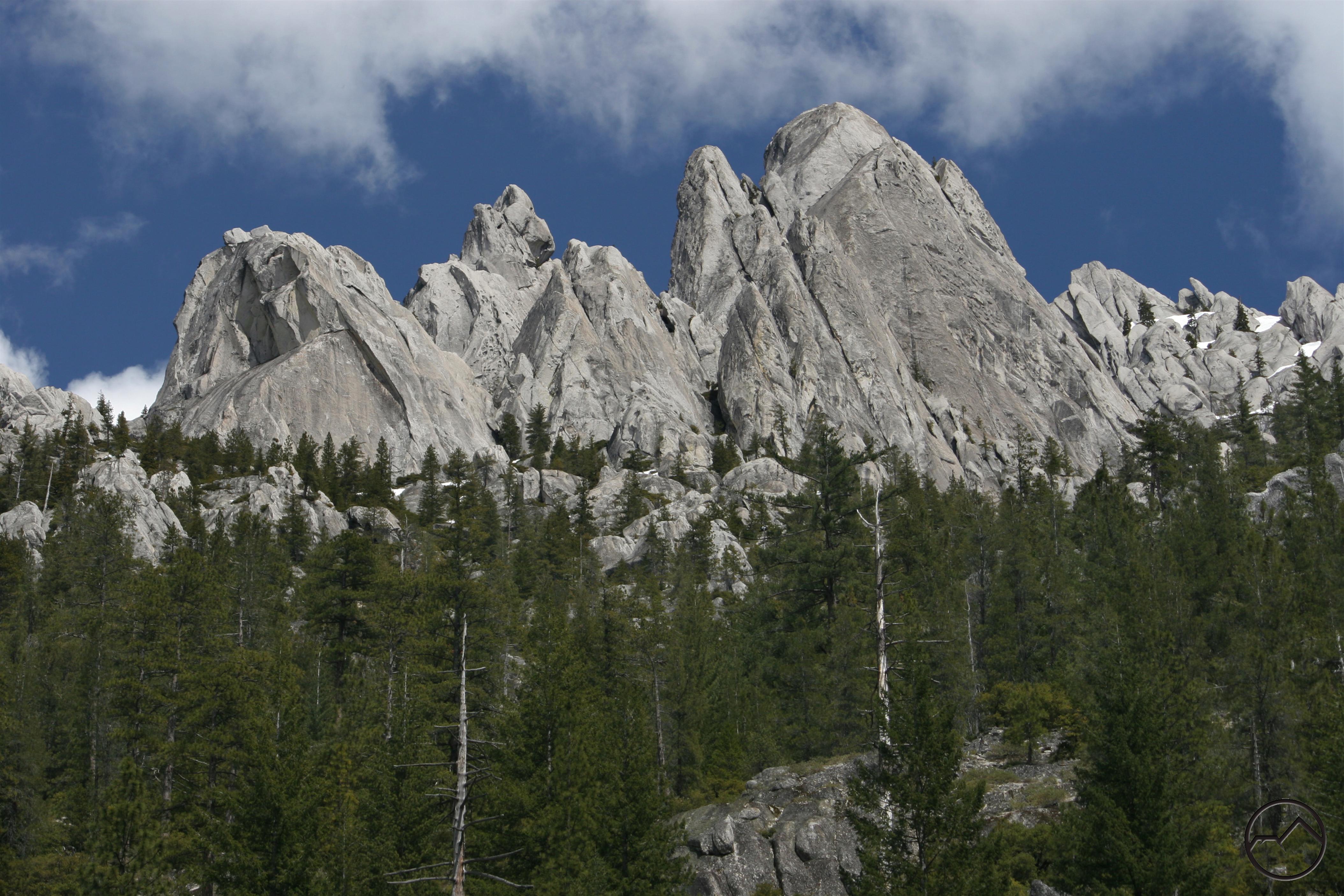
The hike to Burstarse Falls is along the PCT’s long, gradual climb across the southern flank of the massive Crags. After leaving the McCloud River, the trail surmounts a small divide, and then drops down to Squaw Valley Creek. From there it makes a long ascent of Girard Ridge before descending along Falls Creek down to the Sacramento River. It crosses the river and immediately begins climbing up, out the canyon, gaining elevation along the southern flanks of the Castle Crags. These enormous spires are the most rugged terrain encountered by the PCT since the Bucks Lake Wilderness in the Sierra Nevada.

Castle Crags from the PCT.
One of the smaller waterfalls on Burstarse Creek.

Lower Burstarse Falls

I was really tempted to focus this installment of the PCT Spotlight on the Soapstone Trail. This hike features a short section on the PCT and boasts one of the most spectacular views in the whole area. I ultimately chose the classic Burstarse Falls hike, but I would strong encourage everyone to explore the Soapstone Trail and check out the spectacular view of Mount Shasta and the Castle Crags!

This is quite a panorama, but these images are taken from the same spot. Click to enlarge:

Mount Shasta from the PCT, near the Soapstone Trail
Castle Crags from the PCT, near the Soapstone Trail


PCT Spotlight – McCloud River

Posted by bubbasuess on July 16, 2018
Posted in: Cascade Range, Hiking, Klamath Mountains, Mount Shasta, Pacific Crest Trail, Rivers. 1 Comment

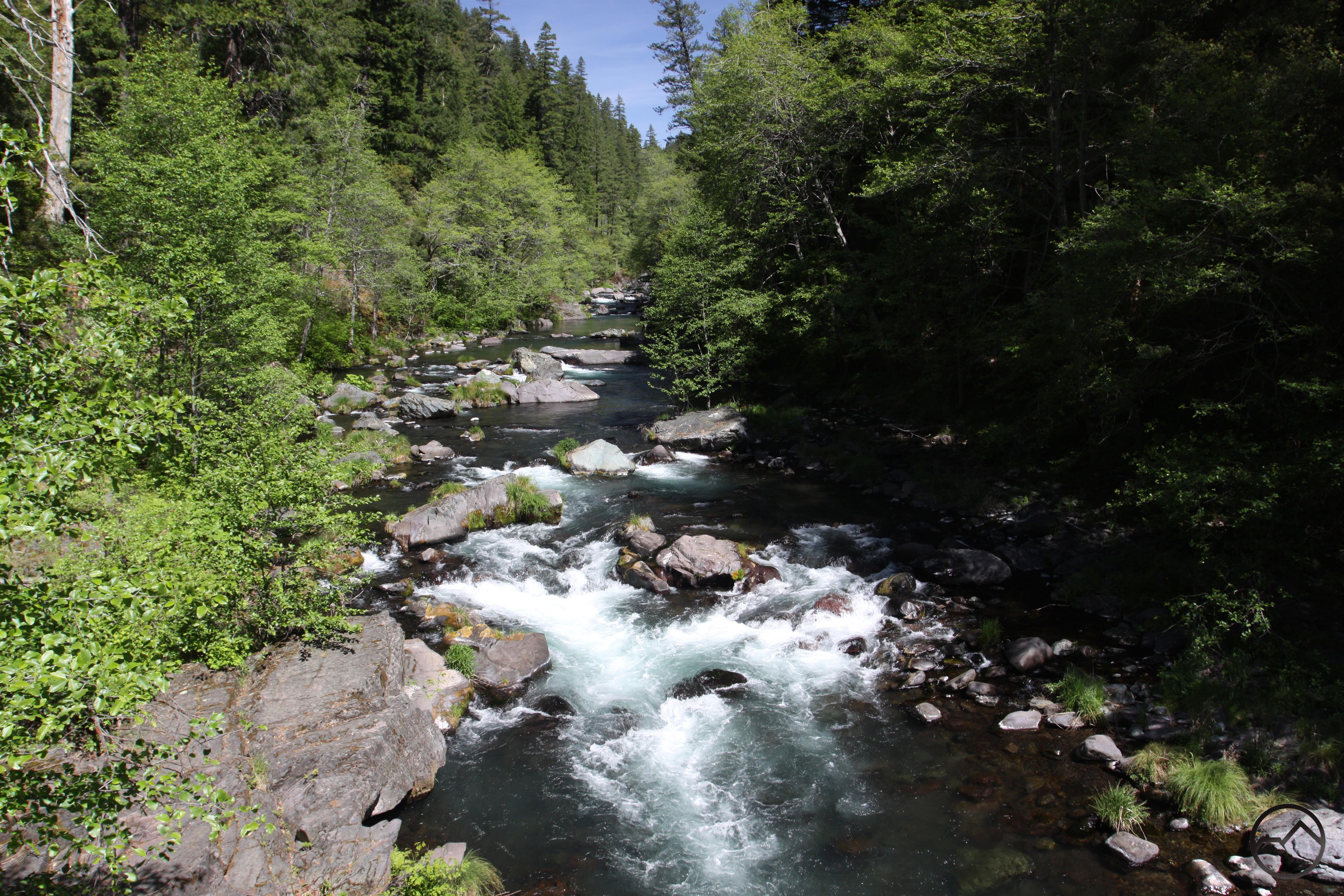
The McCloud River from the PCT bridge. 

With the Pacific Crest Trail Town kick off coming next Saturday, I thought I would highlight one PCT hike in the Mount Shasta area each day of this week. I will feature these in the order a thru-hiker would encounter them as they approached from the south. Hopefully this will encourage everyone to get out and explore the PCT and appreciate what a blessing it is for hikers in this region!

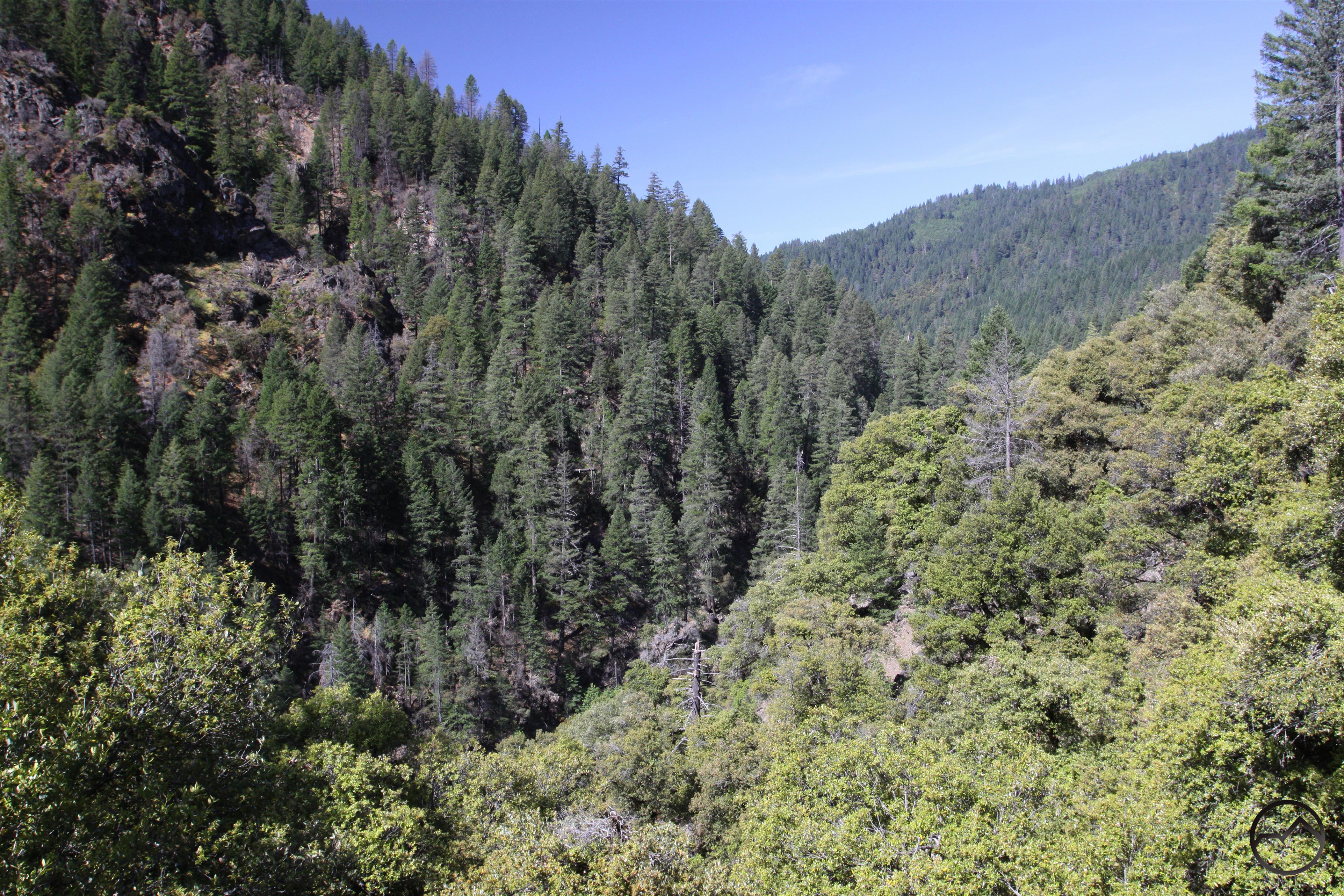
McCloud River Canyon, the heart of the McCloud Range.

So, the first trail I want to focus on is the section of the PCT that stretches from Ash Camp to a road crosses near the Ah-Di-Na campground. This beautiful stretch of the McCloud flows just downstream the dam impounding Lake McCloud but there is no hint that the river had recently been tamed. Here it is a wild, raucous waterway, pouring through large rapids formed by substantial boulders. A sense of isolation permeates that area despite being relatively close to McCloud and accessed easily from there. All in all, it is a beautiful area and one that is often overlooked by hikers.

A large cataract on the McCloud River.

This section of the PCT generally follows the crest of a long ridge that runs from just north of the Pit River in an arc west toward Grizzly Peak and then down to the McCloud River at Ash Camp. It is possible to follow the PCT east from here to Butcherknife Creek but the more interesting hike is to follow the McCloud River west for a few miles. There are numerous place to drop down to the river (steeply sometimes) and some really nice, large cataracts that almost approach the level of being waterfalls rather than big rapids. The PCT eventually crosses a dirt road and begins a long climb up and over a ridge to Squaw Valley Creek. Instead of following the trail, hikers do best to turn left on the road and follow it about 0.5 mile down to the Ah-Di-Na campground. This area has good river access and some fascinating history.

This hike is quite different from the other PCT hikes in the Mount Shasta area. The man feature is the river, rather than the surrounding mountains. The passage through the McCloud’s canyon gives this hike a sense of remoteness that the other hikes don’t necessarily have. I think that that is due, in large measure, to the fact that Mount Shasta is not visible from the trail here. It just feels cut off, but in a good way. No matter what hiker’s feel here, this is a beautiful section of the PCT and one that hikers should consider more often.

The McCloud River from the PCT crossing.

Large cataract on the McCloud River


Mount Shasta – Pacific Crest Trail Town

Posted by bubbasuess on July 14, 2018
Posted in: Cascade Range, Hiking, Mount Shasta, Pacific Crest Trail. Tagged: Trail Town. 1 Comment

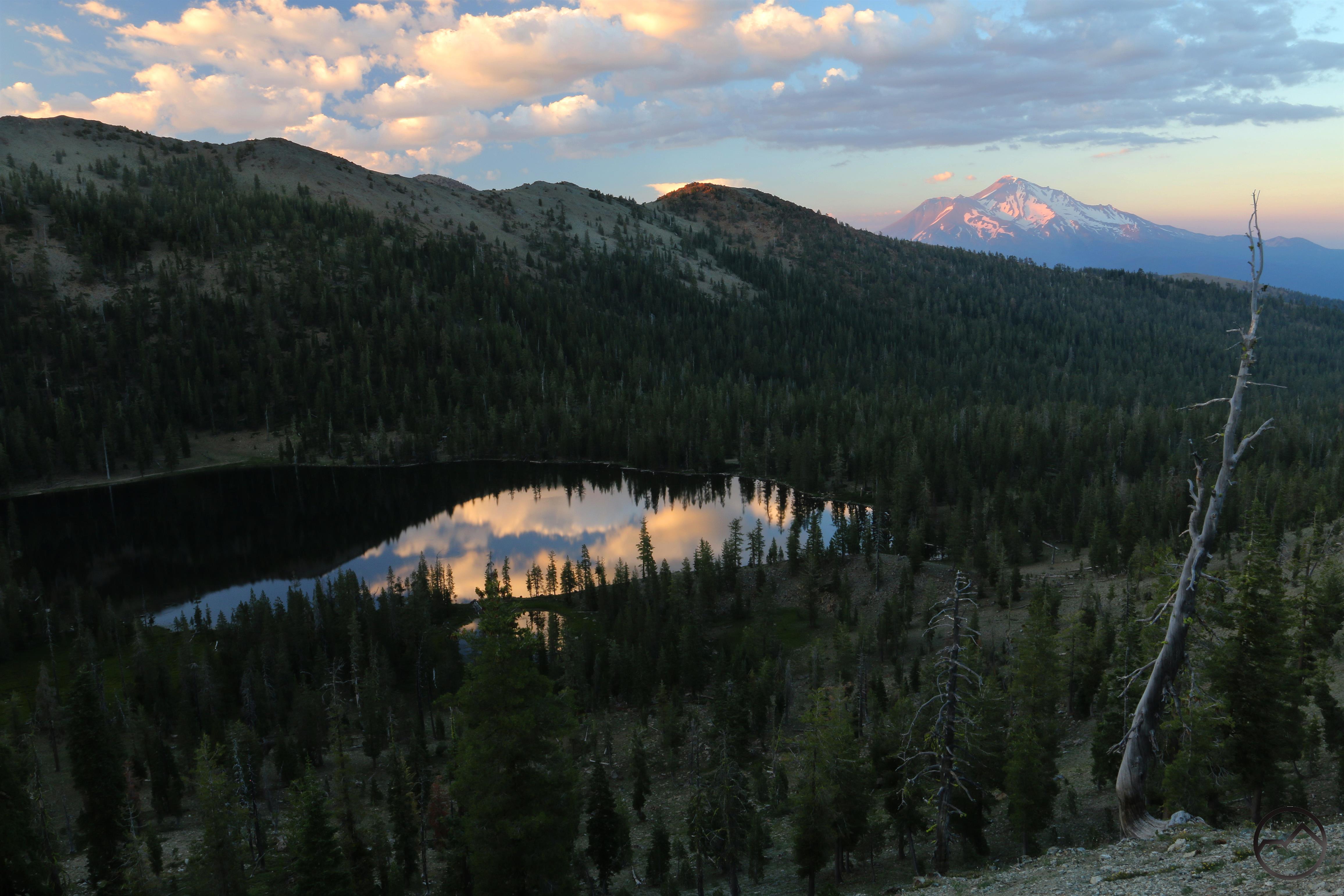
Mount Shasta and spectacular Pacific Crest Trail sunset.

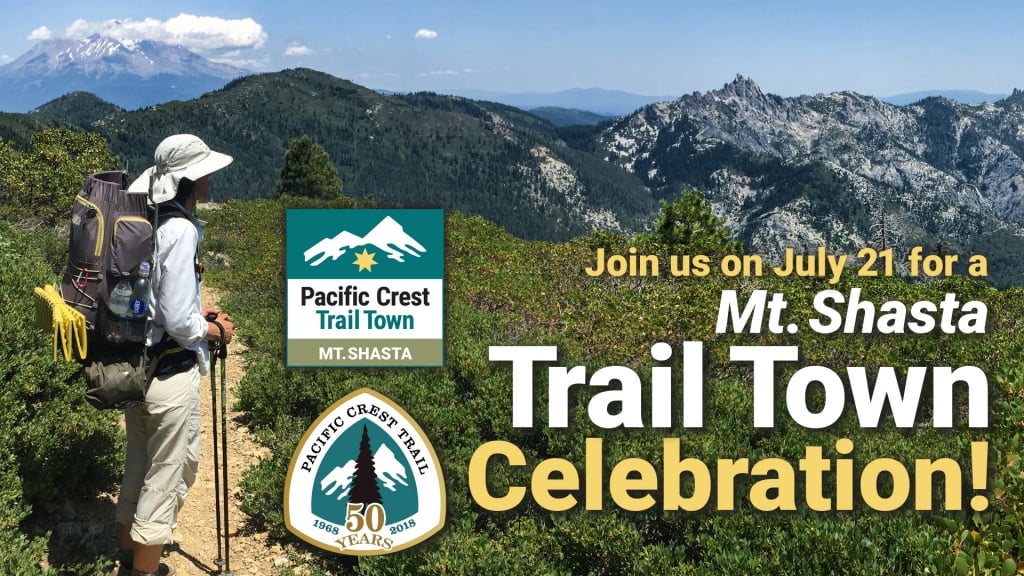
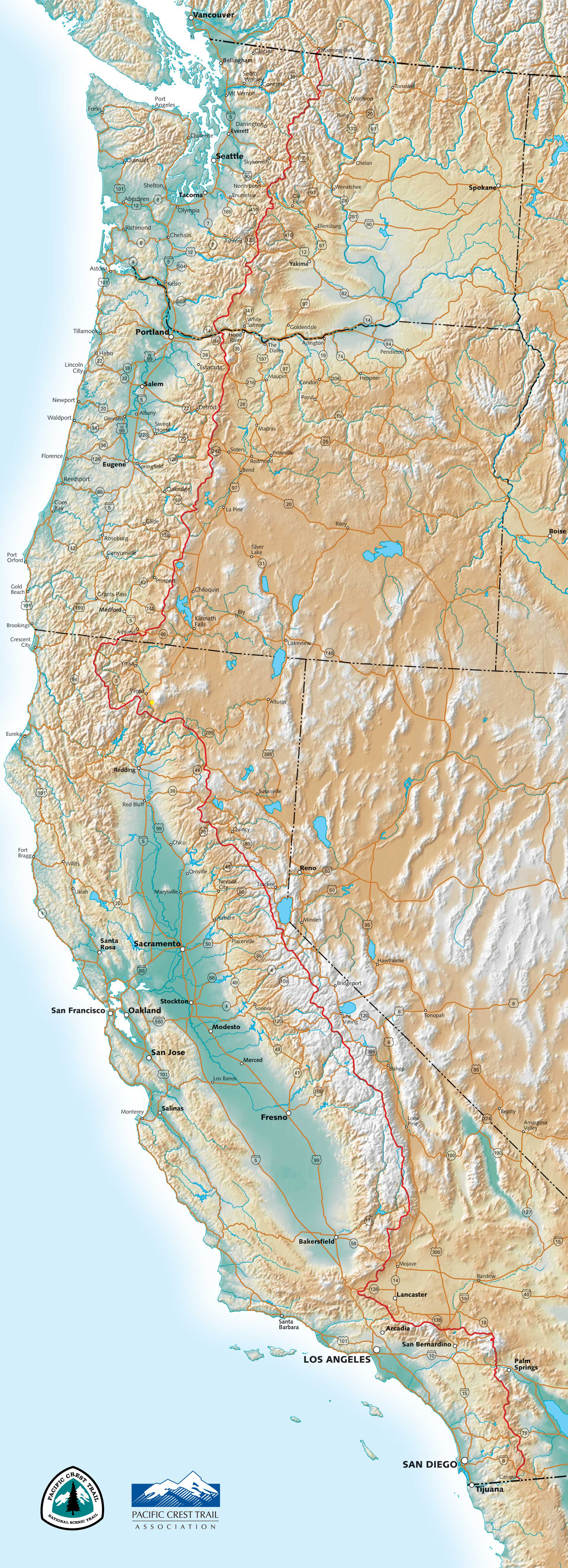
Next Saturday, July 21st, the city of Mount Shasta will be recognized as the very first town to be identified as an official Pacific Crest Trail Trail Town. This is an exciting recognition for our community, particularly considering all the towns the PCT passes near on its 2,659 mile journey from Mexico to Canada.

It makes sense that Mount Shasta is the inaugural town in the new program run by the Pacific Crest Trail Association. No other mountain dominates the PCT like Mount Shasta, visible (to varying degrees) for about 500 miles of the trail, it is a constant presence for thru hikers (people completing the entire, continuous journey from Mexico to Canada) that lingers deep into Oregon. However, there is more than the mountain that makes the town a good place to kick off the Trail Town program. Mount Shasta is centrally located in relation to the rest of the trail. Hikers would pass through the town after completing about 3/5’s of the trail. This means that it is roughly equidistant for PCT enthusiasts in northern Washington and Southern California, and all points in between. Also, the way the mountain looms above town gives Mount Shasta a sense of being “on the trail” in a way many other communities near the trail don’t necessarily posses.

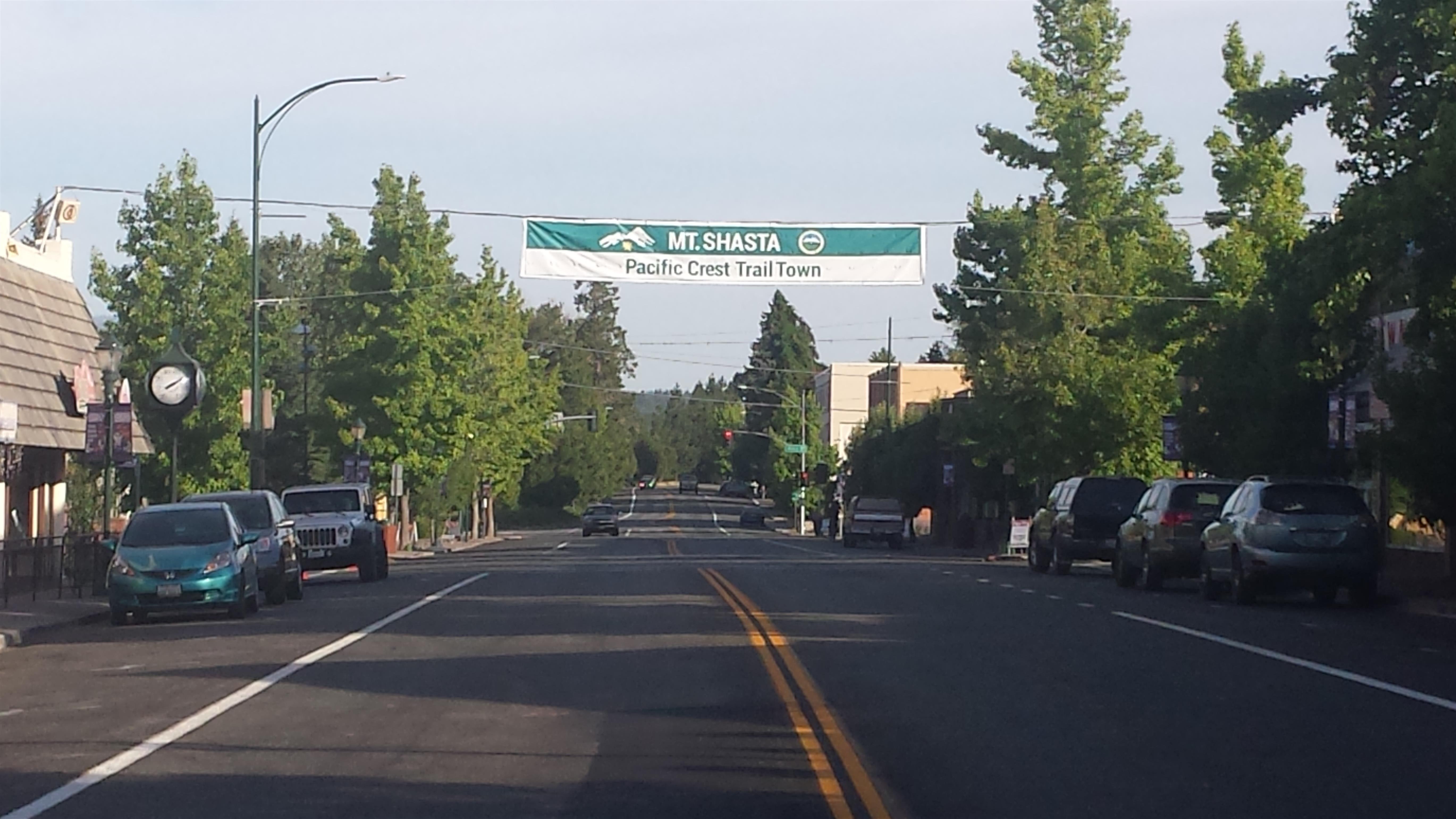
Getting ready for the Trail Town festival.

The festival will begin at 8:00 AM with a guided hike on the PCT. I believe that the hike will begin at the Gumboot trailhead. At noon, the activity will shift to the downtown area, where there will be numerous demonstrations covering a variety of hiking and PCT related topics. Many of these will be put on by local community groups including the 5th Season and Shasta Mountain Guides. Other groups, including the PCTA will be there doing demonstrations as well. Shockingly, I have been invited to have my own booth as well. I will be there talking about local trails, other hiking destinations in the area as well as teaching knot tying. There will also be food and music.

It is going to be a great community event and I hope that everyone will come and check it out! I am particularly excited at the prospect of Mount Shasta, as a community, embracing the fact that we are an excellent destination for hikers, as well as other forms of outdoor recreation. I think that this really is the way forward for not just this town, but for all of southern Siskiyou County. If the recognition of this fact from the PCTA manages to really kick this off as an identity for this town, then all the better.

We are fortunate to have such a great section of the Pacific Crest Trail so close to Mount Shasta. It connects many of the best destinations in the Trinity Divide, creates several opportunities for great backpacking trips and longer hikes, and establishes a trail link to the Trinity Alps and the southernmost part of the Cascades and Sierra Nevada beyond. Whether out for a day hike, a longer overnight trip, or hiking from Mexico to Canada, it is a fantastic asset for the area. I hope everyone enjoys hiking it as much as I do.

Here is a gallery of images taken from the PCT that stretches from McCloud to Trinity Summit, all of which roughly falls within the Mount Shasta orbit!

Click to enlarge:

The McCloud River from the PCT crossing.
Large cataract on the McCloud River
Squaw Valley Creek
PCT bridge over Squaw Valley Creek

Castle Crags from the PCT.
Cliffs of the Crags
The Grey Rocks rise above Castle Creek Valley.

Lower Burstarse Falls
Castle Crags from the PCT, near the Soapstone Trail
Mount Shasta from the PCT, near the Soapstone Trail

Mount Shasta and Mount Eddy from the PCT above Seven Lakes Basin.
PCT view of Seven Lakes Basin.
Upper Seven Lake

Porcupine Peak and Mount Eddy.
Meadow along the PCT.
Porcupine Lake
Toad Lake from the PCT junction.

“Foxtail Basin” beneath Mount Eddy.
Mount Eddy and Upper Deadfall Lake
Deadfall Basin along the PCT.

China Mountain above High Camp Basin
China Mountain and High Camp Basin.
Bluff Lake and High Camp Basin
View east from summit of Cory Peak

High Camp Basin below the PCT.
Bull Lake along the PCT.

What The Oldest HikeMtShasta Kid Has Been Up To

Posted by bubbasuess on July 3, 2018
Posted in: Cascade Range, Desert, Hiking, Lenticular Clouds, Mount Shasta, Waterfalls. Tagged: John Day Fossil Beds, Mt. Hood, Smith Rock. 7 Comments

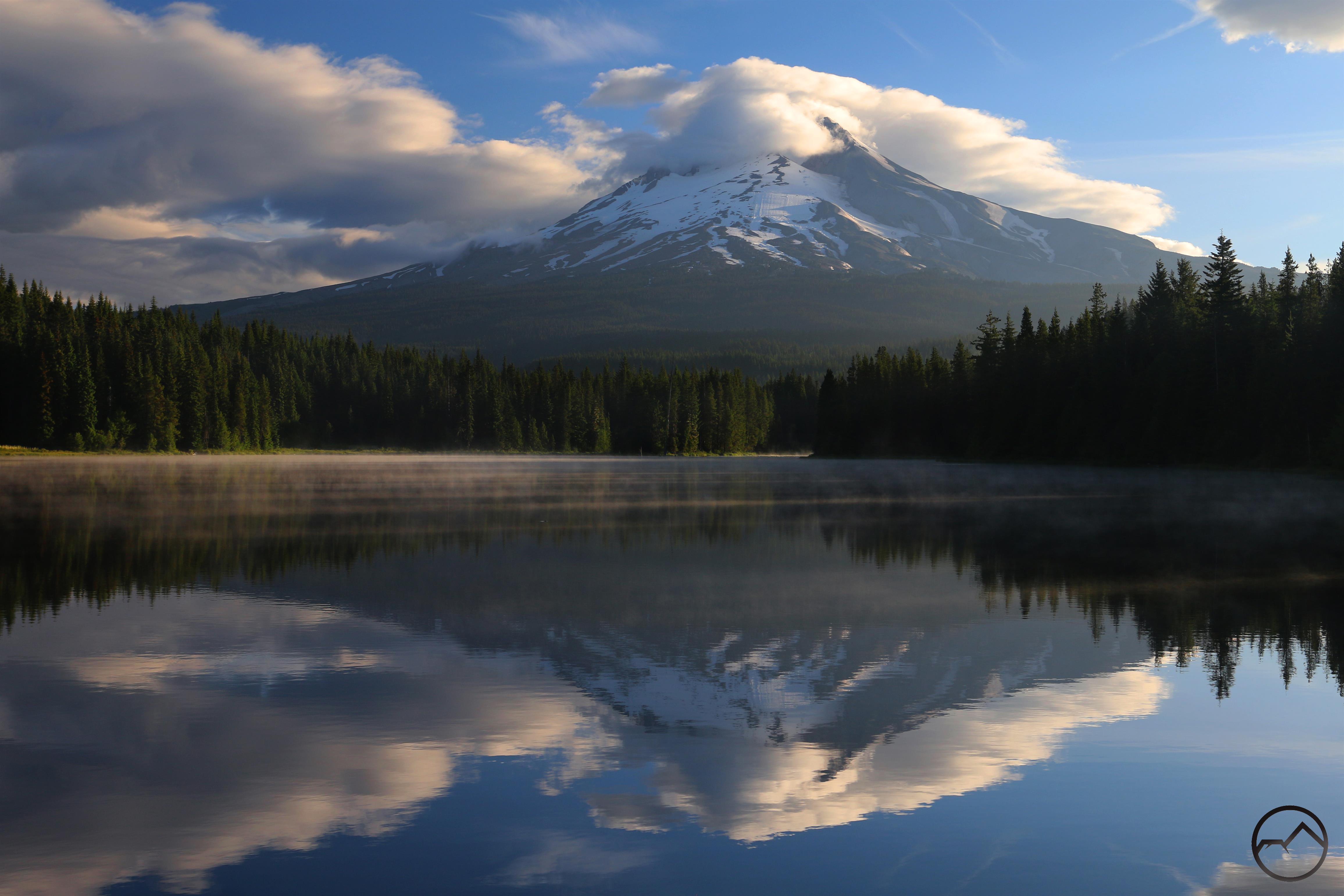
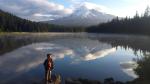
Sunrise view of Mt. Hood at Trillium Lake.

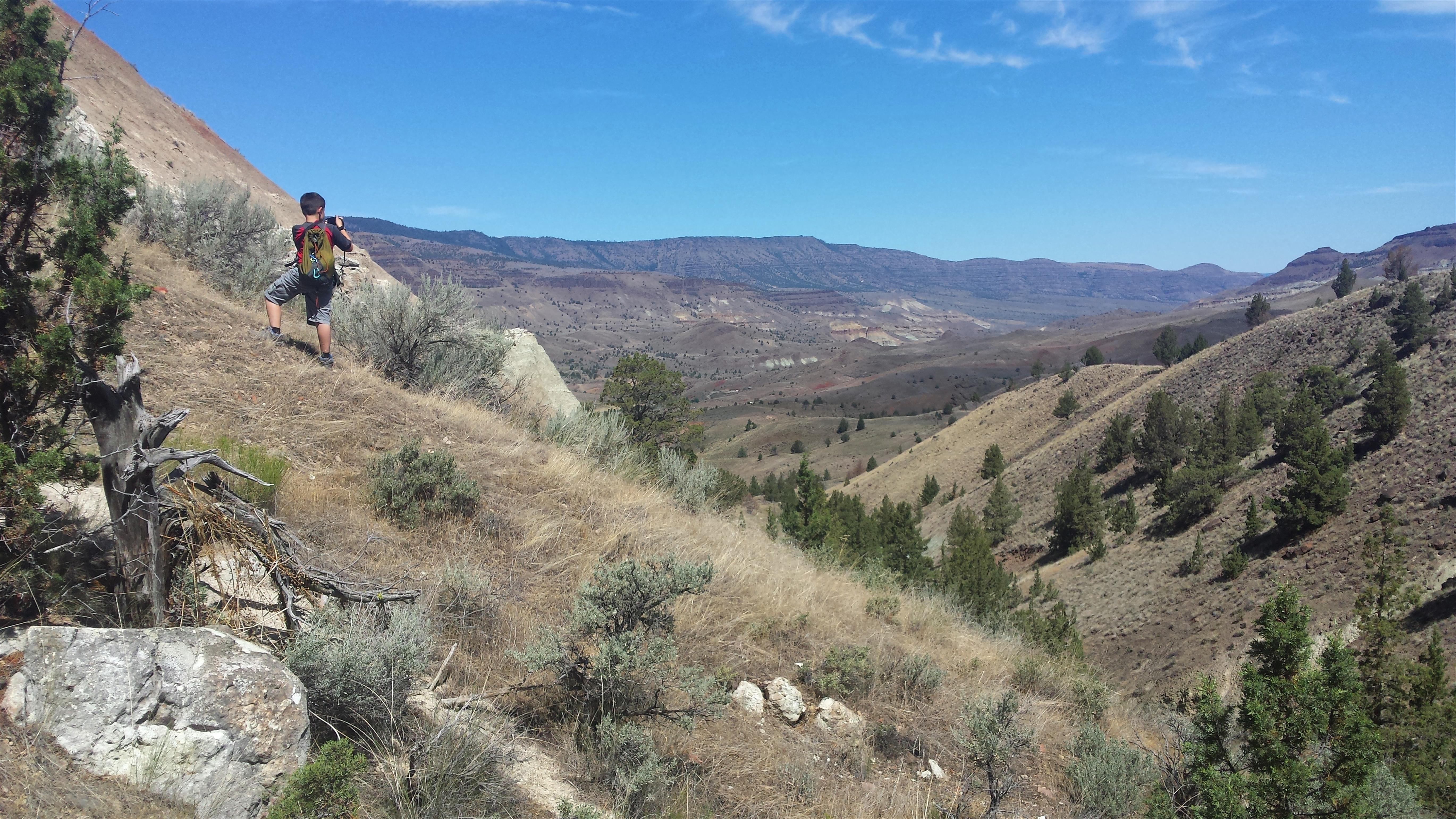
Once again, things have been silent on Hike Mt Shasta for good reason. While we began the month with a trip south to the Sierra Nevada, now I have ended the month by going north. I got home a day ago from a fantastic roadtrip through Oregon with my oldest son. Circumstances played out in a way that allowed me to take him on a trip while my wife and younger kids were down in Sonoma County with grandparents. He’s 8 and primed and ready for all sorts of adventures. I got my trucks camping configuration back together, loaded it up and hit the road at dawn. Armed with a new knife and camera, he was exceedingly excited to head out on a “dad trip”.

I had initially planned on heading to Hells Canyon or out to Utah or something a little further out of our normal orbit but, given the relatively short amount of time (5 days) and my slight hesitation with solo camping of this nature with him, it worked well to keep things closer to home. Despite the less ambitious trip, it worked out quite well. We saw some of the best that Oregon has to offer, were able to experience how diverse the land can be and enjoy each others company. There were conversations about geology, geography, history, theology, philosophy and beyond. I really hope that the memories made on that trip will contribute to a sound foundation for understanding the natural world and our role in it.

As my other kids get older, I look forward to giving them similar experiences!

Crater Lake
McKenzie Pass
McKenzie Pass

John Day Fossil Beds

Mount Hood
Mount Hood
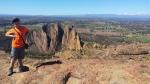
Smith Rock

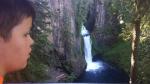
Toketee Falls
Watson Falls

Northern California Review: Lakes Basin Area

Posted by bubbasuess on June 23, 2018
Posted in: Hiking, Lakes, Mount Shasta, Sierra Nevada. Tagged: Lakes Basin Recreation Area. 1 Comment

The magnificent Sierra Buttes rise above the Sardine Lakes.

This is the second post in the Northern California Review, a new series I am kicking off that highlights other natural areas around our great state. I don’t intend these to be trail guides, but rather an opportunity to focus a little light on a particular area and why it is special. Subjects like geology, hydrology and history are the kinds of things I want to discuss. Often times I will draw attention to how they relate back to Mount Shasta, if in some way they do. In no way is this broader scope of areas covered by my blog intended to lessen the focus I will give to Mount Shasta on this site. Rather, it is my hope that I will place Mount Shasta in the broader context of the state and showcase how many excellent destinations we are blessed with. I hope everyone enjoys this journey…

One of the northernmost outposts of rugged, alpine terrain in the Sierra Nevada, the Lakes Basin area is a fantastic hiking, camping, kayaking and mountain biking destination. Boasting nearly 4 dozen named lakes and numerous unnamed tarns, this area lives up to its limnic name. Most of the lakes are set beneath rocky cliffs, which make the area a scenic feast for those who come to enjoy this excellent mountain region. While most of the area is rugged, it is not particularly craggy, with only a few notable mountains make an appearance. Instead, the area exhibits its asperous nature in a more friendly manner. The cliffs are tall, but not exceptionally so. The lakes are varied in size and set in accessible basins, some of which are low and can be driven to while others are high and require long hikes to reach. It is this balanced but beautifully rocky nature that makes the Lakes Basin area such a fantastic hiking destination.
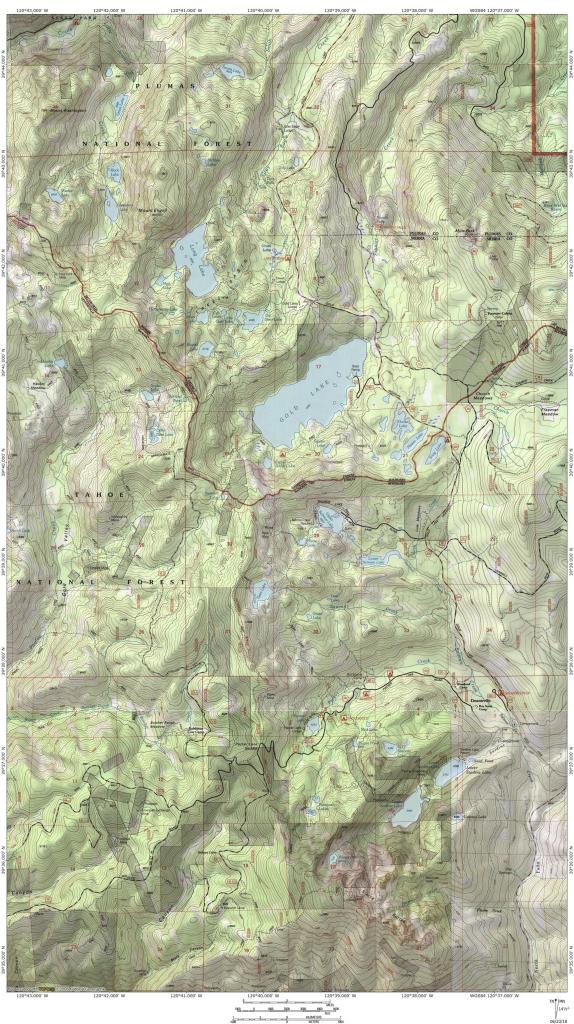
Dozens of lakes and rocky terrain abound in the Lakes Basin area.

In a broad perspective, the northern Sierra Nevada can roughly be defined as that part of the Sierra Nevada that begins at Carson Pass, includes the Lake Tahoe Basin and continues north 120 miles to Lake Almanor. Compared to the parts of the Sierra Nevada that lie further to the south, this area is typically more subdued and less wild than the vast wilderness of jagged mountains that is the signature of California’s signature mountain range. While there are some fantastic mountains around Lake Tahoe, the subdued trend becomes more evident the further north you go. Despite this, the Lakes Basin area appears to be an island of craggy, glacially carved terrain. It is surrounded by decidedly less rocky, less rugged mountains in nearly every direction.
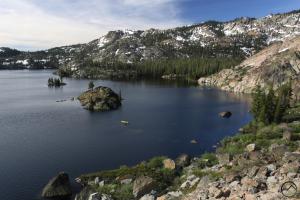
Quartz porphyry cliffs above Long Lake.

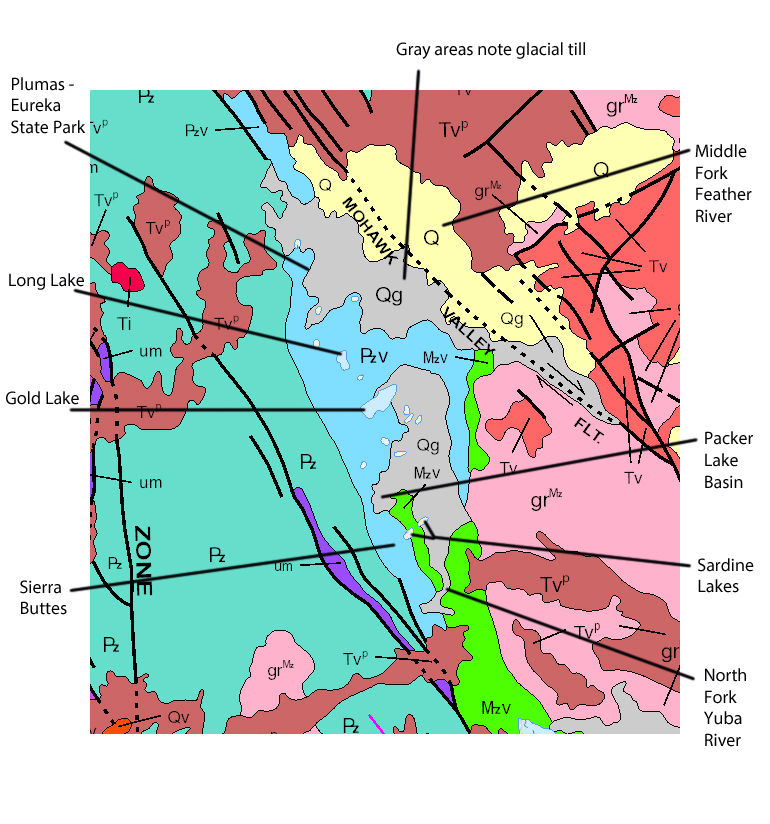
Geologically the area is something of an island as well. Most of the exposed rock in the Lakes Basin area is composed of quartz porphyry. This is situated between an extensive area or marine sediment to the west and a large granite pluton to the east. The confused geologic structure of this area is common in the northern Sierra Nevada. Rather than consisting of a single granite pluton like most of the range to the south, the mountains in this region are a seemingly random mixture of a variety of rock types. In spite of this, the composition of the cliffs at the Lake Basin area are distinct, with few other examples of it anywhere nearby. It is the quartz porphyry that gives the cliffs their white to pink range of colors and the area’s visual distinctiveness.
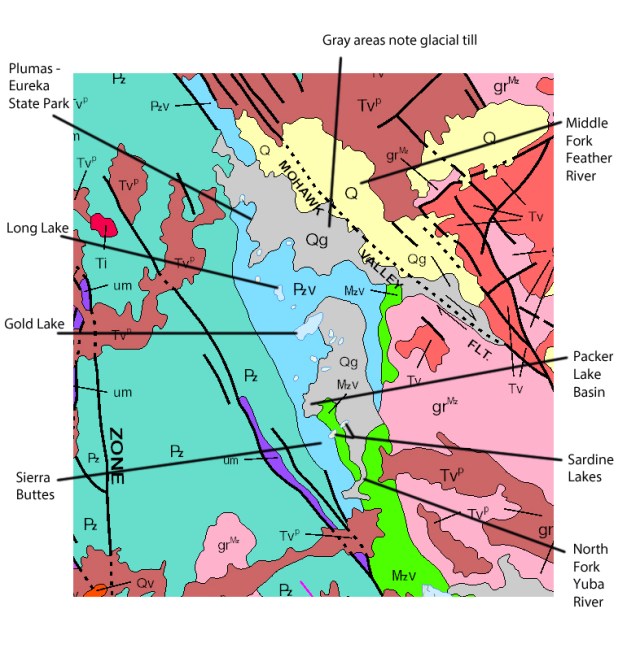
Most of the Lakes Basin area appears in light blue, which indicates quartz porphyry. The gray areas are the glacial till, grindings left by glaciers that carved out the basins. The turquoise area on the left is marine sediment. The pink denotes granite plutons.
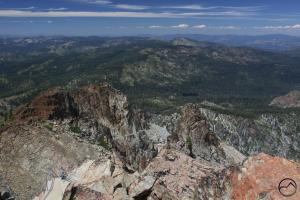
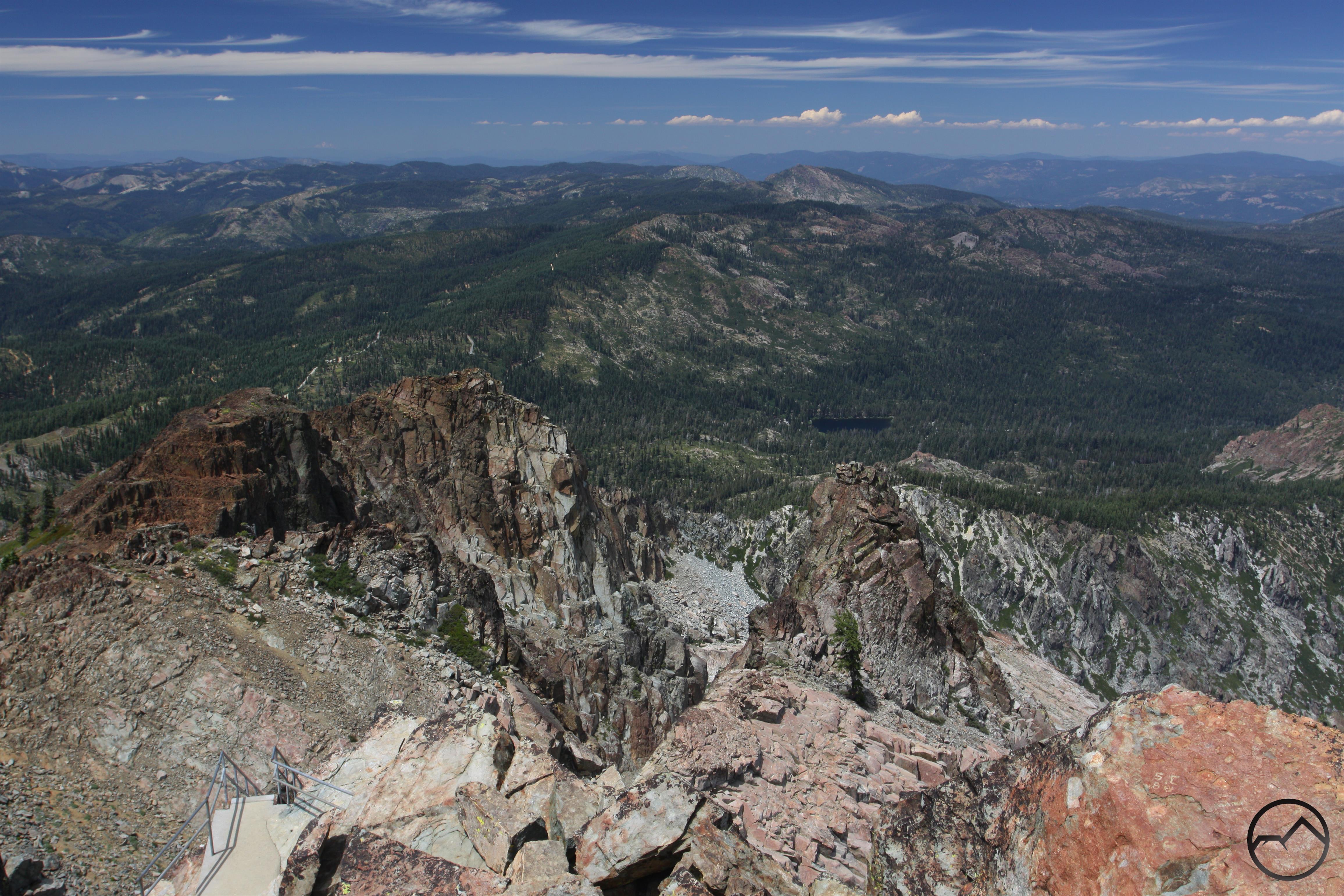
Sierra Buttes view of Packer Lake basin.

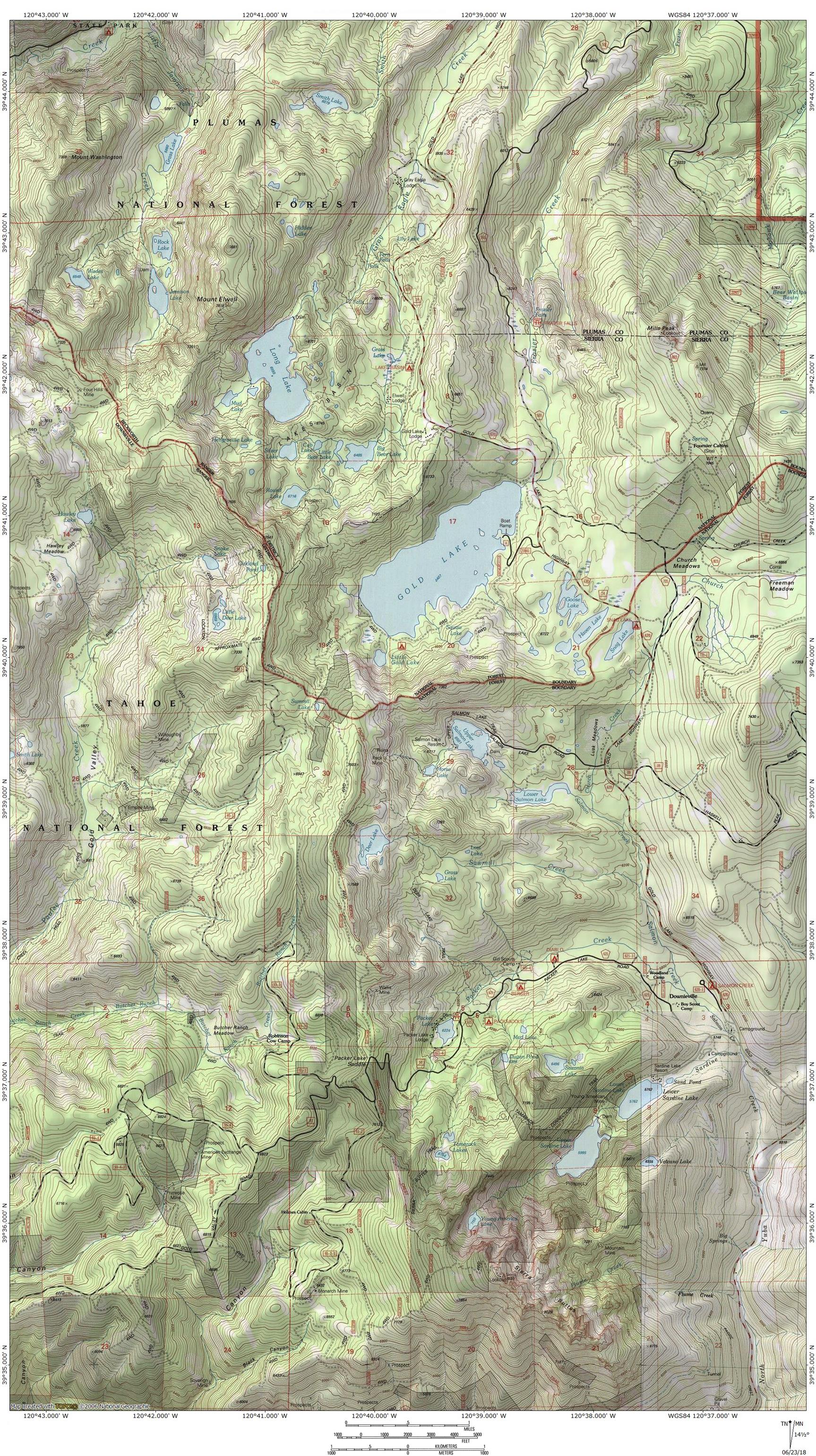
The Lakes Basin area is situated on the divide between the Middle Fork of the Feather River and the North Fork of the Yuba River. Strictly speaking, the Lakes Basin proper lies at the northern end of this glaciated area, focused on the basin containing Long Lake. However, the area is geologically cohesive and glaciation and lakes abound, making the name Lakes Basin appropriate to the whole area. In total, there are 6 primary lakes basins here. From north to south, these are the Jamison, Lakes Basin (proper), Gold Lake, Salmon Lake, Packer Lake and the Sardine Lake basins. Worth noting, the Lakes Basin proper, which is around Long Lake, is the centerpiece of the Lakes Basin Recreation Area, which has several improvements including multiple trailheads, and campground and a good trail network. It is this specific area that lends its name to the whole region.
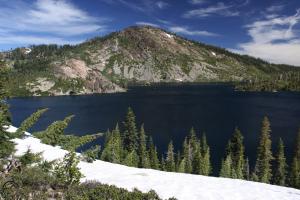
Mount Elwell looms above Long Lake.

Despite the extensive glacial activity that occurred in this area and the proliferation of steep cliffs above the lakes, there are only a couple of particularly notable peaks in the Lakes Basin area. In the north, rising above Long Lake and the Lakes Basin proper is Mount Elwell. At 7,818, it is one of the tallest peaks in this part of the Sierra Nevada. However, it is the massive Sierra Buttes, anchoring the southern end of the Lakes Basin area, that really stands out. Soaring to majestic 8,587, this spectacular collection of peaks, cliffs and spires is easily the most magnificent mountain between Lassen Peak and the Desolation Wilderness, adjacent to Lake Tahoe.
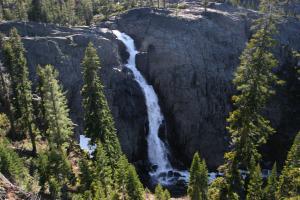
Frazier Falls

Not only are there plenty of lakes and some rugged topography, there are also some excellent waterfalls to be found in the Lakes Basin area. There are several attractive cataracts on Gray Eagle Creek, many of which are accessed as part of the trail network that rings Long Lake. Some quality cascades are also to be found at the Sierra Buttes, especially between the Sardine Lakes. However, the most notable waterfall in the Lakes Basin area is Frazier Falls. Dropping 175 in a succession of vertical cascades, it is one of the tallest waterfalls in the entire northern Sierra. The falls are accessed by an easy 0.5 mile trail.
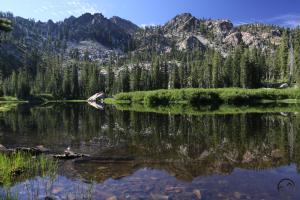
Upper Tamarack Lake, a great OHV destination.

As noted, the Lakes Basin area is a fantastic area for a whole host of outdoor activities. The lakes offer fantastic paddling opportunities while old mining roads provide some great routes for OHV enthusiasts. Mountain biking is increasingly popular area, especially the southern end by the Sierra Buttes. Here shuttles will drop bikers off at the top of the ridge just north of the Sierra Buttes and they can then descend a series of trails and dirt roads all the way down to Downieville, as descent of over 4,000 feet. Also worth noting is the presence of the Pacific Crest Trail, which traverses the entire area along the crest of the ridge. For the most part the PCT does not access any of the lakes and is used primarily by thru-hikers rather than by hikers accessing the lakes.
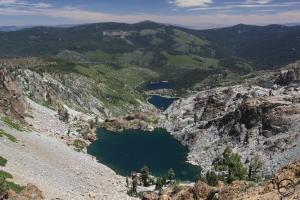
Young America Lake and the Sardine Lakes

Despite all the other activities, it is the hiking trails that offer the best way to explore the Lakes Basin area. The Salmon and Jamison Lakes basins have great, scenic trails winding through them and are good destinations for hikers. However, it is the Sierra Buttes area and the Lakes Basin Recreation Area that really commands the attention of those looking to get on the trail. The former, located in the south, features a long, epic hike to the top of the Sierra Buttes where a marvelously exposed fire lookout stands at the edge of the void. This is a classic Sierra Nevada hike, akin to famous hikes like climbing Half Dome. At the north end of the area is the Lakes Basin Recreation Area. This has the most well-developed trail network, which access all the lakes in the basin as well as climbing to the summit of Mount Elwell and connecting to the Jamison Lake basin.

With its great trails and gorgeous scenery, the Lakes Basin area is a fantastic destination for hikers. While it is not an unknown destination, it sees far, far fewer visitors than the Lake Tahoe or other Sierra Nevada destinations further south. Of those who do come to the Lakes Basin area, a significant portion are there to paddle, bike or fish, leaving the trails with that many fewer people on them. Despite this, there are ample campgrounds and even a few lodges, making the area easy logistically.

For those who do make the trip, the lovely lakes and the soaring towers of the Sierra Buttes are unforgettable.

Lakes Basin area gallery (click to enlarge):

Sierra Buttes above Lower Sardine Lake.
The Sierra Buttes.
Upper Tamarack Lake, a great OHV destination.

Young America Lake and the Sardine Lakes
Sardine Lakes
Sierra Buttes view of Packer Lake basin.

Looking toward the summit lookout tower on the Sierra Buttes.
Lakes Basin rock formations.
Frazier Falls

Long Lake
Mount Elwell above Long Lake.
Mud Lake basin

Mud Lake and Mount Elwell.
Helgrammite Lake
Silver Lake

Big Bear Lake
Falls on Gray Eagle Creek.
 

Ride For The (PCT) Brand

Posted by bubbasuess on June 20, 2018
Posted in: Boy Scouts, Cascade Range, Hiking, Mount Shasta, Pacific Crest Trail. 4 Comments

Pacific Crest Trail view of a Mount Shasta sunset.

I don’t have a specific point to make on this post, but I wanted to draw attention to a couple of interesting facts and events, some of which are only tangentially related to hiking and Mount Shasta.

First is the upcoming Trail Town festival that will be celebrated here in Mount Shasta next month. This is the kick off to a new program backed by the PCTA, which highlights our little town’s relationship to the fabled trail. No doubt others communities will join the ranks as official trail towns but it makes sense for Mount Shasta to be the first for a few reasons. Among them is the relatively central position the town holds relative to the rest of California as well as points north in Oregon and Washington. Also (and I plan on writing extensively about this subject sometime this summer), no other mountain dominates the PCT the way Mount Shasta does. It is a constant feature on the trail for literally hundreds of miles. It’s presence is felt for weeks at a time.

I will actually be a part of the program during the festivities. My role is still being shaped, but I will likely have a booth and be there to talk about trails and all sorts of other salient, trail-related information. It should be a great event. I am really looking forward to meeting trail aficionados and sharing our interest, beta and passion for the trails in this area as well as the PCT in its totality.

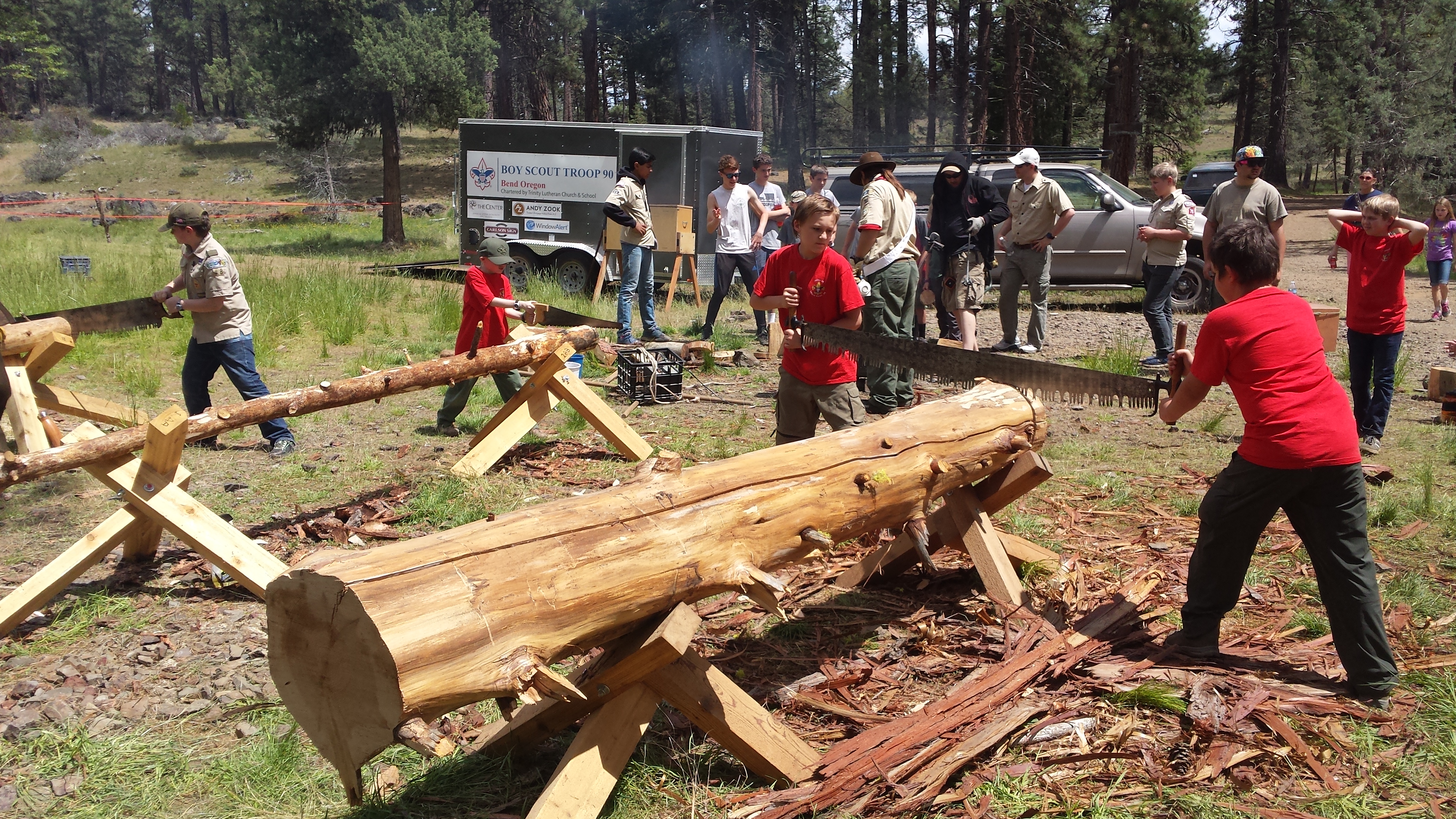
This leads me to the other topic I have been itching to bring up. I have been increasingly involved in the Boy Scouts since my oldest has joined the Cub Scouts. Back in May I took him to our council’s Camperall, which is a large campout with Boy Scouts from all over our region, which stretches from Eureka all the way up the east side of the Cascades up to Madras. One of the many features at this great event was a crosscut saw demonstration. The boys were able to work together to cut “cookies” off of logs and then take them over to an adjacent station station and have the rounds they cut branded with a fleur-di-lis and “BSA” design. Both the sawing and branding was a lot of fun and was the most popular station at the whole event.

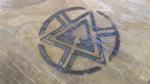
This got me thinking about other brands that I could use. The first one was one I had in mind was for the Order of the Arrow, the elite camping and service society of the Boy Scouts. I think it turned out really, really well:


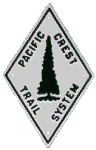
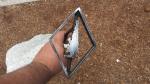
This naturally progressed to other possible brands that could be made and how I could use them. One of the first ideas that came to mind was the vintage PCT logo that was initially used on the Oregon and Washington sections of the trail back in the 1930’s, before the PCT was an officially designated and recognized entity. Unfortunately the lettering on a brand is pretty unrealistic without going to a machine shop (which I am not going to do). However, the rest of the logo was not difficult to recreate. I think it makes an attractive design:


I have a few ideas about how to use this fun little creation. Whatever I end up doing with it, it has been a fun little project (special thanks to my neighbor, who is a master blacksmith). One more little brand is in the works too. I hope to have a nice, small brand with the HikeMtShasta logo on it. This one could be used to brand leather belts and other such things, as well as wood and other things.

It would be fantastic to be able to use the PCT brand at the Trail Town festival. It has been discussed briefly but is by no means a done deal. A lot of logistics would need to be worked out to make that possible. Of course, I should add that there will be a crosscut saw demonstration at the festival, so there would be “cookies” to brand! Either way, the festival will be a great event. I hope a lot of people from the local community will turn out to support it!

Lake Siskiyou Bridges Installed

Posted by bubbasuess on June 14, 2018
Posted in: Cascade Range, Hiking, Mount Shasta. Tagged: Lake Siskiyou. Leave a comment

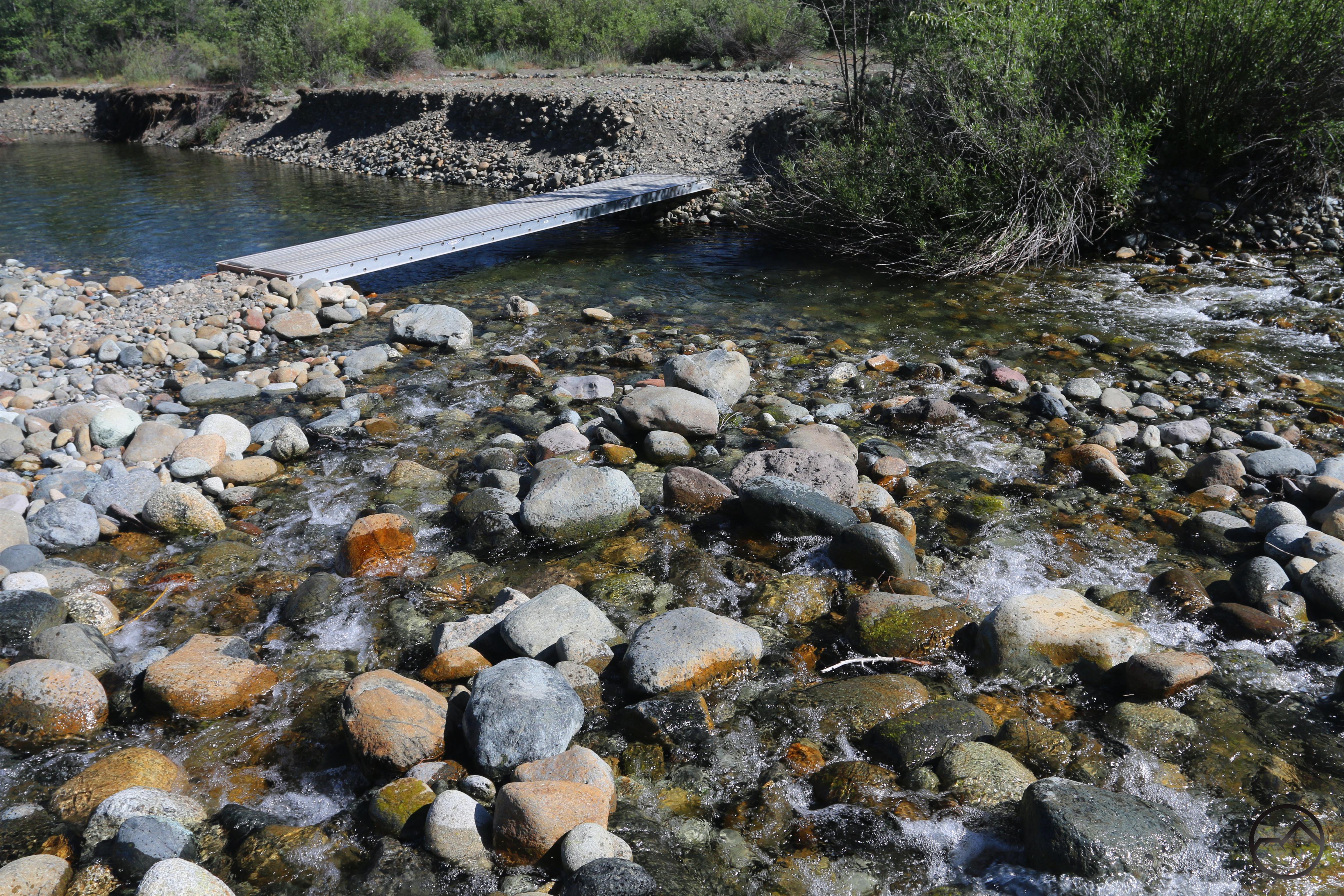
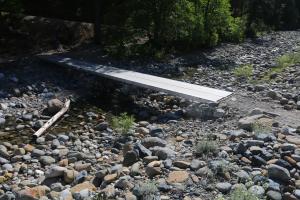
The Sacramento River flows under the Lake Siskiyou Trail’s seasonal bridge.

This is probably late news, but I have not been here to update conditions lately. However, I reckon it is best to mention it than to not. The seasonal bridges over the Sacramento River have finally been installed. This means that the Lake Siskiyou Trail is once again a complete loop. It is now possible to hike or bike the complete circuit around the like. This easy trip is a classic Mount Shasta hike. It may not be the wildest trail in the region but it has lots of interesting features, is easy for the whole family and has some great views.

It is necessary for the bridges to be seasonal because of the constantly shifting terrain at the inlet. The last several years have seen dramatic changes to the inlet geography, with a significant amount of land simply washed away and the routes of the river’s channels changed considerably. During a drought year a few years ago, the bridges were left in since the water level was so low and they were then lost when a sudden storm washed everything away, leaving only some twisted gabions as a reminder that the bridges has once been there.

Washed out section of trail.

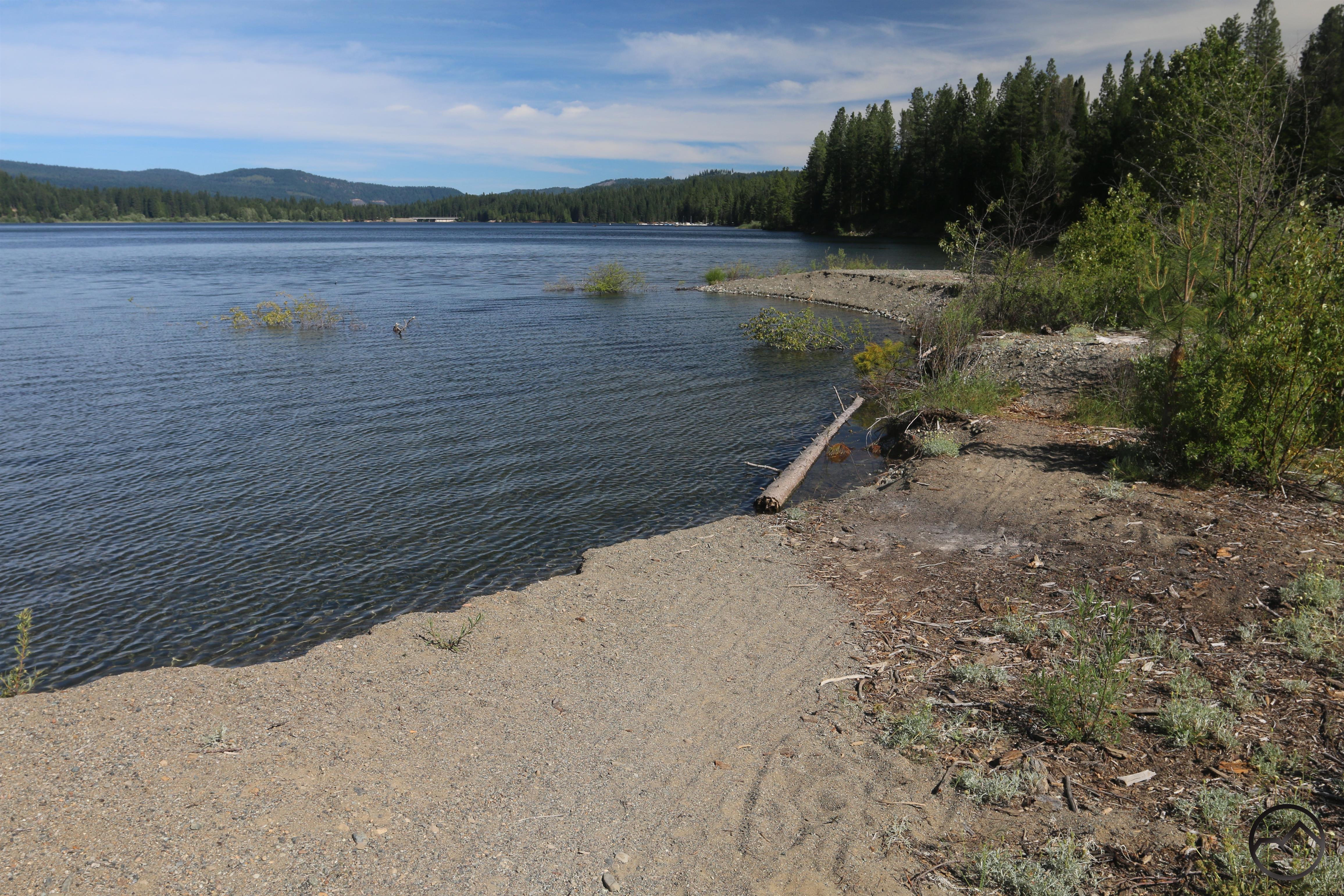
This year there was relatively little change at the inlet. The most significant being the loss of a section of the Lake Siskiyou Trail on the the southern bank of the northern channel (I know that sounds confusing!). For the last few years the trail crossed a narrow isthmus between the lake and a small seasonal pool of water. The lake shore has encroached on the trail, washed away the isthmus and forced the trail inland a little, crossing the now dry pond. Also, like last year, the once dry south channel (which was, at one time, the Sacramento River’s main avenue to the lake) has a small flow of water in it. Perhaps one day the river will return to this channel in earnest.

Now the final piece of the Mount Shasta hiking puzzle is the opening of the road up to the Old Ski Bowl. I’ll be in Hells Canyon when that happens but I will still post something about the conditions of that area when I return from that upcoming trip. In the meantime, get out and enjoy all the trails that are open now!

Click to enlarge:


What The HikeMtShasta Kids Have Been Up To

Posted by bubbasuess on June 13, 2018
Posted in: Hiking, Mount Shasta, Sierra Nevada, Waterfalls, Yosemite. 2 Comments

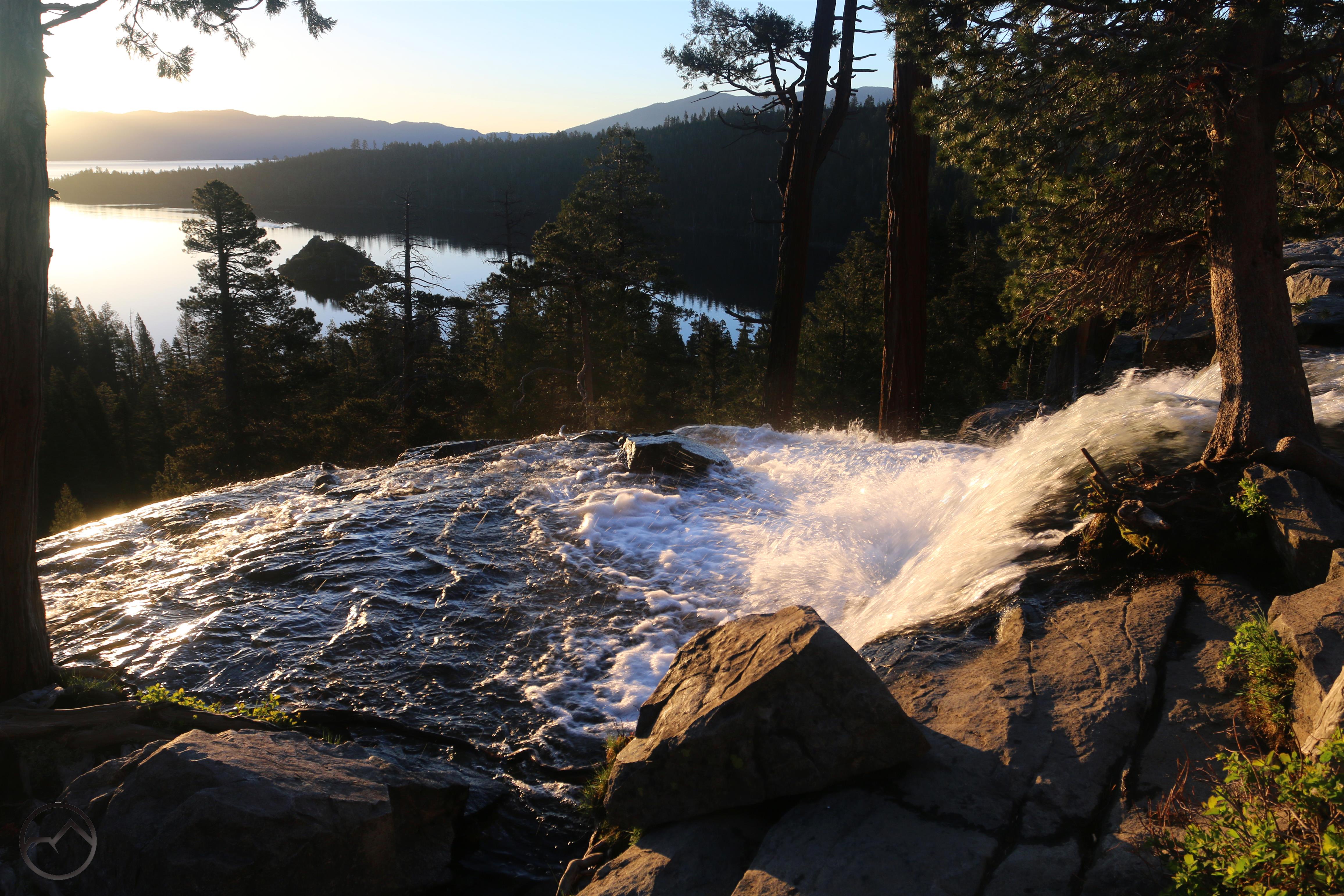
Sunrise over Lake Tahoe, Emerald Bay and the top of Eagle Falls.

Things have gone silent on Hike Mt Shasta for most of the first half of June. I have had a number of posts planned but all those were put on hold since I took my family on a camping trip down to Yosemite, Lake Tahoe and other parts of the Sierra Nevada. For reasons beyond our control, it was a challenging trip but we persevered through the difficulties and it ended up being a great trip through some of the most beautiful places in the world.

It was especially gratifying to see my kids getting a chance to have experiences in Yosemite and beyond, like I did when I was their ages. While I have deep personal connections to Yosemite through my family history, I want my kids to know more about the Sierra Nevada beyond that fabled park so we are making it a point that they become familiar with many parts of that most superlative mountain range. The Hike Mt Shasta kids loved it and had a grand time in spite of the challenges. We even had time to visit the Western Pacific Railway Museum in Portola on the way home, where my youngest son (3), the self-proclaimed “choo-choo boy” was in absolute heaven. It was a great experience for all of them and I am proud of how they did despite some unexpected adversity!

I am including a gallery of some of the stuff they did. Hopefully this weekend I will be able to put a few summer-oriented posts up too!


Magnificent Relic – Mount Shasta’s Medial Moraine

Posted by bubbasuess on June 1, 2018
Posted in: Cascade Range, Glaciers, Hiking, Mount Shasta. Tagged: Hotlum Glacier. 11 Comments

The massive Hotlum Glacier clings to the upper flanks of the northeast side of Mount Shasta.

Mount Shasta is home to the 4 largest glaciers in California. On the northern slopes one can observe the Whitney and Bolam Glaciers while on the east side are the Hotlum and Wintun Glaciers. Of these two eastern glaciers, the Hotlum is the most notable because it is California’s largest glacier. The vast field of ice extends 1.25 miles down the side of the mountain, descending about 3,000 feet. Measuring the combined width of its multiple lobes, the Hotlum Glacier is nearly 1 mile wide at its base. It really is a singularly impressive sheet of ice. Yet, despite being notable for all of these reasons, there is another reason, more difficult to discern and more mysterious than the others. This is the fact that the Hotlum Glacier is the only glacier in California to have an extant medial moraine.

This may sound somewhat anticlimactic, so please allow a quick digression to explain what a moraine is. As glaciers form they begin to move downhill. The massive blocks of ice carve, scour and cut away at whatever feature lies along their path. This slow, gradual grinding away at the landscape is what has formed such famed landmarks at Yosemite Valley and the Kiger Gorge on Steens Mountain. However, all the debris that is worn away by the passage of the glacier is moved along with the glacier, pushed aside by the downhill motion. Debris is also pushed by the head of the glacier as well. These are called lateral and terminal moraines, respectively.

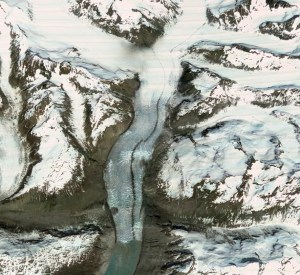
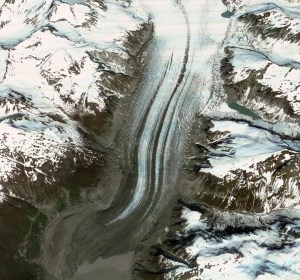
Medial moraines begin as lateral moraines, but when two glaciers meet and form a single glacier, or if two lobes of one glacier recombine, the lateral debris becomes locked in the center of ice. They appear as long, dark lines amidst the bright white and blue of the glacial ice. These features are easily recognizable in glaciers from such places as Alaska, the Alps, and the Himalayas. Here are two examples from Glacier Bay National Park in Alaska:

McBride Glacier
Casement Glacier

Medial moraines do not typically forms on small or moderately sized glaciers. They are the domain of the great glaciers, the long rivers of ice that flow from mountains at extreme latitudes or altitudes. In terms of glacial activity, California is far to the south of where most of the conditions exist for extensive glacial activity. The Sierra Nevada has a few glaciers, but most are just vestigial remnants of the vast ice fields that once covered that mountain range. Furthermore, any evidence of medial moraines, assuming there were any, has long since been washed away. Only on Mount Shasta, and only on the Hotlum Glacier is there evidence of such a feature in California.

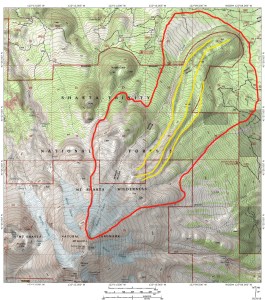
The red marks the current extent of the Hotlum Glacier. The yellow lines mark medial moraines. 

Southern, larger flow of the Hotlum Glacier.

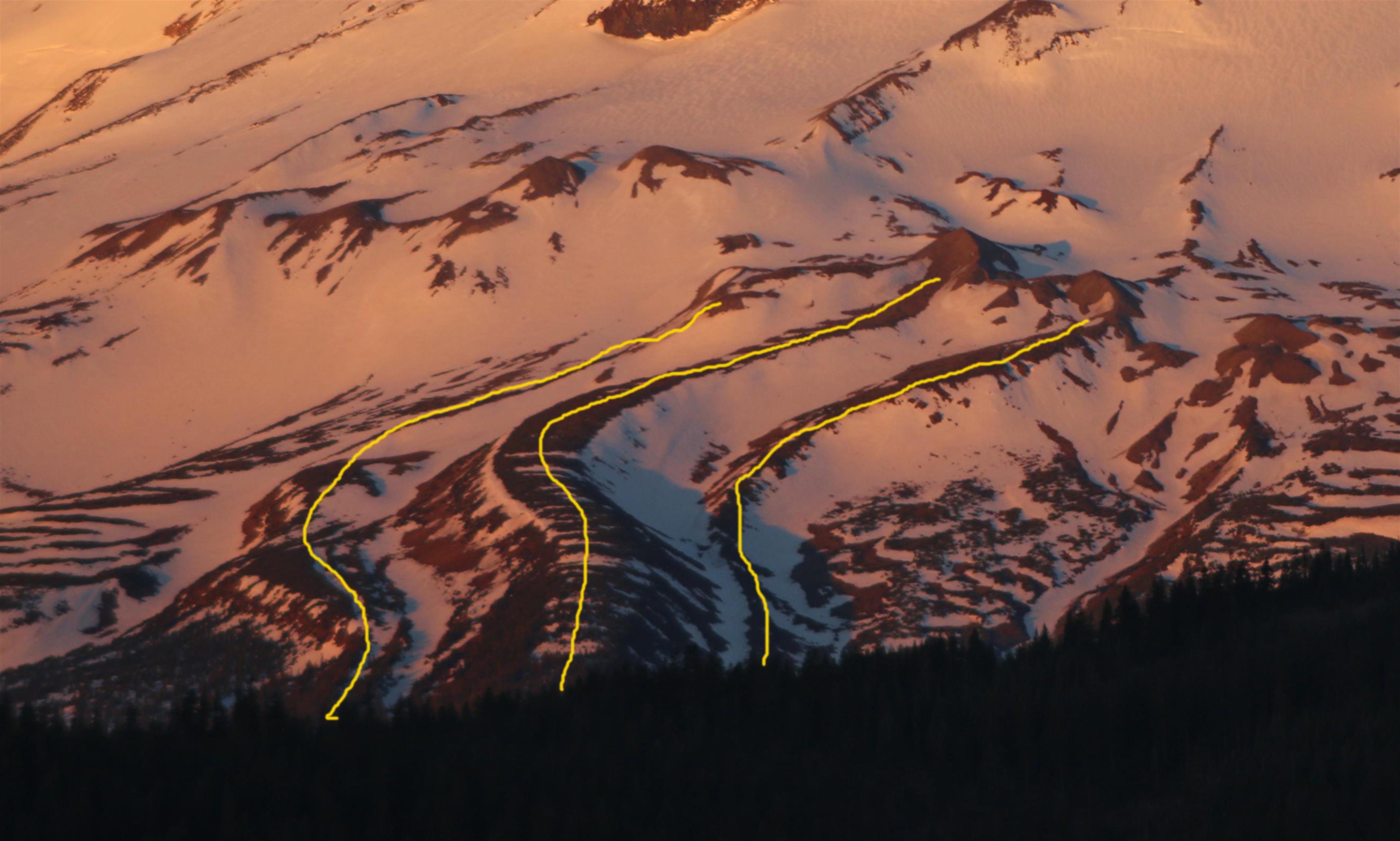
Today, just as it must have done in the past, the Hotlum Glacier splits in two, descending down the flanks of Mount Shasta in two large segments. These are separated by a large rock outcropping that divides the flowing ice. Something similar, though no doubt larger, must also have taken place in the past, for just below this large outcropping is the beginning of the medial moraine. It would appear that this protruding rock divided the glacier into two large flows. Below the rock protrusion the flows converged again, this time carrying the debris carved away from Mount Shasta by the glacier. This debris was then carried downhill as the ice slowly crept its way down the mountain.

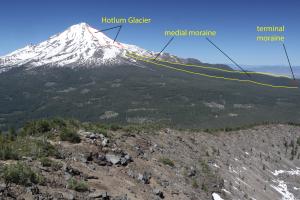
As all glaciers at this latitude have done over the last several millenia, the Hotlum Glacier has receded. This has left the medial moraine isolated from the ice that created it. Nonetheless, the geology is still evident and it is easy to envision how much larger the glacier was in the not-too-distant past. If we accept the terminal moraine, which lies at the end of the medial moraine, to represent the full extent of the glacier’s size, then the massive ice sheet would have extended almost 6 miles down Mount Shasta, descending 7,500 feet over its journey. This would have been a truly staggering chunk of ice. Its measurements would have significantly exceeded Mount Rainier’s Emmons Glacier, the largest glacier in the coterminous United States.

Click to enlarge these two illustrations showing the Hotlum Glacier’s medial moraines:

Approximate former extent of Hotlum Glacier
Current extent and medial moraines

It must have been a magnificent sight to behold. Observing the massive, slow-moving river of ice rising just below Mount Shasta’s summit and creeping all the way down to its lower flanks. Indicative of its size, there was not just one medial moraine on the Hotlum Glacier. The primary one was the largest but it was flanked by two smaller, parallel moraines. They follow the same path of flow and feature the same, distinctive sweeping curve in the first quarter of their length. Indeed, it is this curve that makes the nature of the moraines apparent even to the untrained eye. It is easy to visualize only the top of these moraines visible of the large field of ice that surrounded it.

The upper section of Mount Shasta’s medial moraine.

With the lack of ice surrounding the moraines now, it is not as easy to recognize them at every angle. While their upper reaches extend above the treeline, the preponderance of their bulk is now below this point and is forest cover has taken root midst the rocky terrain. The moraine are also long and low, which does not cause them to stand out from most angles. Nonetheless, once an observer understands what to look for, the medial moraines become much more apparent.

Viewed from Ash Creek Butte.
Viewed from North Gate plugs.

The medial moraines aren’t the only ones that remain to testify to the former scale of the Hotlum Glacier. Both of the main halves of the glacier have below them large fields of smaller, successive terminal moraines. As the glacier receded it would periodically advance again, covering a short distance and pushing a small pile of debris forward before it would melt and shrink again. This is what has caused the distinctive wave patterns around the treeline areas near the medial moraines. The smaller of the two fields lies below the larger of the Hotlum Glacier’s two current halves. However, there are several fields of terminal moraines in the area between the medial moraine and the Hotlum-Bolam Ridge, which seperates the Hotlum Glacier from the Bolam Glacier. The fields of terminal moraines are a dramatic retelling of the Hotlum Glacier’s story, of massive growth and then a protracted age of advance and recession, finally leading to today’s diminished-but-still-massive glacier.

There are not many vantage points that yield good views of California’s lone medial moraine and it has largely gone ignored, overlooked or unappreciated. Despite this, it is one of the most fascinating geologic features not just on Mount Shasta, but possibly in all of California. Only places like Yosemite Valley offer a correspondingly easy-to-understand visual of the power, nature and scale of the glaciers that once covered the majority of the mountains of the Golden State.

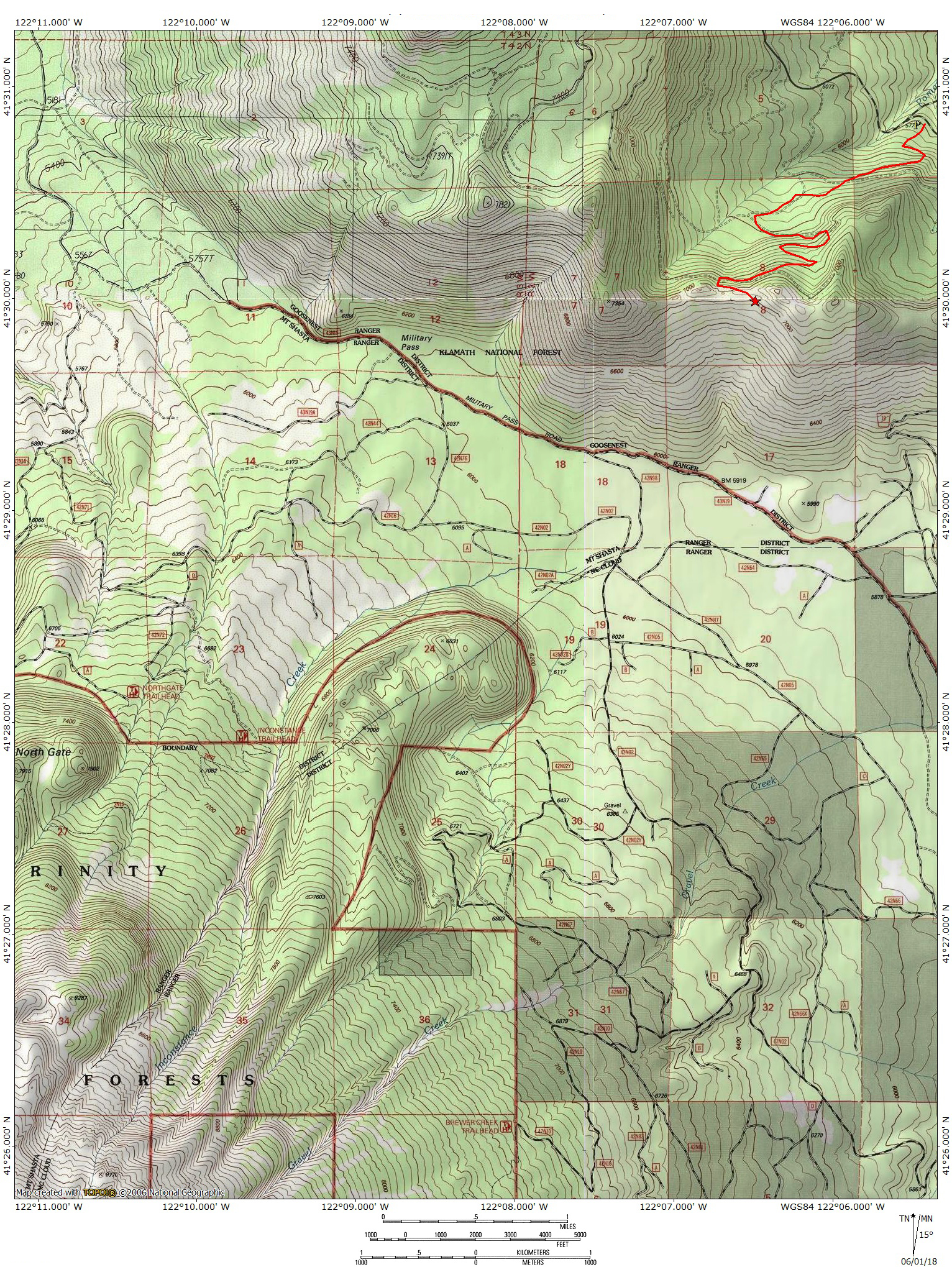
A great way to remedy this would be the construction of a “Moraine Vista Trail”. There is the ridge south of the Whaleback and immediately east of the moraine  offers spectacular views not just of the medial moraine but also of the entire east side of Mount Shasta, which is the least viewed and least appreciated side of the mountain. There is good, paved road access and the land is in the midst of a logged area, which means it is unlikely to be used for little else. It would be great to build a pathway that could be used to educate people on California’s glacial past, present and possible future. It would also give hikers a chance to enjoy a new area and views of the mountain that are currently available the few who venture onto that side of the mountain. Such a trail would be a marvelous addition to the Mount Shasta area’s trail network!

A proposed route for the Moraine Vista Trail:


Posts navigation

← Older Entries
Newer Entries →
    • Recent Posts

      • Winter Shows Up When It Will
      • January Rolled By With Mud, Then Very Dry
      • Mount Shasta 2025 – A Year In Images
      • Mount Shasta On Either Side Of Christmas
      • Adrift In An Ocean Of Fog
      • December Has Been Spectacular Thus Far Pt. II (A Magnificent Lenticular)
      • December Has Been Spectacular Thus Far Pt. I
      • Lenticular Interrupted
      • A Stormy Wave And A Truchas Sunset
      • Aurora Lenticularis
    • Enter your email address to follow Hike Mt Shasta and receive notifications of new posts by email.

    • Archives

      • February 2026
      • January 2026
      • December 2025
      • November 2025
      • October 2025
      • September 2025
      • August 2025
      • July 2025
      • June 2025
      • May 2025
      • April 2025
      • March 2025
      • February 2025
      • January 2025
      • December 2024
      • November 2024
      • October 2024
      • September 2024
      • August 2024
      • July 2024
      • June 2024
      • May 2024
      • April 2024
      • March 2024
      • February 2024
      • January 2024
      • December 2023
      • November 2023
      • October 2023
      • September 2023
      • August 2023
      • July 2023
      • June 2023
      • May 2023
      • April 2023
      • March 2023
      • February 2023
      • January 2023
      • December 2022
      • November 2022
      • October 2022
      • September 2022
      • August 2022
      • July 2022
      • June 2022
      • May 2022
      • April 2022
      • March 2022
      • February 2022
      • January 2022
      • December 2021
      • November 2021
      • October 2021
      • September 2021
      • August 2021
      • June 2021
      • May 2021
      • April 2021
      • March 2021
      • February 2021
      • January 2021
      • December 2020
      • November 2020
      • October 2020
      • September 2020
      • August 2020
      • July 2020
      • June 2020
      • May 2020
      • April 2020
      • March 2020
      • February 2020
      • January 2020
      • December 2019
      • November 2019
      • October 2019
      • September 2019
      • August 2019
      • July 2019
      • June 2019
      • May 2019
      • April 2019
      • March 2019
      • February 2019
      • January 2019
      • December 2018
      • November 2018
      • October 2018
      • September 2018
      • August 2018
      • July 2018
      • June 2018
      • May 2018
      • April 2018
      • March 2018
      • February 2018
      • January 2018
      • December 2017
      • November 2017
      • October 2017
      • September 2017
      • August 2017
      • July 2017
      • June 2017
      • May 2017
      • April 2017
      • March 2017
      • February 2017
      • January 2017
      • December 2016
      • November 2016
      • September 2016
      • August 2016
      • July 2016
      • June 2016
      • May 2016
      • April 2016
      • March 2016
      • February 2016
      • January 2016
      • December 2015
      • November 2015
      • September 2015
      • August 2015
      • July 2015
      • June 2015
      • May 2015
      • April 2015
      • March 2015
      • February 2015
      • January 2015
      • December 2014
      • November 2014
      • July 2014
      • June 2014
      • May 2014
      • April 2014
      • March 2014
      • February 2014
      • January 2014
      • December 2013
      • November 2013
      • October 2013
      • September 2013
      • August 2013
      • July 2013
      • June 2013
      • May 2013
      • April 2013
      • March 2013
      • February 2013
      • January 2013
    • Categories

      • Boy Scouts
      • Cascade Range
      • Castle Crags
      • Desert
      • Echo Point
      • Glaciers
      • Hiking
      • How things came to be…
      • Klamath Mountains
      • Konwakiton Outdoor Designs
      • Lakes
      • Lenticular Clouds
      • Maps
      • Marble Mountains
      • Meadows
      • Mount Eddy
      • Mount Shasta
      • Mount Shasta History
      • Napa County
      • Off Season Trails
      • Pacific Crest Trail
      • Peaks
      • Rivers
      • Rock Climbing
      • Scott Mountains
      • Seldom Seen
      • Shasta Valley
      • Sierra Nevada
      • Siskiyou Mountains
      • Sonoma County
      • Spring Trails
      • sunrise
      • sunset
      • Trinity Alps
      • Trinity Divide
      • Truchas Ridge
      • Uncategorized
      • Water
      • Waterfalls
      • Wilderness
      • Wildflowers
      • Wine Country
      • Winter Trails
      • Yosemite
    • Meta

      • Create account
      • Log in
      • Entries feed
      • Comments feed
      • WordPress.com
    • Copyright © 2013-2024 by Bubba Suess

      DISCLAIMER: Any use of the information contained in this site by any and all persons is done at their own risk. The operator of this site shall be held harmless from any and all alleged claims, demands, causes of action, liability, loss, damage and/or injury to property or persons whether brought by an individual or other entity. This indemnification applies, without limitation, to all actions by an individual or other entity as a result of their use of information contained in this site.
    Blog at WordPress.com.
    Hike Mt. Shasta
    Blog at WordPress.com.
    • Subscribe Subscribed
      • Hike Mt. Shasta
      • Join 983 other subscribers
      • Already have a WordPress.com account? Log in now.
      • Hike Mt. Shasta
      • Subscribe Subscribed
      • Sign up
      • Log in
      • Report this content
      • View site in Reader
      • Manage subscriptions
      • Collapse this bar
     

    Loading Comments...