Hike Mt. Shasta

Exploring the Mount Shasta Region

  • Home
  • Trails
    • Mount Shasta Trails
      • Brewer Creek Trail
      • Clear Creek Trail
      • Gray Butte Trail
      • Green Butte Ridge Trail
      • Horse Camp Trail
      • North Gate Trail
      • Old Ski Bowl Trail
      • Panther Meadow Trail
      • South Gate/Squaw Meadow Trail
      • Whitney Falls Trail
    • Trinity Divide Trails
      • Blue Divide Trail
      • Castle Lake Trail
      • Castle Lake Shore Trail
      • Cliff Lake Trail
      • Deadfall Lakes Trail
      • Gray Rock Lakes Trail
      • Gumboot Trail
      • Heart Lake Trail
      • Porcupine & Toad Lakes Via Pacific Crest Trail
      • Seven Lakes Basin Via Pacific Crest Trail
      • Sisson-Callahan Trail
      • Soapstone Trail
      • South Mumbo Scramble
      • Tamarack Lake Trail
      • Toad Lake Trail
    • Castle Crags Trails
      • Burstarse Falls Via Pacific Crest Trail
      • Castle Dome Trail
      • Flume Trail
      • Lower Castle Crags Via Pacific Crest Trail
      • Root Creek Trail
    • Scott Mountains Trails
      • Bluff Lake & Cement Bluff via Pacific Crest Trail
      • Caldwell Lakes Trail
      • China Mountain Scramble
      • Cory Peak and Bull Lake via Pacific Crest Trail
    • Cascade Crest
      • Ash Creek Butte Scramble
      • Goosenest Trail
      • Juanita Lake Trail
      • Orr Lake Trail
    • Mount Shasta City Area Trails
      • Black Butte Trail
      • Box Canyon Trail
      • Gateway Trail
      • Lake Siskiyou Trail
      • Mount Shasta City Short Trails
      • Ney Springs Canyon Trail
      • Spring Hill Trail
    • Shasta Valley Trails
      • Black Lava Trail
      • Haystack Trail
      • Lake Shastina Trail
      • Pluto Cave Trail
      • Trout Lake Trail
      • Yellow Butte Trail
    • Sacramento River Trails
      • Dunsmuir Trail
      • Hedge Creek Falls Trail
      • Sacramento River Trail
      • Sims History Trail
    • McCloud River Trails
      • Ash Camp To Ah-Di-Na Via Pacific Crest Trail
      • McCloud River Falls Trail
      • McCloud River Preserve Trail
      • Squaw Valley Creek Trail
      • McCloud River Trail: Algoma Camp to Nitwit Camp
      • McCloud River Trail: Nitwit Camp to Cattle Camp Swimming Hole
      • McCloud River Trail: Cattle Camp Swimming Hole to Camp 4
      • McCloud River Trail: Camp 4 to Upper McCloud Falls
      • McCloud River Trail: Pine Tree Hollow Loop
    • Trails Further Afield
      • Trinity Alps Trails
        • Bear Lakes Trail
        • Billys Peak Trail
        • Boulder Creek Lakes Trail
        • Boulder Lake Trail
        • Canyon Creek Trail
        • Caribou Lakes Trail
        • East Boulder Lake Loop
        • East Weaver Lake Trail
        • Four Lakes Loop
        • Granite Peak Trail
        • Grizzly Creek Trail
        • Gulch Lakes Loop
        • Hidden Lake Trail
        • South Fork Lakes Trail
        • Stoddard Lake Trail
        • Stoney Ridge Trail
        • Tangle Blue Lake Trail
      • Warner Mountains
        • Emerson Creek Trail
        • Highgrade Trail
        • Patterson Lake Via Warner Summit Trail
        • Pine Creek Trail
        • Squaw Peak Trail
  • Articles
    • Trails By Area
      • Mount Shasta
        • Vistas, Meadows And Waterfalls: Three Best Hikes On Mount Shasta
        • The End Of The Road: Three Hikes In The Old Ski Bowl Area
        • Two Trails From Bunny Flat
        • Three Trails On Mount Shasta’s East Side
        • Mount Shasta’s Hummingbirds
      • Trinity Divide
        • Great Lakes: Top Five Lake Basins In The Trinity Divide
        • The Headwaters Of The South Fork Of The Sacramento River
        • Neglected Headwaters: Two Lesser Lake Basins On The South Fork
        • Gumboot Saddle: Two Hikes On The PCT
        • Descent Into Mystery: The Sisson-Callahan Trail
        • Mumbo Basin – Overlooked On The West Side
        • The Headwaters Loop: A Proposed Backpacking Loop In The Trinity Divide
      • The McCloud River
        • The McCloud River Trail
      • Shasta Valley
        • Jewels In The Desert
      • Scott Mountains
        • Great Scott! Two Scott Mountains Hikes On The PCT
      • Trinity Alps
        • Carubou Lakes: Trinity Alps On A Grand Scale
        • Switchbacks To Heaven: The Trinity Alps’ Stoney Ridge Trail and Four Lakes Loop
        • Trinities In Proximity: Two Trinity Alps Trails With Easy Access From Mount Shasta
        • Trails in the Carter Meadows Area
        • Trinity Alps Views of Mount Shasta
        • The Psychological Value Of The Trinity Alps
    • Waterfalls
      • Three Waterfalls On Mount Shasta
      • McCloud River Waterfalls
      • Sacramento River Waterfalls
      • Trinity Divide Waterfalls
      • Trinity Alps Waterfalls
      • Avoiding A Dry Whitney Falls
    • Off Season Trails
      • Three Winter Hikes Near Mount Shasta City
      • Winter Hikes In Shasta Valley
      • Winter Hiking In The Shasta Valley Wildlife Refuge
      • Winter Hikes On The Sacramento River
      • Winter Hikes On The Lake Siskiyou Trail
      • Spring Hikes In The Castle Crags
      • Spring Hikes On the Upper McCloud
      • Spring Hikes On The Lower McCloud River
    • Points Of Interest
      • Mount Eddy: Overshadowed, Underrated
      • Black Butte: Hiding In Plain Sight
      • Castle Dome: Steadfast And Staggering
      • Mount Shasta Hoodoos
      • Sacramento Scrambling
      • The Shasta River
      • The Castle Creek Watershed
      • Mount Shasta East Side Glacier View
      • 5 Fantastic Mount Shasta Vistas
      • 5 Highest Peaks Around Mount Shasta
      • 5 Best Hikes On Creeks And Rivers
      • 5 Interesting Footbridges
      • Three Spectacular Drive-To Sunset Vistas
    • North State Geography
      • Introduction
      • Seven Major Regions
      • The California Cascades
      • Klamath Mountains Pt. I
      • Klamath Mountains Pt. II
      • The Great Canyons Of Mount Shasta
      • Mount Shasta, Timberline, And The Relative Size Of Cascade Volcanos
      • Four Eruption Cones Of Mount Shasta
      • Mount Shasta’s Medial Moraine
    • Northern California Review
      • North Table Mountain
      • Lakes Basin Recreation Area
      • Eastern Sierra Fall Color
      • Sonoma County
      • Central Sierra Nevada
      • Orland Buttes
    • Seldom Seen
      • Ash Creek Falls
      • Mud Creek Canyon
      • Lower Mud Creek Canyon
      • Diller Canyon
      • Lower Cascade Gulch
      • The Grey Rocks
      • Castle Creek
      • Upper Wagon Creek
      • Fawn Creek Canyon
      • Confluence of the Sacramento River and Castle Creek
      • Upper Klamath River Canyon
      • Hole In The Ground Geologic Area
      • Ash Creek Butte Fossil Rock Glacier
    • Mount Shasta History
      • Vantage Lost: The Everitt Memorial Vista
      • A Yosemite-Mount Shasta Connection
      • Whitney – What’s In A Name?
      • Mount Shasta Area and the 1838 Exploring Expedition
      • A 19th Century Engraving Of An Epic Mount Shasta Vista
      • Vintage 1907 Color Photos
      • A Misleading Painting
      • A Mysterious Painting
      • A Mysterious Painting Pt. II
      • Stereographic Mt. Shasta
      • Year One Of Hike Mt Shasta
      • Year Two Of Hike Mt Shasta
      • Year Three Of Hike Mt Shasta
      • Year Four Of Hike Mt Shasta
      • Year Five Of Hike Mt Shasta
      • Year Six Of Hike Mt Shasta
      • Year Seven Of Hike Mt Shasta
    • Image Galleries
      • Mount Shasta Trails Gallery
      • Mount Shasta Sunrise Gallery
      • Mount Shasta Sunset Gallery
      • Lenticular Cloud Gallery
      • Mount Shasta NON-Lenticular Clouds
      • Mount Shasta Reflection Gallery
      • Telephoto Gallery
      • Mount Shasta Area Fall Color
      • Castle Crags Gallery
      • Waterfalls Gallery
      • Trinity Divide Lakes Gallery
      • Mount Shasta Area Rivers Gallery
      • Shasta High Desert Gallery
      • Mount Shasta GIF Gallery
    • Random Notes
      • Revew: Three Mount Shasta Trail Maps
      • A Mount Eddy Wilderness?
      • New Land Additions For The Castle Crags
      • Book Plug: Mount Shasta Area Rock Climbing
      • Exile: How I Came To Love Wilderness
  • Mt. Shasta Trail Map
  • Blog
  • About/Contact
  • Links
  • Truchas Ridge

A Mount Shasta Pelican?

Posted by bubbasuess on March 28, 2021
Posted in: Cascade Range, Desert, Hiking, Mount Shasta. 4 Comments

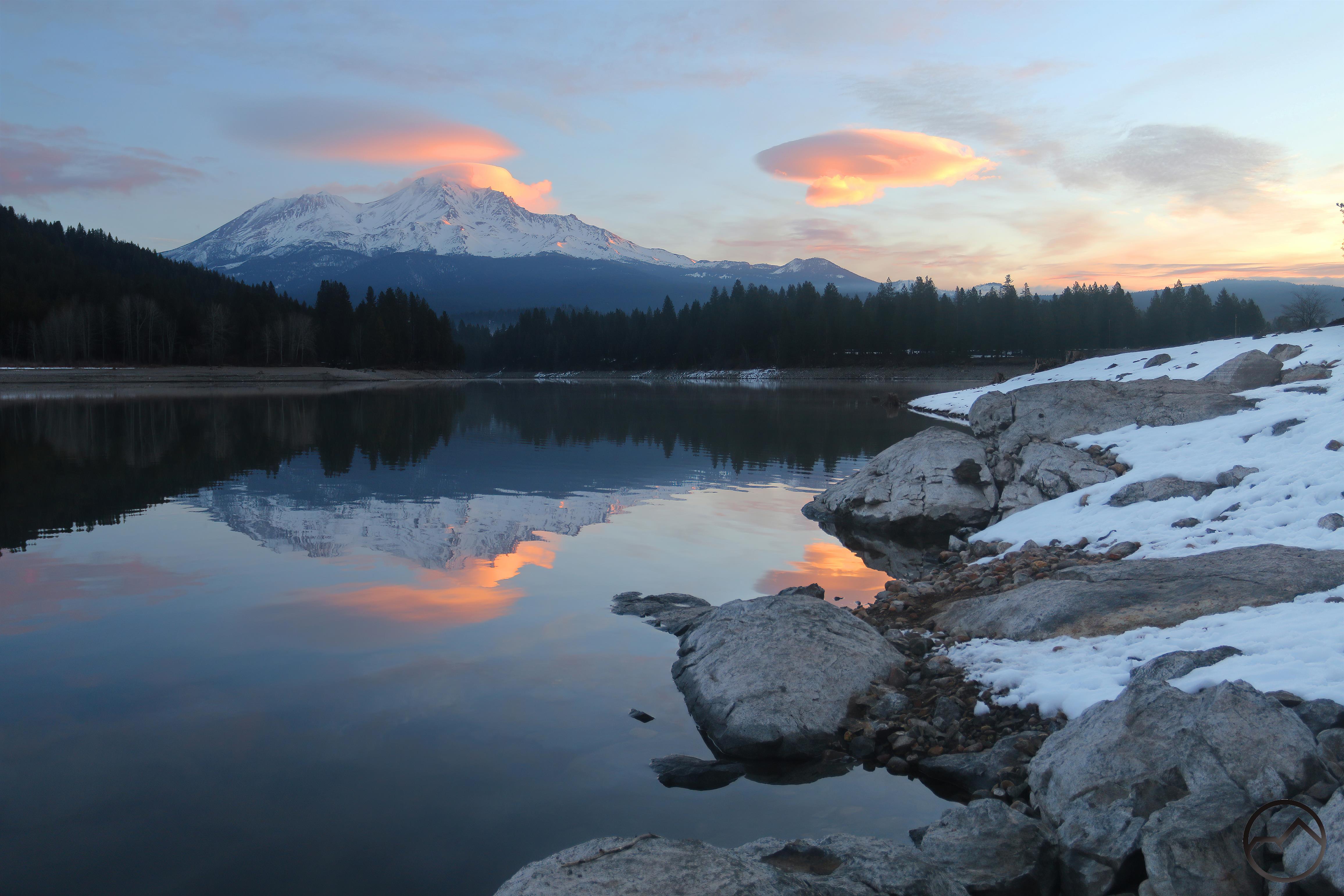
Saturday was the nicest day of 2021 thus far. No doubt days will be getting better as we plunge into spring. The nice weather meant it was a moral imperative to get outside. The morning was spent tracking unnamed waterfalls in the Castle Crags but evening meandered into an unanticipated trip out to Trout Lake in the Shasta Valley. Though there were no clouds of any kind in the sky over Mount Shasta, I thought the high desert terrain and the (hopefully) still water of the lake might make for an interesting sunset.

When I arrived at the wildlife refuge I first went to check on Bass Lake, which was rather low. No doubt if the winter had received more precipitation it would have been full. I proceeded to Trout Lake, which was full. Though there are views of Mount Shasta from everywhere in the Shasta Valley, the vista from the Trout Lake parking lot is among the best and certainly ranks as one of the best drive-to vistas of Mount Shasta. As it turned out, there was no one there, which meant, since no one was at Bass Lake or any of the other parking areas along the route to Trout Lake, I was the only visitor in the refuge.

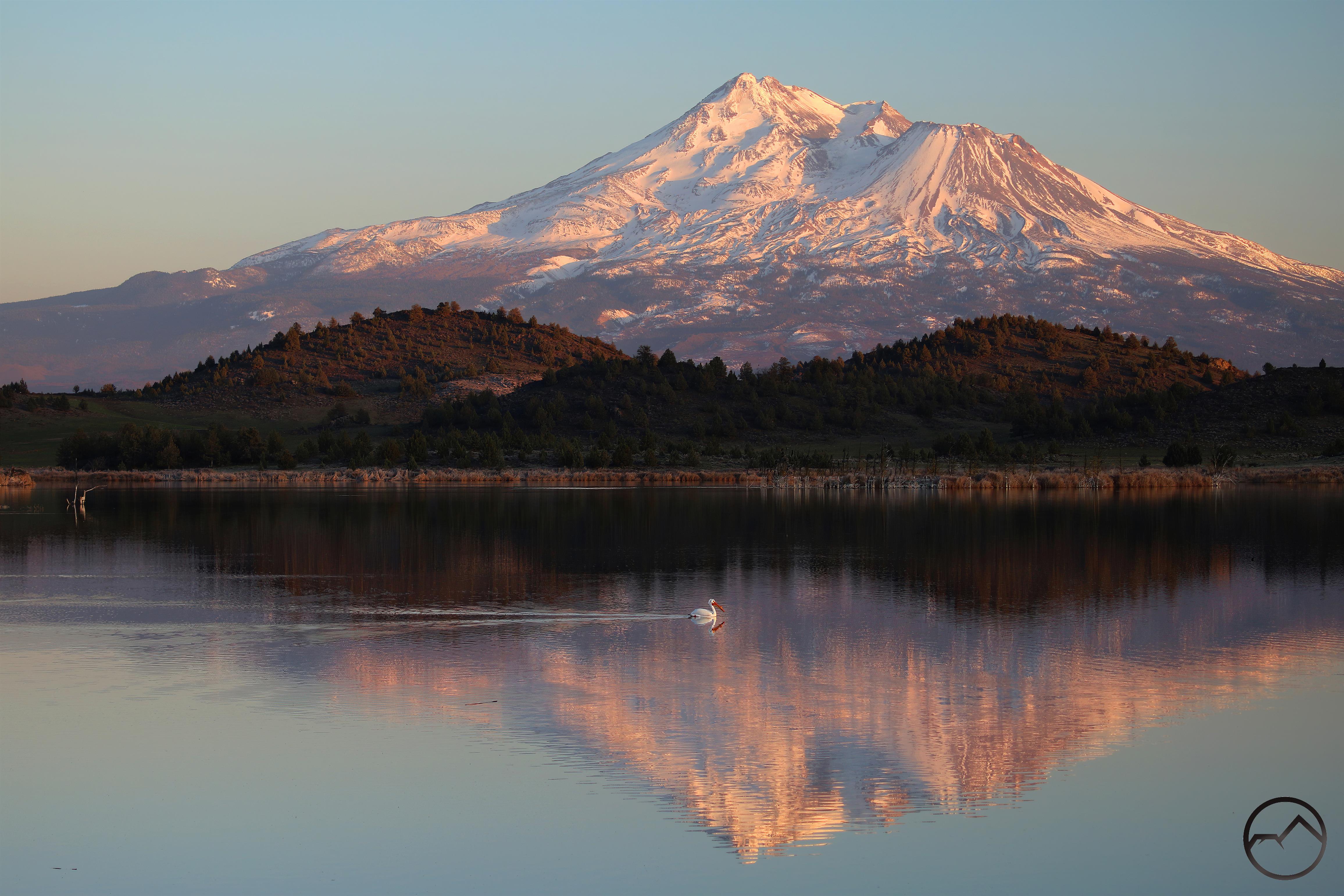
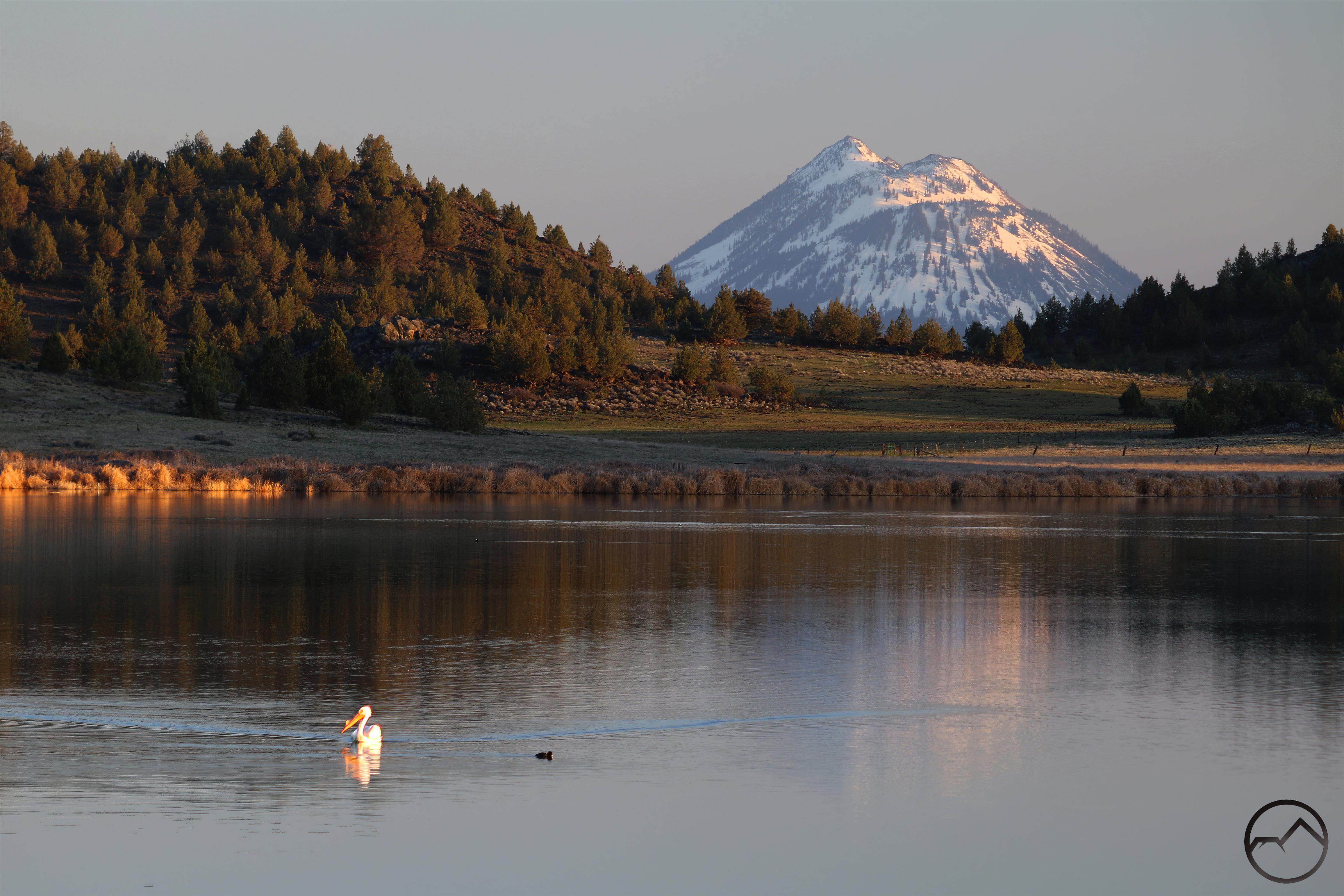
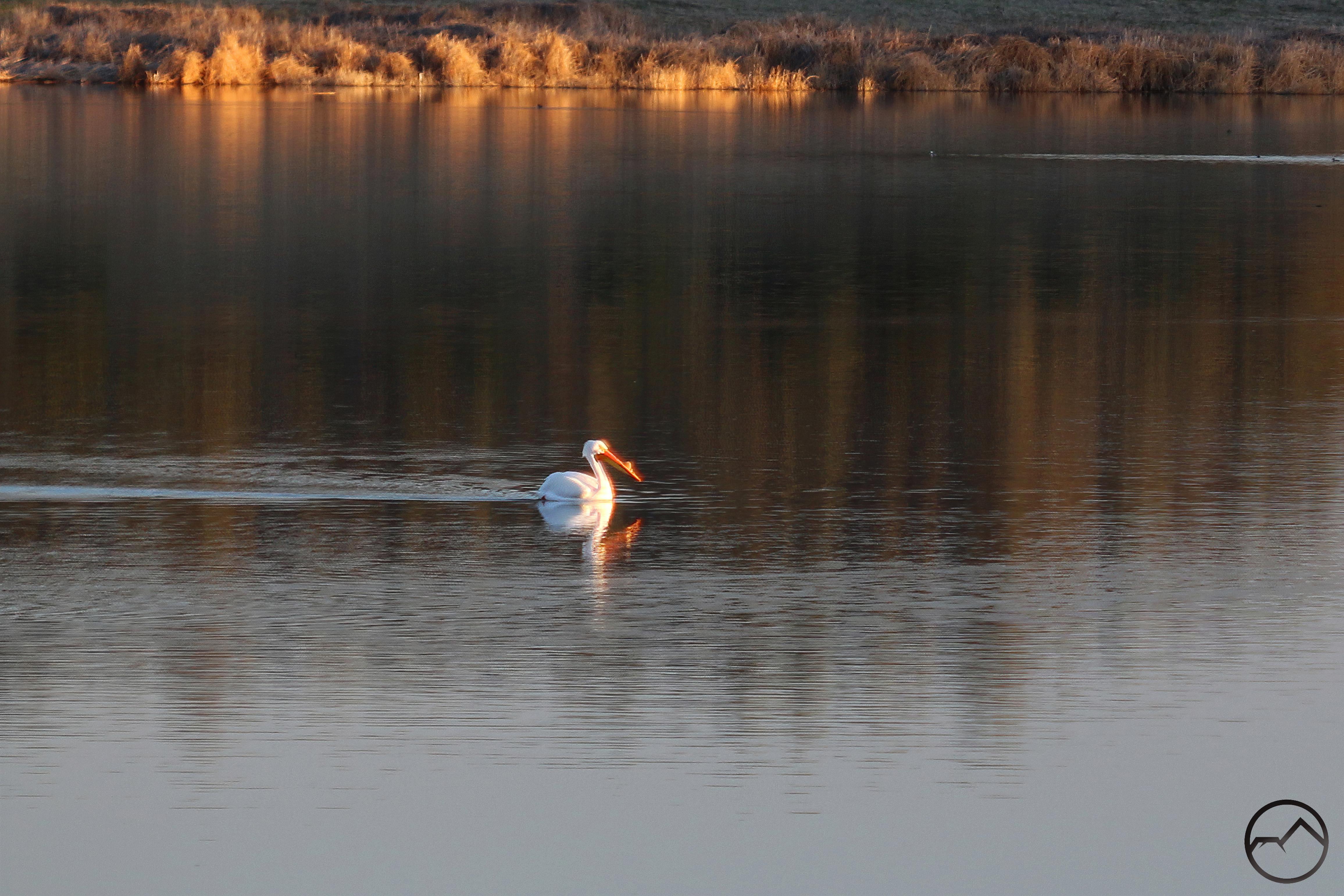
I set up my camera and enjoyed the changing light on Mount Shasta. As to be expected, there were a lot of birds around the lake, including geese, ducks, seagulls and the oddly-footed coots. However, one avian denizen stood out as it swam back and forth across the lake. A large white pelican and decided to take up residence in Trout Lake. Although I have seen pelicans many times at Orr Lake, I have never seen one in the Shasta Valley. I invariably associate pelicans with the sea, so seeing one happily swimming through a reflection of Mount Shasta, I find it unexpected and somewhat out of sorts.

The pelican seemed quite content swimming back and forth, from the east to the west and back again. Coots would periodically come and visit the large bird but other than these small encounters, the pelican was on its own. At first I was frustrated because its swimming marred the already imperfect reflections I was getting. However, after a few minutes I decided my perceived incongruence of seabird and Cascade volcanos made more interesting pictures anyway so I relented and allowed myself to enjoy it.

I must confess that I am not much of a wildlife guy. Unless it is a bison (for which I have an abiding appreciation), wildlife does not generate a lot of excitement for me. The geology is always my first interest and the flora is my second so birds are typically pretty far down on my interest totem pole. Yet, for some reason seeing the pelican turned out to make an ordinary, cloudless Mount Shasta sunset (still a magnificent thing!) much more appealing. Perhaps my interests are broadening!

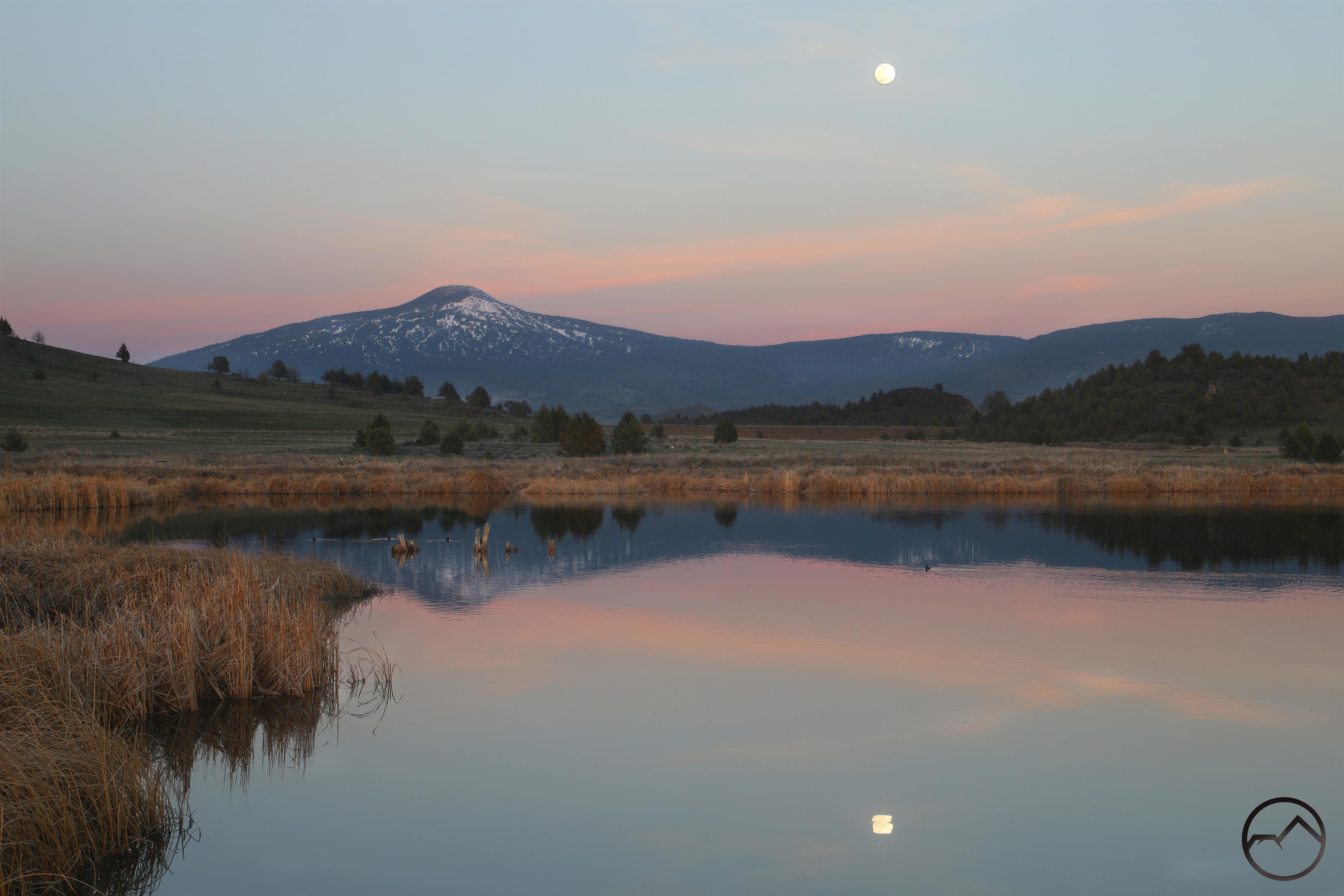
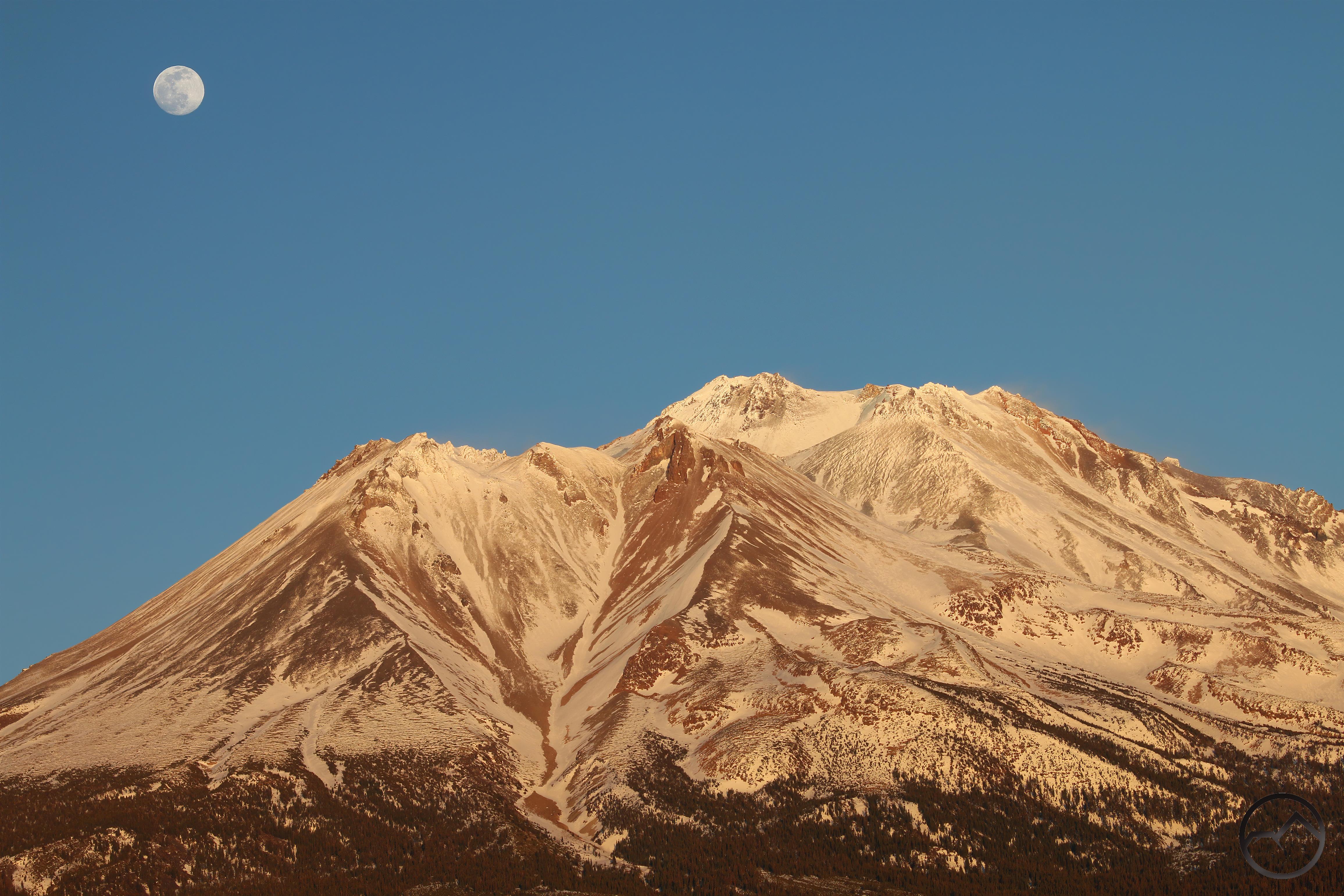
As it turned out, the rest of the sunset was also beautiful, if devoid of the long-beaked seabird. The moon was full and some thing clouds to the east and west captured more of the sunset’s light, all of which was reflected on the still waters of Trout Lake. The entire Shasta Valley has turned green with the onset of spring, though it is still a little too early for the lupine to have sprouted. That is not too far off now. Things are looking up.


2021 Mount Shasta Spring Hiking Round Up

Posted by bubbasuess on March 27, 2021
Posted in: Cascade Range, Desert, Hiking, Mount Shasta, Off Season Trails, Spring Trails, Winter Trails. 1 Comment

A springtime sunset on Mount Shasta.

We are a week past the 2021 vernal equinox and moving right into spring. Though we will no doubt have some more precipitation (I sure hope!) for now we are blessed with a week’s worth of spectacular spring weather! It is prime time to head out and explore the low and mid-elevation trails around Mount Shasta. For me, that means it it peak time to dive into the Castle Crags and do some waterfall hunting. There are a lot of hidden jewels in that massive pile of rock.

Though the weather is perfect for hiking, the winter’s snow means we will have to wait a while longer before the high country trails are clear of snow. Thankfully the Mount Shasta area is blessed with an abundance of trails at lower elevations, which means that hiking and enjoying the fantastic scenery that surrounds us is in full swing. The best spots to explore this time of year are along the McCloud River and in the Castle Crags. Despite the lower elevation, they still offer great mountain experiences. The Gateway Trail is also a good option for spring hiking, with good views of the mountain and a sense of solitude in the near-town but remote backcountry of the trail. The high desert of the Shasta Valley is another great place to explore right now. Of course, all the other areas usually considered good winter destinations are also fantastic places to hike right now. Summer may be coming but the time to get out and hit the trail is now!

Spring Hiking On The Gateway Trail

Located just outside of Mount Shasta City, the Gateway Trail is an impressive and soon-to-be-expanding network of trails that wind their way through the wooded flanks of Mount Shasta. The first couple miles of the trail, however, are largely in the open, passing through rocky terrain that features great perspectives on the white mountain looming over 10,000 feet overhead. Once the trail plunges into the deep forest, numerous loop options exist, along with a few rocky outcroppings and some good vistas of Trinity Divide. Read more here.

A last view of Mount Shasta before heading into the forest.
The trail also features good perspectives on Mount Eddy and Black Butte.

Spring Hikes In The Castle Crags

The Castle Crags are one of the most majestic mountain features in California. However, their lower elevation means they are often accessible when higher terrain is still smothered in snow. Still, the granite spires and great rock walls stand shoulder to shoulder with some of the most rugged terrain in the state. Though best hiked in spring, when the creeks are gushing and the weather, especially on the south side where most trails are found, is perfect, the winter may still be a good time to get out and enjoy this gorgeous mountain playground. Read more here.

Spires of the Crags
Mount Shasta seen from the Castle Crags

Spring Hikes On The Upper McCloud River

The McCloud River is one of the great attractions of the Mount Shasta area. With great fishing, a trio a awesome waterfalls, and beautiful forest surroundings, it is a popular destination. The waterfall along the river is a great hike and ought to be considered during winter if the access road is open. However, the McCloud River Trail follows the river for 15 miles and any section of this makes a great hike as long as snow is not covering the ground. Read more here.

Basalt gorge on the McCloud River
The McCloud River downstream from Cattle Camp.
McCloud River from the top of Middle Falls
Middle McCloud Falls

Spring Hikes On The Lower McCloud

The Lower McCloud River sees far less activity than the upper section. Separted by Hearst property and the McCloud Reservoir, the two areas are strikingly different. The upper section flows through volcanic terrain while the lower part passes through an outlier of the Klamath Mountain. The terrain is very rugged and can be difficult access during winter. However, when it can be reached, solitude a beautiful scenery await! Read more here.

Large cataract on the McCloud River
The McCloud River from the PCT crossing.
In the McCloud River Canyon
Squaw Valley Creek Falls

Spring Hiking At Orr Lake

The area around Orr Lake is a mix of high desert and ponderosa pine forest, surrounding a large, lush meadow fed by remote Butte Creek. It’s higher in elevation than the high desert of the Shasta Valley, which means it is often not a good place to go in winter. However, in spring, it is ideal. The lake is full, the creek is running strong and Mount Shasta, visible beyond the lake, is white. Other than portions of the trail being closed at times for nesting birds, it is a great place to get outside in the months before summer. Read more here.

Sunrise at Orr Lake.
Mount Shasta rises above Butte Creek
The distant Goosenest seen from Butte Creek.
Orr Mountain seen beyond the Orr Lake meadow.

Spring Hikes In The Shasta Valley

North of Mount Shasta, the desert landscapes of the Shasta Valley offer a strikingly different environment than what is found along most trails in the region. The only conifers here are junipers and sagebrush is ubiquitous. For those that like the desert, the beauty of this area needs no explanation. For those less familiar, there is ample wildlife, beautiful rock formations and magnificent 360 degree views, crowned by some of the best views of Mount Shasta to be found anywhere. Read more here.

Mount Shasta rises above Yellow Butte
Herd Peak, Sheep Rock and Yellow Butte
Pluto Cave
Mount Shasta rises above Pluto Cave

Spring Hikes In The Shasta Valley Wildlife Refuge

At the northern end of the Shasta Valley lies a large parkland administered by the State of California. The Shasta Valley Wildlife Refuge was once a working ranch but is now a haven for a variety of wildlife, especially birds. It is also a refuge for hikers looking for incredible vistas. Though it can be closed at times during winter, there are still opportunities to explore it and once it is reopened completely, it is a place of great beauty, beckoning to be explored! Read more here.

Mount Shasta reflects in a pool by Steamboat Mountain.
Looking north toward the Siskiyous
The Cascade Crest seen from Trout Lake
Mount Shasta looms far beyond Trout Lake

Three Spring Trails Near Mount Shasta City

Mount Shasta City is blessed with a number of great paths within and just outside of its city limits. Three of the best are the Box Canyon, Ney Springs and Spring Hill Trail. These offer solitude, Mount Shasta Vistas, unique history, spectacular geography and even some excellent waterfalls. These all lie just minutes outside of town. Also, don’t forget that Mount Shasta City has some great short trails right in town! Read more here.

Box Canyon of the Sacramento River.
Inside the Box Canyon of the Sacramento
Faery Falls
Rocky Point on the Spring Hill Trail.

Spring Hikes On The Lake Siskiyou Trail

The Lake Siskiyou Trail is an incredible recreational resource just a couple minutes outside of Mount Shasta City. During the summer and fall, a loop trail encircles the lake. However, in winter the seasonal bridges over the Sacramento River are removed. While the loop can’t be hiked without fording the river (extremely dangerous after storms and during high runoff), several sections of the trail still make great out and back hikes. They feature beautiful forests, the lake itself and incredible views. Due to the relatively light winter, the bridges should be places over the Sacramento sooner rather than later this year. Read more here.

Mount Eddy at the Sacramento River inlet.
Hiking along South Shore
Views from North Shore.

Spring Hikes On The Sacramento River

Most people in California think of the Sacramento River as the wide, winding waterway that lazily flows through the Central Valley. Here just below the headwaters, however, it is a swiftly flowing mountain river. Deep in its canyon, the lower elevation means it is often free of snow and the trails are easily accessed. Hiking along the river in winter is a treat that offers a taste of wild mountains for minimal effort. Read more here.

Hedge Creek Falls
Behind Hedge Creek Falls
Rapids Along the River Trail.
Along the Sacramento River Trail.

The Winter Snowpack Thus Far In Mount Shasta

Posted by bubbasuess on March 17, 2021
Posted in: Boy Scouts, Cascade Range, Hiking, Mount Shasta. 6 Comments

Unusually snowy hills of the Shasta Valley lie beneath alpenglow-bathed Mount Shasta.

As we near the end of winter (at this point, I can’t wait!), it is worth considering the snowpack that has developed and how things look going into the warmer months. This can be done both anecdotally and with data and both are useful at this point. The water that falls here in the mountains at the far northern end of the state has considerable bearing on the water fortunes of the rest of California as well as helping prepare for the kind of fire season that may manifest. Both are critically important both locally and statewide.

I want to first address the data that is available at this time. According to the National Resource Conservation Service, which is part of the US Department of Agriculture, as of the beginning of March, the Mount Shasta area was at 88% of normal snowpack. This figure was averaged from the snowpack percentages of both the Upper Sacramento River and Klamath River watersheds.

Western watersheds and snowpack conditions. Mount Shasta marked with red dot.

That data is available on this map, which has a ton of resources and is worth exploring. Of those two watersheds, the Upper Sacramento is more pertinent to Mount Shasta, since the SNOTEL stations and California Cooperative Snow Survey sites that are in the Mount Shasta vicinity are located in this watershed. According to the map, the Upper Sacramento watershed was at 94% at the beginning of March. This area includes the western Trinity Divide, the southern half of Mount Shasta, the Sacramento River down to the Shasta Dam, the McCloud River watershed and the entire Pit River watershed, which notably contains the high country of the Warner Mountains.

The Upper Sacramento River, as per NRCS data, is marked in blue. Mount Shasta marked red.

This is encouraging data. The large storm we had in January went a long way towards establishing a quality snowpack. The area to the north and west, in the Klamath River watershed, is slightly less well off, with 82% of normal as of the beginning of March. This area contains the preponderance of the Klamath Mountains and the east side of the Cascades deep into Oregon, reaching just north of Crater Lake. Obviously this area is pretty diverse and the data for the whole region can be skewed by one area having more or less snow.

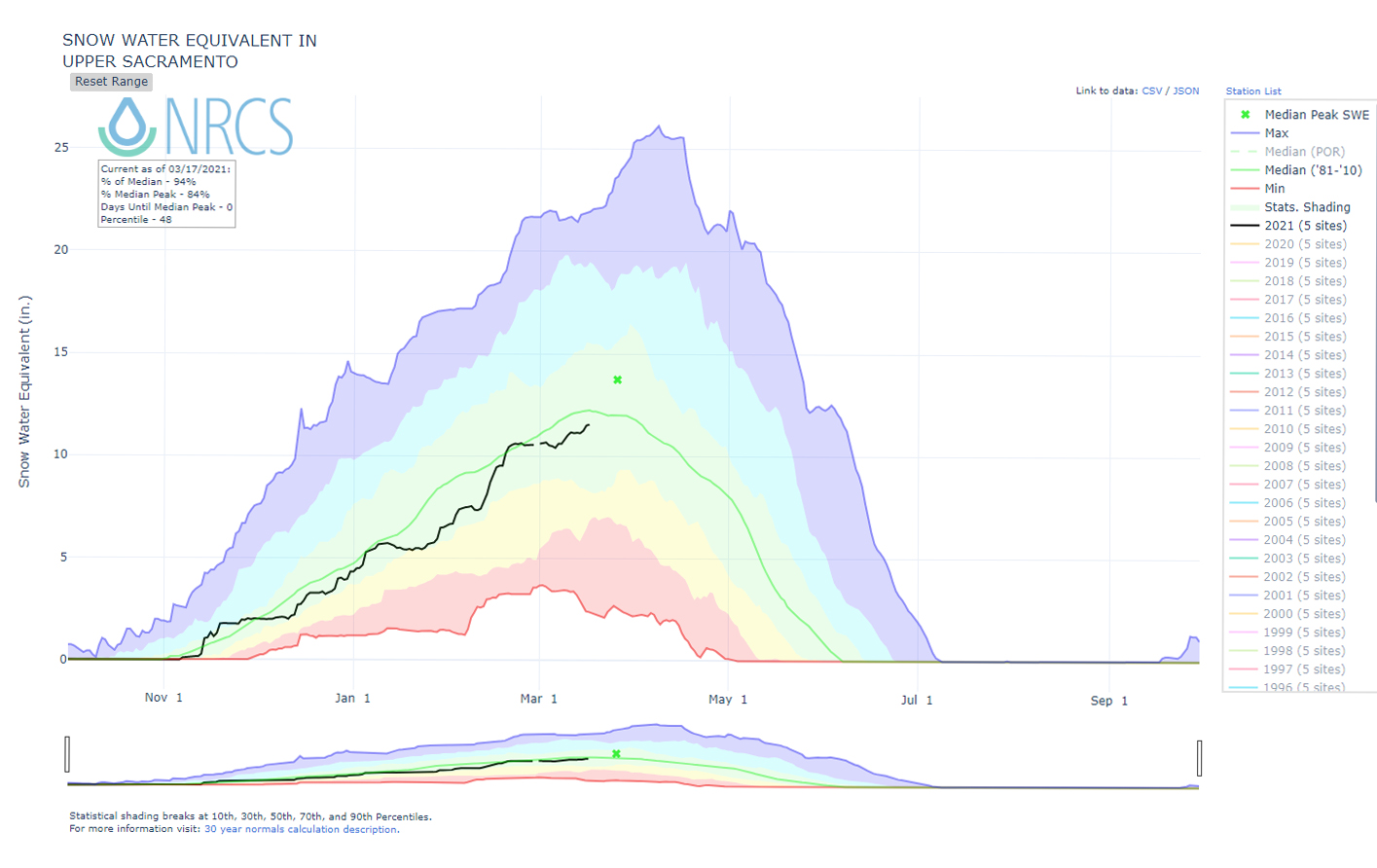
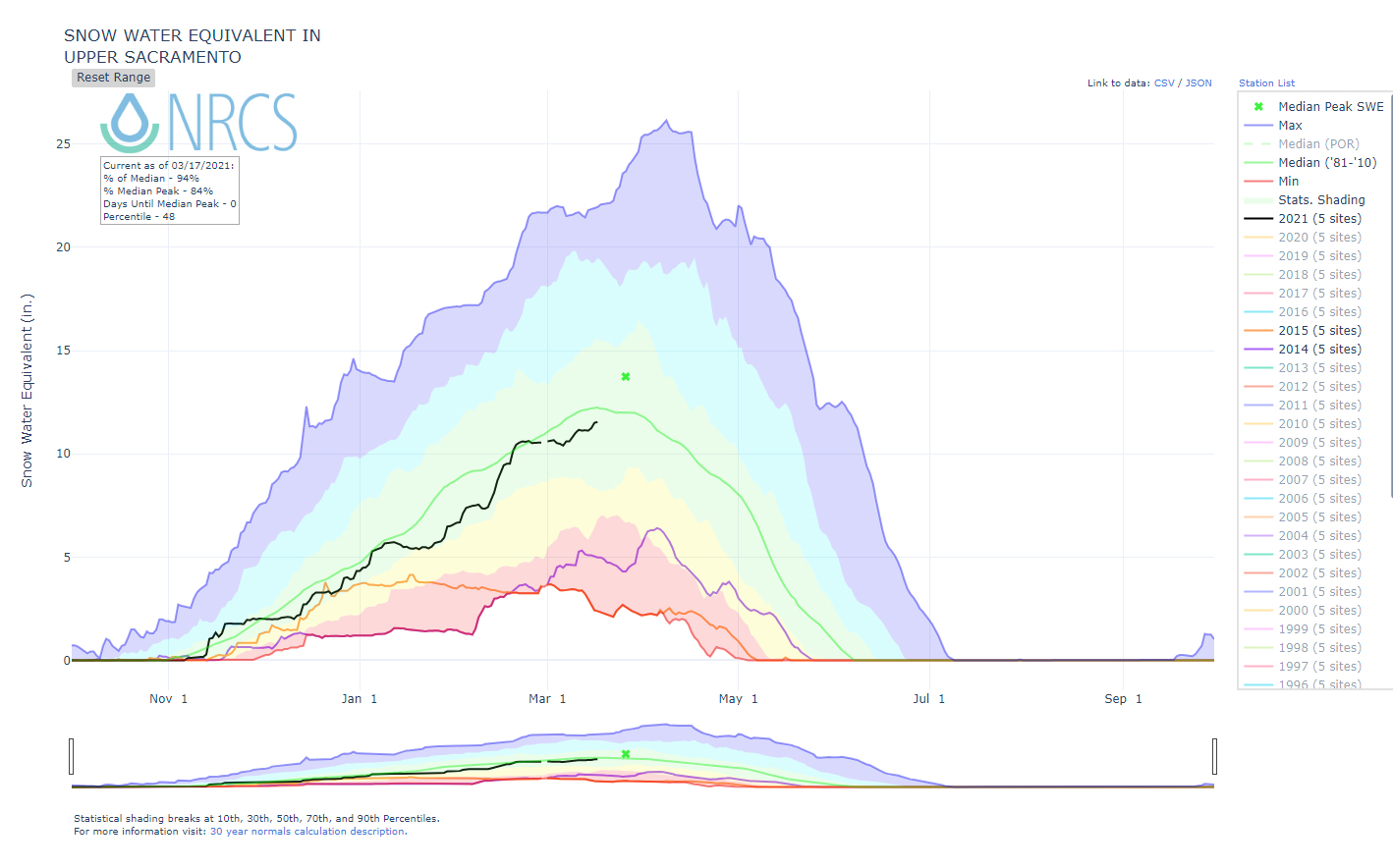
Here’s another way to look at the data (be sure to check this page out, which shows annual Snow Water Equivalent all the way back to 1981). Thus far, by mid-March, we are approaching the 30 year (1981-2010) median for water content of the snow that has fallen. We are still off about 2 inches of SWE from the median peak. Again, we are not really at average yet, but this winter has not been a total disaster. For example, the graph below shows this winter (black line) compared to the wretched drought years of 2014 (purple line) and 2015 (orange line).

Obviously we are doing significantly better than those severe drought years. While I would be happier if the winter had produced a deeper snowpack, it has certainly not been a bust and there is a good accumulation of snow. We still have two weeks of March (and rain/snow imminent as I write this) as well as a good chance for more precipitation in April. Naturally, I am ready for some warm spring weather (and Castle Crags exploration!) I won’t argue with more water padding the totals we have gotten thus far.

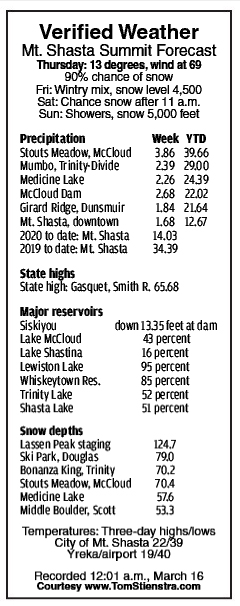
Though it does not seem to correlate with the data on the NRCS, the numbers according to the Mount Shasta Herald’s site paints a much starker picture. It states that downtown Mount Shasta has only received 12.67 inches. I am not certain what the annual average is but that seems low. In addition, the report lists Stouts Meadow, which is often one of the wettest places in Northern California and its 39.66 inches is lower than what other years have produced. Other areas look lower than normal as well, though none of the averages are cited.

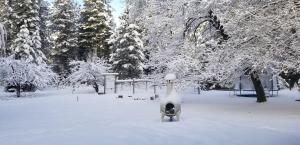
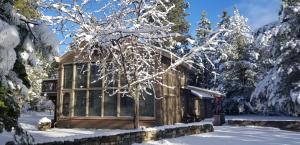
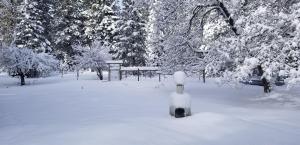
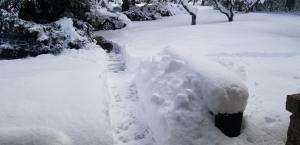
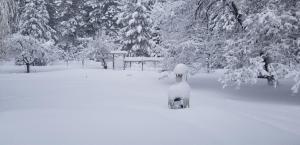
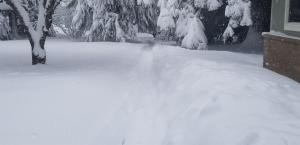
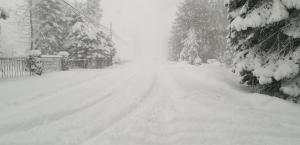
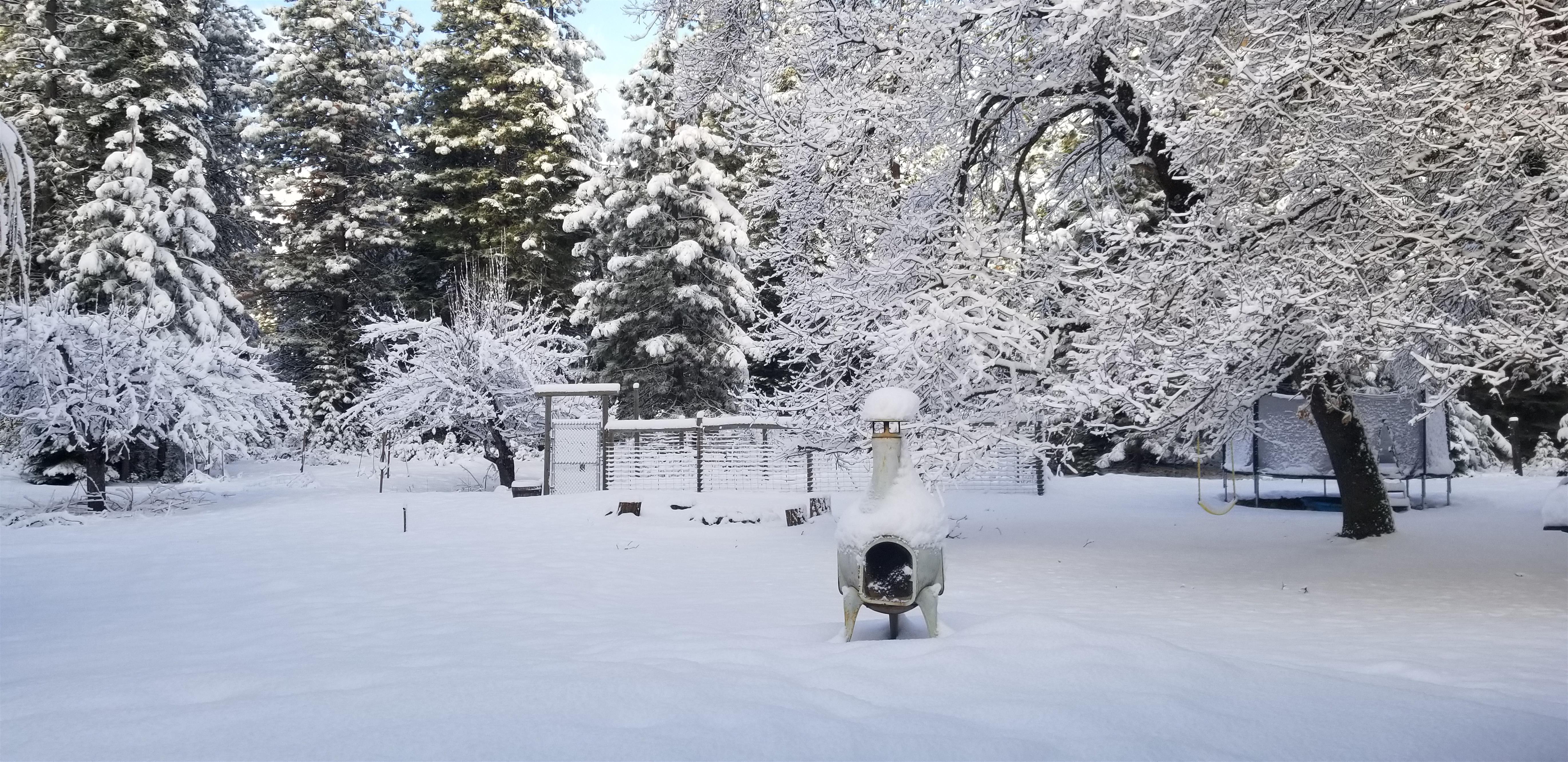
While some of these numbers are pretty good, they don’t necessarily reconcile with the MSH’s numbers. The NRCS data looks good but the MSH numbers seems bleak. This leads to the anecdotal aspect of this snowpack assessment. It is my observation that the winter seems just about normal. With the big storm we had in January depositing a lot of snow in the mountains (especially the Trinity Divide, whereas Mount Shasta’s snow was seemingly blown off by some pretty violent winds), I suspect a good base was laid down. That was reflected with the NRCS numbers that only ran up to the beginning of March. Since then, we have had three notable weather systems pass through the area. Between the three storms, we have had a considerable amount of snow dropped. The accumulated depth (at least at my house) was upwards of three feet of snow. Consider these images from around my house and cabin:

March 6th
March 6th

March 10th
March 10th

March 15th
March 15th

March 15th

I don’t know if these images do the accumulation justice but it was a lot. In these cases, the snow dropped, settled, melted a little and then had more piled on. The last two storms in particular left over 2 feet between them. Between the lateness in the winter and the slight warming trend we had been enjoying, I had not mentally prepared myself for the amount of snow we got. Both of the latter storms required significant snow clearing.

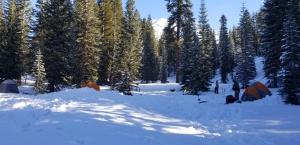
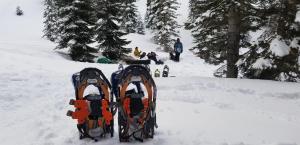
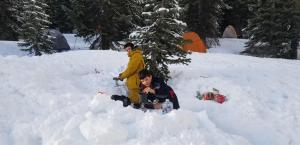
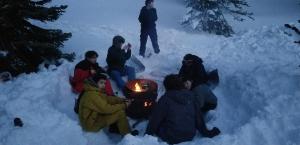
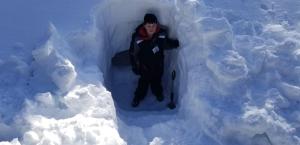
In the middle of all that, I also managed to take the boy scout troop for which I am scoutmaster on the annual snow camping trip on Mount Shasta. I am grateful that I am able to get these guys out there, even when so many are missing out on so much of life due to virus conditions. Many of these boys would still be stuck at home without something like boy scouts giving them some great memories and experience. Thankfully, the snow is there too. Winter may be coming to an end, but there is still plenty of snow to enjoy for the time being!


To summarize what I have looked at here, according to the NRCS, at the beginning of March the Upper Sacramento and Klamath watersheds had 94% and 82% of normal snowpack, respectively. Since that time, three weather systems have dropped significant precipitation in the area. Consequently, I have to assume that, at the least, the Upper Sacramento watershed might be approaching 100% of normal snowpack as of mid-March. The Klamath, which was lagging, must have improved significantly and if it is not at 100% of normal must be near to it. The one caveat to this is that, for as much snow fell, it was fairly dry and did not have a big water content. Nonetheless, considering how much snow actually fell, it is a positive addition to the snowpack.

The winter may have started later than normal but once it got going, we have done pretty well. A good storm in December, a big one in January and some strong systems in March have helped build a decent snowpack that looks to be close to a normal winter’s accumulation. There is still room in the wet season to pad that out with more snow and rain too. This is good news for the Mount Shasta area and for California!

A frozen sunrise in the Shasta Valley.

Mount Shasta Was On A Roll This Week (Plus Fresh Snow)

Posted by bubbasuess on March 6, 2021
Posted in: Cascade Range, Hiking, Lenticular Clouds, Mount Shasta. 1 Comment

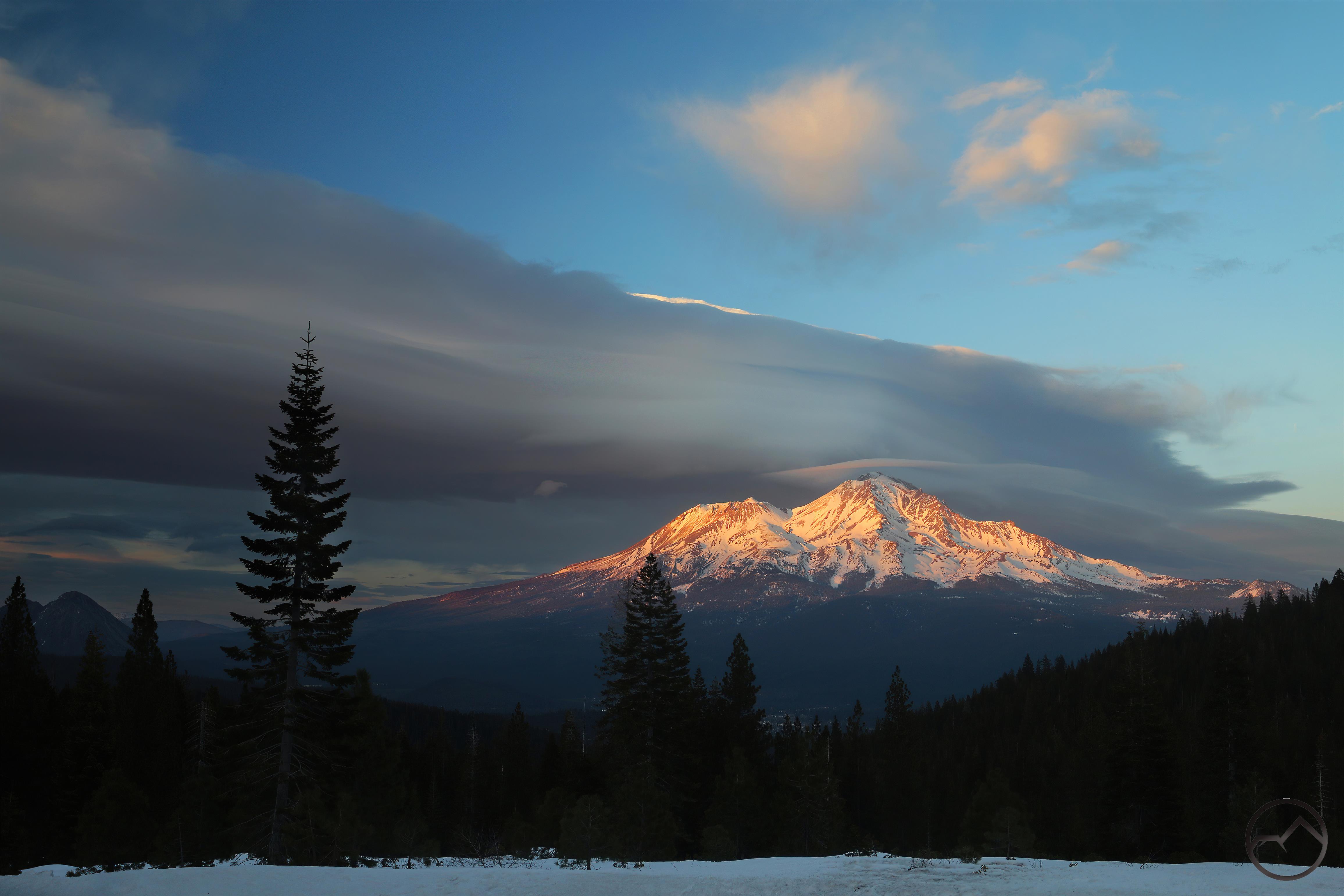
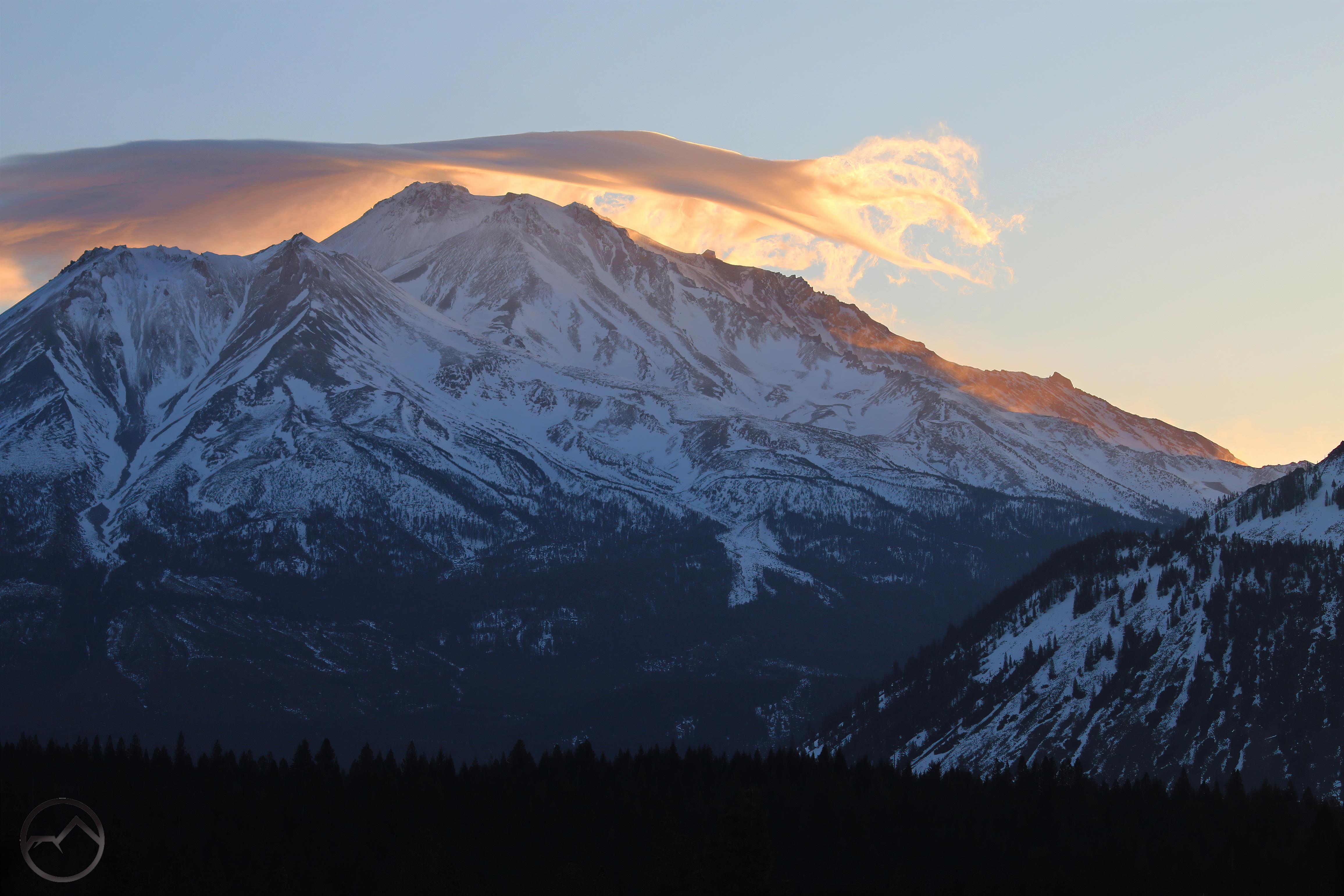
Alpenglow on Mount Shasta beneath a massive lenticular wave.

I have noted on a few occasions that the current lenticular season has been somewhat lackluster. Though there have been a few events scattered throughout the past several months there haven’t been any really massive formations, the kind the tend to punctuate the season and really make you stop and marvel when they do occur. That all changed this past week. In the first 5 days of March, beginning Monday, there were 3 excellent clouds. Though their quality did lessen as the week progressed, they all still far outperformed what had preceded them.

As if that weren’t enough, the storm they had all been prelude to swept through and dropped 4-5 inches of snow at my house. While we were all hoping for more, that is still a welcome burst of snow. The skies are clearing even now and whoever heads up to the ski park is in for a gorgeous bluebird day!

Monday

The first lenticular of the week was by far the most impressive. Large, stable and stretching across the sky, it was one the most massive cloud events over Mount Shasta I have seen. It’s beginning didn’t quite augur its true proportions but those were revealed rather swiftly and maintained an immense presence throughout the day. It ended up coalescing into a staggering wave, similar to those that form over the Sierra Nevada. At sunset, the cloud didn’t quite light up as I had hoped but Mount Shasta managed to catch the alpenglow and it was an utterly spectacular scene.


Thursday

A few days later Mount Shasta again generated another interesting formation. This time it was a large stack to the northeast of the summit. At dawn it highlighted a really fiery sky, though the upper half of the stack was left totally in the dark. Like the wave from Monday, it stuck around all day. However, by sunset, though still extant over Mount Shasta, it was thin and wispy, hardly noticeable or catching light. However, the cloud clinging to the summit of Mount Shasta added some interest and it was still a beautiful end to the day.


Friday

The final lenticular of the week was also a fine one but was positioned further away from Mount Shasta, making it a bit frustrating to photograph. Nonetheless, like its predecessors, it was stable enough to stick around all day, though it was most interesting first thing in the morning. By noon it had flattened out but managed tighten up again for sunset. Unfortunately it never really got any vivid light. In spite of this, it was another spectacular formation to end the week!


Saturday

And now we have some fresh snow, just in time to do a little camping on Mount Shasta!

Chasing A Titan: A Day With An Evolving Mount Shasta Lenticular

Posted by bubbasuess on March 3, 2021
Posted in: Cascade Range, Hiking, Lenticular Clouds, Mount Shasta. 1 Comment

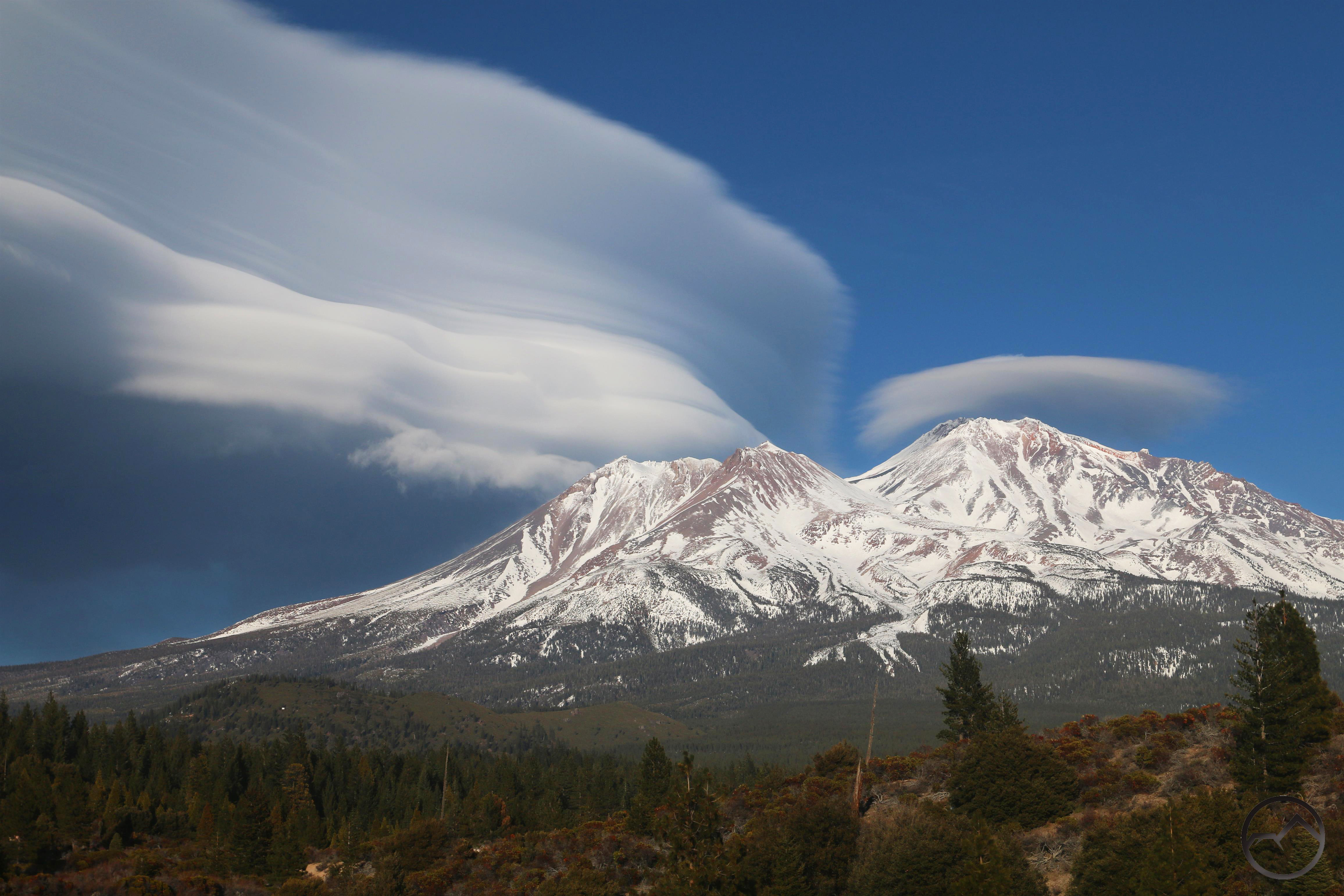
A pair of lenticulars, one massive one a simple disk, hover over Mount Shasta.

Seemingly out of nowhere, a titanic lenticular event manifested over Mount Shasta on Monday, kicking off March with a bang. The sky was basically cloudless at sunrise but by mid-morning it was already getting interesting. Naturally I could not resist heading out and documenting the spectacle, which I did at various times during the day, trying to catch it in its many iterations painted across the sky.

It was obvious from the beginning that this was the big event I have been waiting months for. From the west side of Mount Shasta the clouds seem to stretch from the mountain itself west to Mount Eddy. At times it was a series of lenticular disks while at other times the individual clouds seemed to merge into a single band of wavy formations. However, it was only when traveling to the north that the full scope of the cloud could be appreciated, as it could be seen extending east beyond the Whaleback. It is difficult to gauge the scale of the cloud from a fixed spot low down on the ground but just the linear distance between Mount Eddy and Whaleback is approximately 22.5 miles. That’s a big lenticular!

Click to enlarge:

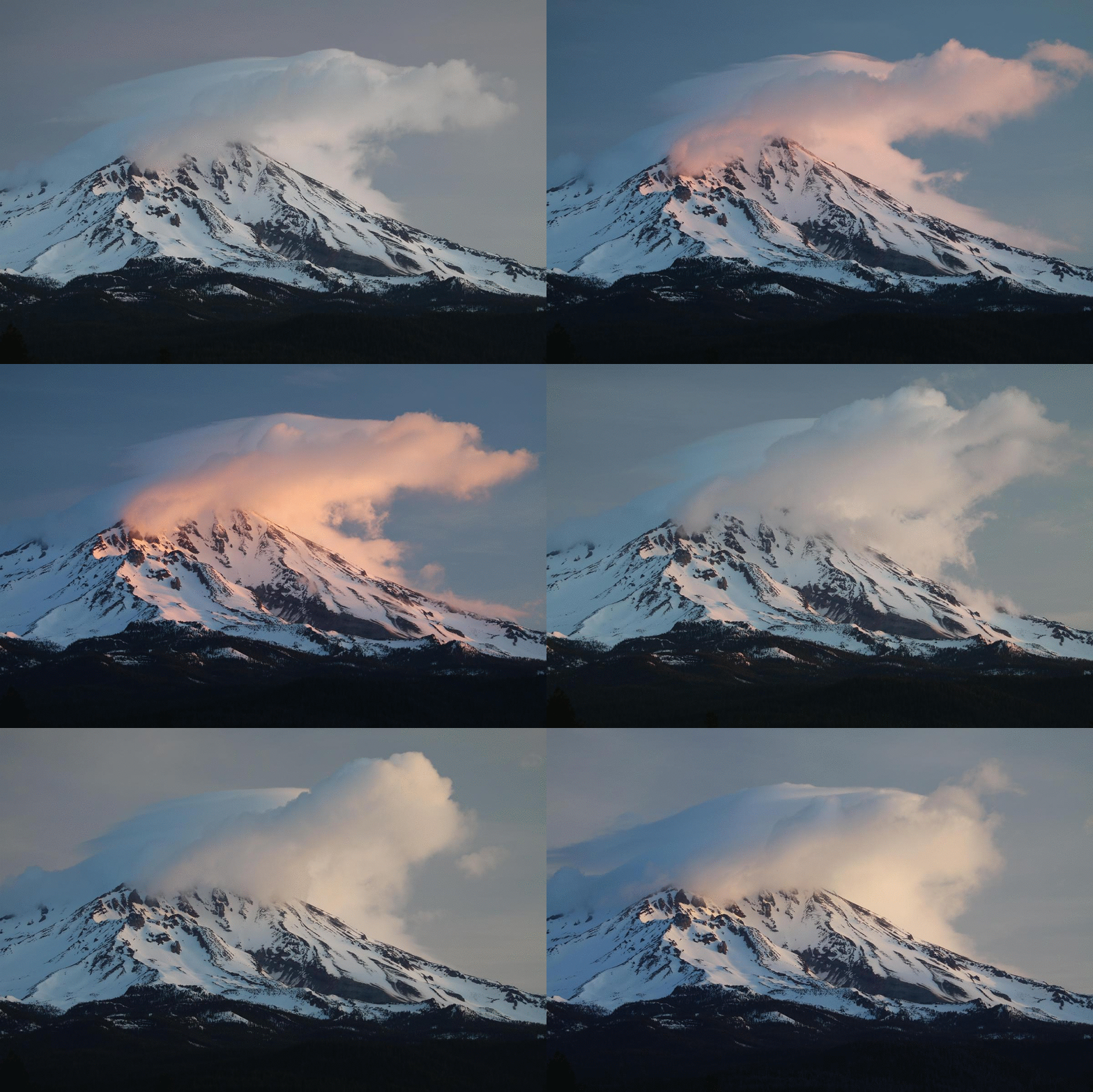
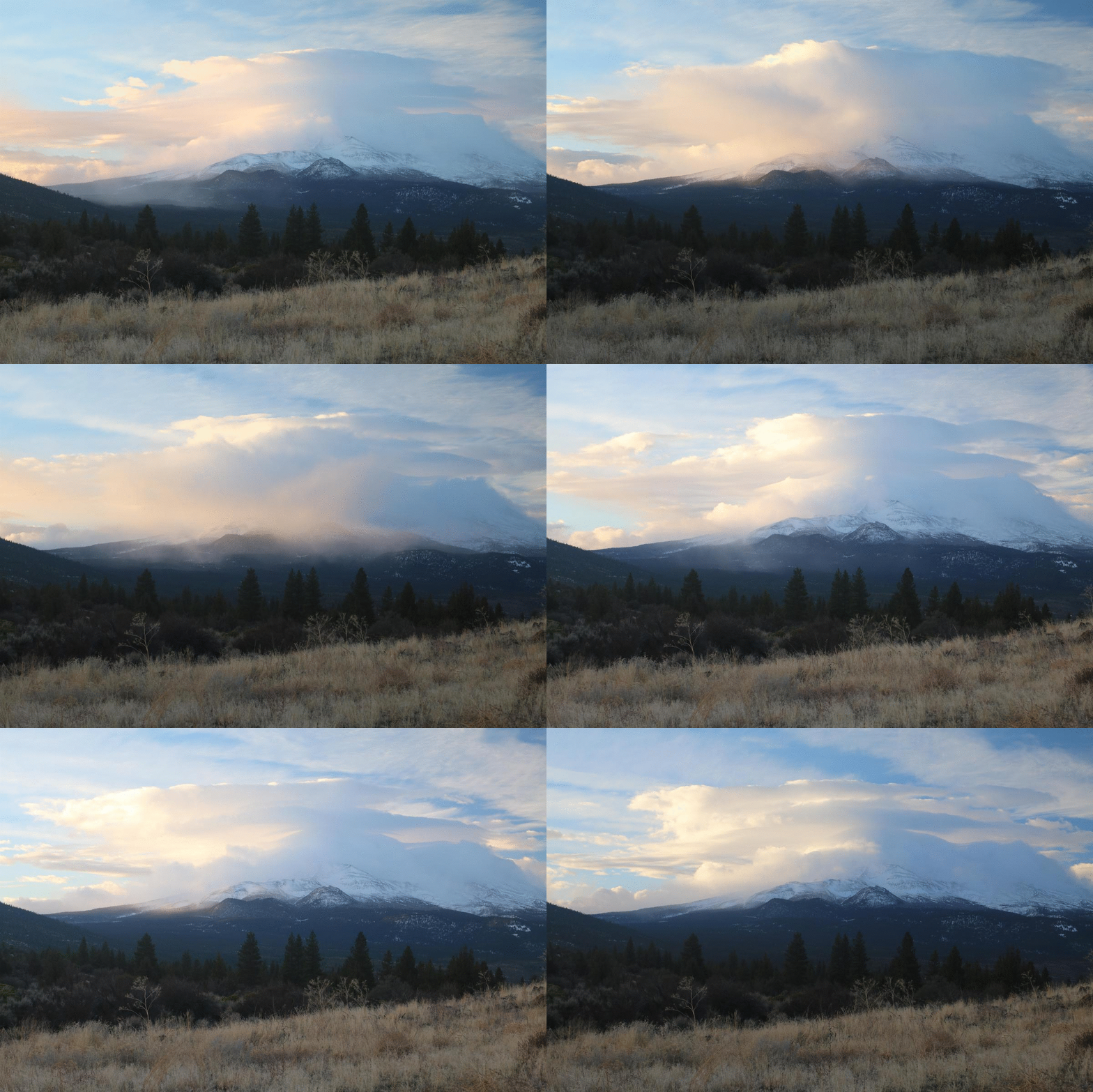
An early indication that big things were afoot, a sizable lenticular stack appeared over Mount Eddy. While this peak does occasionally get lenticulars, it is unusual for a formation this large to manifest here.


As the alpenglow increased on Mount Shasta, the lenticulars all combined into a great band, reminiscent of a Sierra Wave. The layers weren’t quite as defined as they had been just a few minutes before but it was still striking. A nice lens hovered above the summit of Mount Shasta as well.

Finally, after going dim for a few minutes, the final light of sunset hit the scene. I had hoped the entire cloud would light up but this more subtle sunset offered it own, subdued-yet-spectacular final moment before all the light went out.

The wave never quite lit up the way I had hoped but it was a spectacular end to a staggering day nonetheless. The mountain had good color at times and the alpenglow’s subtle illumination of the clouds was still gorgeous if not grand. The totality of the scene was grand enough and then some. I had hoped that a formation as large and durable as this one would still be manifest in the morning. Some form of lenticular was still visible in the moonlight well after midnight. However, with only the surging winds signaling its departure, the titanic formation dissipated into the night. When I headed out the next morning, hoping to capture a lenticular sunrise, there was not even a remnant of it. Such is the will of the mountain. It is unpredictable!

The massive lenticular having vanished , it was just another morning on Mount Shasta.

This was indeed the lenticular I had been waiting for all season. There have been plenty of formations for months but none ever really elevated themselves into the rarified company of the great events. This one did that. I don’t want to be greedy but I hope we get another before summer gets here!

Mount Shasta: Morning, Noon and Night

Posted by bubbasuess on February 27, 2021
Posted in: Cascade Range, Hiking, Lenticular Clouds, Mount Shasta. 3 Comments

A sunrise-lit lenticular seems to be grabbing for Shastarama Point.

Friday was another interesting day around Mount Shasta. Like the day before, the forecast called for partly cloudy skies, which meant that there was a chance something interesting might show up around the mountain. While the day before had been a bit of a disappointment since the promising morning gave way to an essentially cloudless day, Friday promised to offer something completely different. Indeed, the interesting weather persisted through the day and into the night. While the eventful conditions made for a frustrating day at the ski park (too windy for some of the chairlifts), it made for a pleasant day looking through the lens of my camera.

Click to enlarge:

While I considered heading over to McCloud for the sunrise, I knew I didn’t have time so instead I climbed up to the west. Though the mountain did not have any direct light on it, the lenticular was lit up nicely.
When the sun finally broke the horizon, the shape of the lenticular changed dramatically. It flattened out and lost the tendrils that had been its most distinctive feature. It was a beautiful morning nonetheless!

By noon the clouds around Mount Shasta got a lot more turbulent. The lenticular was still present but it had been reduced in size significantly. It remained the rest of the day but the other clouds around the mountain grew until Mount Shasta was completely obscured from the west.
At sunset, I had to head around to the south side in order to see the mountain. The lenticular was still hovering over the summit, though it had an odd, oblique position. The color on the mountain was crisp and pink and highlighted the west-facing crags beautifully.

Just as the alpenglow was fading, the clouds obscuring the summit cleared, revealing a final look at the top of Mount Shasta while still bathed in the warm light. A magnificent sunset indeed.
As I headed home, the moon popped up just above Mount Shasta’s Jack Flat. There was only a small gap between the ridge and a layer of cloud and the moon shone brightly through it. I was able to pull over and capture the scene before the moon climbed into the clouds. All in all, a satisfying evening!

Mount Shasta’s Show Fleeting But A Fine One (And Mount Eddy Too!)

Posted by bubbasuess on February 25, 2021
Posted in: Cascade Range, Hiking, Mount Eddy, Mount Shasta, Trinity Divide. Leave a comment

Though Wednesday proved to be clear-skied Thursday morning offered something altogether different. The forecast called for clouds in the morning. With that in mind, I headed out yet again, but I had slept longer than normal so I only had a few minutes to get to a vantage point before the color really set in. The destination was one only a few minutes from my house and it is a classic standby. I generally try to avoid this one these days but when time is short, it works in a pinch. This turned out to be a good morning to go there, since the color on Mount Shasta was good and the clouds were interesting but the real show was over Mount Eddy. This spot has a good perspective on both, which really paid off.


The summit of Mount Shasta was partially obscured in the clouds but the clouds themselves were quite nice. They soaked up the light of the rising sun in fine fashion. It was hard to distinguish but there was actually a bit of a lenticular in a higher layer of cloud. Though it would have been challenging to really appreciate from the north, the mountain also cast a nice sunrise shadow. Overall, a nice sunrise, but not one as grand as I had hoped.


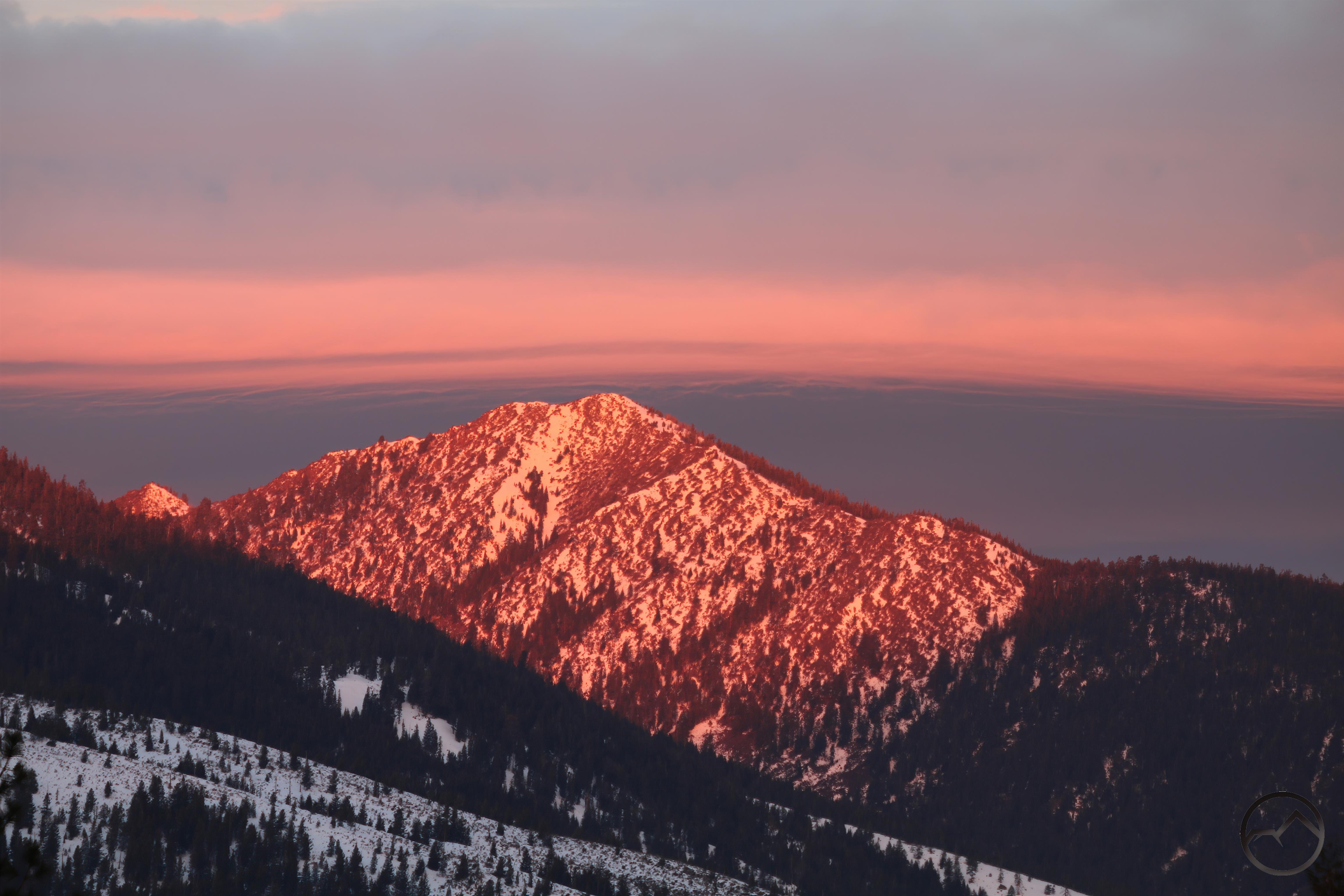
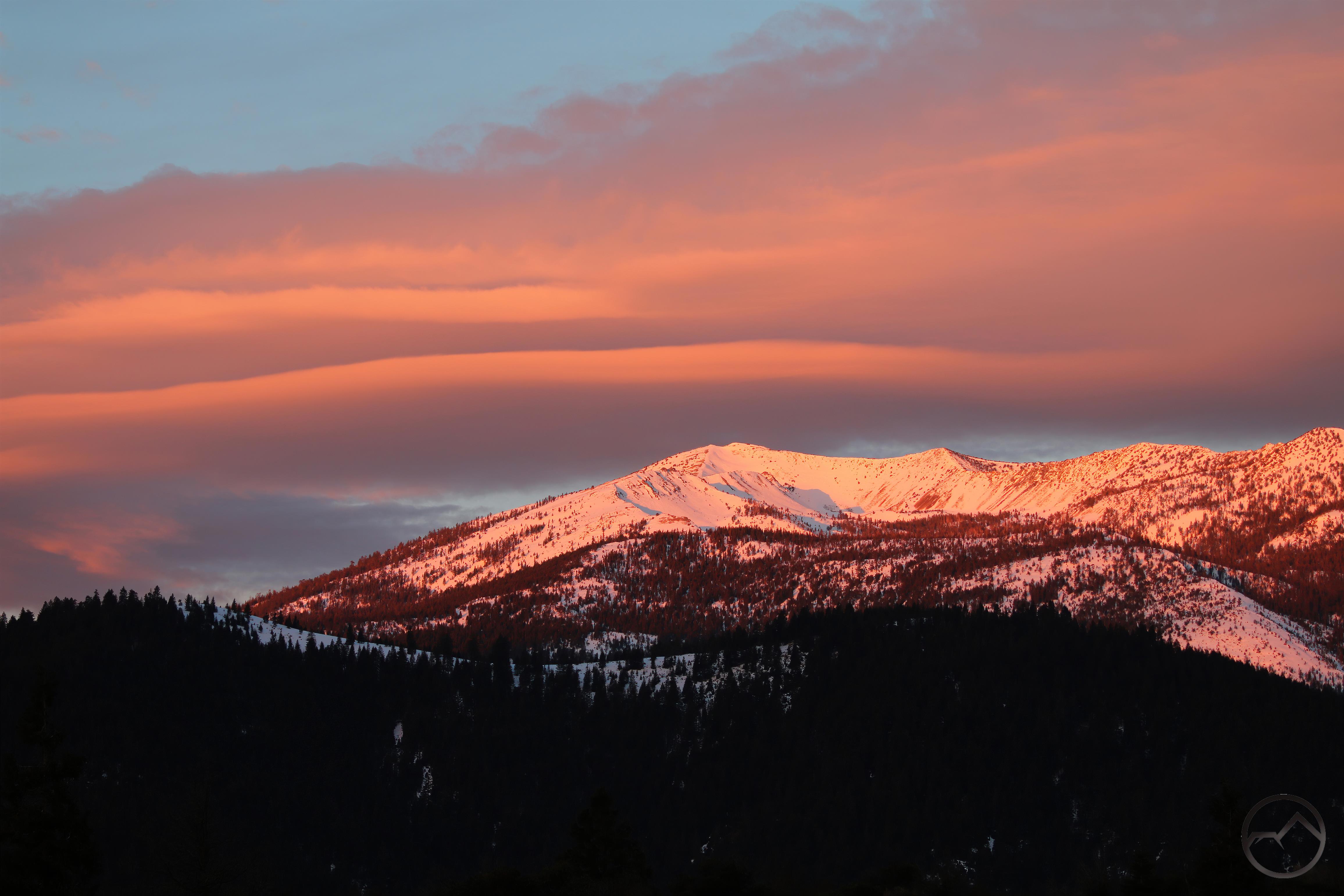
While Mount Shasta lacked really interesting clouds, the peaks to the west were graced with lenticular-like clouds. Peak 7,869 was light up brightly by the morning light. Over the summit a stream of cloud coursed in layered urgency. It too was alight. This prominent peak is surprisingly nameless and I have come up with various names in the past but that will have to be the subject of another post. If you have a name for this peak, leave a comment. I would love to hear other ideas for this one.


Mount Eddy was the real star of the morning. Even though the eastern side of the mountain is not its best visage it is still higher and larger than anything to the west and the rugged, treeless upper flanks are still quite scenic. Thursday morning saw the mountain overshadowed by a layered lenticular that was highlighted by the sunrise glow. It was hard to get the entire scene into frame and the cloud extended well south of Mount Eddy but the best parts were captured and it ended up being one of the better cloud formations I have captured over that mountain.


Without warning, the color began to fade as the sun rose and the clouds blocked out the light. It grew really overcast before all the clouds blew away, leaving only a small lenticular over Mount Shasta. That too was gone before noon, leaving clear skies for the rest of the day. It was a short performance but it was a good one.


By evening the clouds had not made a return but, on the way home from renting some skis for my son, I saw the moon had risen over Mount Shasta. That was worth a stop to capture with the mountain starting to light up with alpenglow. Considering there were no clouds over the mountain, it was a nice way to end the day. We’ll see what tomorrow brings…

Cut Into The Mountain’s Heart: The Great Canyons Of Mount Shasta

Posted by bubbasuess on February 19, 2021
Posted in: Cascade Range, Hiking, Mount Shasta. 3 Comments

Mount Shasta’s Ash Creek Falls pours into the lower half of Ash Creek Canyon.

Mount Shasta is justly known as a towering, glacier-clad volcano, standing in grand isolation high above all the other peaks in the region. Tall and isolated, it can be seen from over 150 miles distant, looming high above California’s Central Valley. It is a destination for hikers and mountaineers, both seeking grand vistas and incredible beauty, which they find in abundance. However, one of Mount Shasta’s most spectacular features is usually overlooked but offers stunning scenery for those who seek them out.

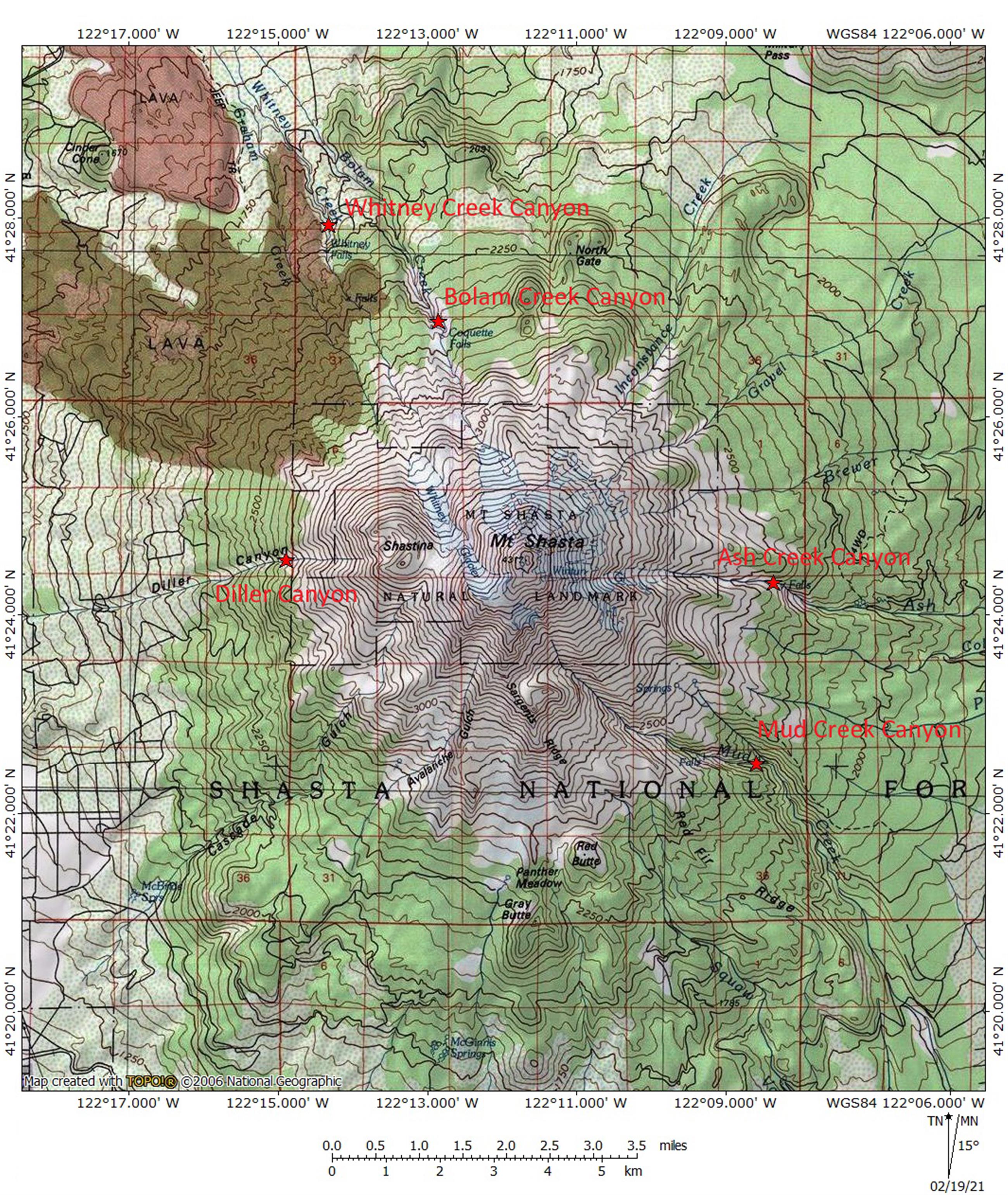
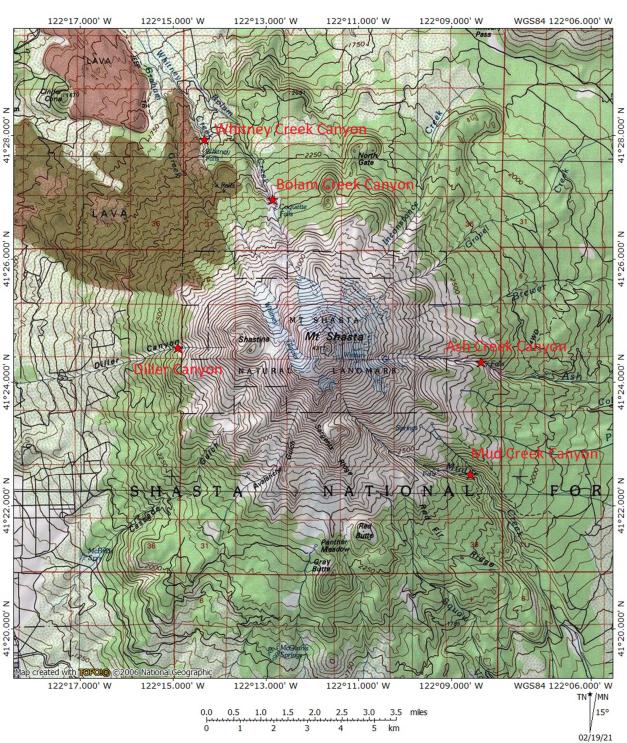
There are many canyons running down the flanks of Mount Shasta but 5 stand out above all the rest in terms of size and beauty. These are Bolam Creek Canyon, Whitney Creek Canyon, Diller Canyon, Mud Creek Canyon and Ash Creek Canyon. These five are wider, deeper and and generally more massive than any of the others. It should also come as no surprise that 4 of the 5 of these house the largest waterfalls on Mount Shasta. Exploring them offers incredible hiking, great adventure and beauty that is rarely equaled in this part of California.

In many ways, the canyons are similar geologically but their perspectives on Mount Shasta, the waterfalls in them, their size and scale all combine to give each one a unique appearance. Each is worthy of exploration, both on the mountain and also here on this website. The following is a brief review of the 5 major canyons that grace the flanks of Mount Shasta.


Bolam Creek Canyon
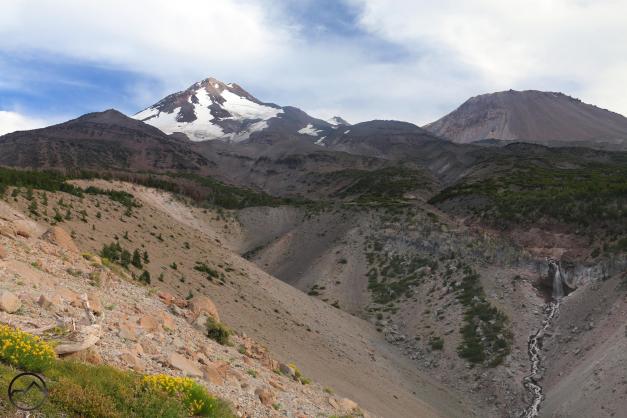
A gorgeous view of the upper portion of Bolam Creek Canyon.

Though most of the canyons on Mount Shasta suffer from some level of obscurity, Bolam Creek Canyon is perhaps the most obscure. The causes for this are many, but I think the two most important reasons are the fact that it is located on the edge of Mount Shasta’s east side, which is the most isolated and least visited side of Mount Shasta. This is compounded by the fact that there are no trails accessing the canyon. The North Gate Trail does pass within a mile of the trail but nearly all the hikers on that route are headed toward the summit, not a sandy off trail jaunt through a maze of white bark pine snags.

What winds up being lost in the mists of anonymity is one of the most magnificent scenes on Mount Shasta. Bolam Creek Canyon boasts fantastic views of Mount Shasta’s alpine heights along with one of the mountain’s finest waterfalls. The canyon itself is about 400-500 feet deep. Like most of the canyons on Mount Shasta, the walls of Bolam Creek Canyon are loose layers composed of sand, ash, cinders and other volcanic detritus. They tend to be V-shaped, obviously unexcavated by glaciers. However, like most of the canyons, once again, they are not disconnected from the glaciers on Mount Shasta. The Bolam Glacier, visible high overhead, releases its meltwater to feed Bolam Creek. The creek flows through the canyon, entering it by plunging over a cliff in a beautiful waterfall before cascading steeply into the depths of the canyon.

The waterfall in particular deserves a brief note. The canyon was once the home of Coquette Falls, which was the primary route by which the meltwater from the Bolam Glacier flowed into the canyon. The current location of the falls was only a seasonal cataract. However, sometime between 2006 and 2010 (probably closer to the latter) there was a significant outburst from the glacier that blocked up Bolam Creek’s original channel. This caused the flow to reroute to its current configuration and the full volume of the glacier’s meltwater to flow over the new waterfall. Consequently, Coquette Falls dried up. The new waterfall is sometimes called Bolam Creek Falls but I am eager to break away from the somewhat mundane names that dominate Mount Shasta’s waterfalls. I think something along the lines of New Coquette Falls is more interesting and memorable.

New Coquette Falls. Note the band of erosion resistant rock that has caused the falls to form.
Peering down into the depths of Bolam Creek Canyon.

A glance downstream into the inaccessible depths of the canyon. The loose walls make travel into the canyon difficult.
A closer view of the falls.

Looking south into the Shasta Valley from the canyon rim.

Whitney Creek Canyon

Mount Shasta and Shastina peek out above Whitney Falls and Whitney Creek Canyon.

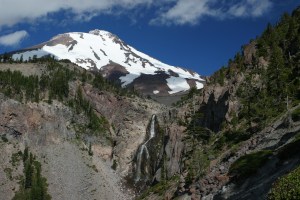
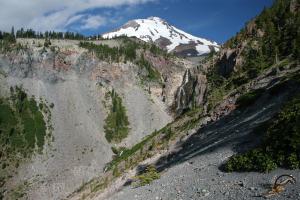
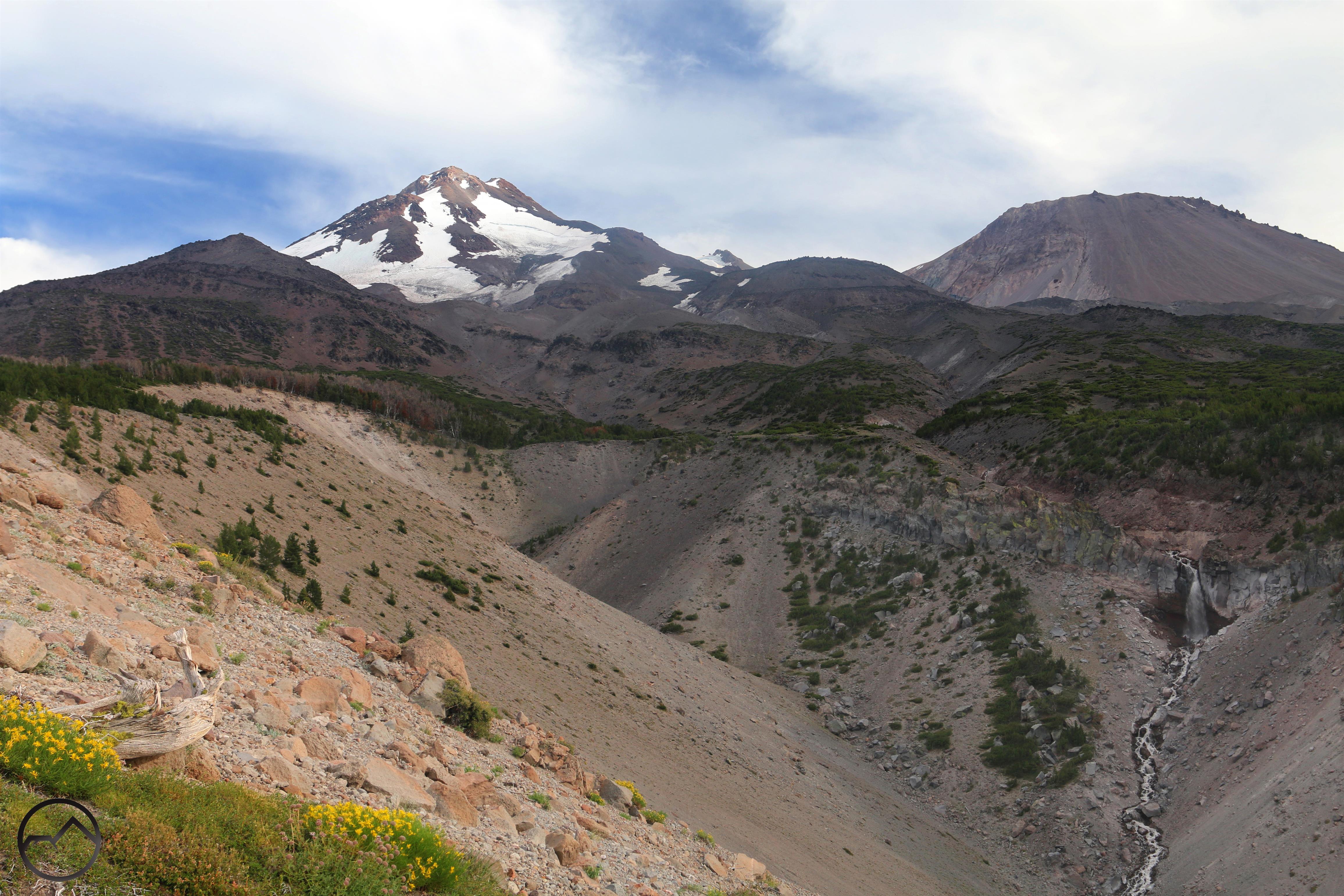
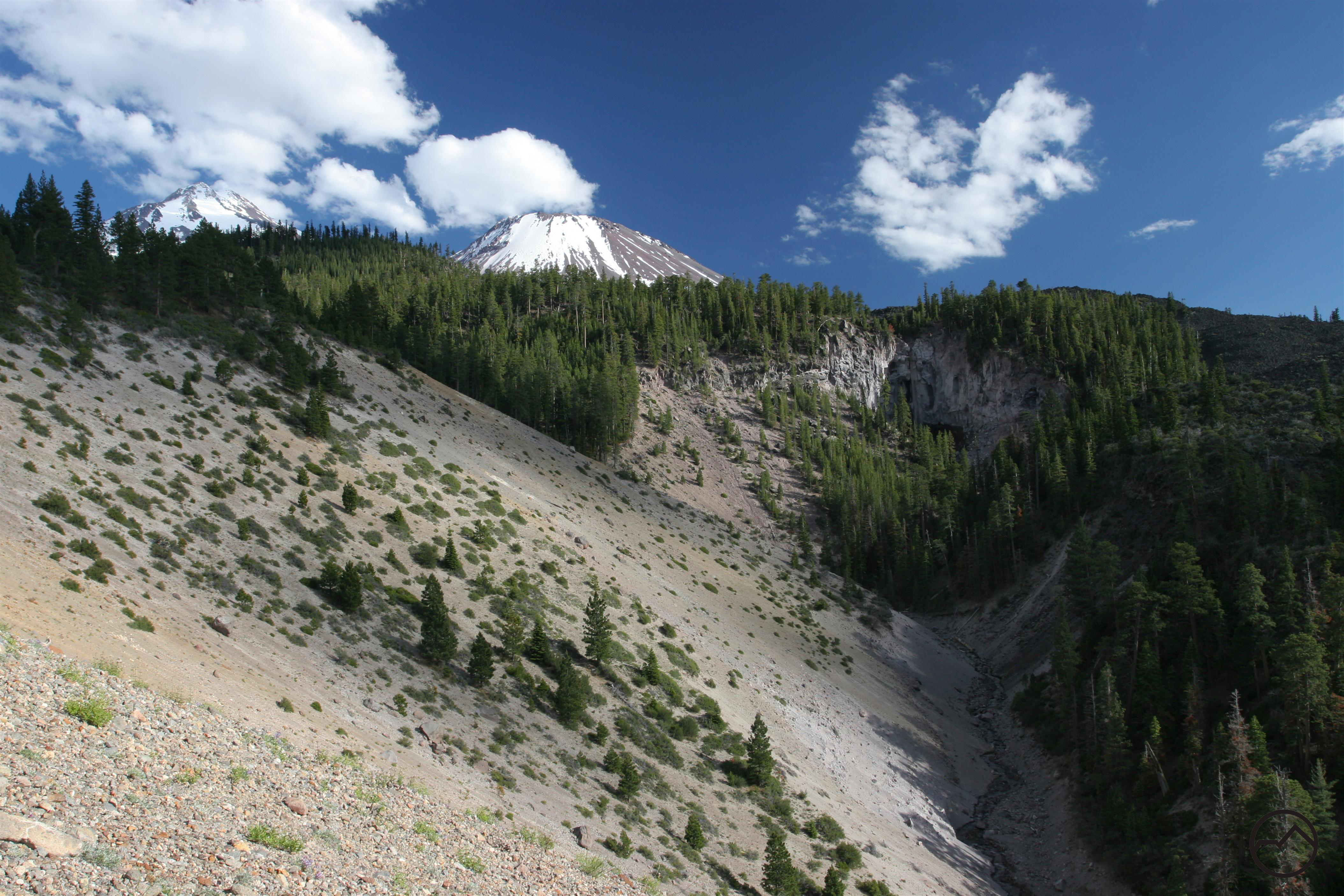
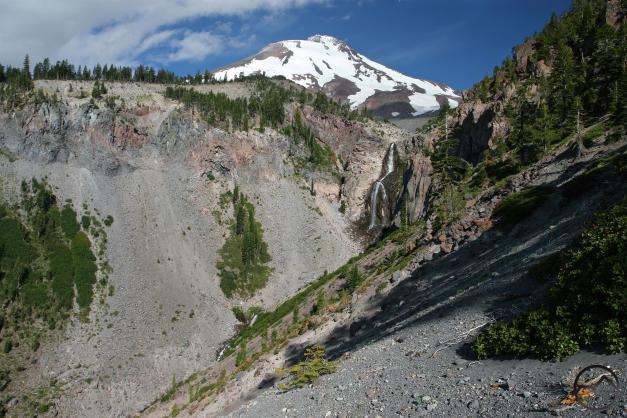
Whitney Creek Canyon is the smallest of Mount Shasta’s canyon. Carved by Whitney Creek, like nearby Bolam Creek, this waterway typically only flows in the heat of the summer, when the glaciers melt and the runoff flows swiftly off the mountain. Though shorter and shallower than Bolam Creek Canyon, they nonetheless exhibit similar characteristics. Both have sandy, sloped canyon walls with little rock extruding from the walls. Like its neighbor, the real highlight of Whitney Creek Canyon is the presence of Whitney Falls. Like all the major waterfalls on Mount Shasta, it is formed when the creek hits a band of erosion resistant rock. The water then plunges 200 feet into an isolated amphitheater. Whitney Falls is the most easily accessed of the waterfalls on the mountain, making it a popular hiking destination. However, it is important to watch whether there is water in Whitney Creek as is passes under Highway 97. If there is no water present, then it is unlikely that there is water flowing over the falls.
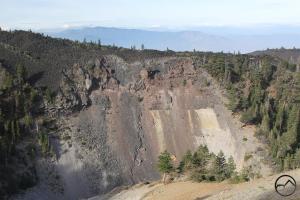
The cross-section of the Graham Lava Flow.

One feature unique to Whitney Creek Canyon is its proximity to the Graham Lave Flow. This means that the dark, craggy lava lines the western rim of the canyon. Not only does this give an unusual look to the canyon and enhance the wildness of the area, but it also reveals some fascinating geology. Downstream from Whitney Falls the creek has carved a course that, at one time, passed beneath the edge of the lava flow. Over time this area was undercut by the water and collapsed. Now it is possible to see the sandy layers beneath lava as well as the broken edges of where the lava gave way into the canyon. It is basically a giant cross-section view of a fresh lava flow. There may be other places to observe the internal structure of lava flows like this but if there are, this is still likely one of the easiest to get to.

The dark lava extends above Whitney Falls as well but the creek has only carved a shallow channel through this area. Consequently, the falls lie at the head of the canyon, not within it.

The summit of Mount Shasta and the broad north face of Shastina are seen above Whitney Falls and the head of Whitney Creek Canyon.
A closer view of Shastina and Whitney Falls

Whitney Creek flows through the isolated and difficult-to-reach depths of Whitney Creek Canyon.

The Shasta Valley spreads out to the north of Whitney Creek Canyon.
The large undercut of the Graham Lava Flow, which creates a cross-section view of the flow.

Diller Canyon
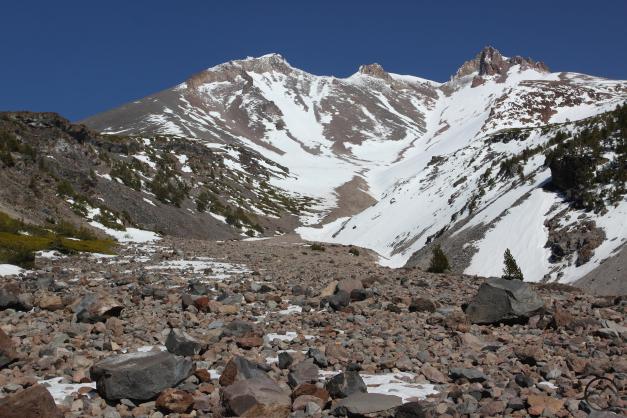
Looking up into the massive V-shaped upper portion of Diller Canyon.

Unusual in many respects, Diller Canyon is an outlier among the other chasms on Mount Shasta. Most notably, it is the only canyon on Shastina, Mount Shasta’s large satellite cone. It is also extends much further than most canyons on the mountain. It begins at the edge of Shastina’s eruption crater at nearly 11,500 feet and descends all the way down to approximately 5,000 feet. It is a single, linear chute from top to bottom. It is also the only one of the 5 canyons that does not have a significant waterfall in it. There are a couple of small cataracts (15-20 feet high) but that is all.
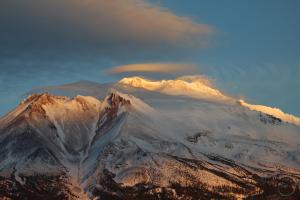
The upper reaches of Diller Canyon at sunset.

It’s character is different from the other canyons on Mount Shasta too. The other four canyons were formed by glacial runoff eroding their way through the loose ash and cinders that make up the lower flanks of Mount Shasta. Though Shastina does have a similar composition in some areas, Diller Canyon has glaciers and, consequently, no significant creek flowing through it (there is a small one during the spring thaw) but the canyon itself is much rockier than the other four. This is evident both in the presence of significant quantities of loose rocks but also in the rocky outcroppings that line the canyon rim. All of this combines to give Diller Canyon a far different appearance than the other canyons on Mount Shasta.

Diller Canyon is, by far, the most visible canyon on Mount Shasta. Prominently seen from much of the west side of Mount Shasta, the canyon has a distinct v-shape at its highest elevations but narrows down to a linear chute at its mid to lower elevations. Though many people don’t recognize Diller Canyon by name, it is among the most recognizable landmarks on the mountain.

A classic view up Diller Canyon
Inside the shallow inner gorge of Diller Canyon. Diller Canyon

One of the small, seasonal waterfalls inside Diller Canyon. Here it is frozen for the winter.
Looking downcanyon, toward China Mountain, highpoint of the Scott Mountains.

The shallow inner gorge of Diller Canyon.
The view north, across the canyon from the south rim.

Mud Creek Canyon

A staggering view of the massive, hoodoo-lined upper portion of Mud Creek Canyon.

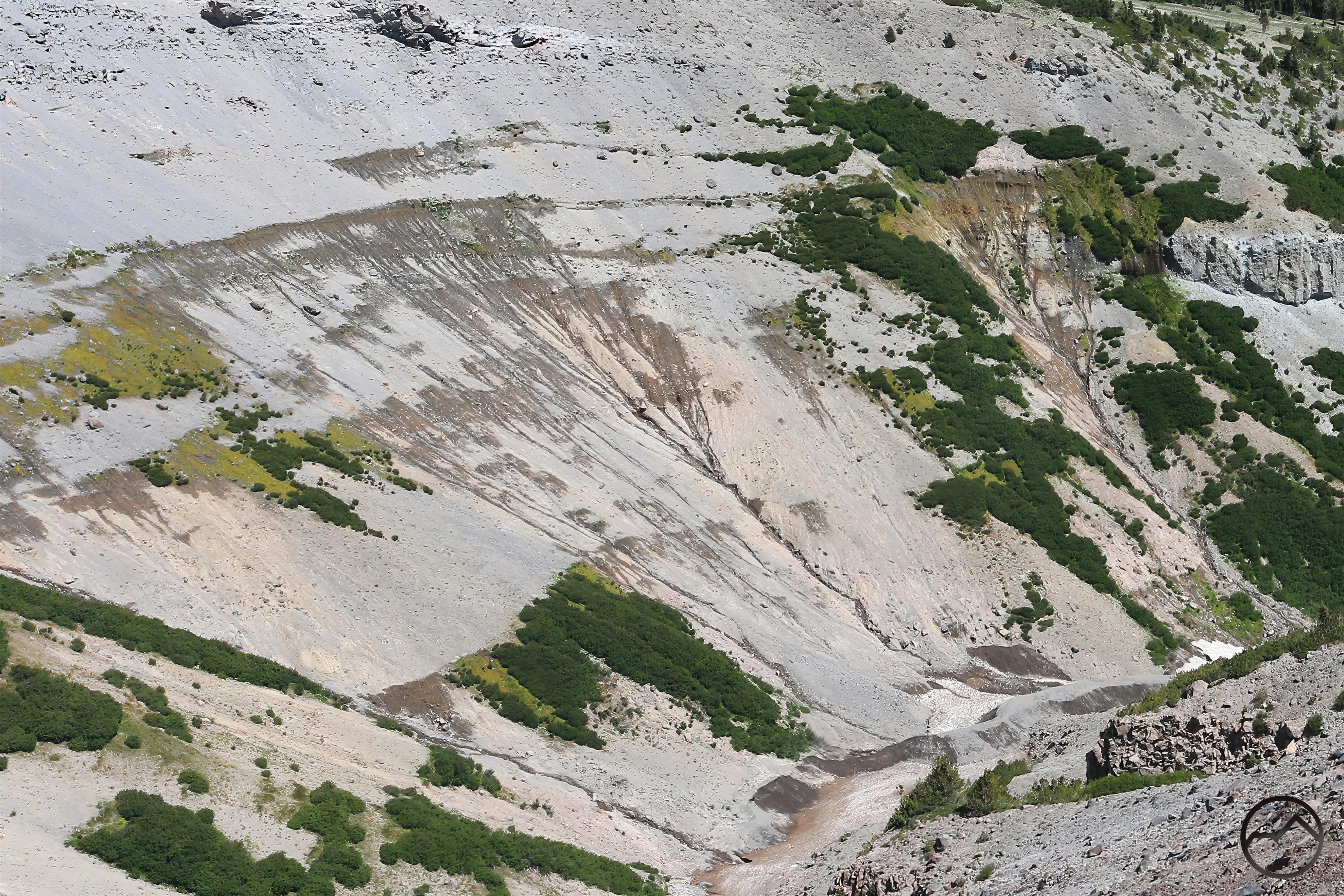
Mud Creek Canyon is simply one of the most spectacular features, not just on Mount Shasta, but in all of Northern California. Longer, larger and deeper than all the other canyons on the mountain, it is a natural titan of staggering proportions. Reaching up to 1,500 feet deep in some place (averaging about 1,100 to 800 feet for much of its course) and extending over 6 miles down the flanks of Mount Shasta, it is a colossal gap that literally cuts into the heart of Mount Shasta. The head of Mud Creek Canyon is formed in massive Mud Creek Basin, the oldest exposed part of Mount Shasta. Here one will find what is likely the most complicated and chaotic geology on the mountain, where 3 of the mountain’s 4 major eruption cones meet. It is a twisted, colorful landscape that is capped by the small (in relation to the four major glaciers on Mount Shasta) Konwakiton Glacier. This is the source of Mud Creek, which flows through the length of the canyon and is the largest stream coming off of Mount Shasta.
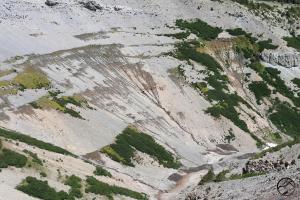
Springs and meadows emerge from between the strata.

As noted, the geology of Mud Creek Canyon is fabulously complex. Not only do 3 eruption cones (each representing a different epoch of Mount Shasta’s activity) meet here but the landscape has been both scoured by glaciers and continuously eroded. A look up into Mud Creek Basin reveals a seemingly unending series of layers broken, uplifted and twisted, forming a jumbled collection of spires and crags. This is also the most colorful corner of Mount Shasta, with a variety of exposed rock types all exhibiting different hues of red, purple, orange, yellow and gray. Below the upper basin, Mud Creek Canyon resembles the other canyons on the mountain (excepting Diller Canyon) in its composition. It is formed of loose ash and cinders, with the addition of sporadic large rocks punctuating the canyon walls. The canyon is still seeking its angle of repose and the sound of rocks clattering down the steep walls is common. Like the other canyons, but on a much grander scale, the loose aggregate of Mud Creek Canyon is divided into strata. Between many of these water flows through the layers. Where the canyon has cut away the strata, the water flows out into the open. Some are marked by large wet spots while others are the source of verdant meadows clinging to the side of the canyon walls. It is a fascinating and majestic spectacle.
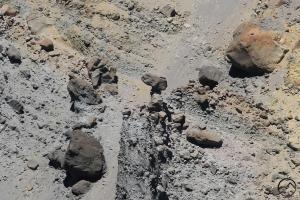
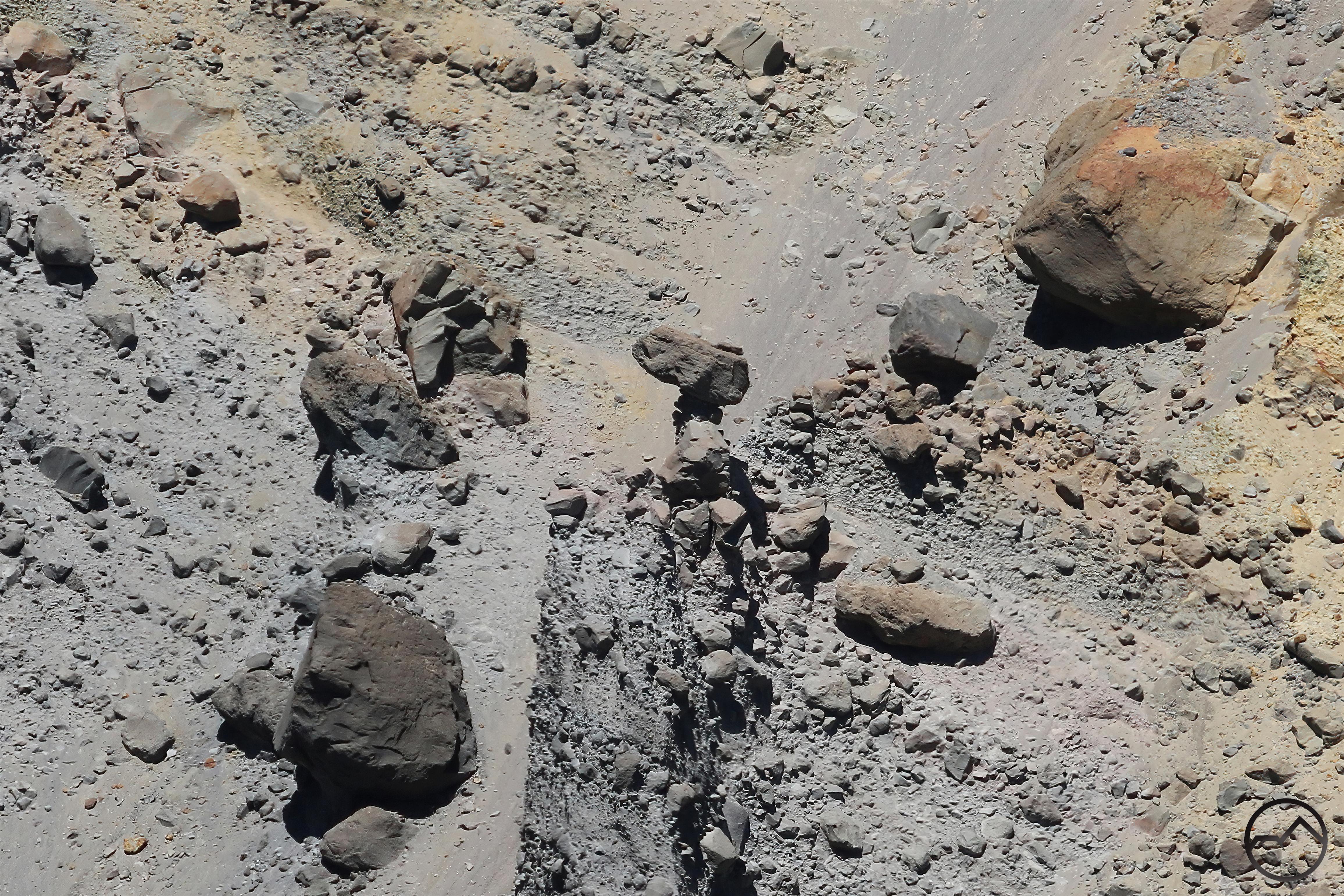
Telephoto view of Camel Rock from over a mile away.

One of Mud Creek Canyon’s most interesting features is the presence of large hoodoos. Such formations are not uncommon is volcanic geology but Mud Creek Canyon has some notably large and prominent ones. Unfortunately, these are only viewed from certain angles since the canyon itself is fairly remote and one must climb out onto the rim in order to observe them. The hoodoos are located on the walls of the upper canyon, but below the expanse of Mud Creek Basin. Though the base of the hoodoos seems stable, the upper portions of the towers appear to evolve rapidly. At time they feature balances rocks and just a couple years later, these rocks have toppled. Though many of them are quite interesting, one in particular stands out, which I have dubbed “Camel Rock”. This tower is not a traditional hoodoo but the remnants of one that has now collapsed. In its place stands a narrow neck of rock with a large, flat boulder balanced precariously on top. It is so named because it resembles New Mexico’s famed rock of the same name. It is hard to assess just how large the rock is but I think 30 – 40 feet high is not unrealistic. It is likely to topple at any time given the rapid rate at which the walls of Mud Creek Canyon evolve.

Lastly, Mud Creek Canyon features the highest concentration of large waterfalls on Mount Shasta. Two in particular are well over 100 feet high but the lower canyon also has a few large waterfalls that are over 25 feet in height. While these are beautiful and worthy destinations of exploration, it is the upper two falls that are the pinnacle of waterfall beauty in Mud Creek Canyon. The highest falls, Konwakiton Falls, pours out of Mud Creek Basin into the uppermost reaches of the canyon. At times parts of the falls are obscured by piles of debris. Sometimes the debris is flushed away by heavy runoff. The other waterfall is Mud Creek Falls, one of the classic falls on Mount Shasta and a contender for the mountain’s most beautiful.
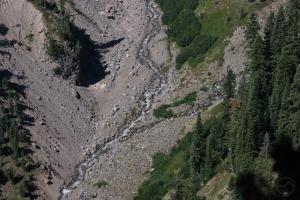
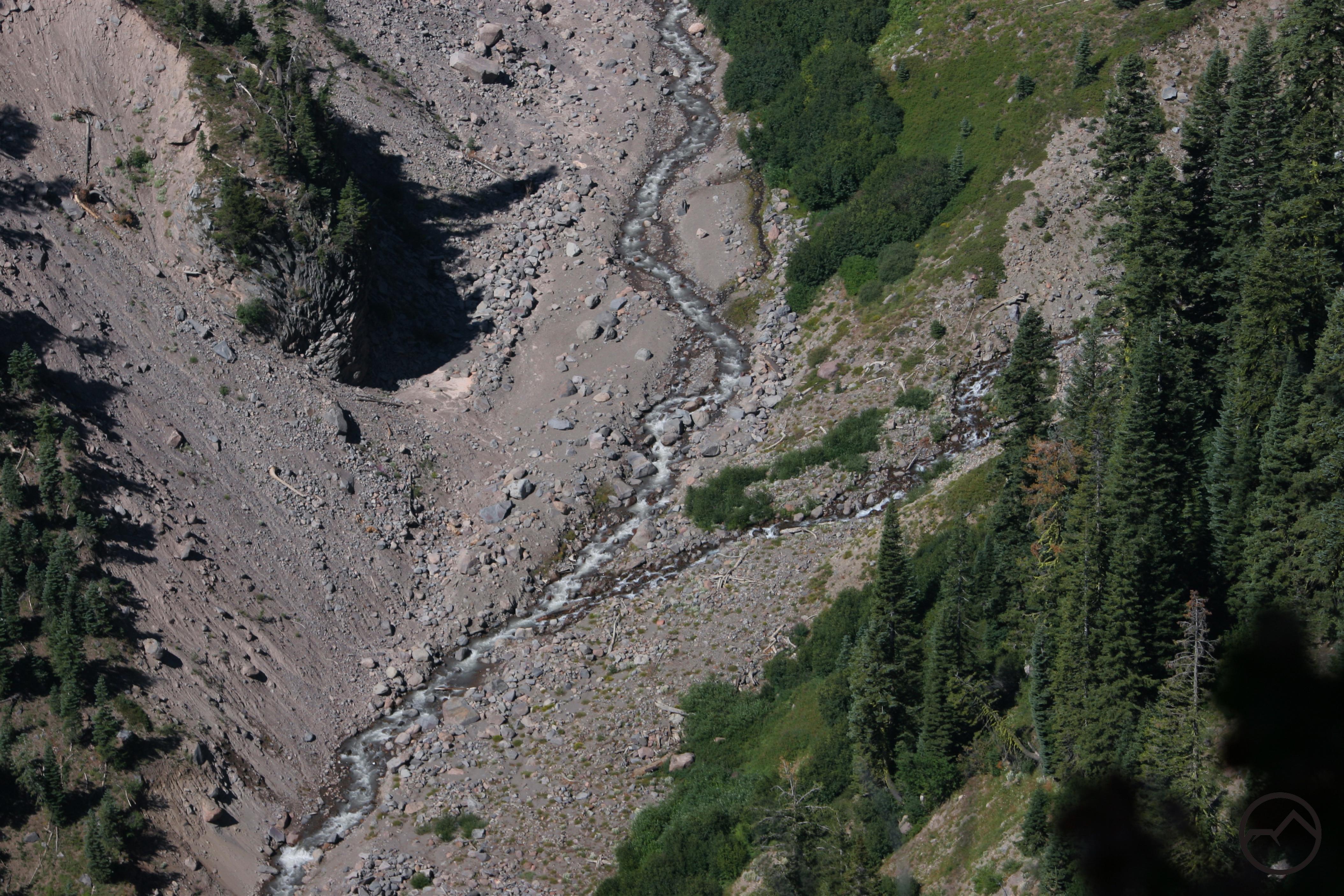
The confluence of Mud and Clear Creeks.

The sheer size of the canyon distinguishes it from the rest of the canyons on Mount Shasta. It also has far more distinct sections than the other canyons. The uppermost canyon is high, treeless and filled with giant hoodoos. Below that, the canyons deepens and doubles in width. It is through here that the extensive collections of springs burst from the stratified canyon walls. This section ends at Mud Creek Falls. Below the falls the canyons widens yet again, as Mud Creek is here joined by Clear Creek. This is the only major confluence of creeks in the depths of one of Mount Shasta’s canyons. Beyond the confluence, Mud Creek Canyon narrows, but still maintains a depth of around 800 feet. A few more notable waterfalls punctuate the creek.

All these features taken together, and given the massive scale of the canyon and its wild character, Mud Creek is easily one of the most scenic waterways in Northern California.

The massive upper section of Mud Creek Canyon.
Konwakiton Falls

Hoodoos lining the upper canyon.
Camel Rock

The middle, wider section of Mud Creek Canyon. Note the water seeping from the exposed strate.
A look up above Mud Creek Falls into the middle portion of Mud Creek Canyon.

The view from the east side across the widest section of Mud Creek Canyon.
A similar view of the canyon in early summer.

The confluence of Mud and Clear Creeks.
Mud Creek Falls

Mount Shasta peeks out above the lowest section of Mud Creek Canyon.
The lowest of the large waterfalls on Mud Creek Canyon.

Ash Creek Canyon

Spectacular Ash Creek Falls, the highest waterfall on Mount Shasta.

Ash Creek Canyon is located on the remote east side of Mount Shasta. Long and deep, it is the second largest canyon on the mountain. Though it is not the equal of nearby Mud Creek Canyon, the canyon carved by Ash Creek remains one of the most spectacular features on Mount Shasta. It boasts many excellent features. Chief among them is awesome Ash Creek Falls, which is the tallest, and likely the most beautiful, waterfall on the mountain. At about 350 feet high, it is a glorious sight, with Mount Shasta looming majestically behind it. The waterfall divides the canyon into two distinct sections. The lower, v-shaped section resembles most of the other canyons on the mountain. The upper section has a similar composition, consisting of ash and cinders, but is larger, wider and, most significantly, graced with the massive sheet of ice that is the Wintun Glacier. This is the third largest glacier in California (after the nearby Hotlum and Whitney Glaciers on Mount Shasta’s northeast and north side).

The canyon consists of two parts. The upper part is largely above tree line and is occupied by the Wintun Glacier at its highest reaches. The walls of the canyon are sand and cinder like the other canyons on Mount Shasta but the lack of trees and the presence of the glacier give it a distinct, wild feel that is altogether different from the other canyons on the mountain. The transition from the upper to lower canyon is Ash Creek Falls. Below the waterfall the canyon is more like the other canyons on the north side of the mountain. The trees crowd the canyon rim and the walls are steeply sloped loose cinders and rocks. However, here on the wetter, east side of Mount Shasta, the forest is much, much thicker and in some places consists of old growth Shasta red firs.

All these features make Ash Creek Canyon one of the more beautiful spots on Mount Shasta. Taken together, the canyon of Ash Creek deserves far more renown that it gets, even with its superlative waterfall.

A view toward the summit of Mount Shasta, through the upper section of Ash Creek Canyon. Note the Wintun Glacier at the head of the canyon.
The upper part of Ash Creek Falls is visible at the transition from the upper and lower canyon.

Mount Shasta and Ash Creek Falls.
A wider view showing the scale of the width of Ash Creek Canyon.

Gazing down into the nearly accessible interior of Ash Creek Canyon.
The classic V-shaped lower section of Ash Creek Canyon.
Mount Shasta GIF Gallery

Posted by bubbasuess on February 16, 2021
Posted in: Cascade Range, Hiking, Mount Shasta. 4 Comments

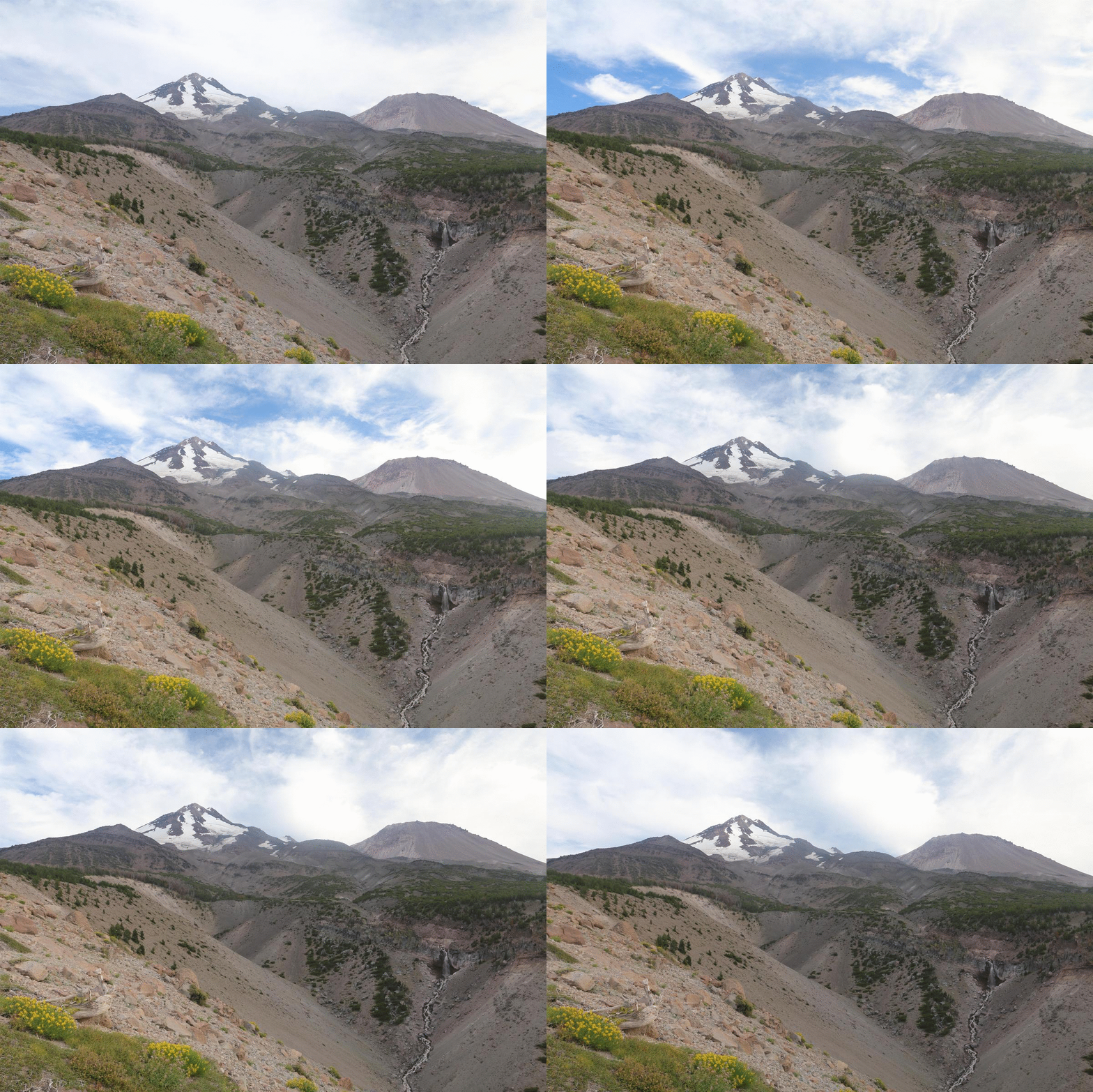
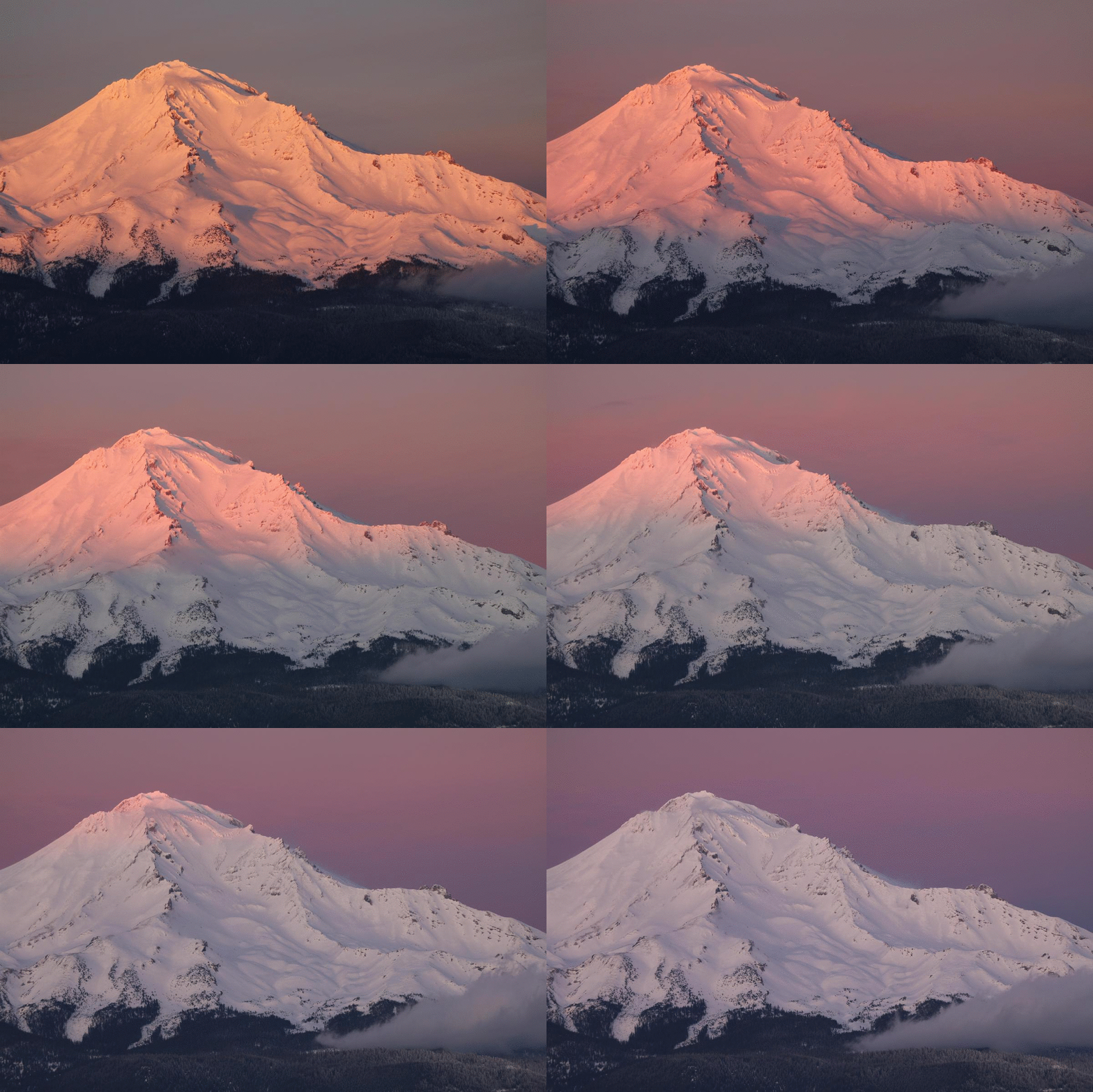
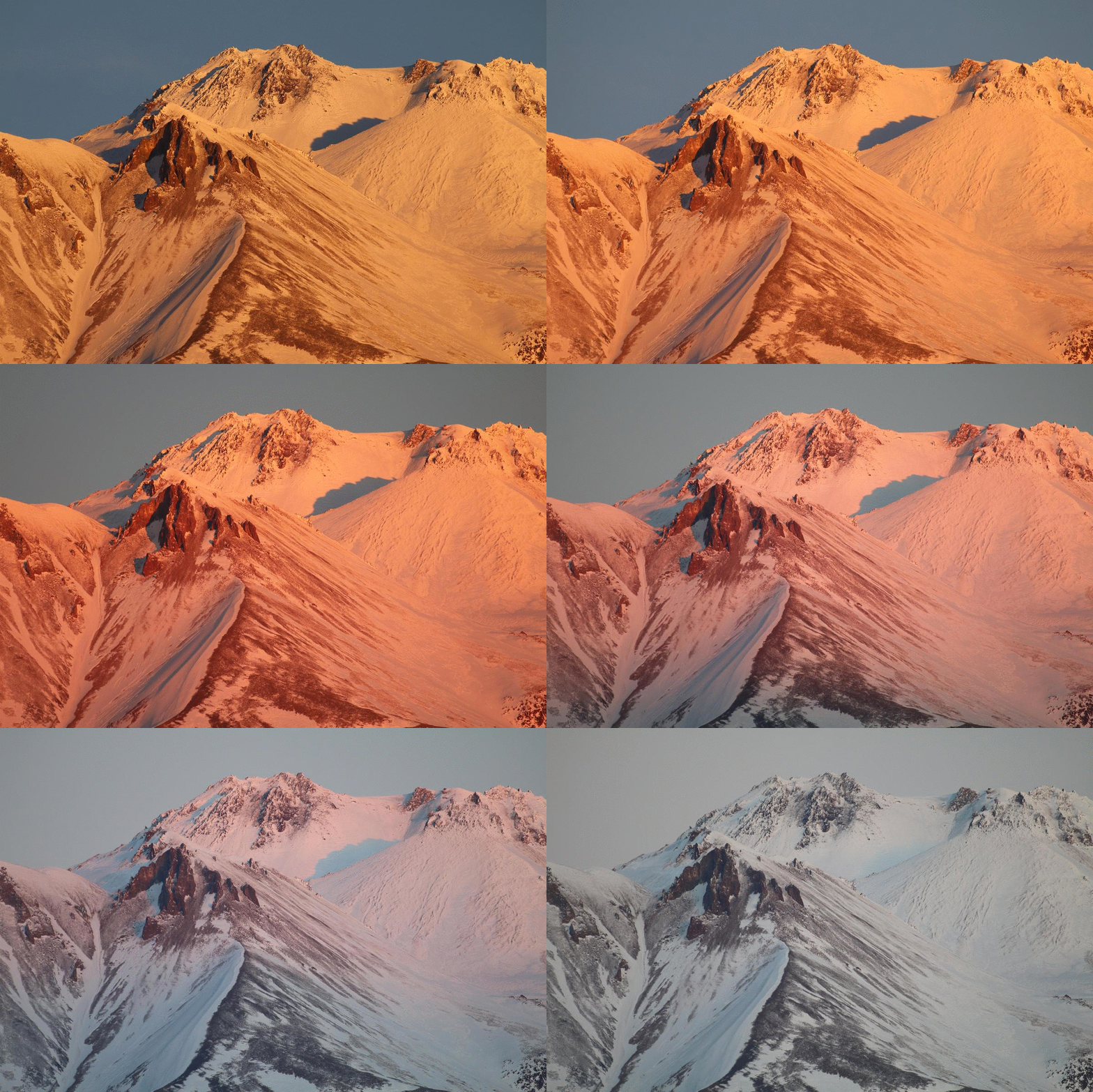
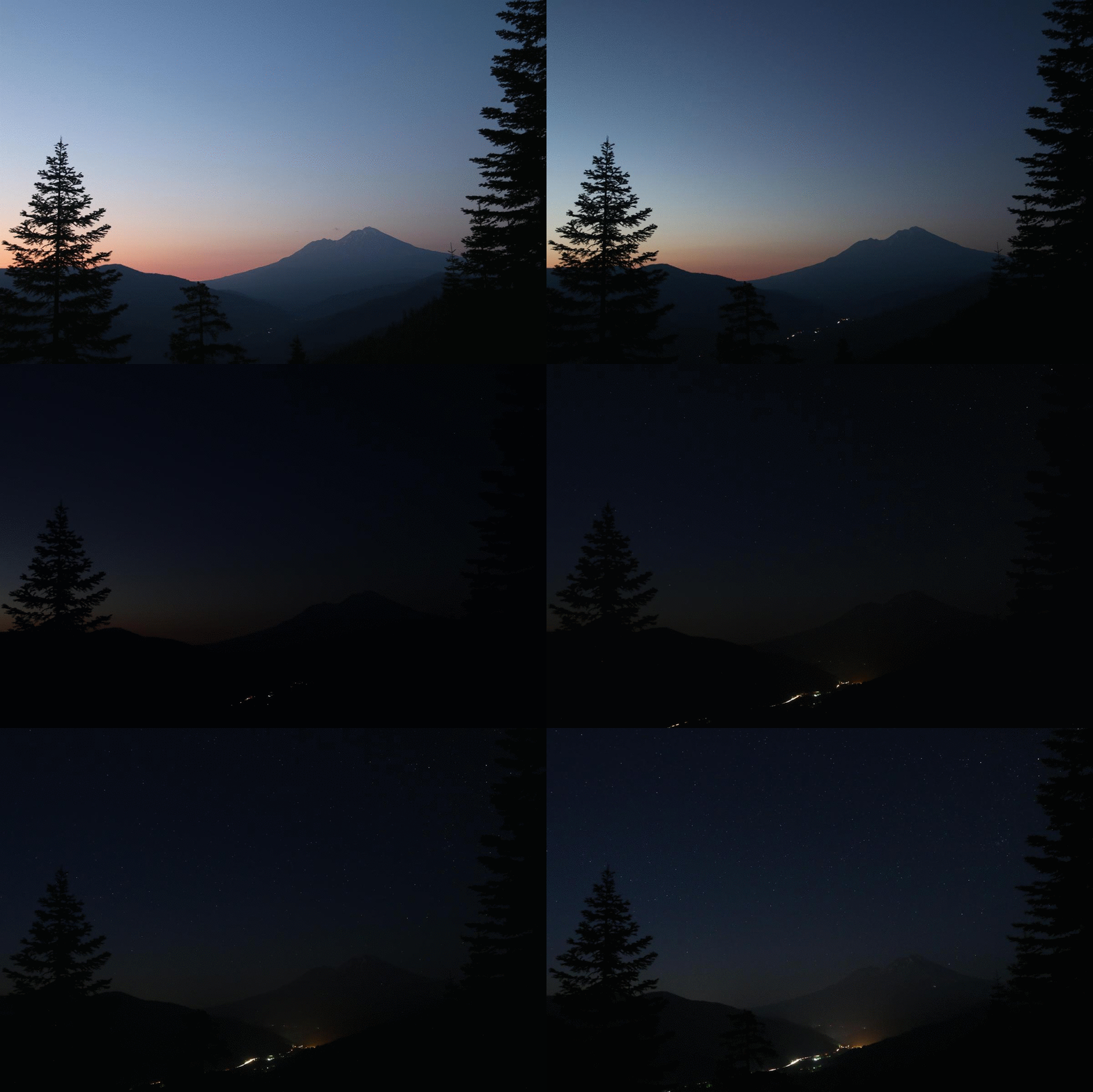
Over the years, it has been my focus to capture Mount Shasta in images and I have not ventured much beyond that in terms of other media. However, periodically over the last couple of years I have dipped my toe into making GIFs. They are essentially all low-grade time lapses. I have not had the patience or knowledge to make true, high quality time lapses but the GIFs give an idea of what the scene looked and felt like. That really is the essence of what I have sought to do with the entire Hike Mt Shasta website: to give those who come here a sense of place through images and the written word. This short little animations are just one more tool to accomplish that goal.

The thought occurred to me that I had finally accumulated enough animated images that I ought to gather them all together in one place and make them easier to find, for those so inclined. I hope that these capture, in some small way, the spirit of awe and majesty that is expressed through Mount Shasta!


This is probably my favorite GIF I have made. It was an epic sunrise full of color and awesome clouds. Note the shadow cast by the lenticular in the upper right. It is awesome testimony to how large the clouds are that the shadow is cast in the sky. This was one of my favorite sunrises of 2019.


There was nothing particularly noteworthy in the sky or anything else at this scene but the scene itself was epic enough. Looking south at the head the upper end of Bolam Creek Canyon, the Bolam Glacier clings to Mount Shasta’s heights. New Coquette Falls flows into the canyon from the side, pouring over a band of dense rock that has resisted erosion. Things don’t get too much more epic than this.


An awesome sunset on Mount Shasta viewed from the west. I love how the sunrises start at the summit of the mountain and then move downward while sunsets start at the base of the mountain and move upward. The latter leaves the last little bit of light clinging to the summit as the sun moves beyond the horizon and then the light just fades away. Magnificent.


Another sunset, this time viewed from the northwest. From here Mount Shasta looks less like a singular mountain and more like a collection of high peaks in a mountain range. This is in part due to the presence of Shastina, which dominates the lower left half of this frame. Its crags, as well as Diller Canyon, add a lot of depth to this perspective.


A spectacular morning at Lake Siskiyou, with a trio of lenticulars over Mount Shasta. The reflection wasn’t perfect but I was not complaining. This collection of clouds did not seem like they were going to amount to much but right before the light came they all coalesced into the formation as seen here.


A great, colorful morning at Lake Siskiyou with some awesome lenticulars over Mount Shasta. Aside from the awesome clouds, the most memorable aspect of this morning was the way the light bounced off of the high clouds and made the whole area glow. This is especially visible on Mount Shasta itself. No direct sunlight hit the mountain but the mountain lights up nonetheless.


Yet another morning at Lake Siskiyou. This sunrise had a nice reflection in the water and a full lake, so there was not bathtub ring visible. Though this animation is short, it gives a good example of how the sunlight creeps across the sky as the sun comes up.


This was a sunset I witnessed from Girard Ridge, south of Dunsmuir. I was there to try to capture a night image of Mount Shasta with the Neowise comet. The sunset itself proved to be pretty interesting and, though I don’t like man-made objects in my images, I have to confess the lights on I-5 did add a lot of interest to this scene. If you look carefully, you can spot lights descending Everitt Memorial Highway on Mount Shasta too. The change in brightness once the sun set was due to my adjusting the settings on my camera.


This sunset on Mount Shasta was graced by a nice lenticular wave. Not only is this a good example of how the light fades upwards but it also gives a good sense of how the waves are constantly in flux when they appear over the mountain. Overall, a pretty awesome sequence.


This scene was captured from McCloud, south of Mount Shasta. The cloud was a lenticular and that was more evident when viewed from the west. From the south the lens-shaped cloud could still be seen but its rougher, chaotic edge where it dissipated dominated this perspective.


This animation is short and has a bit of a lurch because of the camera shifting but it was an epic scene. What more can I say?


Mount Shasta was not very visible for this event but the way the lenticulars clouded up and then casted off the extra cloud was pretty awesome. The sequence captured here was the third of three that I witnessed as the sun was coming up.


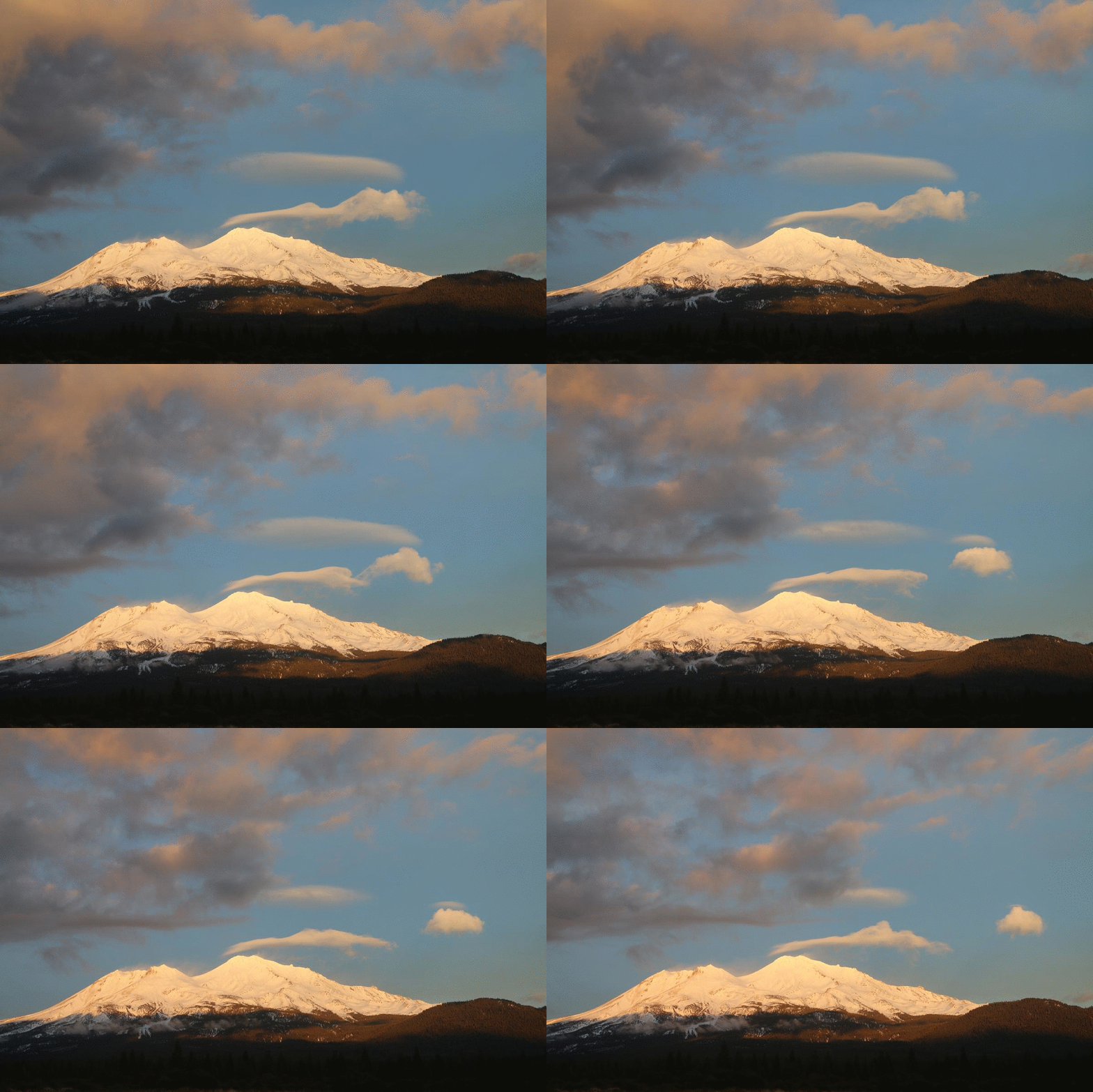
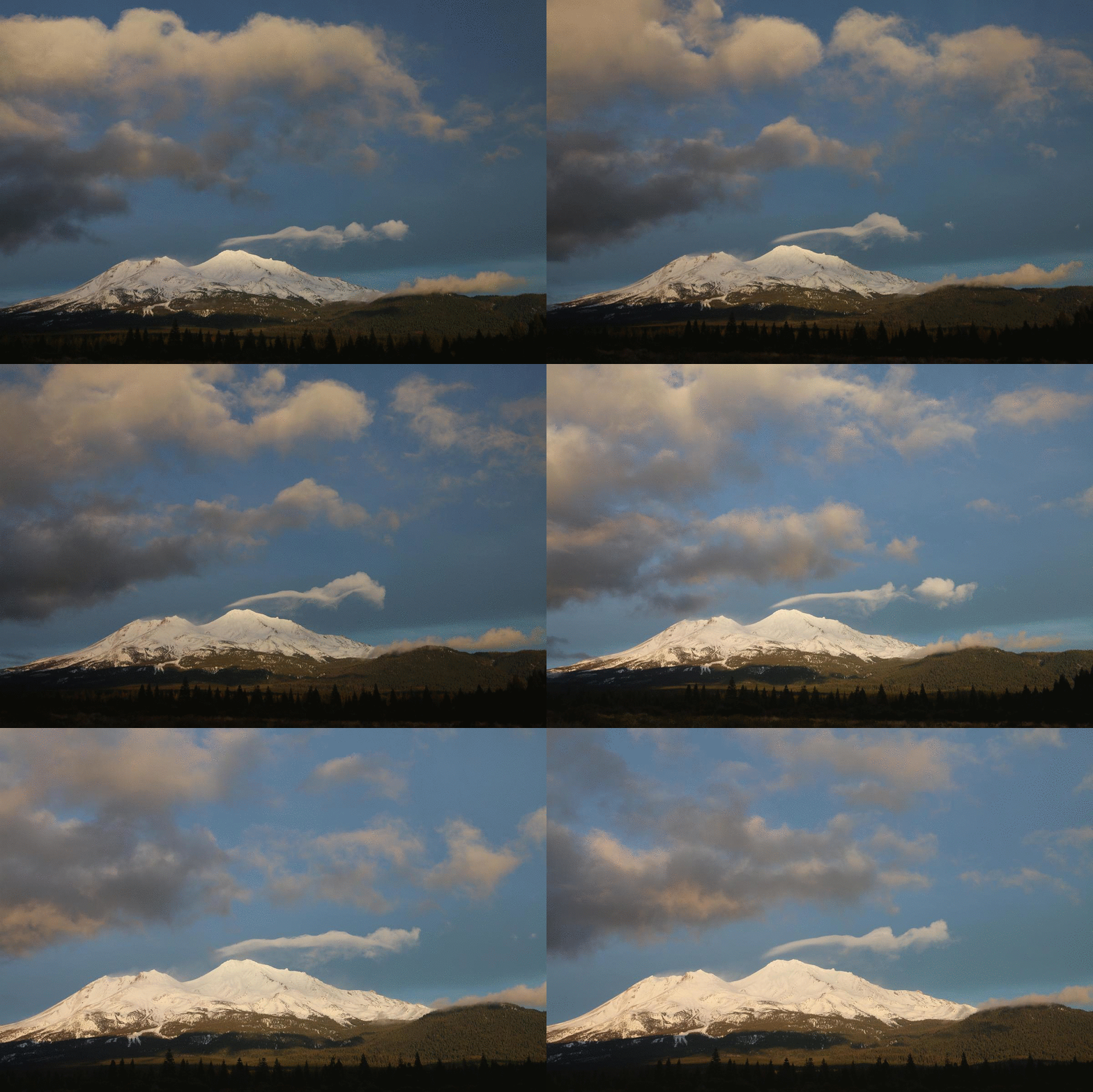
This particular animation was intended to document the way the wave over the mountain and the disk above it sloughed off a corresponding smaller cloud and smaller disk. I have never seen a formation like this nor this kind of behavior where twin segments separated themselves from the main clouds.


This was the first GIF I made for Hike Mt Shasta. it was short and had some camera lurch but it was only intended to be an experiment to see if such an animation were possible. A bit of history, this one!

2021 Winter Hiking Round Up

Posted by bubbasuess on February 14, 2021
Posted in: Cascade Range, Hiking, Mount Shasta, Off Season Trails, Winter Trails. 2 Comments

Mount Shasta and lenticular clouds viewed from the Lake Siskiyou Trail.

The winter season of 2020-2021 has been with us for a few months now. Things started off pretty slowly, with some rain here and there. I nice snow came through on Christmas day and stuck. The temperatures were low enough for the snow to linger for a while but it eventually melted off. Then, towards the end of January a heavy storm came through, leaving over 3 feet in some inhabited areas, a little less in town. Rain fell heavily in the Mount Shasta’s rain shadow as well. Now we are halfway through February, which means there is only a month and a half of “winter” left, though we know April can be winterlike at times. With a lot of snow still on the ground, it is high time for many of us to start feeling the pinch of cabin fever and we want to get outside.

Fortunately, the Mount Shasta area’s geography makes it possible for numerous trails to be snow-free in the winter time. The volcano rises out of low valley that lies between the high mountain areas of the Cascade Range and Klamath Mountains. The valley floor itself is low enough that it often escapes the snow that falls at higher elevations. The rivers then rush south, falling lower in elevation still and avoid even more snow. Yet, too the north lies the rain shadow of Mount Shasta. Rather than great conifer forests, the area is desert, thanks to the mountain wringing moistures from the storms that move through. Here, the snow falls infrequently and the trails that explore this area offer hikers great views, lots of sunshine and a strikingly different kind of environment from the alpine areas immediately to the south.

Whatever you are looking for in a winter trail, it is hard to find a more diverse and spectacular setting than those around Mount Shasta!

The following are all articles that discuss off-season hiking opportunities in Mount Shasta. They can also be accessed from the “trails” drop down menu. Click to enlarge all images.

Three Winter Trails Near Mount Shasta City

Mount Shasta City is blessed with a number of great paths within and just outside of its city limits. Three of the best are the Box Canyon, Ney Springs and Spring Hill Trail. These offer solitude, Mount Shasta Vistas, unique history, spectacular geography and even some excellent waterfalls. These all lie just minutes outside of town. Also, don’t forget that Mount Shasta City has some great short trails right in town! Read more here.

Box Canyon of the Sacramento River.
Inside the Box Canyon of the Sacramento
Faery Falls at high water.
Rocky Point on the Spring Hill Trail.

Winter Hikes On The Lake Siskiyou Trail

The Lake Siskiyou Trail is an incredible recreational resource just a couple minutes outside of Mount Shasta City. During the summer and fall, a loop trail encircles the lake. However, in winter the seasonal bridges over the Sacramento River are removed. While the loop can’t be hiked without fording the river (extremely dangerous after storms and during high runoff), several sections of the trail still make great out and back hikes. They feature beautiful forests, the lake itself and incredible views. Read more here.

Mount Eddy at the Sacramento River inlet.
Hiking along South Shore
Views from North Shore.
December

Winter Hikes On The Sacramento River

Most people in California think of the Sacramento River as the wide, winding waterway that lazily flows through the Central Valley. Here just below the headwaters, however, it is a swiftly flowing mountain river. Deep in its canyon, the lower elevation means it is often free of snow and the trails are easily accessed. Hiking along the river in winter is a treat that offers a taste of wild mountains for minimal effort. Read more here.

Hedge Creek Falls
Behind Hedge Creek Falls
Rapids Along the River Trail.
Along the Sacramento River Trail.

Winter Hikes In The Shasta Valley

North of Mount Shasta, the desert landscapes of the Shasta Valley offer a strikingly different environment than what is found along most trails in the region. The only conifers here are junipers and sagebrush is ubiquitous. For those that like the desert, the beauty of this area needs no explanation. For those less familiar, there is ample wildlife, beautiful rock formations and magnificent 360 degree views, crowned by some of the best views of Mount Shasta to be found anywhere. Unfortunately, part of the Yellow Butte Trail has been fenced off. There is still a lot of interesting terrain to explore on the Butte but be aware of land boundaries. Read more here.
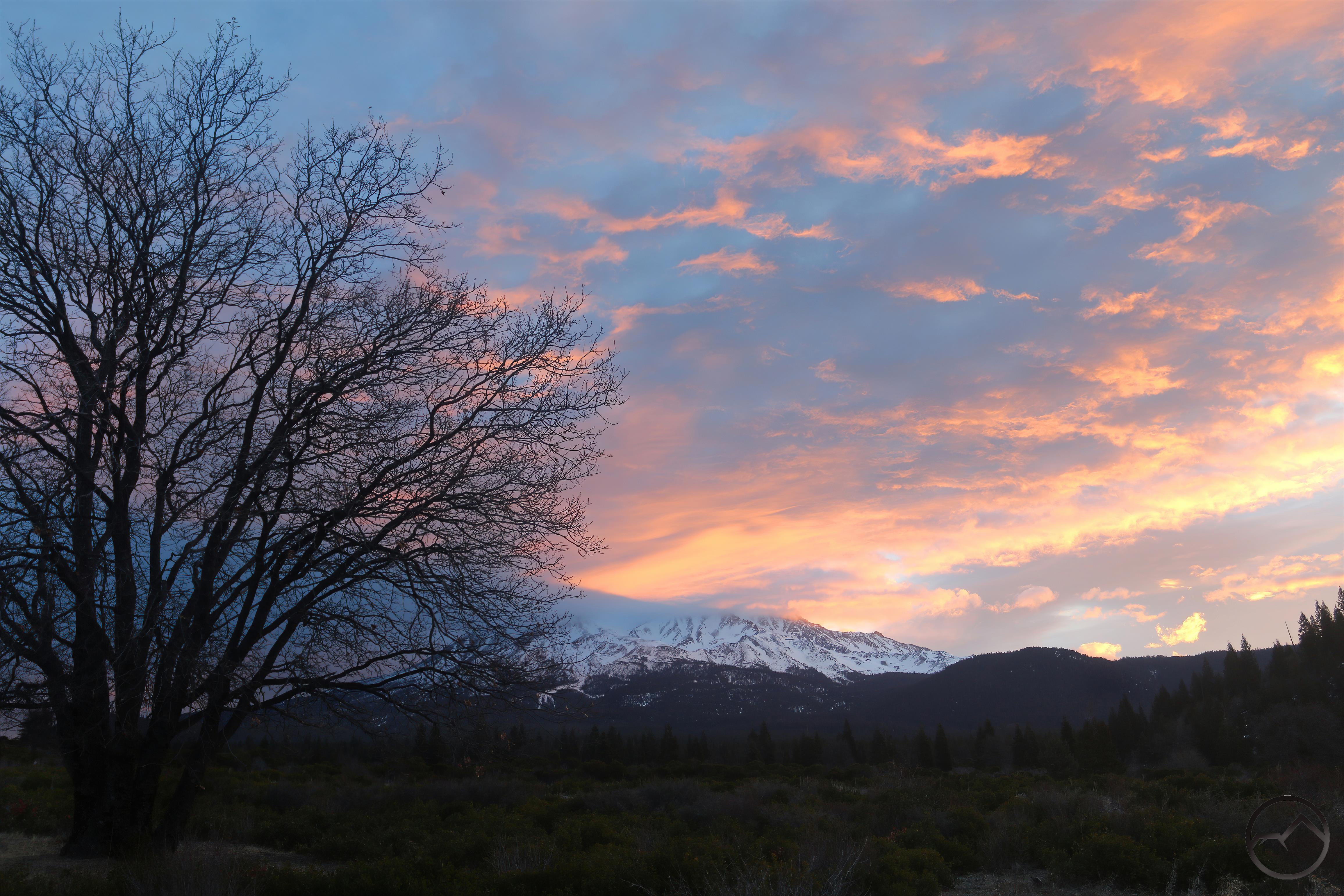
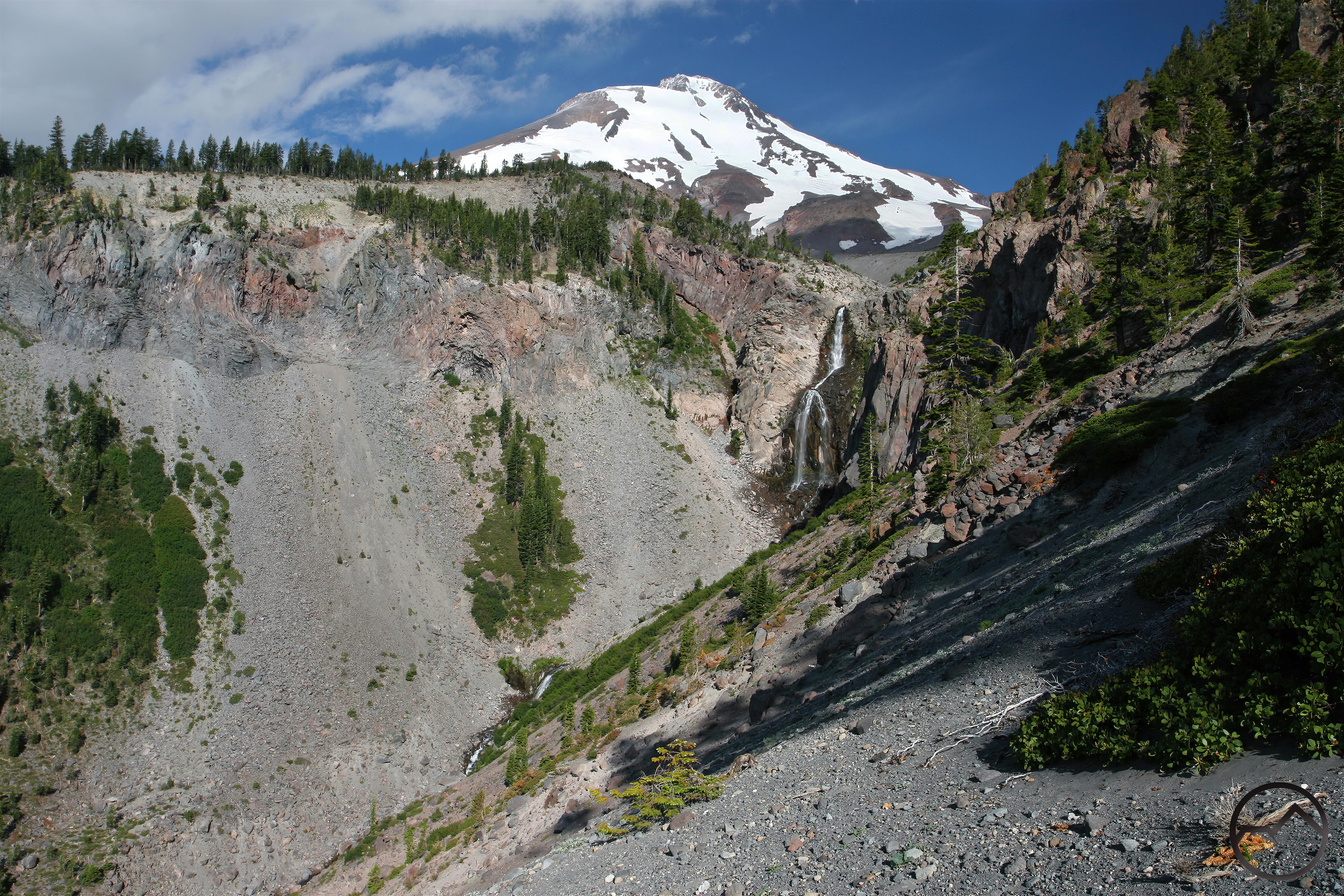
Mount Shasta from the Haystack.
Herd Peak, Sheep Rock and Yellow Butte
Pluto Cave
Mount Shasta rises above Pluto Cave

Winter Hikes In The Shasta Valley Wildlife Refuge

At the northern end of the Shasta Valley lies a large parkland administered by the State of California. The Shasta Valley Wildlife Refuge was once a working ranch but is now a haven for a variety of wildlife, especially birds. It is also a refuge for hikers looking for incredible vistas. Though it can be closed at times during winter, there are still opportunities to explore it and once it is reopened completely, it is a place of great beauty, beckoning to be explored! Read more here.

Mount Shasta reflects in a pool by Steamboat Mountain.
Looking north toward the Siskiyous
The Cascade Crest seen from Trout Lake
Mount Shasta looms far beyond Trout Lake

Other parts of the Mount Shasta area are best hiked in spring, but often, during drier winters with less snow, some of these areas are also easily accessed during winter and offer stunning hikes for those looking for longer and more rugged outings. It must be noted that these areas have a higher chance of being inaccessible during snowy winters.

Spring Hikes In The Castle Crags

The Castle Crags are one of the most majestic mountain features in California. However, their lower elevation means they are often accessible when higher terrain is still smothered in snow. Still, the granite spires and great rock walls stand shoulder to shoulder with some of the most rugged terrain in the state. Though best hiked in spring, when the creeks are gushing and the weather, especially on the south side where most trails are found, is perfect, the winter may still be a good time to get out and enjoy this gorgeous mountain playground. Read more here.

Spires of the Crags
Mount Shasta seen from the Castle Crags

Spring Hikes On The Upper McCloud River

The McCloud River is one of the great attractions of the Mount Shasta area. With great fishing, a trio a awesome waterfalls, and beautiful forest surroundings, it is a popular destination. The waterfall along the river is a great hike and ought to be considered during winter if the access road is open. However, the McCloud River Trail follows the river for 15 miles and any section of this makes a great hike as long as snow is not covering the ground. Read more here.

Basalt gorge on the McCloud River
The McCloud River downstream from Cattle Camp.
McCloud River from the top of Middle Falls
Middle McCloud Falls

Spring Hikes On The Lower McCloud

The Lower McCloud River sees far less activity than the upper section. Separted by Hearst property and the McCloud Reservoir, the two areas are strikingly different. The upper section flows through volcanic terrain while the lower part passes through an outlier of the Klamath Mountain. The terrain is very rugged and can be difficult access during winter. However, when it can be reached, solitude a beautiful scenery await! Read more here.

Large cataract on the McCloud River
The McCloud River from the PCT crossing.
In the McCloud River Canyon
Squaw Valley Creek Falls

Posts navigation

← Older Entries
Newer Entries →
    • Recent Posts

      • Winter Shows Up When It Will
      • January Rolled By With Mud, Then Very Dry
      • Mount Shasta 2025 – A Year In Images
      • Mount Shasta On Either Side Of Christmas
      • Adrift In An Ocean Of Fog
      • December Has Been Spectacular Thus Far Pt. II (A Magnificent Lenticular)
      • December Has Been Spectacular Thus Far Pt. I
      • Lenticular Interrupted
      • A Stormy Wave And A Truchas Sunset
      • Aurora Lenticularis
    • Enter your email address to follow Hike Mt Shasta and receive notifications of new posts by email.

    • Archives

      • February 2026
      • January 2026
      • December 2025
      • November 2025
      • October 2025
      • September 2025
      • August 2025
      • July 2025
      • June 2025
      • May 2025
      • April 2025
      • March 2025
      • February 2025
      • January 2025
      • December 2024
      • November 2024
      • October 2024
      • September 2024
      • August 2024
      • July 2024
      • June 2024
      • May 2024
      • April 2024
      • March 2024
      • February 2024
      • January 2024
      • December 2023
      • November 2023
      • October 2023
      • September 2023
      • August 2023
      • July 2023
      • June 2023
      • May 2023
      • April 2023
      • March 2023
      • February 2023
      • January 2023
      • December 2022
      • November 2022
      • October 2022
      • September 2022
      • August 2022
      • July 2022
      • June 2022
      • May 2022
      • April 2022
      • March 2022
      • February 2022
      • January 2022
      • December 2021
      • November 2021
      • October 2021
      • September 2021
      • August 2021
      • June 2021
      • May 2021
      • April 2021
      • March 2021
      • February 2021
      • January 2021
      • December 2020
      • November 2020
      • October 2020
      • September 2020
      • August 2020
      • July 2020
      • June 2020
      • May 2020
      • April 2020
      • March 2020
      • February 2020
      • January 2020
      • December 2019
      • November 2019
      • October 2019
      • September 2019
      • August 2019
      • July 2019
      • June 2019
      • May 2019
      • April 2019
      • March 2019
      • February 2019
      • January 2019
      • December 2018
      • November 2018
      • October 2018
      • September 2018
      • August 2018
      • July 2018
      • June 2018
      • May 2018
      • April 2018
      • March 2018
      • February 2018
      • January 2018
      • December 2017
      • November 2017
      • October 2017
      • September 2017
      • August 2017
      • July 2017
      • June 2017
      • May 2017
      • April 2017
      • March 2017
      • February 2017
      • January 2017
      • December 2016
      • November 2016
      • September 2016
      • August 2016
      • July 2016
      • June 2016
      • May 2016
      • April 2016
      • March 2016
      • February 2016
      • January 2016
      • December 2015
      • November 2015
      • September 2015
      • August 2015
      • July 2015
      • June 2015
      • May 2015
      • April 2015
      • March 2015
      • February 2015
      • January 2015
      • December 2014
      • November 2014
      • July 2014
      • June 2014
      • May 2014
      • April 2014
      • March 2014
      • February 2014
      • January 2014
      • December 2013
      • November 2013
      • October 2013
      • September 2013
      • August 2013
      • July 2013
      • June 2013
      • May 2013
      • April 2013
      • March 2013
      • February 2013
      • January 2013
    • Categories

      • Boy Scouts
      • Cascade Range
      • Castle Crags
      • Desert
      • Echo Point
      • Glaciers
      • Hiking
      • How things came to be…
      • Klamath Mountains
      • Konwakiton Outdoor Designs
      • Lakes
      • Lenticular Clouds
      • Maps
      • Marble Mountains
      • Meadows
      • Mount Eddy
      • Mount Shasta
      • Mount Shasta History
      • Napa County
      • Off Season Trails
      • Pacific Crest Trail
      • Peaks
      • Rivers
      • Rock Climbing
      • Scott Mountains
      • Seldom Seen
      • Shasta Valley
      • Sierra Nevada
      • Siskiyou Mountains
      • Sonoma County
      • Spring Trails
      • sunrise
      • sunset
      • Trinity Alps
      • Trinity Divide
      • Truchas Ridge
      • Uncategorized
      • Water
      • Waterfalls
      • Wilderness
      • Wildflowers
      • Wine Country
      • Winter Trails
      • Yosemite
    • Meta

      • Create account
      • Log in
      • Entries feed
      • Comments feed
      • WordPress.com
    • Copyright © 2013-2024 by Bubba Suess

      DISCLAIMER: Any use of the information contained in this site by any and all persons is done at their own risk. The operator of this site shall be held harmless from any and all alleged claims, demands, causes of action, liability, loss, damage and/or injury to property or persons whether brought by an individual or other entity. This indemnification applies, without limitation, to all actions by an individual or other entity as a result of their use of information contained in this site.

    Blog at WordPress.com.
    Hike Mt. Shasta
    Blog at WordPress.com.
    • Subscribe Subscribed
      • Hike Mt. Shasta
      • Join 983 other subscribers
      • Already have a WordPress.com account? Log in now.
      • Hike Mt. Shasta
      • Subscribe Subscribed
      • Sign up
      • Log in
      • Report this content
      • View site in Reader
      • Manage subscriptions
      • Collapse this bar
     

    Loading Comments...