Hike Mt. Shasta

Exploring the Mount Shasta Region

  • Home
  • Trails
    • Mount Shasta Trails
      • Brewer Creek Trail
      • Clear Creek Trail
      • Gray Butte Trail
      • Green Butte Ridge Trail
      • Horse Camp Trail
      • North Gate Trail
      • Old Ski Bowl Trail
      • Panther Meadow Trail
      • South Gate/Squaw Meadow Trail
      • Whitney Falls Trail
    • Trinity Divide Trails
      • Blue Divide Trail
      • Castle Lake Trail
      • Castle Lake Shore Trail
      • Cliff Lake Trail
      • Deadfall Lakes Trail
      • Gray Rock Lakes Trail
      • Gumboot Trail
      • Heart Lake Trail
      • Porcupine & Toad Lakes Via Pacific Crest Trail
      • Seven Lakes Basin Via Pacific Crest Trail
      • Sisson-Callahan Trail
      • Soapstone Trail
      • South Mumbo Scramble
      • Tamarack Lake Trail
      • Toad Lake Trail
    • Castle Crags Trails
      • Burstarse Falls Via Pacific Crest Trail
      • Castle Dome Trail
      • Flume Trail
      • Lower Castle Crags Via Pacific Crest Trail
      • Root Creek Trail
    • Scott Mountains Trails
      • Bluff Lake & Cement Bluff via Pacific Crest Trail
      • Caldwell Lakes Trail
      • China Mountain Scramble
      • Cory Peak and Bull Lake via Pacific Crest Trail
    • Cascade Crest
      • Ash Creek Butte Scramble
      • Goosenest Trail
      • Juanita Lake Trail
      • Orr Lake Trail
    • Mount Shasta City Area Trails
      • Black Butte Trail
      • Box Canyon Trail
      • Gateway Trail
      • Lake Siskiyou Trail
      • Mount Shasta City Short Trails
      • Ney Springs Canyon Trail
      • Spring Hill Trail
    • Shasta Valley Trails
      • Black Lava Trail
      • Haystack Trail
      • Lake Shastina Trail
      • Pluto Cave Trail
      • Trout Lake Trail
      • Yellow Butte Trail
    • Sacramento River Trails
      • Dunsmuir Trail
      • Hedge Creek Falls Trail
      • Sacramento River Trail
      • Sims History Trail
    • McCloud River Trails
      • Ash Camp To Ah-Di-Na Via Pacific Crest Trail
      • McCloud River Falls Trail
      • McCloud River Preserve Trail
      • Squaw Valley Creek Trail
      • McCloud River Trail: Algoma Camp to Nitwit Camp
      • McCloud River Trail: Nitwit Camp to Cattle Camp Swimming Hole
      • McCloud River Trail: Cattle Camp Swimming Hole to Camp 4
      • McCloud River Trail: Camp 4 to Upper McCloud Falls
      • McCloud River Trail: Pine Tree Hollow Loop
    • Trails Further Afield
      • Trinity Alps Trails
        • Bear Lakes Trail
        • Billys Peak Trail
        • Boulder Creek Lakes Trail
        • Boulder Lake Trail
        • Canyon Creek Trail
        • Caribou Lakes Trail
        • East Boulder Lake Loop
        • East Weaver Lake Trail
        • Four Lakes Loop
        • Granite Peak Trail
        • Grizzly Creek Trail
        • Gulch Lakes Loop
        • Hidden Lake Trail
        • South Fork Lakes Trail
        • Stoddard Lake Trail
        • Stoney Ridge Trail
        • Tangle Blue Lake Trail
      • Warner Mountains
        • Emerson Creek Trail
        • Highgrade Trail
        • Patterson Lake Via Warner Summit Trail
        • Pine Creek Trail
        • Squaw Peak Trail
  • Articles
    • Trails By Area
      • Mount Shasta
        • Vistas, Meadows And Waterfalls: Three Best Hikes On Mount Shasta
        • The End Of The Road: Three Hikes In The Old Ski Bowl Area
        • Two Trails From Bunny Flat
        • Three Trails On Mount Shasta’s East Side
        • Mount Shasta’s Hummingbirds
      • Trinity Divide
        • Great Lakes: Top Five Lake Basins In The Trinity Divide
        • The Headwaters Of The South Fork Of The Sacramento River
        • Neglected Headwaters: Two Lesser Lake Basins On The South Fork
        • Gumboot Saddle: Two Hikes On The PCT
        • Descent Into Mystery: The Sisson-Callahan Trail
        • Mumbo Basin – Overlooked On The West Side
        • The Headwaters Loop: A Proposed Backpacking Loop In The Trinity Divide
      • The McCloud River
        • The McCloud River Trail
      • Shasta Valley
        • Jewels In The Desert
      • Scott Mountains
        • Great Scott! Two Scott Mountains Hikes On The PCT
      • Trinity Alps
        • Carubou Lakes: Trinity Alps On A Grand Scale
        • Switchbacks To Heaven: The Trinity Alps’ Stoney Ridge Trail and Four Lakes Loop
        • Trinities In Proximity: Two Trinity Alps Trails With Easy Access From Mount Shasta
        • Trails in the Carter Meadows Area
        • Trinity Alps Views of Mount Shasta
        • The Psychological Value Of The Trinity Alps
    • Waterfalls
      • Three Waterfalls On Mount Shasta
      • McCloud River Waterfalls
      • Sacramento River Waterfalls
      • Trinity Divide Waterfalls
      • Trinity Alps Waterfalls
      • Avoiding A Dry Whitney Falls
    • Off Season Trails
      • Three Winter Hikes Near Mount Shasta City
      • Winter Hikes In Shasta Valley
      • Winter Hiking In The Shasta Valley Wildlife Refuge
      • Winter Hikes On The Sacramento River
      • Winter Hikes On The Lake Siskiyou Trail
      • Spring Hikes In The Castle Crags
      • Spring Hikes On the Upper McCloud
      • Spring Hikes On The Lower McCloud River
    • Points Of Interest
      • Mount Eddy: Overshadowed, Underrated
      • Black Butte: Hiding In Plain Sight
      • Castle Dome: Steadfast And Staggering
      • Mount Shasta Hoodoos
      • Sacramento Scrambling
      • The Shasta River
      • The Castle Creek Watershed
      • Mount Shasta East Side Glacier View
      • 5 Fantastic Mount Shasta Vistas
      • 5 Highest Peaks Around Mount Shasta
      • 5 Best Hikes On Creeks And Rivers
      • 5 Interesting Footbridges
      • Three Spectacular Drive-To Sunset Vistas
    • North State Geography
      • Introduction
      • Seven Major Regions
      • The California Cascades
      • Klamath Mountains Pt. I
      • Klamath Mountains Pt. II
      • The Great Canyons Of Mount Shasta
      • Mount Shasta, Timberline, And The Relative Size Of Cascade Volcanos
      • Four Eruption Cones Of Mount Shasta
      • Mount Shasta’s Medial Moraine
    • Northern California Review
      • North Table Mountain
      • Lakes Basin Recreation Area
      • Eastern Sierra Fall Color
      • Sonoma County
      • Central Sierra Nevada
      • Orland Buttes
    • Seldom Seen
      • Ash Creek Falls
      • Mud Creek Canyon
      • Lower Mud Creek Canyon
      • Diller Canyon
      • Lower Cascade Gulch
      • The Grey Rocks
      • Castle Creek
      • Upper Wagon Creek
      • Fawn Creek Canyon
      • Confluence of the Sacramento River and Castle Creek
      • Upper Klamath River Canyon
      • Hole In The Ground Geologic Area
      • Ash Creek Butte Fossil Rock Glacier
    • Mount Shasta History
      • Vantage Lost: The Everitt Memorial Vista
      • A Yosemite-Mount Shasta Connection
      • Whitney – What’s In A Name?
      • Mount Shasta Area and the 1838 Exploring Expedition
      • A 19th Century Engraving Of An Epic Mount Shasta Vista
      • Vintage 1907 Color Photos
      • A Misleading Painting
      • A Mysterious Painting
      • A Mysterious Painting Pt. II
      • Stereographic Mt. Shasta
      • Year One Of Hike Mt Shasta
      • Year Two Of Hike Mt Shasta
      • Year Three Of Hike Mt Shasta
      • Year Four Of Hike Mt Shasta
      • Year Five Of Hike Mt Shasta
      • Year Six Of Hike Mt Shasta
      • Year Seven Of Hike Mt Shasta
    • Image Galleries
      • Mount Shasta Trails Gallery
      • Mount Shasta Sunrise Gallery
      • Mount Shasta Sunset Gallery
      • Lenticular Cloud Gallery
      • Mount Shasta NON-Lenticular Clouds
      • Mount Shasta Reflection Gallery
      • Telephoto Gallery
      • Mount Shasta Area Fall Color
      • Castle Crags Gallery
      • Waterfalls Gallery
      • Trinity Divide Lakes Gallery
      • Mount Shasta Area Rivers Gallery
      • Shasta High Desert Gallery
      • Mount Shasta GIF Gallery
    • Random Notes
      • Revew: Three Mount Shasta Trail Maps
      • A Mount Eddy Wilderness?
      • New Land Additions For The Castle Crags
      • Book Plug: Mount Shasta Area Rock Climbing
      • Exile: How I Came To Love Wilderness
  • Mt. Shasta Trail Map
  • Blog
  • About/Contact
  • Links
  • Truchas Ridge

A Rainbow Against The Black

Posted by bubbasuess on September 22, 2019
Posted in: Cascade Range, Hiking, Mount Shasta. Tagged: Black Butte, rainbow. 6 Comments

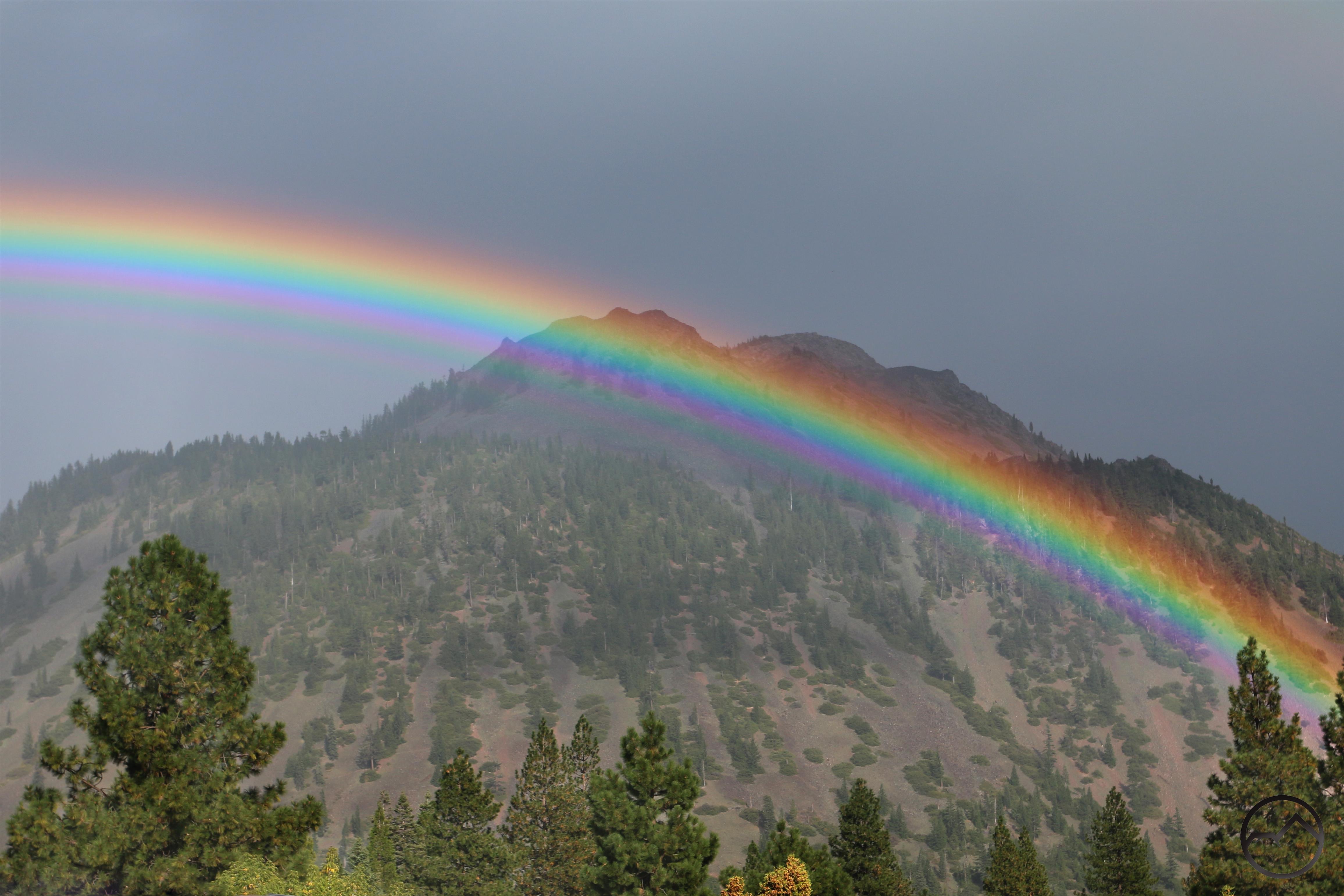
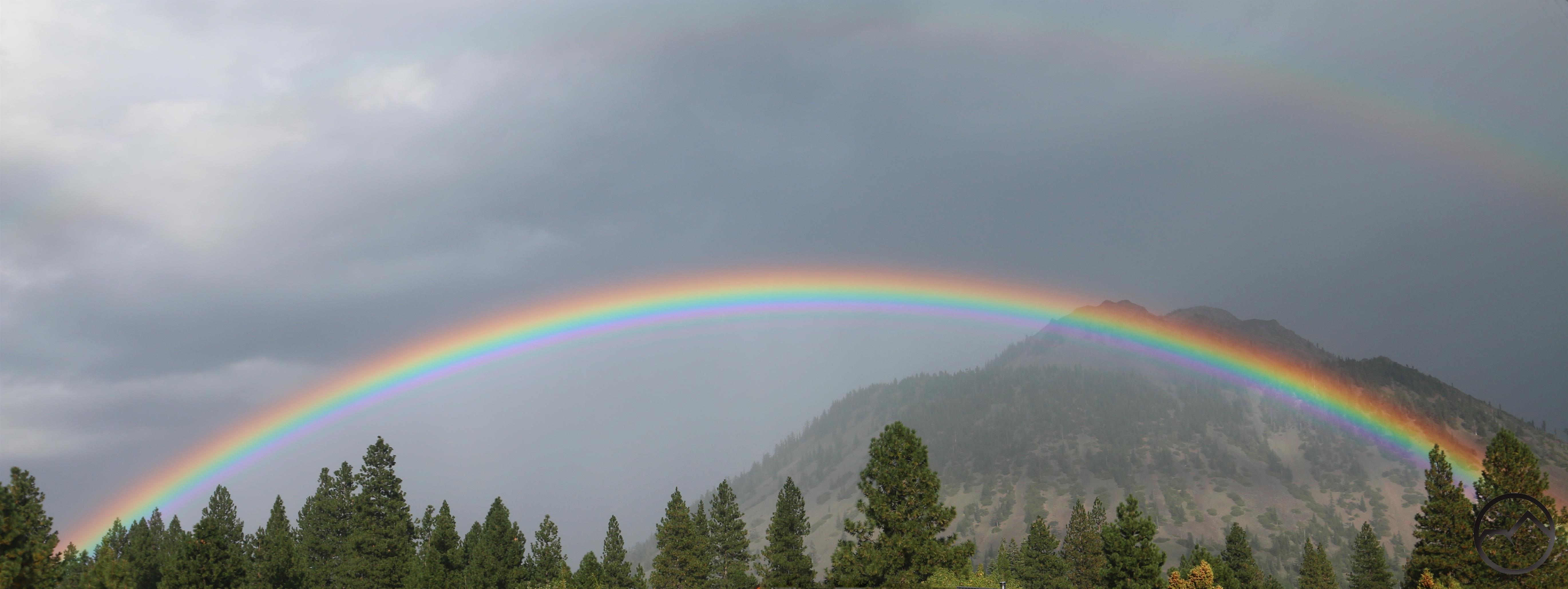
A dramatic rainbow glitters in front of Black Butte.

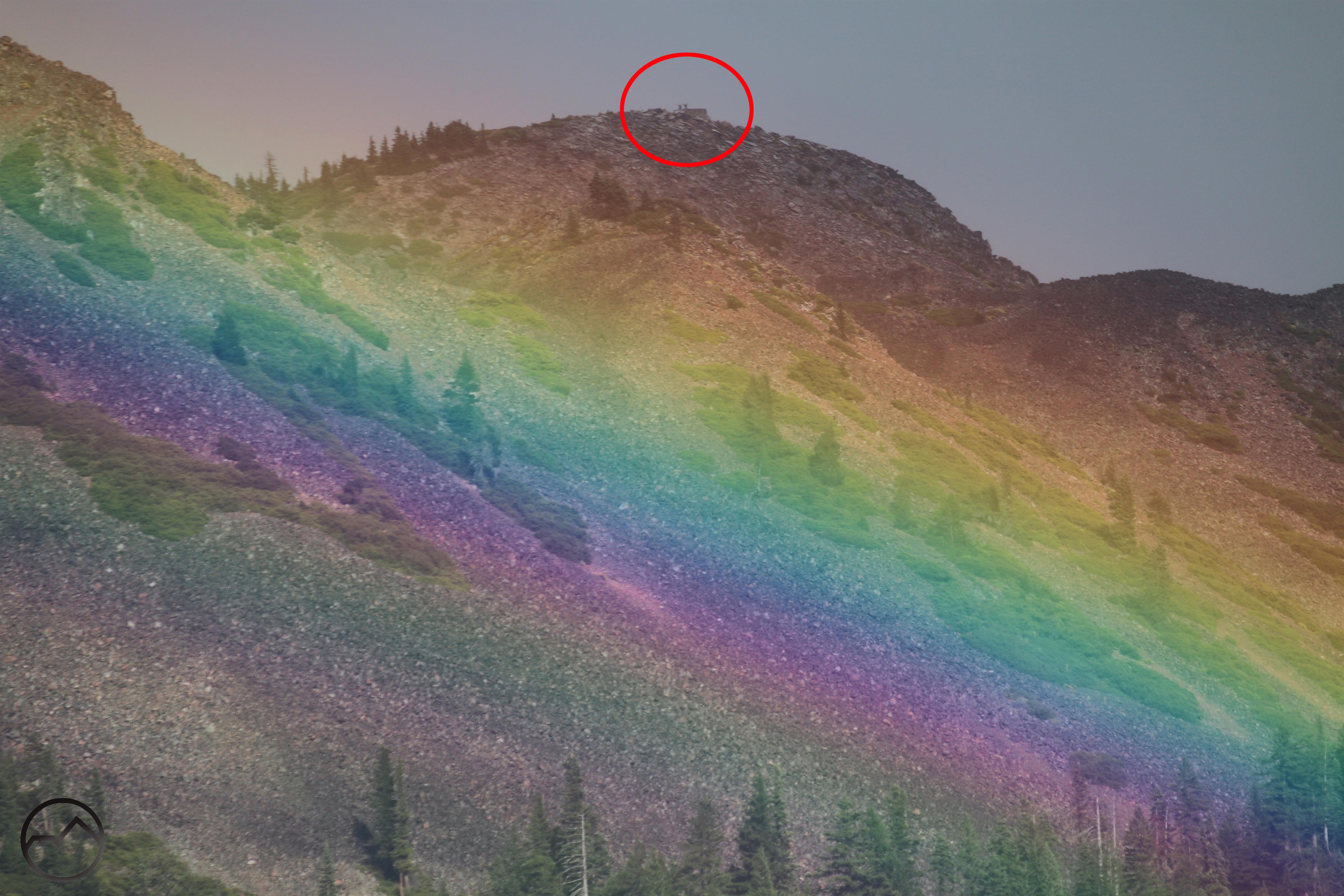
Though this morning started off clear, it quickly grew overcast. The pall hung heavy over the Mount Shasta area for most of the day, with little precipitation coming from the clouds. However, the afternoon briefly brought some rain that suddenly exploded into one of the most vivid, colorful rainbows I have ever seen. It was, in fact, a double rainbow but the upper arch was not nearly as dramatic as the lower one. The brighter bow arced in front of Black Butte, casting its colorful hues on the peak. It was so vivid, the indigo and violet section repeated twice, creating a sort of rainbow echo.

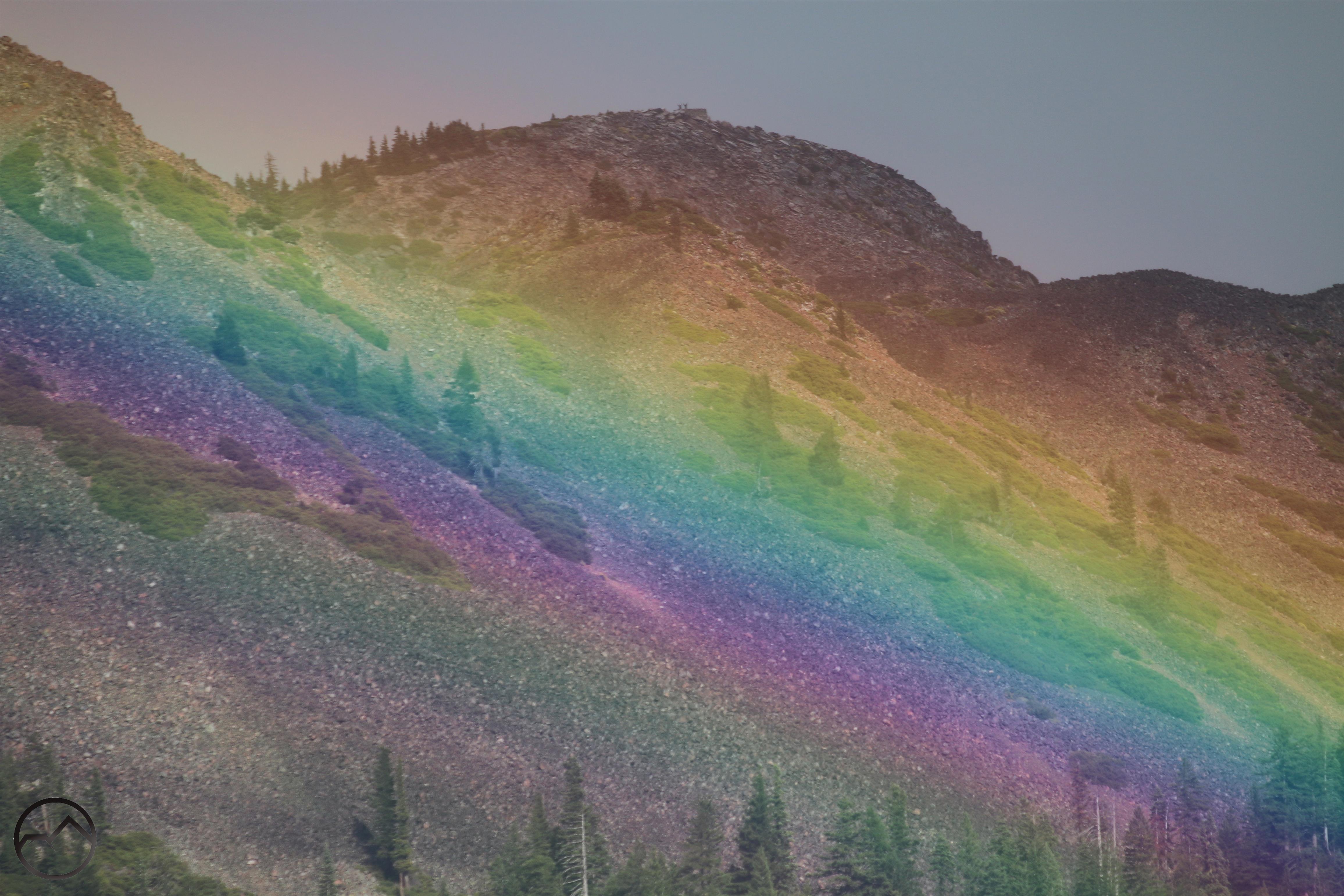
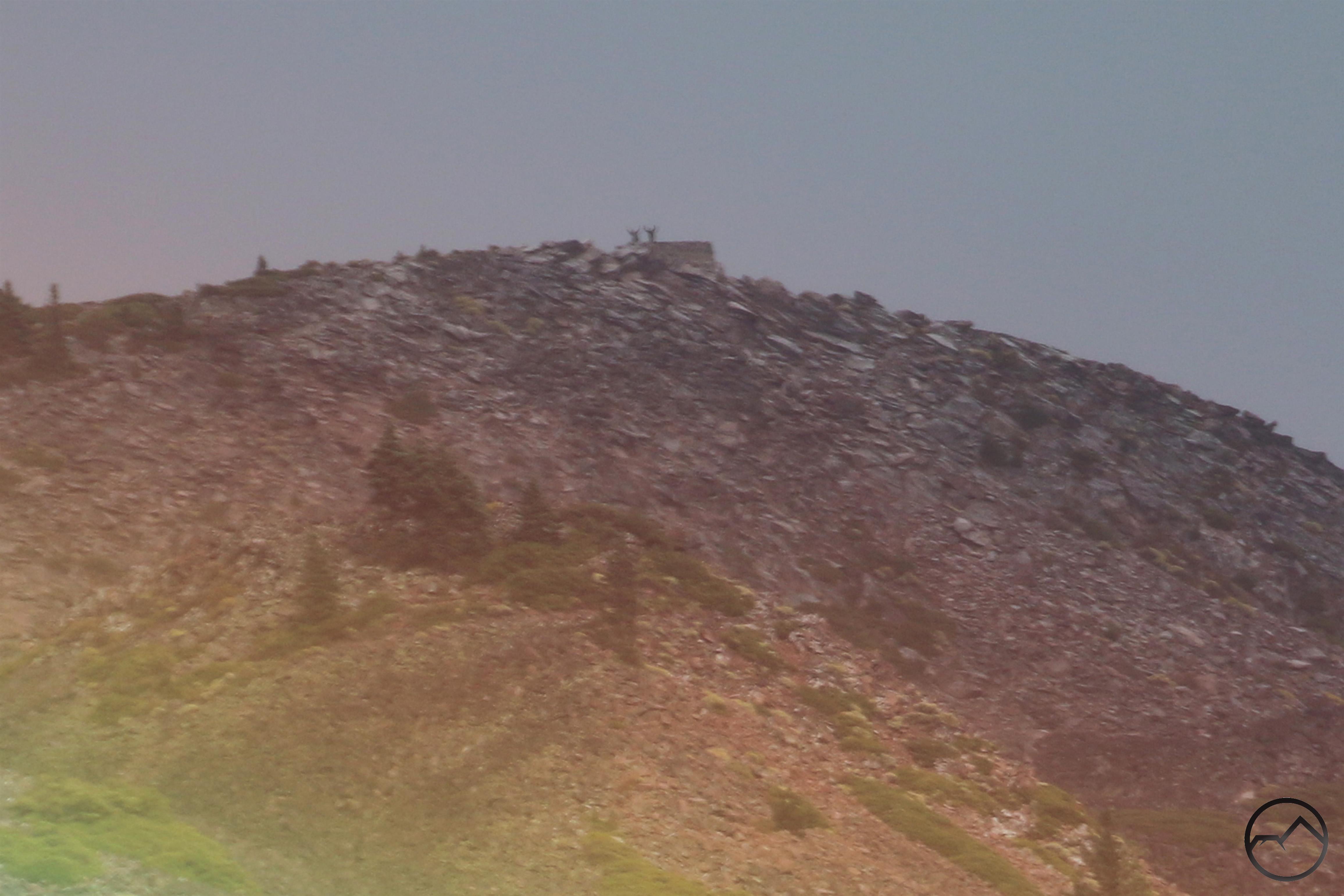
Of course, I just happened to be out in front of my house taking pictures of my friend and his son on the summit of Black Butte with my telephoto lens. I was out there before the rainbow appeared, but was stunned when it was manifest and I could capture images of them through the colors.

A help, if they aren’t obvious:

Zoomed in and cropped:

They had a pretty spectacular view of the rainbow from the summit. It looked as though the colors were cascading out of the sky and falling to earth as if a great waterfall plunge. What an awesome experience that must have been. It certainly was magical from down below.

The clouds, the rain, the colors, are all evidence that fall as arrived. I am excited that it is here.

Update:

I had a few inquiries about how far away my friend was on the summit of Black Butte. The summit is 2,580 feet above me and 9,926 feet away. According to the Pythagorean Theorem, that means the summit, along the hypotenuse, is 10,256 feet from my position. Converted to miles, that would be 1.94 miles away.

Mount Shasta’s Three Waterfalls On Mud Creek

Posted by bubbasuess on September 7, 2019
Posted in: Cascade Range, Hiking, Mount Shasta, Waterfalls. Leave a comment

Waterfalls are among natures most beautiful spectacles. Grace and power of water plunging and cascading over rugged terrain has always captured human imagination. It often seems that for a scene to be complete, there needs to be running water and it is at its apogee when the water falls precipitously. Like many of the Cascade’s great volcanoes, Mount Shasta has its share of waterfalls and some are among the most beautiful in California. However, nowhere else on Mount Shasta is there a higher concentration of cataracts as there are on Mud Creek. Three waterfalls, each distinct in appearance, punctuate Mud Creek’s long, incredible decent through its eponymously named canyon. Each is a beautiful sight, worthy destinations for some of the mountains most spectacular trails.

It is significant that these three waterfalls are located on Mud Creek. Emerging from the melt of the Konwakiton Glacier and nearby permanent snowfields, Mud Creek is among the largest waterways to form on Mount Shasta. Only Squaw Valley Creek, which begins nearby at South Gate Meadow rivals Mud Creek. However, while the former can be accessed fairly easily, the waterfalls on Mud Creek present significant challenges to those who seek to appreciate them. All three are found in Mud Creek Canyon, though their locations are distributed to each of the canyon’s major sections. The uppermost falls, Konwakiton Falls, is located high on Mount Shasta at about 10,500 feet, at the head of the canyon. Mud Creek Falls is positioned in the midst of the widest section of the canyon, near the confluence with Clear Creek. The last falls, Red Fir Falls, is found is the shallowest and narrowest part of Mud Creek Canyon. Their respective locations contribute to the diverse character of each of the waterfalls, adding intrigue and mystery to the hunt for these awesome pageants of falling water.

1. Konwakiton Falls

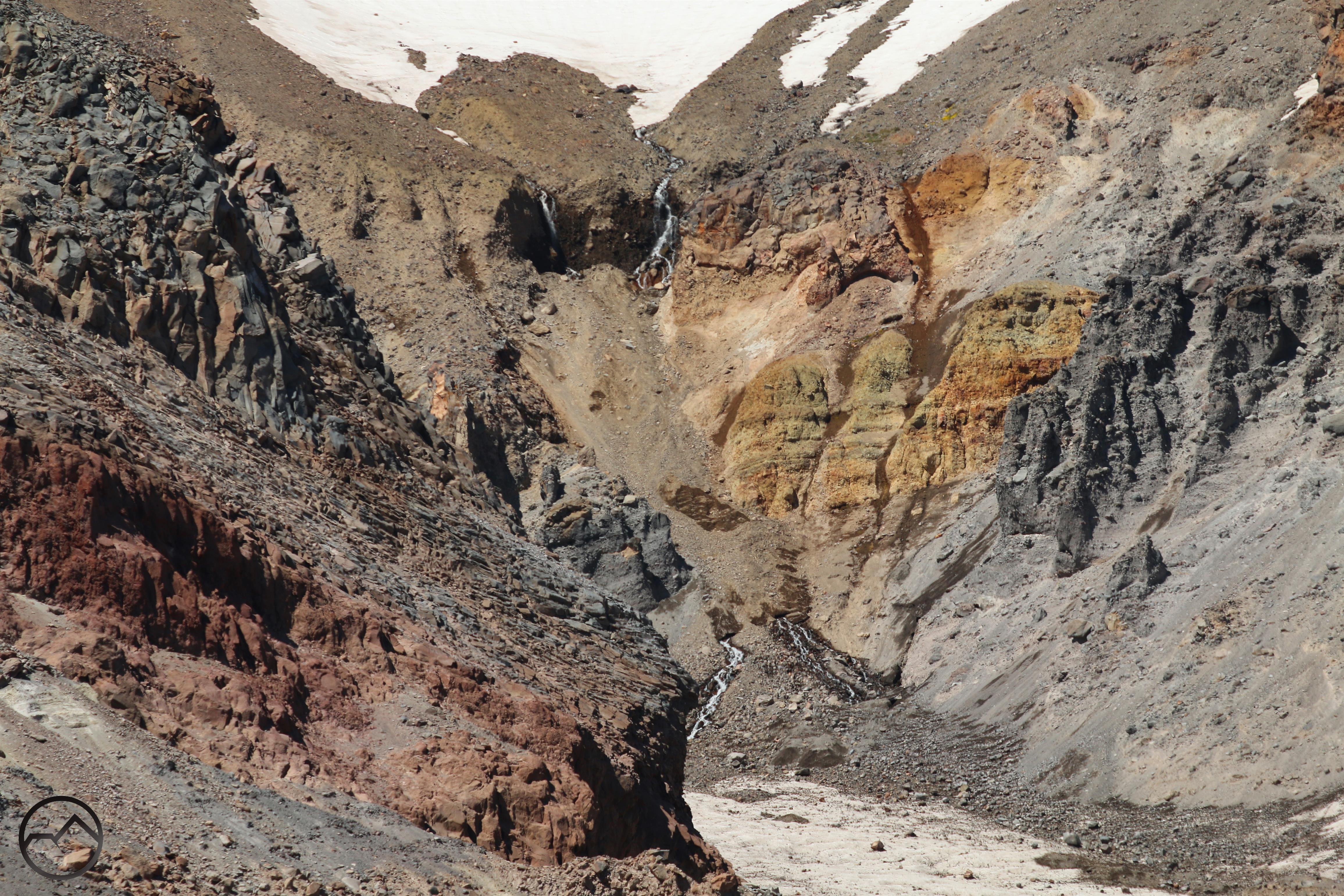
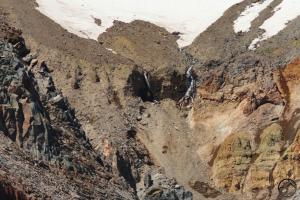
Konwakiton Falls at the head of Mud Creek Canyon.

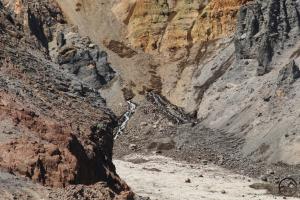
The most difficult of the waterfalls to reach is also the highest. Konwakiton Falls is found in Mount Shasta’s ancient, primordial heart. The complex geology of some of its oldest eruptive periods is exposed in the cliffs around the falls. The loose scree and crumbling volcanic cliffs make Konwakiton Falls all but inaccessible. Consequently, there are only a few good vantages from which to observe the falls. The unstable terrain also makes it difficult to determine the height of the waterfall. A permanent snowfield covered by rocky debris lies below the exposed part of the falls. It hides the full extent of the drop. As the water passes beneath this crumbling curtain it is hidden from view, only to reemerge a few hundred feet below. Interestingly enough, once the water has reappeared from behind the rock and ice, it only travels a short distance before disappearing once again. This patter is repeated several times as Mud Creek makes its way down the canyon. The constantly shifting canyon walls is perpetually burying the creek and forcing it to amend its course.

Upper section of Konwakiton Falls.
Lower section of Konwakiton Falls.

There are only a few good vantage points from which to observe Konwakiton Falls. The rim of Mud Creek Canyon is the best.

2. Mud Creek Falls

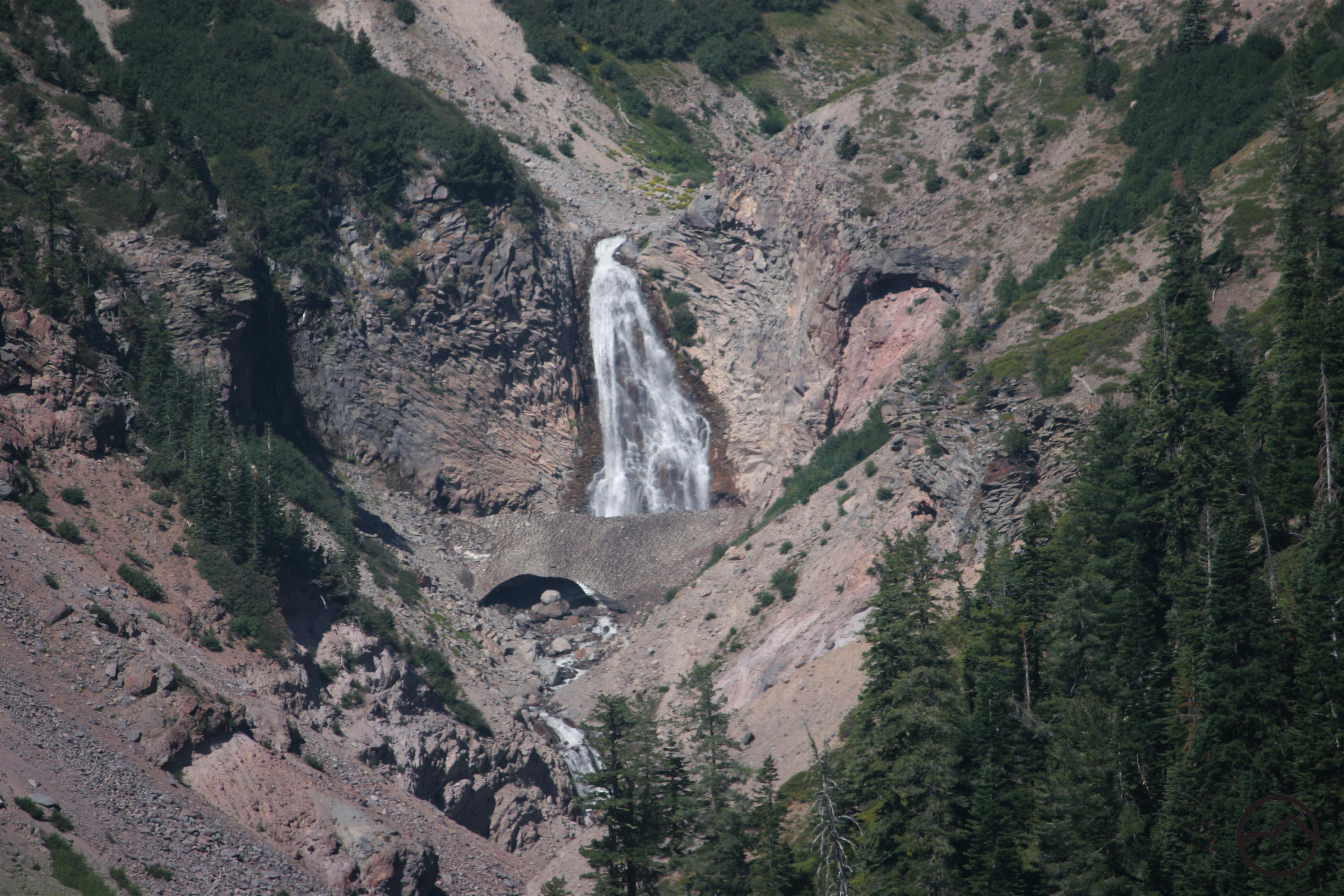
Mud Creek Falls

Taking its name from the creek that gives it life, Mud Creek Falls is a top contender to be the most beautiful waterfall on Mount Shasta. Its location in the canyon is certainly once of the most spectacular locations imaginable for a large waterfall. The falls is large and full as it plunges over a sheer cliff. Where Konwakiton Falls relied on glacial melt to feed it, by the time Mud Creek flows over the second waterfall it has been fed by numerous large springs that line the walls of Mud Creek Canyon. As the water slides over the precipice, it fans out over the band of erosion resistant rock, giving the falls a fuller body than any other waterfall on Mount Shasta. The waterfall is also one of the tallest in the area but its size is dwarfed by the tremendous canyon that surrounds it. This is truly one of the mountain’s grandest displays.

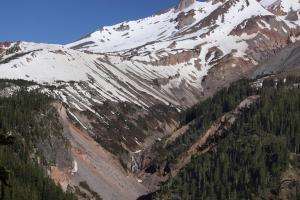
The view from the east side across the widest section of Mud Creek Canyon.

Mud Creek Falls is best observed from the Clear Creek Trail. For the really adventurous, there is a route by which one can scramble down to the falls. This is the same route by which hikers must cross Mud Creek Canyon on a circumnavigation of the mountain.

3. Red Fir Falls

Mud Creek tumbles over Red Fir Falls.

Perhaps the most mysterious of the waterfalls on Mud Creek, Red Fir Falls is the smallest and easiest to get, save for the shroud of anonymity that has girdled this cataract. Found in the shallowest and narrowest part of Mud Creek Canyon, the area is seemingly lost to all but the most motivated few who explore this area. The waterfall got its moniker (unofficially, of course) from the nearby Red Fir Ridge. This ridge was the location of the old route that once led across the flanks of Mount Shasta in the 19th century. The falls are not tall, perhaps only 35 feet or so, but they are easily reached and be enjoyed from afar and from their base, making them something of a unique experience among the big waterfalls on Mount Shasta, all of which are found in steep canyons and must generally be viewed from afar. The intimacy offered by this little cataract and the seemingly “lost” nature of the place, make this a great place just to come and be.

Mount Shasta peeks out above the lowest section of Mud Creek Canyon.

Red Fir Falls is reached by an easy hike, for those motivated to find.

Lenticular Fizzle

Posted by bubbasuess on September 5, 2019
Posted in: Cascade Range, Hiking, Lenticular Clouds, Mount Shasta. 2 Comments

The remnants of a brief but awesome lenticular.

The last 48 hours have seen some awesome but frustrating lenticular activity. Wednesday afternoon a great series of clouds formed over Mount Shasta. However, I was at my daughter’s soccer practice and couldn’t go capture it like I wanted. Being a dutiful father, I kept my priorities in order. By the time I was finally able to get to a spot where I could try to get it, the cloud had withered into an indistinct blob above the mountain. Deflated I went home but I had a suspicion that the cloud would return during the night and might present a great sunrise.

I got up well before dawn and headed over to the east side of Mount Shasta. Sure enough, the lenticular was back, though it was not quite as distinct as I had hoped it would be. Nonetheless, the morning was beautiful and I was hopeful that with some great morning color it would still be a spectacular sunrise. Alas, though the morning light was good, it never got as explosive as I had thought it might. It was still an exceedingly beautiful morning and I was grateful to have been out there watching the colors on Mount Shasta once again.

Sunrise on Mount Shasta and its lenticular crown.

I headed back into town and found that the lenticular cloud had more definition on the west side than I thought it would. It was enough to make me stop and document the cloud’s appearance.

The mountain was in shadow but the cloud’s layers were still evident.

By mid-day the cloud had gotten really impressive. The wind was blowing steadily and it was obvious that weather systems were in flux. When meteorological changes are afoot there is always a chance a lenticular might develop. Today was a good example of that. The cloud itself seemed particularly unstable, changing its shape with celerity.

An impressive lenticular on Mount Shasta by noon.

Mount Shasta was not the only mountain to see lenticular activity today. There was an excellent display over Mount Eddy as well. The second highest peak in the area does not often see large formations develop in its vicinity but today it had a really impressive array of lenticular clouds.

Lenticulars over Mount Eddy.

However, while the clouds continued for a few more hours, by about 4:30 PM they had shrunk considerably. It was apparent that the clouds would not last until sunset as I had been hoping they would. By the afternoon, there was just a small dome over Mount Shasta’s summit.

All that was left of a once massive display.

Even the small cap over Mount Shasta did not last. By 5:00 PM it was gone. At the same time, the collapsing weather system brought air currents from the south and on these currents road in the smoke from a fire down by Red Bluff. The light grew red and the plume grew to the south. Not only had the lenticular disintegrated but the skies were growing smoky! Interestingly, as I went into town for my daughter’s evening soccer game (her first of the season), I could see the tendrils of smoke closest to Mount Shasta taking on a lenticular-type shape. It seemed even though the condensation necessary to form the cloud had dissipated, the air currents were still moving similar patterns.

It is not obvious but the smoke in the lower left was matching an earlier lenticular in the same position.

The great lenticular that had marked much of the day fizzled and faded. I was disappointed at the lost opportunity for an incredible sunset. In the end, however, a much more important thing was witnessed this evening. My daughter, who will be seven in a couple weeks, played her first soccer game. She scored two goals and was a fierce competitor the entire time. I was an extremely proud father!

My daughter on her way to scoring her first goal!

An Examination Of Trinity Alps Peaks From The Old Ski Bowl

Posted by bubbasuess on September 1, 2019
Posted in: Cascade Range, Hiking, Klamath Mountains, Mount Shasta, Trinity Alps. Tagged: Old Ski Bowl. Leave a comment

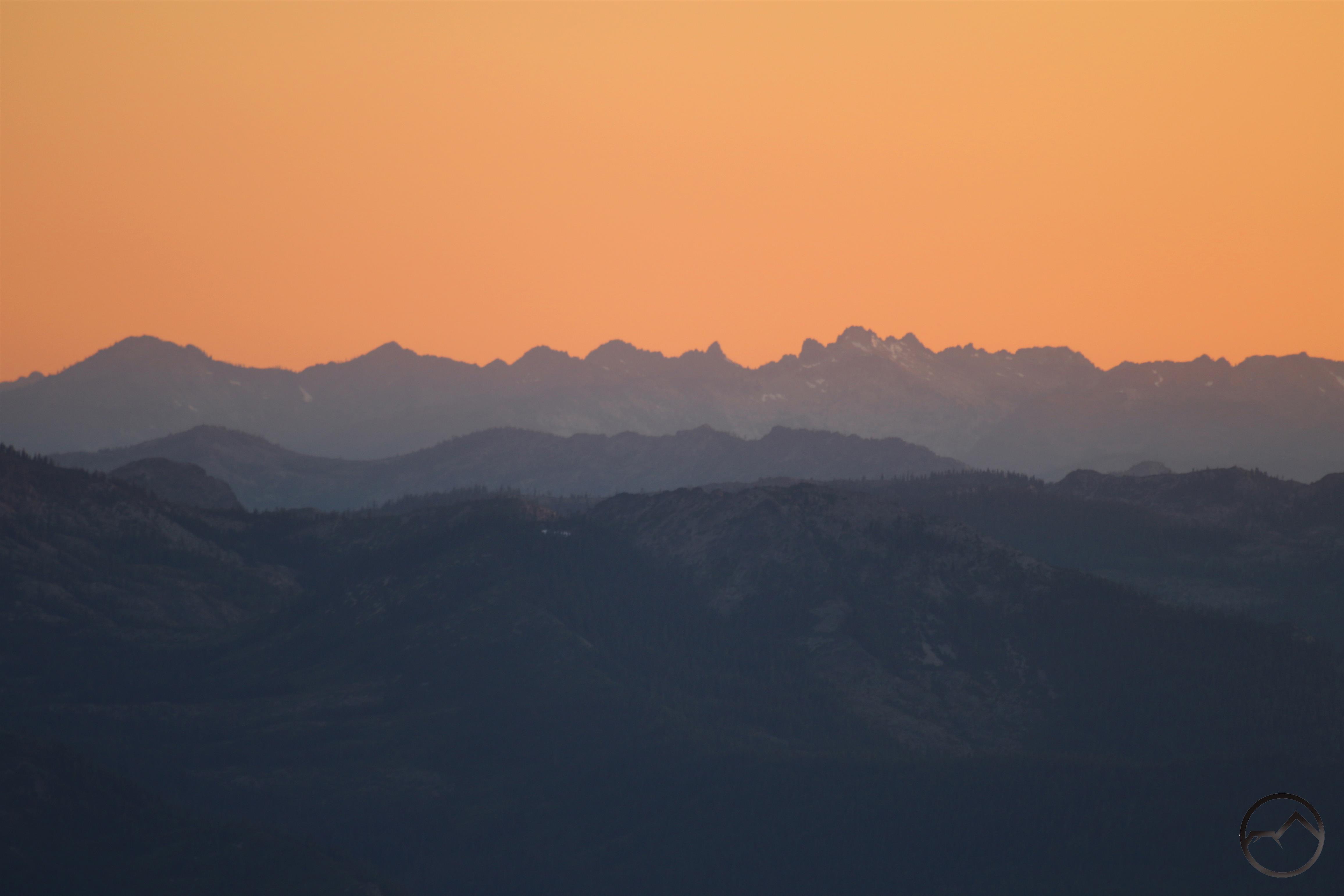
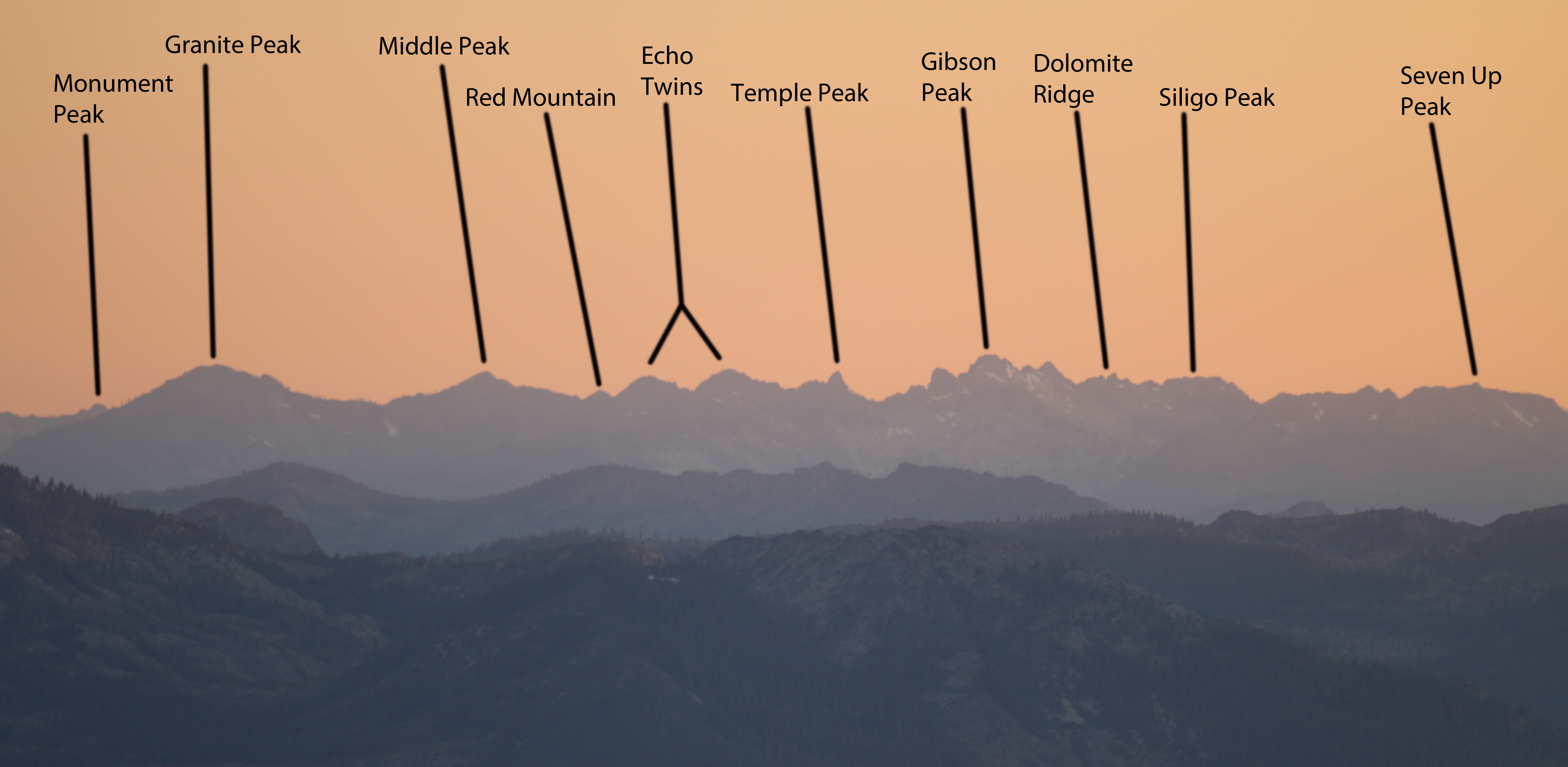
The Old Ski Bowl is one of the best drive-to vistas around. Not only does it have a great perspective on Mount Shasta and many of its landmarks but the view of the surrounding North State are tremendous. The entire Trinity Divide, the Sacramento River Canyon, Trinity Alps, the McCloud Range and the southern end of the Cascade Range around Lassen Peak are all unfolded below the vista like a giant map. Many of the landmarks are easy to distinguish and identify. However, beyond recognizing the entirety of the Trinity Alps on the horizon, it may be a challenge to name each of the summits visible.

It is the purpose of this article to provide a locator in order to put a name with a peak in the Trinity Alps. However, I think it will be interesting to take things a step further and look at them up close as well, to put a face to the name, so to speak. Looking at mountains from a great distance away looses many of their distinctives and it is hard to appreciate them individually. I hope that this different approach inspires some interest in these awesome mountains and adds color and perspective to the amazing view from the Old Ski Bowl.

The approach will be to work through the peaks identified in the locator, moving from left to right. A larger image will be followed by some brief commentary on the peak.

1. Monument Peak

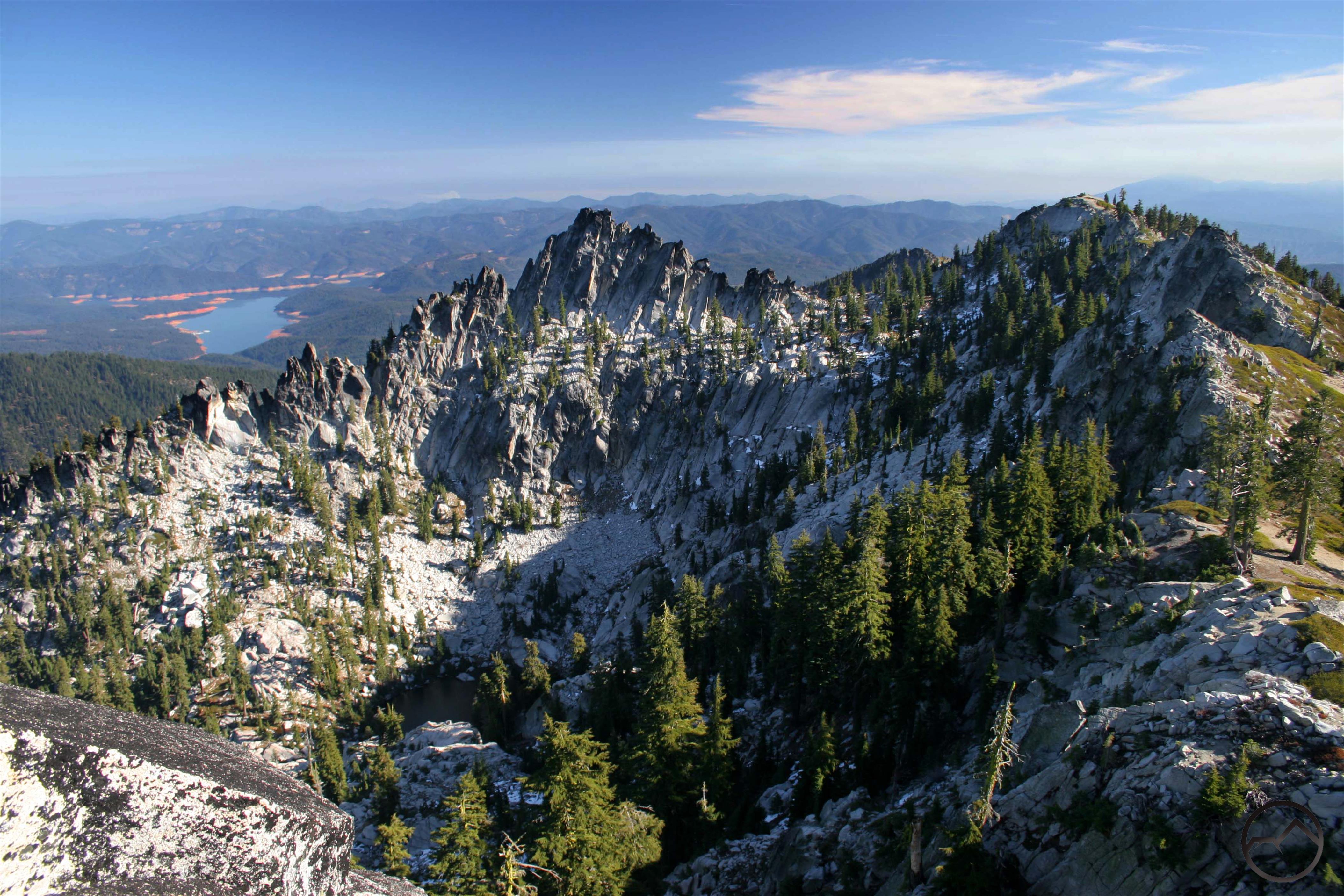
Granite spires of Monument Peak.

This is one of the southernmost peaks in the Trinity Alps. Just a few miles north of Weaverville, it is a large, isolated jumble of granite spire. In some ways it resembles the Castle Crags, but it is not set apart from the range quite like the Crags. In truth, it is part of the larger Canyon Creek area of the Trinities. It harbors a few spectacular lakes amidst its towers.

Looking down on Upper Rush Creek Lake on Monument Peak.

2. Granite Peak

Granite Peak from the climb above Red Mountain Meadow.

At over 8,000 feet, Granite Peak is amongst the higher peaks in the Trinity Alps. It is one of a trio of peaks, along with Middle Peak and Red Mountain that form the southeast rampart of the Trinity Alps. Unlike all its neighboring peaks, it is composed of granite (obviously), making it a bit of an outlier in this extremely complex area.

3. Middle Peak

Middle Peak from a tarn near Echo Lake.

Middle Peak is not particularly prominent, but it is an incredibly beautiful mountain. The best perspectives are from Echo Lake and from Red Mountain. From these angles, the mountain is revealed to be rugged in nature, with lots of cliffs and towers around it. Of the high peaks over 8,000 feet in the Trinity Alps, this may be the least appreciated.

Middle Peak from Red Mountain.

4. Red Mountain

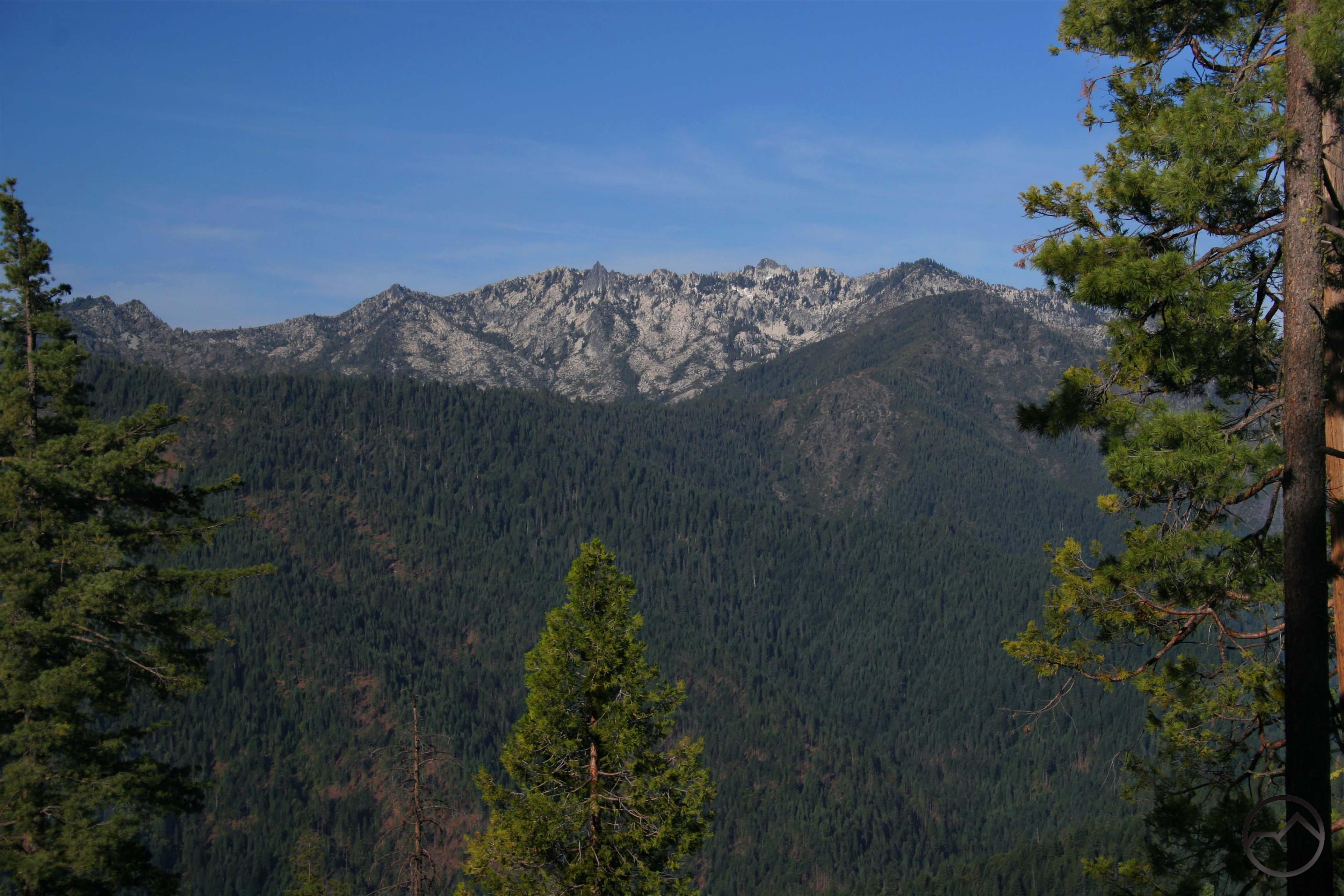
Red Mountain presents a striking profile.

Red Mountain is a magnificent chunk peridotite. Rising to a sharp point and a southern face that falls away steeply, it is a remarkable guardian of the Trinity Alps southeastern corner. Perhaps the most attractive angle to view the peak from is to the north, from the far side of Van Matre Meadow. Here the red cliffs are laid bare and the mountain holds court regally above the lush amphitheater. Explorers will enjoy finding the small lake hidden amongst these cliffs.

Red Mountain above Van Matre Meadows.

5. Echo Twins

The Echo Twins from Van Matre Meadows.

These peaks do not have an official name but their geminate likeness is striking, weather viewing them up close or from Mount Shasta. They also have the enviable position above Echo, Anna and Billy-Be-Damned Lakes. Their setting could not be more beautiful. They are particularly close to Echo Lake, which lends them their unofficial name.

6.  Temple Peak

Temple Peak towers above Siligo Meadow.

While this peak is also unofficially named I have seen literature dating back 60 years refer to it by the name of Temple Peak. It is a strikingly rugged peak, especially when contrasted against the lush alpine landscape of Siligo Meadow. Anna and Billy-Be-Damned Lakes like on the east side of the tower.

7. Gibson Peak

The mighty walls of Gibson Peak rise above Siligo Meadow.

Gibson Peak is the highest peak in the Trinity Alps that is not part of the cluster of granite peaks that is focused around the Canyon Creek/Caribou Lakes area. Climbing over 8,500 feet, it is one of the tallest peaks in the North State. There are only 7 peaks in the entire Klamath Mountains range that are taller. It is surrounded by stunning scenery on all sides, including the Four Lakes Loop area, Long Canyon, Siligo Meadow and the Granite Lake Basin. This is really one of the great peaks of Northern California but it always seems to go unnoticed unless standing right below it.

8. Siligo Peak

Siligo Peak gazes down on Deer Lake and the Deer Creek Canyon.

Siligo Peak ranks among the most beautiful in the Trinity Alps (and therefore the entire North State). It is the focal point of the incredible Four Lakes Loop, a loop trail that connects the four lake basins that lie below the summit. It is one of the most scenic trails around. It is remarkable how distinctly different each of the four lakes are, despite being situated around the same mountain.

Diamond Lake
Luella Lake

Summit Lake
Deer Lake

9. Dolomite Ridge

Dolomite Ridge is a striking contrast to lush Deer Creek Meadow.

Another peak with no official name, I have also seen this cluster of peaks referred to by an unofficial name. Regardless of what its moniker is, it is a momentous wall of granite, especially when seen from the vast meadow that is found along Deer Creek. The sheer wall looms almost 1,700 feet above the grassy valley. It is an idyllic setting.

10. Seven Up Peak

Seven Up Peak (left) above Luella Lake.

Seven Up Peak is evidence of the complex geology that makes up the southeast corner of the Trinity Alps. A massive mound of peridotite, the peak is slammed up against Dolomite Ridge, the two distinct rock formations have been welded together by terrific geologic forces. The peak is a beautiful presence above Deer Creek and a fascinating loop trail of its own encircles the peak.

I hope that this little tour of a magnificent corner of the Trinity Alps has been helpful in illuminating how amazing these mountains are and how amazing the view from the Old Ski Bowl is. We are blessed to be surrounded by this staggering landscape!


Revisiting Mount Shasta’s Hoodoos: A Spectacular, Dynamic Landscape

Posted by bubbasuess on August 28, 2019
Posted in: Cascade Range, Hiking, Mount Shasta. Tagged: Hoodoos. 3 Comments

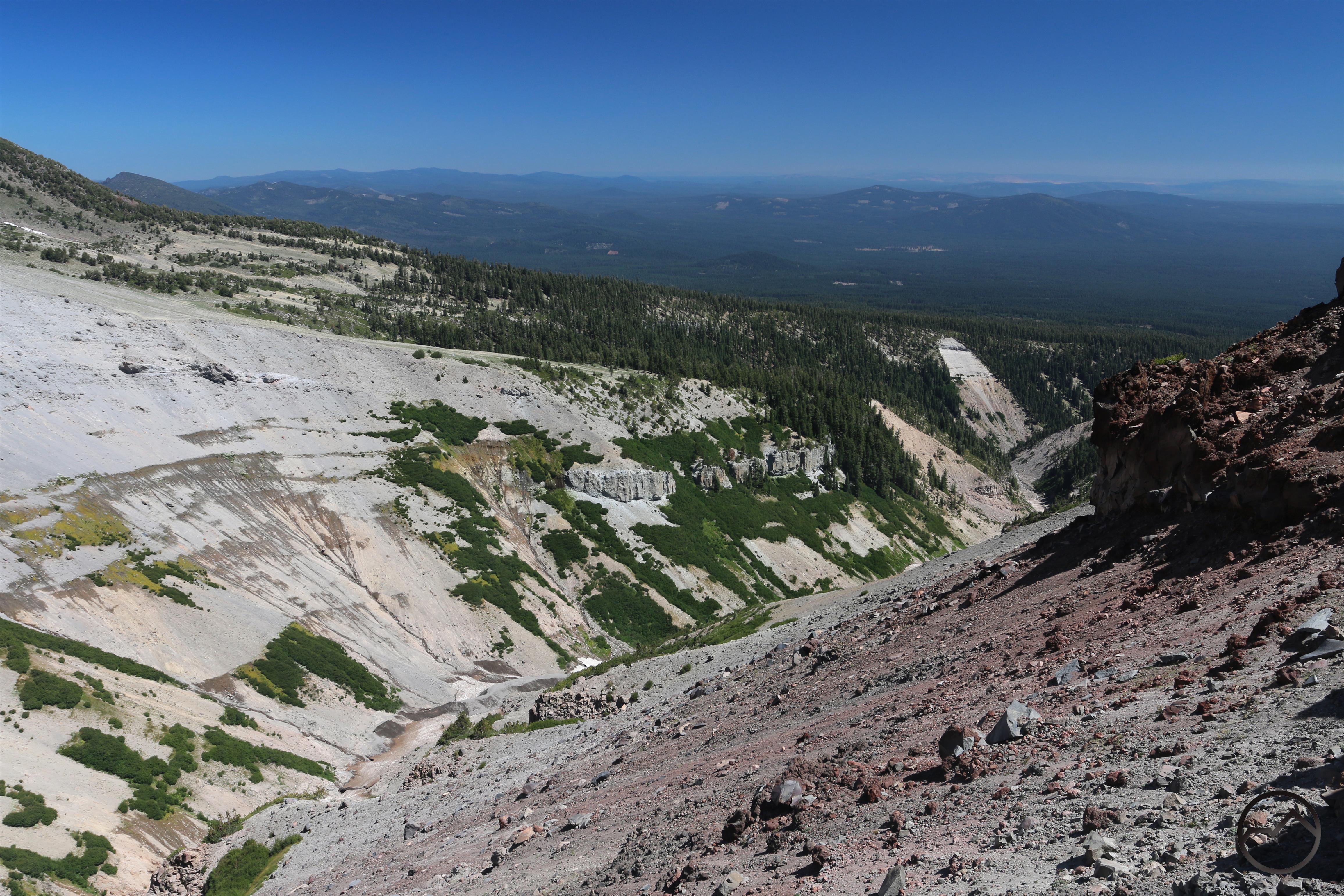
A spectacular view into the upper section of Mud Creek Canyon. 

A few years ago I posted an article on the hoodoos hidden away in Mount Shasta’s Mud Creek Canyon. The canyon is the largest on Mount Shasta and one of the most spectacular landmarks in California’s North State. For all of its grandeur, it remains a largely unappreciated destination, in significant part because there is no trail access. Only the Clear Creek Trail offers glimpses into the staggering chasm. These views, while magnificent, are focused on the lower part of the canyon and the upper section is obscured. It is in this isolated upper canyon that the hoodoos are sequestered. The hoodoos, tall pillars of volcanic rock and compressed ash, are some of the more fascinating and unusual formations on Mount Shasta, made all the more so by their anonymity and inaccessibility.

I recently revisited the rim of Mud Creek Canyon, one of my favorite spots on the mountain. Here, beneath the tall spires of Sargents Ridge, the Konwakiton Glacier and the gaping maw of the massive canyon, one gets an unusual sense of the wildness of Mount Shasta, as land itself is still in upheaval. Great cataclysm created this landscape and cataclysm continues to shape terrain. The glacial outburst from the Konwakiton Glacier in 2014 sent huge amounts of debris roiling down the canyon all the way into the McCloud Flats. However, it is the deep cut into the mountain, a fissure nearly 1,500 feet deep, that is the most volatile. While there is a significant amount of bedrock within Mount Shasta, much of the volcano is composed of loose rock, cinders and ash, the result of numerous eruptions. Mud Creek, which flows from the glacier, has succeeded in carving deeply into the flanks of the mountain, exposing the eruptive layers and more loose debris that demands to be settled. Consequently, the slopes of the canyon still seek their angle of repose. The hoodoos are redoubts that have, to some degree, resisted the erosion that has undermined the canyon walls.

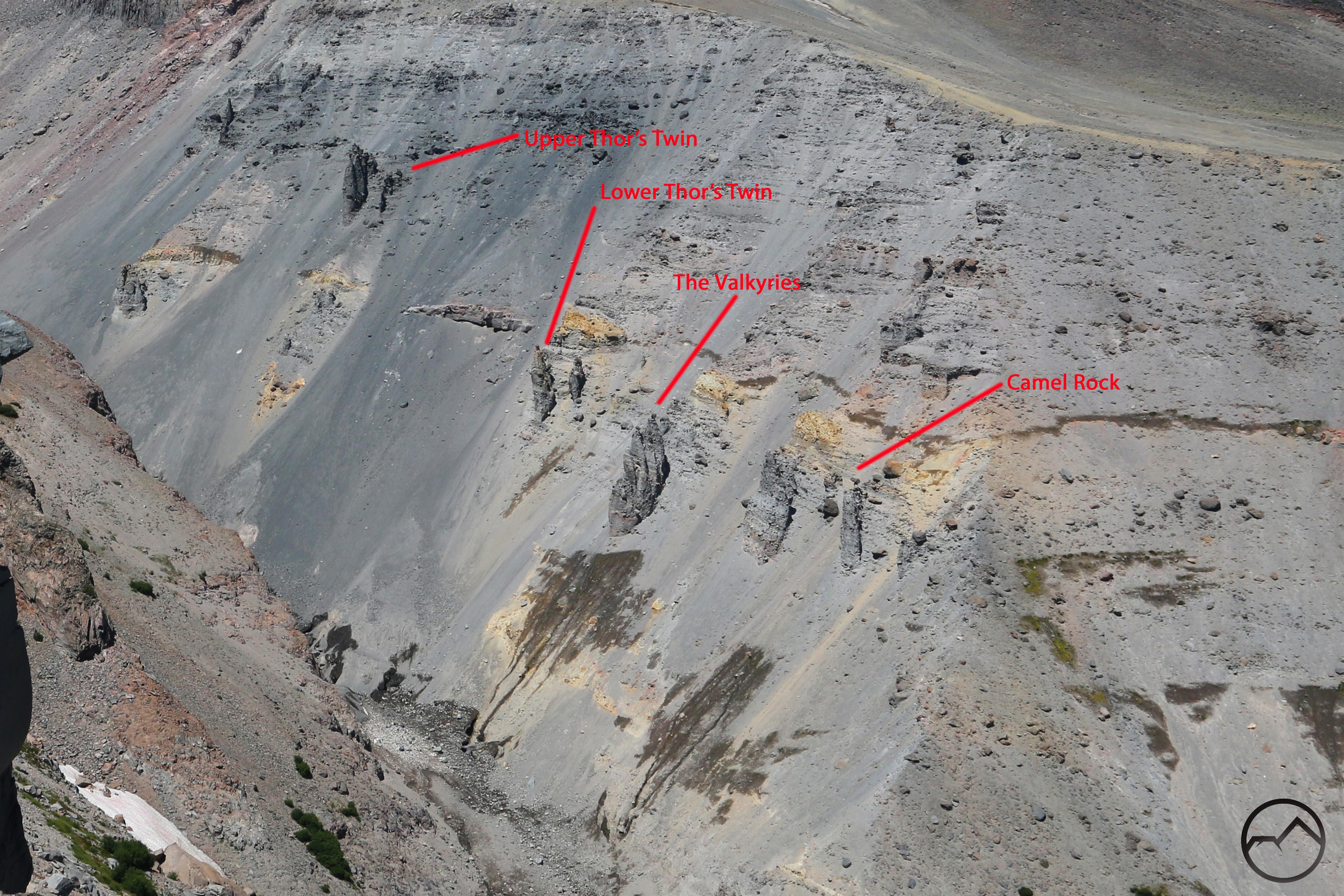
The first time I came to the canyon rim and spied the hoodoos, I was shocked to discover their existence. These were a completely unappreciated but incredible feature on the mountain. I reckoned the towers measured 100-150 feet high, impressive monuments to the mountain’s violent past. A few of the hoodoos were impressive enough to warrant naming at that time. A pair of particularly prominent spires boasted balanced rocks. Through a bit of convoluted logic, I dubbed these Thor’s Twins (see my first post on hoodoos for the reasoning). Another nearby formation seemed to be a cluster of towers and these I named the Valkyries.

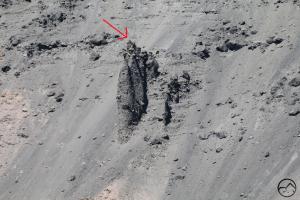
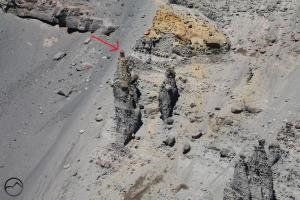
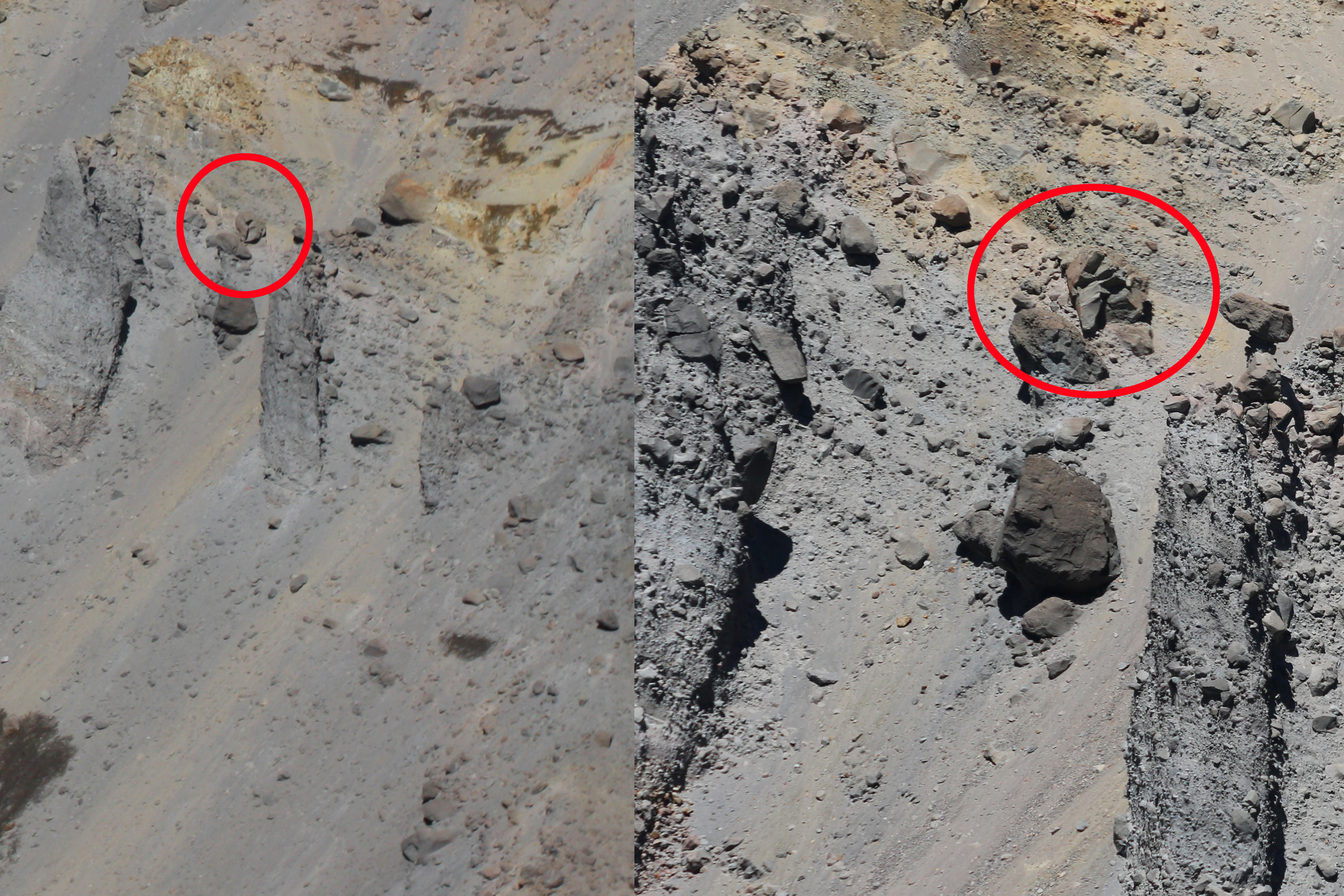
On this latest trip to Mud Creek Canyon, I was surprised to notice that the landscape had been altered considerably. The balanced rocks on the Thor’s Twins had been toppled. Meanwhile, the somewhat nondescript tips of the Valkyries had eroded into small balanced rocks of their own. Obviously there had been a significant amount of tumult in the earth since I had last visited.

Be sure to enlarge these images to see the detail. The changes in the rocks and conditions of the canyon is amazing!

2013 – Upper Thor’s Twin
2019 – Upper Thor’s Twin

2013 – Lower Thor’s Twin
2019 – Lower Thor’s Twin

2013 – The Valkyries
2019 – The Valkyries

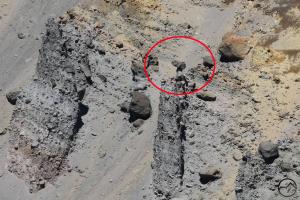
While I was dismayed to see the loss of the balanced rocks atop the Twins, I was happy to see the evolution of the Valkyries. However, the most astounding change to the landscape was atop a tower that had previously lacked any distinction. Where a loose pile of rock had rested atop the tower when I last photographed it, I was now excited to observe a fabulously balanced rock now appeared. I reckon the rock is nearly 15 feet across and it sits tenuously atop a narrow stem of tufa (I am guessing as to the composition). It immediately reminded me of Camel Rock in New Mexico. I thus christened this new formation Camel Rock, in honor of the one in the Land of Enchantment.


While gazing out over the canyon and observing the changing conditions of the hoodoos, I was struck by how active the mountain had been. When I last photographed this part of the canyon, much of the slopes were blanketed in scree, creating a smooth texture from afar. Now the the slopes are littered with massive boulders and exposed strata. It is obvious that things have been shaking loose in dramatic fashion.

Below is one illustration of this change in condition. Note the increase of large boulders on the slopes and the exposed strata. In particular, observe the yellow tower in the first image. In the current image the tower is gone. Just below it in the earlier image a large boulder just pokes out from the scree. In the current image much more of the boulder has been exposed. I have no idea what kind of event precipitated the collapse of the tower, the exposure of the volcanic strata and the inundation of the slopes with huge rocks. Obviously something significant has taken place.


The forces at work get even more mysterious one looking at specific rocks. Some of the boulders, which can generally be described as “car-sized”, have been blown apart by a powerful force. Despite the rocks being obliterated, their precarious situation on the loose slopes does not seem to have significantly altered. The only force I can think that would work on rocks in this fashion is frost fracturing. However, this process would likely take longer than the interval at which I captured images of the hoodoos. Here is an example:

The rock seems to have been split in half. Oddly enough the rocks around the split boulder do not exhibit evidence of an event that wrought destruction of the whole area. The damage is quite localized. The clues of what forces at work are tantalizing but the true story of what has been happening in Mud Creek Canyon remains something of a mystery.

It seems obvious now that the hoodoos of Mud Creek Canyon are part of a landscape that is in constant flux. As awesome as Camel Rock it, it will eventually collapse, probably sooner rather than later. It is humbling to think that such an amazing formation could have formed and died and no one would have ever been blessed to have marveled at its beauty and mystery. I am grateful to have had the opportunity to preserve the rock’s existence in some fashion. Even more humbling is to know how powerful the forces at work on and within Mount Shasta are. This is the revelation of something mighty, something bigger than Mount Shasta. May it be that we recognize it.

Downstream from hoodoo canyon, Mud Creek Canyon widens significantly.

5 Excellent Mount Shasta Area Meadows

Posted by bubbasuess on August 24, 2019
Posted in: Cascade Range, Hiking, Klamath Mountains, Meadows, Mount Shasta, Trinity Divide. 5 Comments

South Gate Meadows on Mount Shasta.

When thinking of the Mount Shasta area, we often focus on some of the more obvious features like mountains and rivers and lakes. This is natural, given the cornucopia of these incredible locations we are blessed with. However, many of the best spots in the area are a little more subtle, though just as beautiful. The meadows of the Mount Shasta region are as diverse as the mountains and make awesome destinations for some of the most beautiful hikes. They are the perfect combination of delicate beauty, refreshingly vibrant and, given the lack of obstructions, boast some of the best views around. It is critical to note, however, that these are delicate landscapes and should be treated with respect. If you visit any of these spots, be sure to practice Leave No Trace principles, especially walking and camping on durable surfaces. Doing so will help ensure the continued beauty of these small slices of paradise!

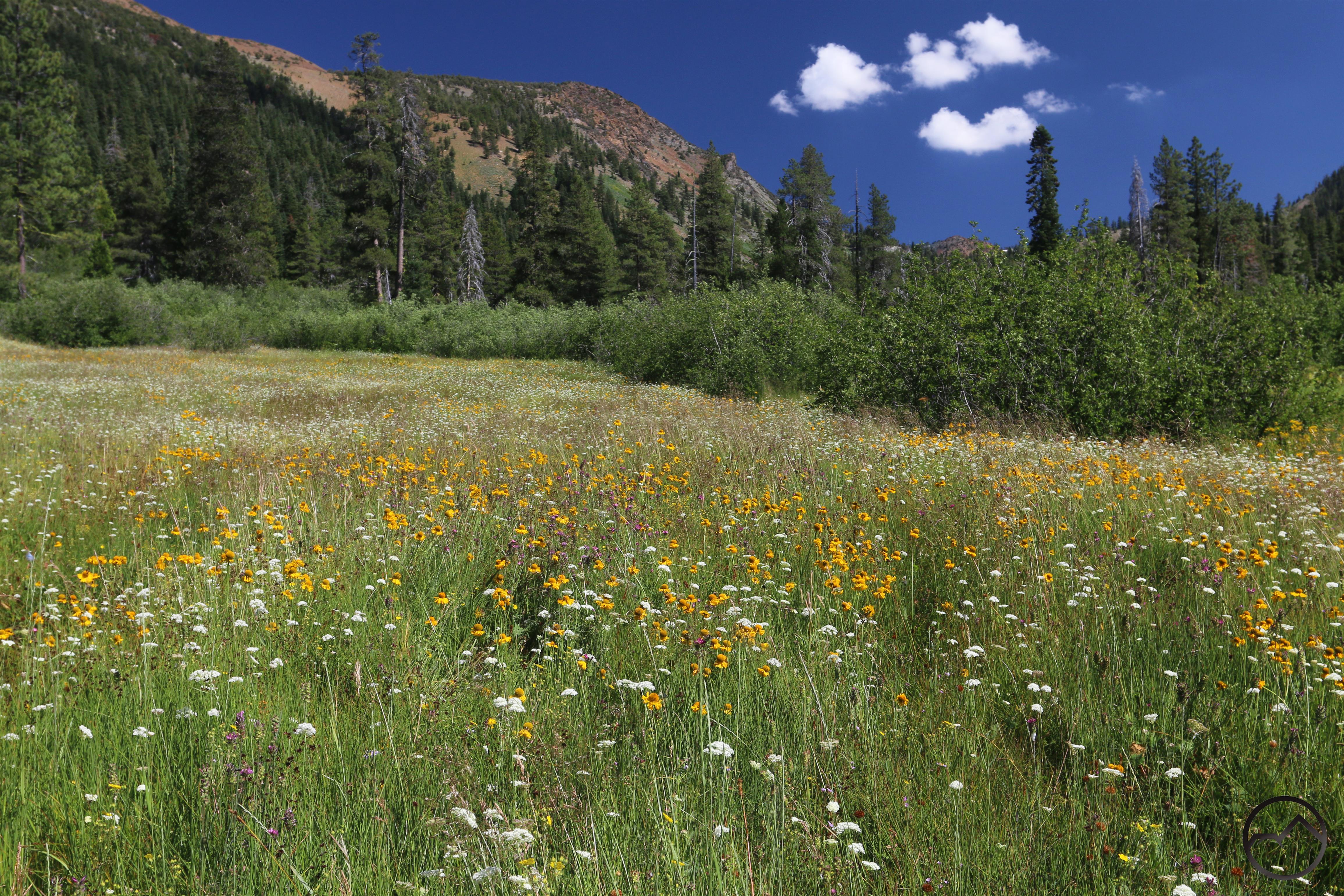
Lush flowers fill Deadfall Meadow.

Mount Eddy is one of the dominant features of the Mount Shasta area. The peak looms over the surrounding landscape in dramatic fashion and if not for the presence of Mount Shasta, it would be a far more famous mountain than it is. Aside from its height and prominence, it has many other great attractions that include fascinating geology, gorgeous alpine lakes and the verdant Deadfall Meadows. Stretching out in a crescent for almost two miles between the Deadfall Lakes and the confluence with High Camp Creek, the meadows present some of the best wildflower displays in the region. Nearly choked with flowers in season, it is a glorious sight to behold. Rather than a single meadow, it encompasses a patchwork of grassy areas connected by Deadfall Creek and the outlet creek from Lower Deadfall Lake. The rugged cliffs of Mount Eddy tower above and completing the beautiful scene.


The Grey Rocks rise above Tamarack Meadow

Tamarack Ridge rises beyond the meadow.

“Tamarack Meadow” is an obscure meadow located at the south end of the Trinity Divide, near gorgeous Tamarack Lake. The name is unofficial, as few people make it here and most that do push right past the small vale en route to the Twin Lakes and Tamarack Lake. However, those that pause here will find one of the most spectacular skylines of any meadow in the region. To the north, the dark crags of the Grey Rocks line the horizon while to the south the bright cliffs of Tamarack Ridge rise beautifully above the lodgepole forest. Vernal pools are found throughout the meadow. Early in the summer this small patch of earth is absolute paradise.

Robbers Meadow in the Scott Mountains.

One of the larger meadows in the Scott Mountains, Robbers Meadow was once on the route of the original Sisson-Callahan Trail. Thought that section of the trail has fallen into disrepair, the meadow now lies below the Pacific Crest Trail and does see a small trickle of visitors hiking along that route. It is among the more remote meadows in the area but isolation only adds to its charm. Much of the forest around the meadow is sparse due to the harsh soils common that result from the serpentine and peridotite, both common in the Scott Mountains. Remnants of the Sisson-Callahan Trail can still be found around the meadow and some route finding will lead to a small but beautiful tarn.

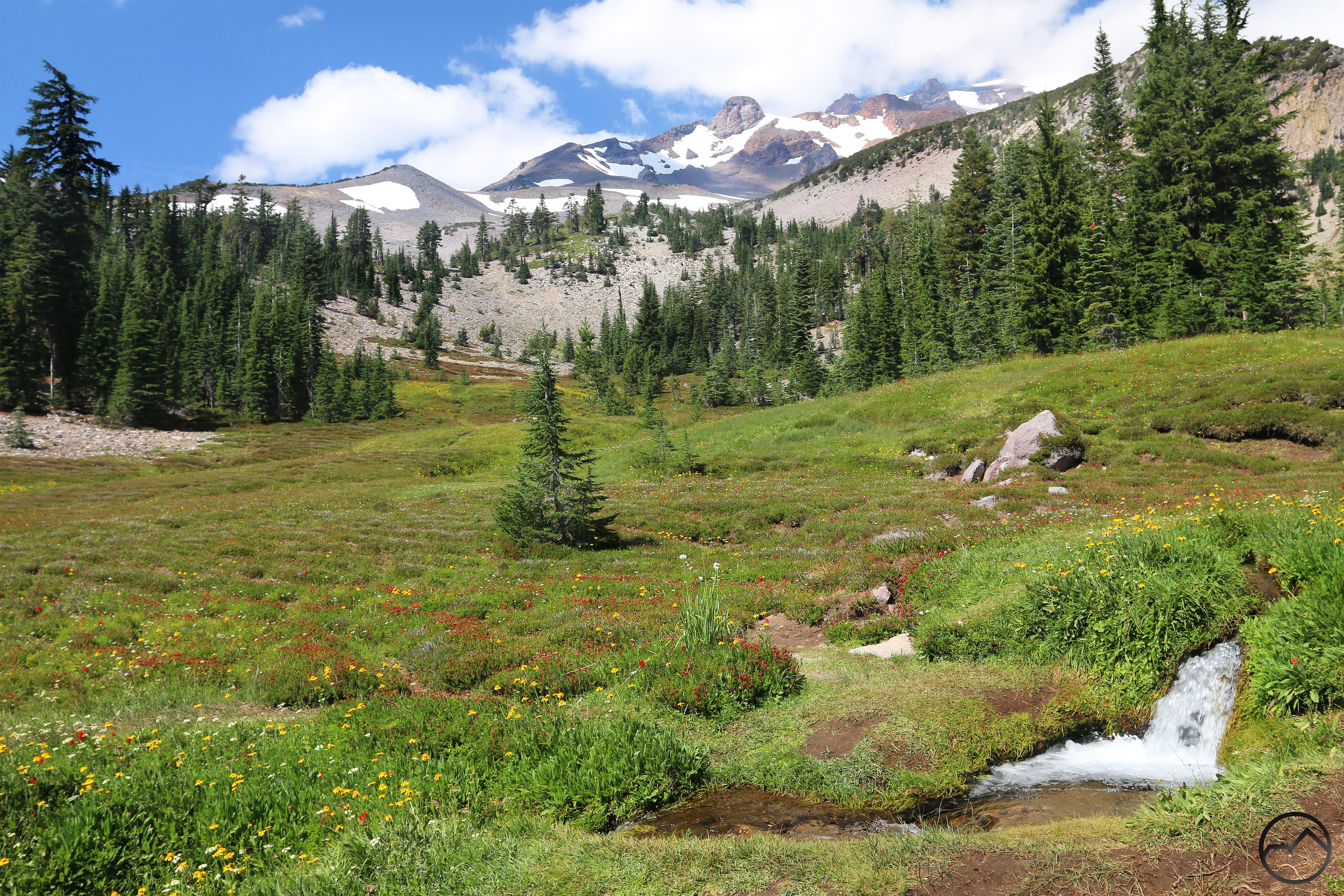
Cascades and wildflowers in South Gate Meadow.

The foremost meadow of the Mount Shasta area, superlatives run dry describing this lush jewel. Located on the south side of the mountain, it is reached via an easy but spectacular trail. Separated into upper and lower sections by a beautiful cascade, this meadow beckons hikers to explore. There are many places of staggering beauty just beyond the meadow, for those that want to explore. The lowest part of the meadow has a fantastic view of Sargents Ridge and the Konwakiton Glacier.

A spectacular view of Mount Shasta from Mud Creek Meadow.

The easiest meadow to reach in the Mount Shasta area is one of the least appreciated. However, this vast clearing in the woods features a drop-dead view of Mount Shasta that is perfect for sunrises. This spot is tough to top.

This list was very difficult to compile, given how many awesome meadows there are in the area. I think I may have to follow up with a Part II!

2nd Edition Book Update And An Unusual Geologic Connection To The Shasta Area

Posted by bubbasuess on August 18, 2019
Posted in: Hiking, Mount Shasta, Napa County, Sonoma County. Leave a comment

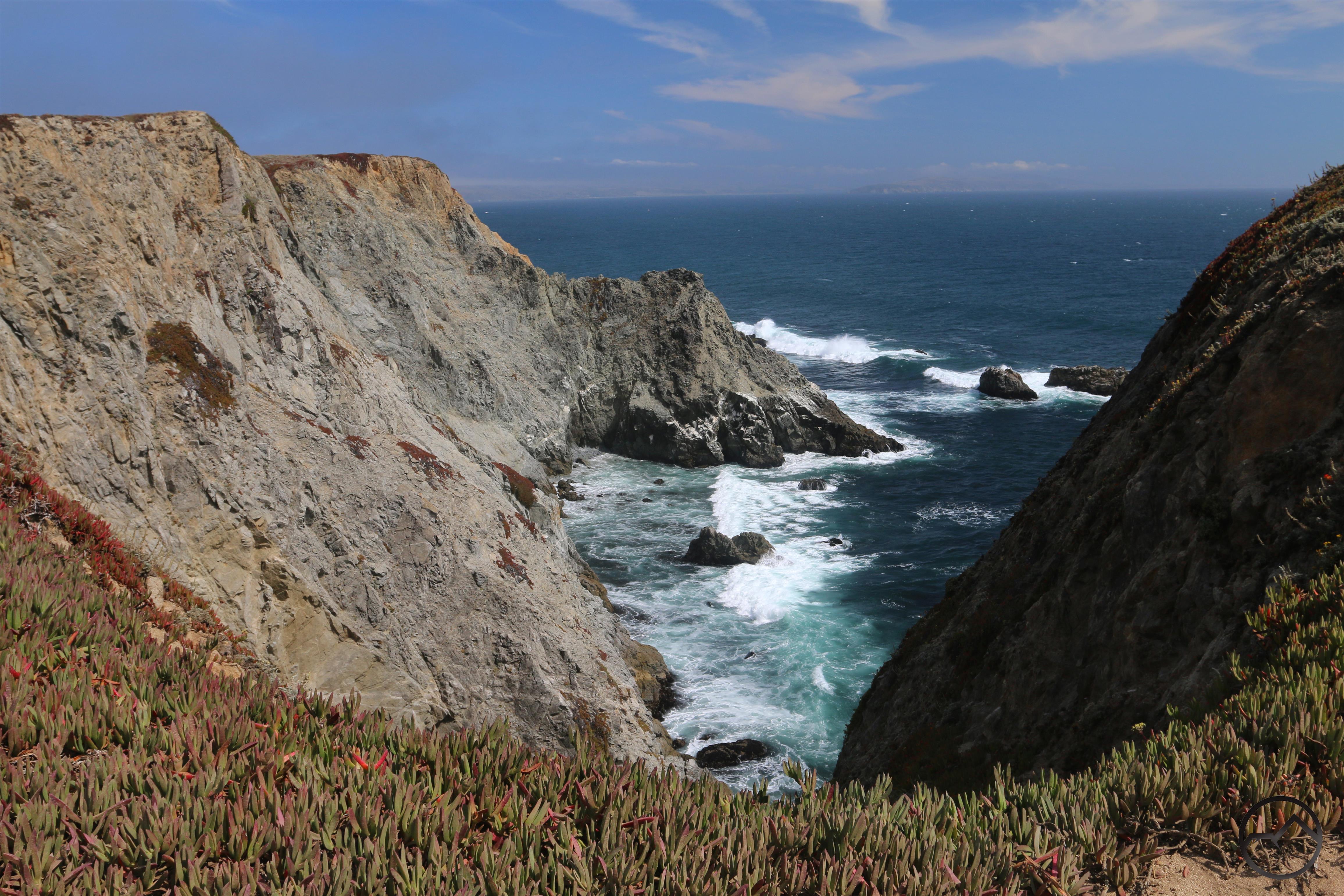
Craggy cliffs plunge into the Pacific Ocean at Bodega Head. Tomales Point is visible in the distance.

Last weekend I went down to Sonoma County to finish hiking the trails for the 2nd edition of my Hiking California’s Wine Country guidebook. It was a really busy trip as I rehiked several trails, checking on changed conditions and taking a bunch of pictures to add to the book. Most of my time was spent out on the coast but the Sonoma Valley and Mount Saint Helena were also areas of focus for this trip.

Bodega Head
Bodega Head
Bodega Head

Jenner Headlands
Jenner Headlands
Pole Mountain

Pole Mountain
Mount Saint Helena
Mount Saint Helena

Shiloh Ranch
Bartholomew Park
Jack London’s Wolf House

The highlight was when my brother came up from his home in Carmel to hike the new trail to Pole Mountain in the Jenner Headlands Preserve. This is the tallest mountain on the Sonoma Coast and some of the most spectacular views in the region. While being able to look out over the Pacific Ocean, one can still see almost all of Sonoma County, deep into Mendocino and Lake Counties as well as south into Marin and San Francisco Bay. It is a tough hike, stretching over 15 miles and climbing over 3,500 feet. The effort is well worth it, as you are rewarded with Big Sur-style, top of the world views.


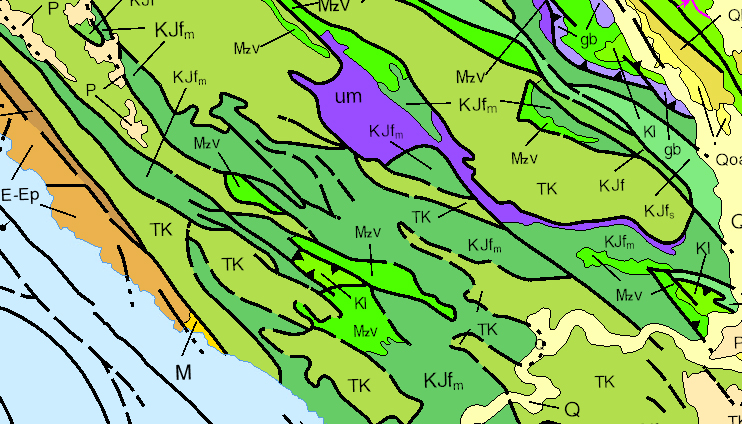
One particular geologic feature caught my eye while on the summit of Pole Mountain. The peak offers a rare view of the Cedars, one of the most fascinating and isolated features in Sonoma County. The Cedars is an 11 square mile block of ultramafic rock that has been extruded in the midst of the sedimentary rocks that make up California’s North Coast Range.

The purple area is the ultramafic rocks of the Cedars.

The ultramafic rocks in the Cedars are primarily serpentine and peridotite. While serpentine is fairly common throughout California (indeed, it is the state rock) but peridotite is significantly less common. The place in California were it exists at the highest concentrations is in the Klamath Mountains, particularly places like Mount Eddy. The peridotite is what gives Mount Eddy its russet complexion. This harsh rock is also one of the reasons there is so much unusual flora in the Klamath Mountains and it is the same at the Cedars. The large extrusion is covered in the very rare Sargents Cypress which is endemic to California.

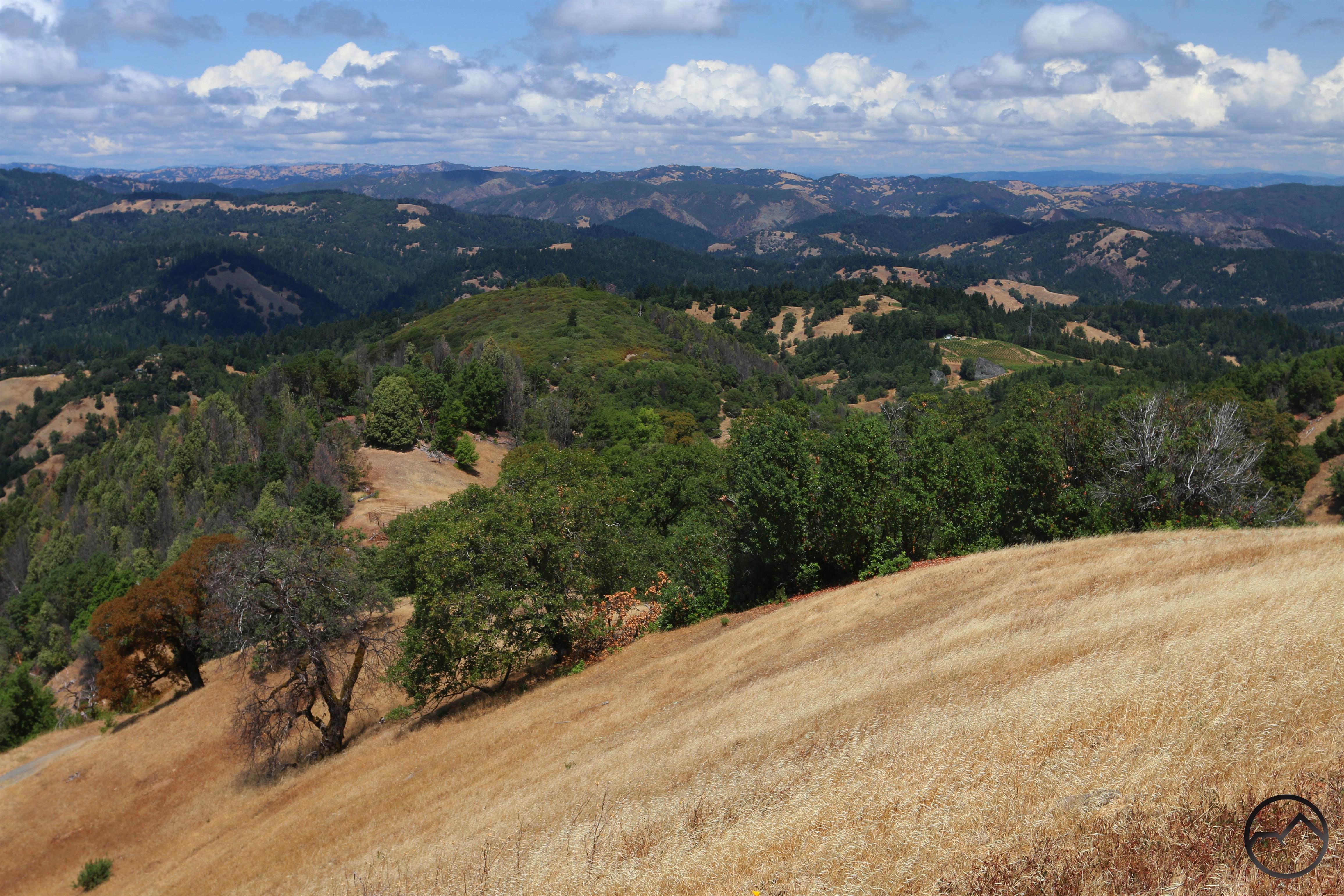
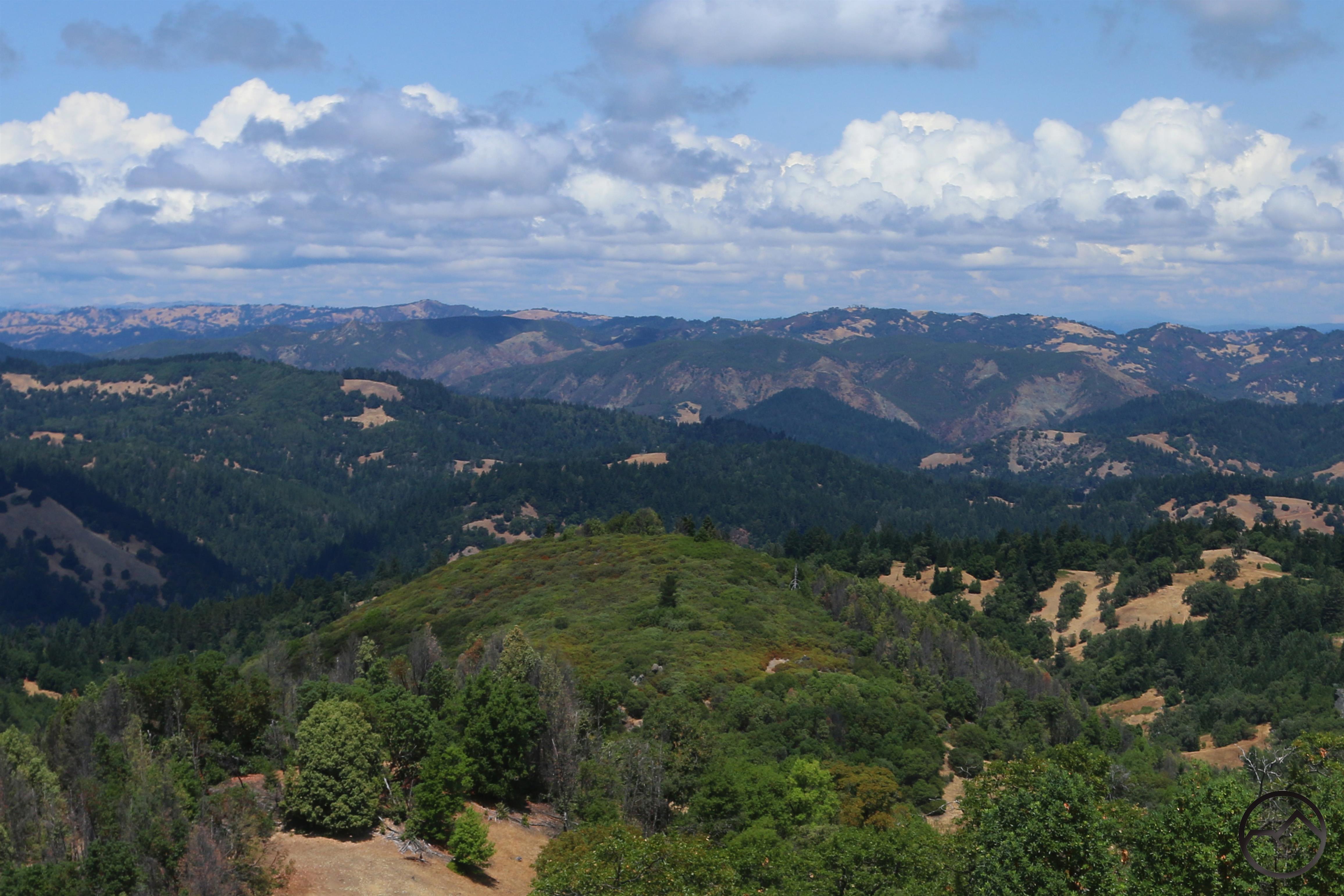
The Cedars are very remote and surrounded by private land so access is difficult. However, from the summit of Pole Mountain, it is possible to see a significant portion of the formation. The really spectacular inner canyon is barely visible but the southern end, which hosts some interesting seasonal waterfalls is readily apparent. The formation is identifiable by the dark rock and the grayer shade of green, produced by the concentration of cypresses, that blankets the rounded summit. It is something that immediately draws the eye but it is still a fascinating sight, if one understands its significance.

A distant view of the Cedars

A closer view of the Cedars. The formation stands out from the surrounding landscape.

The trip south was quite productive and it was great to be able to spend a day with my brother, who I unabashedly admire a great deal. Now I have to buckle down and really work to finish my manuscript. It is due in one month!


Sunset And Sunrise On Awesome Old Ski Bowl Crags

Posted by bubbasuess on August 17, 2019
Posted in: Cascade Range, Hiking, Mount Shasta. Tagged: Old Ski Bowl. Leave a comment

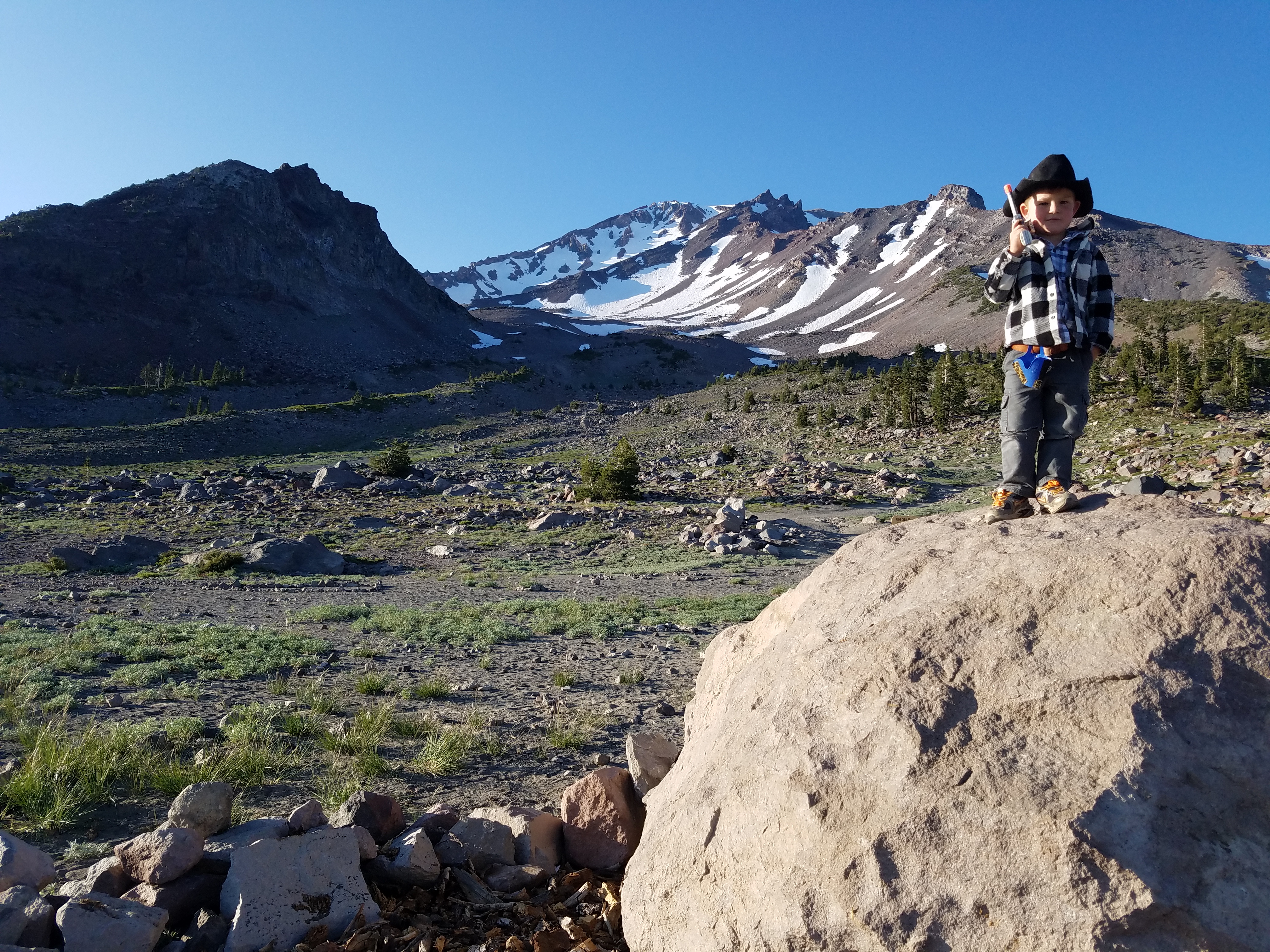
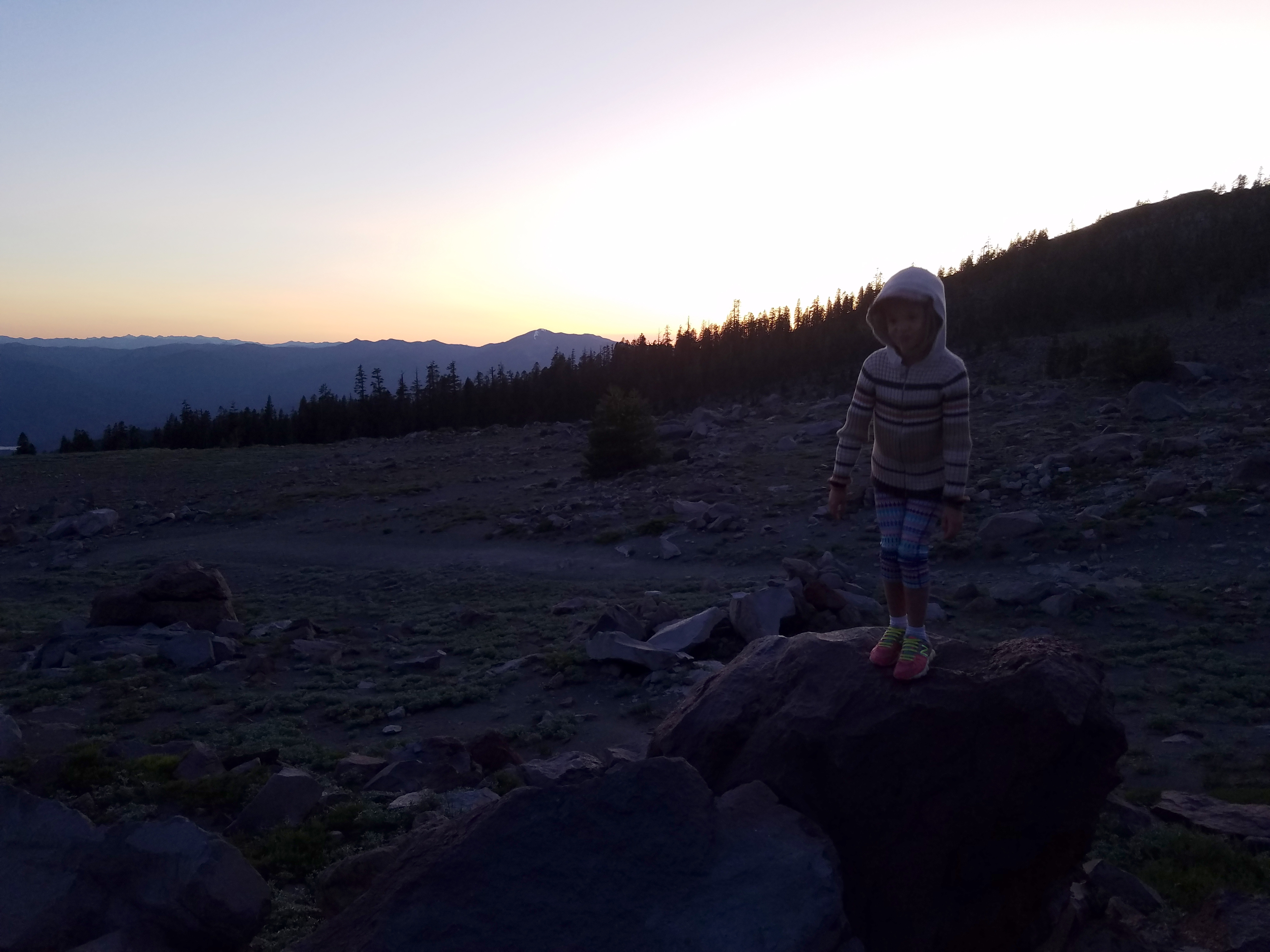
The Lone Ranger at the Old Ski Bowl.

Last night my wife and I took our kids up to the Old Ski Bowl for a picnic dinner and to watch the sunset. As always, our kids had a magnificent time playing on the rocks. They concocted odd rocky meals in their rocky restaurant, played cowboys and did goofy dances and comedy routines on large boulders. It was classic Suess family fun.

Doing the sunset dance.

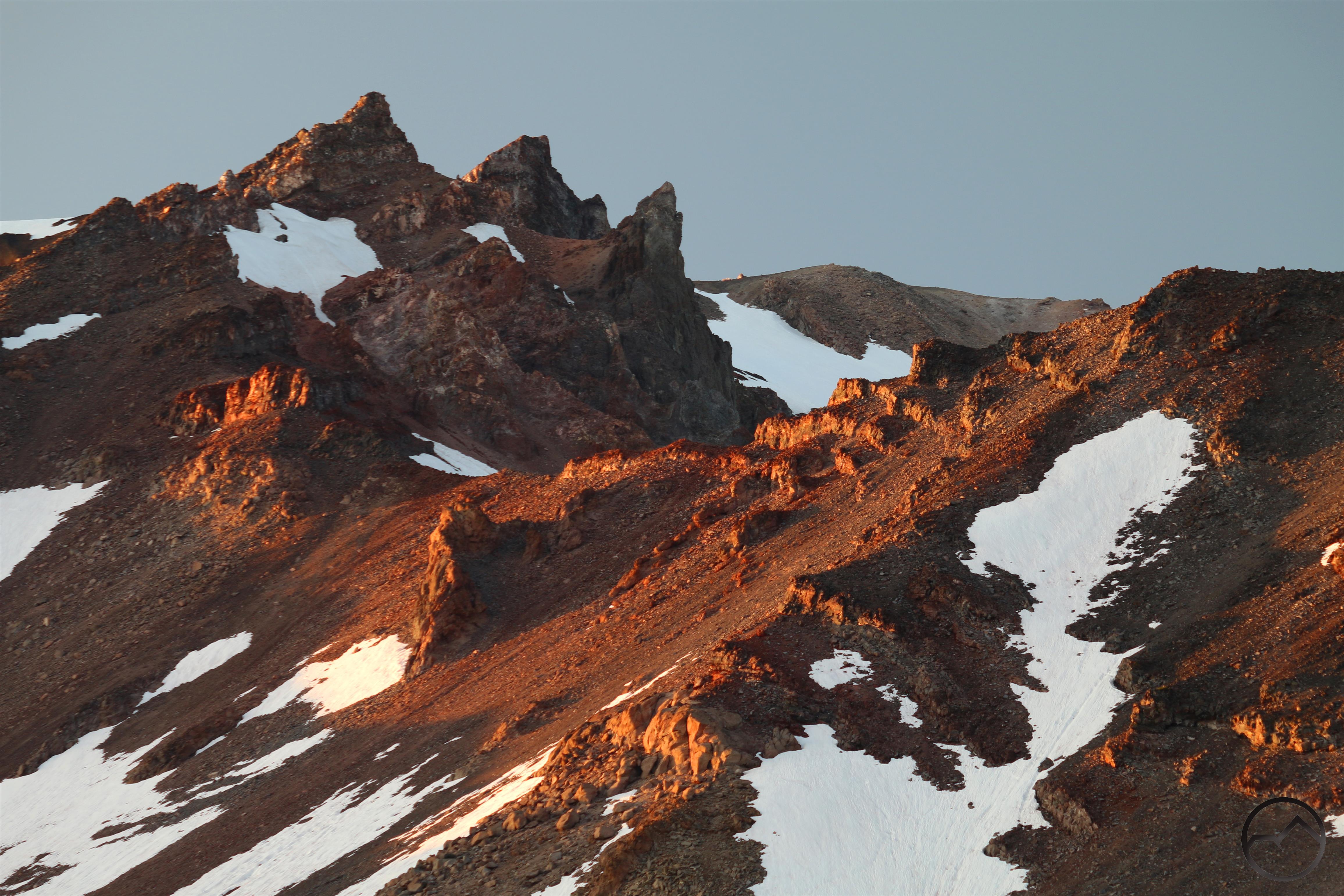
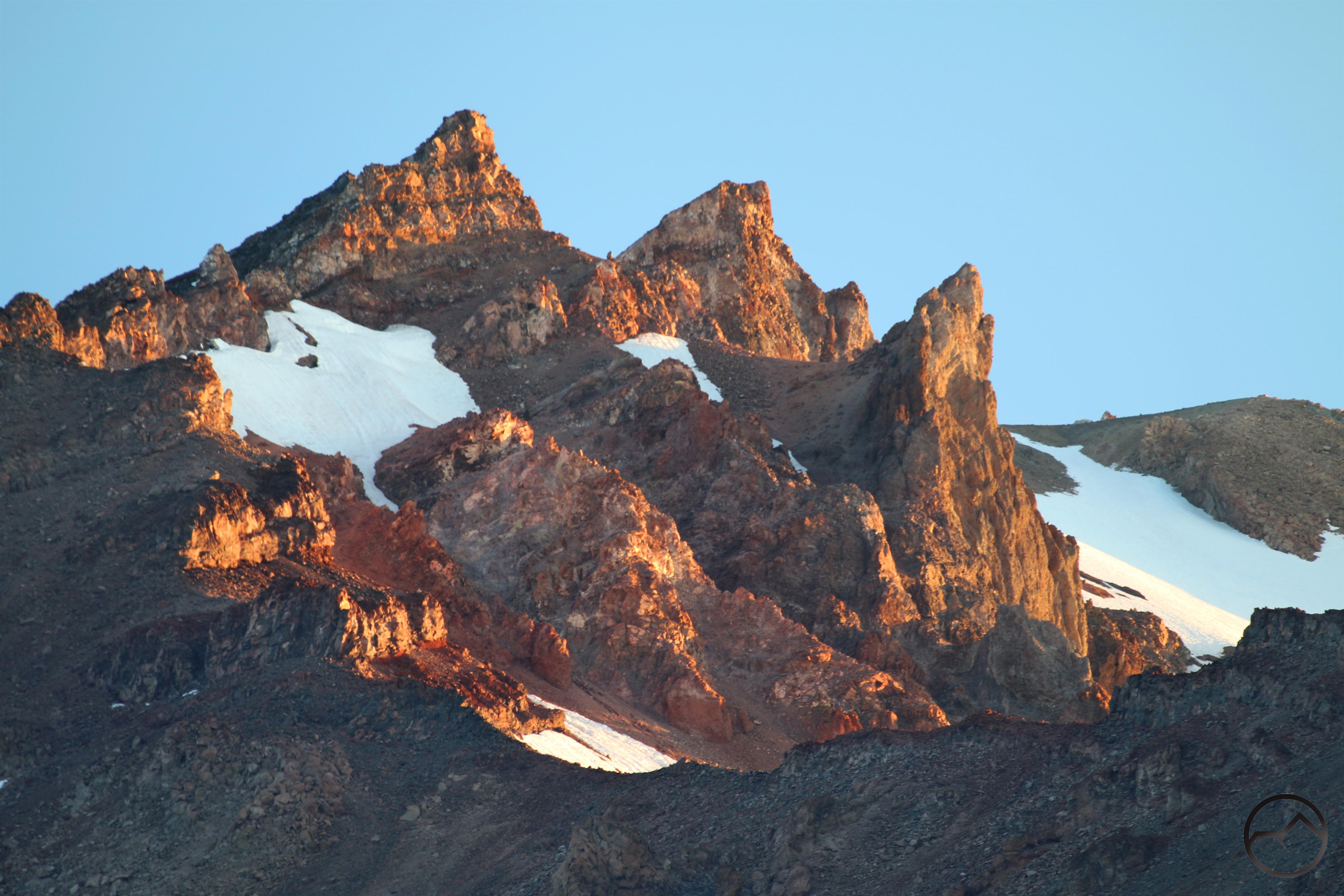
While the show went on, I could not help but stay near my camera so that I could capture the sunset. Although there is still quite a bit of snow on Mount Shasta, what I was particularly interested in was a set of crags located below Thumb Rock and above Shastarama Point. These crags are unnamed but their awesome spires are one of my favorite features on the mountain. I have considered many names for them, including the Muir Fist (being like many knuckles and below Thumb Rock) and the Konwakiton Spires (or Crags). The latter name is in reference to the Konwakiton Glacier, to which they are adjacent. Regardless of the name, or lack thereof, they are a spectacular formation. It was a beautiful sunset. The crags were in the shadow but other parts of Sargents Ridge were bathed in alpenglow.

I knew I had to go back at sunrise so I made my way up around 5:00 this morning to watch the mountain catch the dawn light. Not surprisingly, it was like watching a mirror image the sunset. Everywhere in the Old Ski Bowl and on Sargents Ridge were in the shadow but the crags were light up by the rising sun. This too was an awesome sight.

The light really emphasized how much terrain there really is up on the side of Mount Shasta. Canyons and towers that often seem to blend in with the landscape stood out and made the formation look far more rugged than it does with out the added definition of the light and dark.

Next time, I will try to make it over to South Gate Meadow for the sunrise. That is a perspective where the entire area will be awash in light. I’ll have to get up extra early for that little endeavor.

Mount Shasta Telephoto Gallery

Posted by bubbasuess on August 7, 2019
Posted in: Cascade Range, Hiking, Mount Shasta. 4 Comments

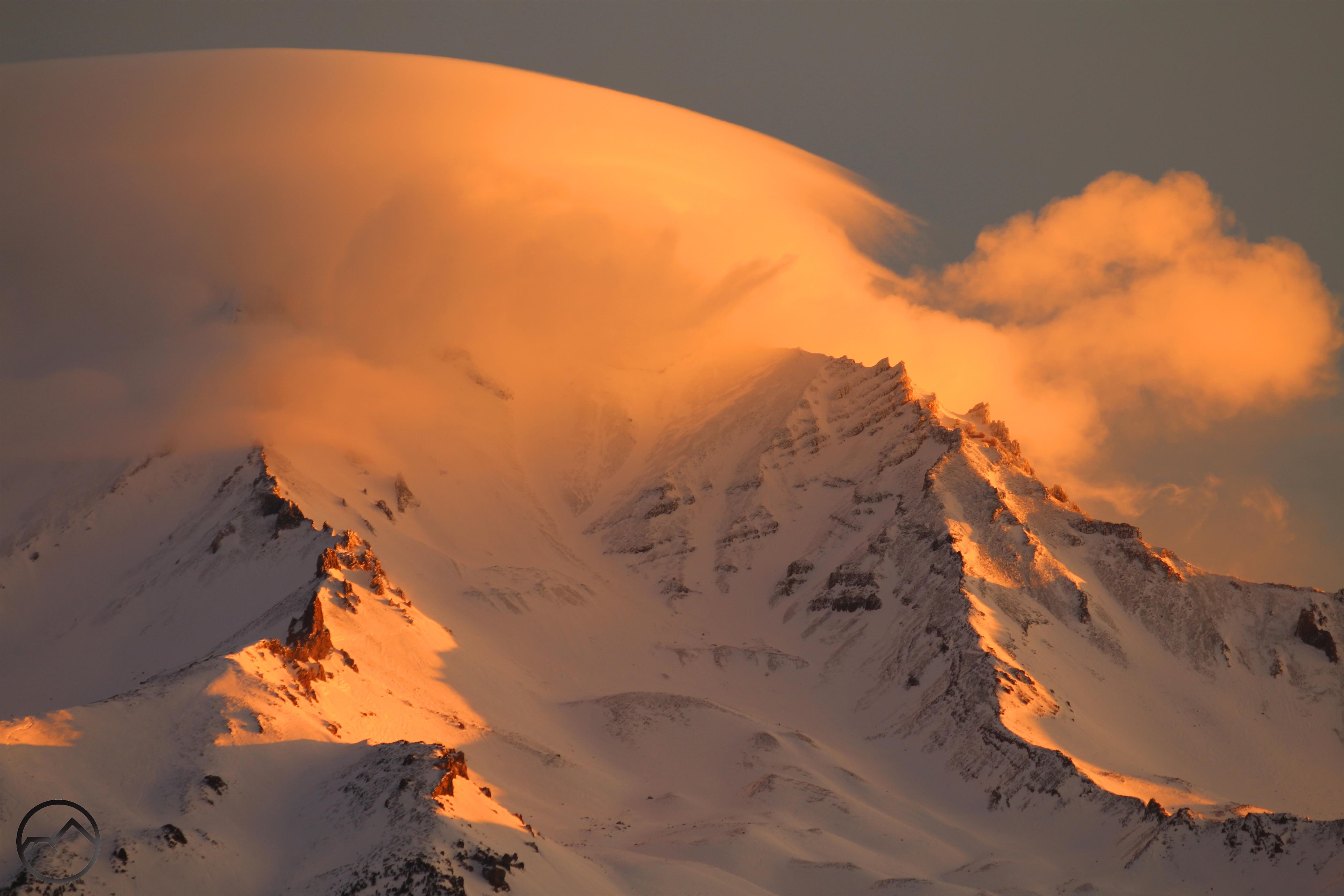
A small lenticular cloud highlights a spectacular morning on Mount Shasta.

It can, at times, be hard to appreciate some of the nuance and smaller details of Mount Shasta’s terrain. When gazing up at the mountain, it is natural to observe Mount Shasta as a whole rather than to focus in on its various parts. While it is so massive that it is nearly an entire mountain unto itself, its solitary nature is such that it is often taken in total. This is unfortunate, since so much of Mount Shasta’s beauty and character are wrapped up in its epic features. From glaciers and canyons to towering crags and knife-edge ridges, there is a lot of magnificent scenery hidden in the mountain’s details. Obviously, a great deal of this should be observed from exploring on the mountain itself. However, some of the best perspectives are from below and using optics to enhance the view, to focus in on the detail reveals views of the mountain that can’t be had from the trail. This gallery is set aside to collect these views and appreciate the nuance of Mount Shasta.


Strong Flow On Whitney Creek – A Good Time To Hike Whitney Falls

Posted by bubbasuess on August 7, 2019
Posted in: Cascade Range, Hiking, Mount Shasta, Waterfalls. Tagged: Whitney Creek, Whitney Falls. Leave a comment

Morning on Whitney Creek.

The easiest of Mount Shasta’s four high waterfalls to reach is Whitney Falls. It is the only one of the four that has a dedicated trail to a vista overlooking the falling water. The hike there is a beautiful jaunt on the mountain’s north side, boasting some good views of Mount Shasta and some intriguing exposure to a creek that is still actively carving out its route. Unfortunately, the shifting creekbed and some lack of have maintenance has given the trail a few troubles. To make matters worse, Whitney Creek itself can be a bit fickle and can have unpredictable flow. This is because the creek is generally fed by the melting of the Bolam and Whitney Glaciers during warmer summer weather rather than spring snowmelt and rain. It is not uncommon to cross over the creek and find it dry or to hike up the trail and find the falls missing. Not only is the source of the water somewhat difficult to predict but the sandy volcanic landscape is thirsty and can often absorb the water sooner than one would like. All of this adds up to making timing essential in order to observe Whitney Falls.

Whitney Falls

For those interested in hiking up to Whitney Falls, the time to go is now. The creek currently has a lot of water in it. This was observed at sunrise, which means that the volume will only increase as the day warms up. The warmer temperatures will melt the glacier faster and the volume will correspondingly go up. Afternoon is the best time to go, since the melting will be thoroughly underway. Making conditions even better, the afternoon and evening light is the best time to see the falls.

If you are heading out that way, be prepared for some challenging creek crossings. One, right at the trailhead, is difficult due to loose scree along the creek. Further up, flooding has washing out the creekbank, leaving a challenging crossing. The original route of the trail is still extant but is getting overgrown. We need to organize a group to hike out there with some lopers and clear it up. Not only is that route safer and more convenient but it also has the best views of Mount Shasta from the trail. Considering that this is the only trail on the north side of the mountain, this ought to be a big selling point.

Whatever the condition of the trail, the view of Whitney Falls is worth the effort. Now is a good time to make the journey.

20190807_065802

20190807_065802

Posts navigation

← Older Entries
Newer Entries →
    • Recent Posts

      • Winter Shows Up When It Will
      • January Rolled By With Mud, Then Very Dry
      • Mount Shasta 2025 – A Year In Images
      • Mount Shasta On Either Side Of Christmas
      • Adrift In An Ocean Of Fog
      • December Has Been Spectacular Thus Far Pt. II (A Magnificent Lenticular)
      • December Has Been Spectacular Thus Far Pt. I
      • Lenticular Interrupted
      • A Stormy Wave And A Truchas Sunset
      • Aurora Lenticularis
    • Enter your email address to follow Hike Mt Shasta and receive notifications of new posts by email.

    • Archives

      • February 2026
      • January 2026
      • December 2025
      • November 2025
      • October 2025
      • September 2025
      • August 2025
      • July 2025
      • June 2025
      • May 2025
      • April 2025
      • March 2025
      • February 2025
      • January 2025
      • December 2024
      • November 2024
      • October 2024
      • September 2024
      • August 2024
      • July 2024
      • June 2024
      • May 2024
      • April 2024
      • March 2024
      • February 2024
      • January 2024
      • December 2023
      • November 2023
      • October 2023
      • September 2023
      • August 2023
      • July 2023
      • June 2023
      • May 2023
      • April 2023
      • March 2023
      • February 2023
      • January 2023
      • December 2022
      • November 2022
      • October 2022
      • September 2022
      • August 2022
      • July 2022
      • June 2022
      • May 2022
      • April 2022
      • March 2022
      • February 2022
      • January 2022
      • December 2021
      • November 2021
      • October 2021
      • September 2021
      • August 2021
      • June 2021
      • May 2021
      • April 2021
      • March 2021
      • February 2021
      • January 2021
      • December 2020
      • November 2020
      • October 2020
      • September 2020
      • August 2020
      • July 2020
      • June 2020
      • May 2020
      • April 2020
      • March 2020
      • February 2020
      • January 2020
      • December 2019
      • November 2019
      • October 2019
      • September 2019
      • August 2019
      • July 2019
      • June 2019
      • May 2019
      • April 2019
      • March 2019
      • February 2019
      • January 2019
      • December 2018
      • November 2018
      • October 2018
      • September 2018
      • August 2018
      • July 2018
      • June 2018
      • May 2018
      • April 2018
      • March 2018
      • February 2018
      • January 2018
      • December 2017
      • November 2017
      • October 2017
      • September 2017
      • August 2017
      • July 2017
      • June 2017
      • May 2017
      • April 2017
      • March 2017
      • February 2017
      • January 2017
      • December 2016
      • November 2016
      • September 2016
      • August 2016
      • July 2016
      • June 2016
      • May 2016
      • April 2016
      • March 2016
      • February 2016
      • January 2016
      • December 2015
      • November 2015
      • September 2015
      • August 2015
      • July 2015
      • June 2015
      • May 2015
      • April 2015
      • March 2015
      • February 2015
      • January 2015
      • December 2014
      • November 2014
      • July 2014
      • June 2014
      • May 2014
      • April 2014
      • March 2014
      • February 2014
      • January 2014
      • December 2013
      • November 2013
      • October 2013
      • September 2013
      • August 2013
      • July 2013
      • June 2013
      • May 2013
      • April 2013
      • March 2013
      • February 2013
      • January 2013
    • Categories

      • Boy Scouts
      • Cascade Range
      • Castle Crags
      • Desert
      • Echo Point
      • Glaciers
      • Hiking
      • How things came to be…
      • Klamath Mountains
      • Konwakiton Outdoor Designs
      • Lakes
      • Lenticular Clouds
      • Maps
      • Marble Mountains
      • Meadows
      • Mount Eddy
      • Mount Shasta
      • Mount Shasta History
      • Napa County
      • Off Season Trails
      • Pacific Crest Trail
      • Peaks
      • Rivers
      • Rock Climbing
      • Scott Mountains
      • Seldom Seen
      • Shasta Valley
      • Sierra Nevada
      • Siskiyou Mountains
      • Sonoma County
      • Spring Trails
      • sunrise
      • sunset
      • Trinity Alps
      • Trinity Divide
      • Truchas Ridge
      • Uncategorized
      • Water
      • Waterfalls
      • Wilderness
      • Wildflowers
      • Wine Country
      • Winter Trails
      • Yosemite
    • Meta

      • Create account
      • Log in
      • Entries feed
      • Comments feed
      • WordPress.com
    • Copyright © 2013-2024 by Bubba Suess

      DISCLAIMER: Any use of the information contained in this site by any and all persons is done at their own risk. The operator of this site shall be held harmless from any and all alleged claims, demands, causes of action, liability, loss, damage and/or injury to property or persons whether brought by an individual or other entity. This indemnification applies, without limitation, to all actions by an individual or other entity as a result of their use of information contained in this site.

    Blog at WordPress.com.
    Hike Mt. Shasta
    Blog at WordPress.com.
    • Subscribe Subscribed
      • Hike Mt. Shasta
      • Join 983 other subscribers
      • Already have a WordPress.com account? Log in now.
      • Hike Mt. Shasta
      • Subscribe Subscribed
      • Sign up
      • Log in
      • Report this content
      • View site in Reader
      • Manage subscriptions
      • Collapse this bar
     

    Loading Comments...