Hike Mt. Shasta

Exploring the Mount Shasta Region

  • Home
  • Trails
    • Mount Shasta Trails
      • Brewer Creek Trail
      • Clear Creek Trail
      • Gray Butte Trail
      • Green Butte Ridge Trail
      • Horse Camp Trail
      • North Gate Trail
      • Old Ski Bowl Trail
      • Panther Meadow Trail
      • South Gate/Squaw Meadow Trail
      • Whitney Falls Trail
    • Trinity Divide Trails
      • Blue Divide Trail
      • Castle Lake Trail
      • Castle Lake Shore Trail
      • Cliff Lake Trail
      • Deadfall Lakes Trail
      • Gray Rock Lakes Trail
      • Gumboot Trail
      • Heart Lake Trail
      • Porcupine & Toad Lakes Via Pacific Crest Trail
      • Seven Lakes Basin Via Pacific Crest Trail
      • Sisson-Callahan Trail
      • Soapstone Trail
      • South Mumbo Scramble
      • Tamarack Lake Trail
      • Toad Lake Trail
    • Castle Crags Trails
      • Burstarse Falls Via Pacific Crest Trail
      • Castle Dome Trail
      • Flume Trail
      • Lower Castle Crags Via Pacific Crest Trail
      • Root Creek Trail
    • Scott Mountains Trails
      • Bluff Lake & Cement Bluff via Pacific Crest Trail
      • Caldwell Lakes Trail
      • China Mountain Scramble
      • Cory Peak and Bull Lake via Pacific Crest Trail
    • Cascade Crest
      • Ash Creek Butte Scramble
      • Goosenest Trail
      • Juanita Lake Trail
      • Orr Lake Trail
    • Mount Shasta City Area Trails
      • Black Butte Trail
      • Box Canyon Trail
      • Gateway Trail
      • Lake Siskiyou Trail
      • Mount Shasta City Short Trails
      • Ney Springs Canyon Trail
      • Spring Hill Trail
    • Shasta Valley Trails
      • Black Lava Trail
      • Haystack Trail
      • Lake Shastina Trail
      • Pluto Cave Trail
      • Trout Lake Trail
      • Yellow Butte Trail
    • Sacramento River Trails
      • Dunsmuir Trail
      • Hedge Creek Falls Trail
      • Sacramento River Trail
      • Sims History Trail
    • McCloud River Trails
      • Ash Camp To Ah-Di-Na Via Pacific Crest Trail
      • McCloud River Falls Trail
      • McCloud River Preserve Trail
      • Squaw Valley Creek Trail
      • McCloud River Trail: Algoma Camp to Nitwit Camp
      • McCloud River Trail: Nitwit Camp to Cattle Camp Swimming Hole
      • McCloud River Trail: Cattle Camp Swimming Hole to Camp 4
      • McCloud River Trail: Camp 4 to Upper McCloud Falls
      • McCloud River Trail: Pine Tree Hollow Loop
    • Trails Further Afield
      • Trinity Alps Trails
        • Bear Lakes Trail
        • Billys Peak Trail
        • Boulder Creek Lakes Trail
        • Boulder Lake Trail
        • Canyon Creek Trail
        • Caribou Lakes Trail
        • East Boulder Lake Loop
        • East Weaver Lake Trail
        • Four Lakes Loop
        • Granite Peak Trail
        • Grizzly Creek Trail
        • Gulch Lakes Loop
        • Hidden Lake Trail
        • South Fork Lakes Trail
        • Stoddard Lake Trail
        • Stoney Ridge Trail
        • Tangle Blue Lake Trail
      • Warner Mountains
        • Emerson Creek Trail
        • Highgrade Trail
        • Patterson Lake Via Warner Summit Trail
        • Pine Creek Trail
        • Squaw Peak Trail
  • Articles
    • Trails By Area
      • Mount Shasta
        • Vistas, Meadows And Waterfalls: Three Best Hikes On Mount Shasta
        • The End Of The Road: Three Hikes In The Old Ski Bowl Area
        • Two Trails From Bunny Flat
        • Three Trails On Mount Shasta’s East Side
        • Mount Shasta’s Hummingbirds
      • Trinity Divide
        • Great Lakes: Top Five Lake Basins In The Trinity Divide
        • The Headwaters Of The South Fork Of The Sacramento River
        • Neglected Headwaters: Two Lesser Lake Basins On The South Fork
        • Gumboot Saddle: Two Hikes On The PCT
        • Descent Into Mystery: The Sisson-Callahan Trail
        • Mumbo Basin – Overlooked On The West Side
        • The Headwaters Loop: A Proposed Backpacking Loop In The Trinity Divide
      • The McCloud River
        • The McCloud River Trail
      • Shasta Valley
        • Jewels In The Desert
      • Scott Mountains
        • Great Scott! Two Scott Mountains Hikes On The PCT
      • Trinity Alps
        • Carubou Lakes: Trinity Alps On A Grand Scale
        • Switchbacks To Heaven: The Trinity Alps’ Stoney Ridge Trail and Four Lakes Loop
        • Trinities In Proximity: Two Trinity Alps Trails With Easy Access From Mount Shasta
        • Trails in the Carter Meadows Area
        • Trinity Alps Views of Mount Shasta
        • The Psychological Value Of The Trinity Alps
    • Waterfalls
      • Three Waterfalls On Mount Shasta
      • McCloud River Waterfalls
      • Sacramento River Waterfalls
      • Trinity Divide Waterfalls
      • Trinity Alps Waterfalls
      • Avoiding A Dry Whitney Falls
    • Off Season Trails
      • Three Winter Hikes Near Mount Shasta City
      • Winter Hikes In Shasta Valley
      • Winter Hiking In The Shasta Valley Wildlife Refuge
      • Winter Hikes On The Sacramento River
      • Winter Hikes On The Lake Siskiyou Trail
      • Spring Hikes In The Castle Crags
      • Spring Hikes On the Upper McCloud
      • Spring Hikes On The Lower McCloud River
    • Points Of Interest
      • Mount Eddy: Overshadowed, Underrated
      • Black Butte: Hiding In Plain Sight
      • Castle Dome: Steadfast And Staggering
      • Mount Shasta Hoodoos
      • Sacramento Scrambling
      • The Shasta River
      • The Castle Creek Watershed
      • Mount Shasta East Side Glacier View
      • 5 Fantastic Mount Shasta Vistas
      • 5 Highest Peaks Around Mount Shasta
      • 5 Best Hikes On Creeks And Rivers
      • 5 Interesting Footbridges
      • Three Spectacular Drive-To Sunset Vistas
    • North State Geography
      • Introduction
      • Seven Major Regions
      • The California Cascades
      • Klamath Mountains Pt. I
      • Klamath Mountains Pt. II
      • The Great Canyons Of Mount Shasta
      • Mount Shasta, Timberline, And The Relative Size Of Cascade Volcanos
      • Four Eruption Cones Of Mount Shasta
      • Mount Shasta’s Medial Moraine
    • Northern California Review
      • North Table Mountain
      • Lakes Basin Recreation Area
      • Eastern Sierra Fall Color
      • Sonoma County
      • Central Sierra Nevada
      • Orland Buttes
    • Seldom Seen
      • Ash Creek Falls
      • Mud Creek Canyon
      • Lower Mud Creek Canyon
      • Diller Canyon
      • Lower Cascade Gulch
      • The Grey Rocks
      • Castle Creek
      • Upper Wagon Creek
      • Fawn Creek Canyon
      • Confluence of the Sacramento River and Castle Creek
      • Upper Klamath River Canyon
      • Hole In The Ground Geologic Area
      • Ash Creek Butte Fossil Rock Glacier
    • Mount Shasta History
      • Vantage Lost: The Everitt Memorial Vista
      • A Yosemite-Mount Shasta Connection
      • Whitney – What’s In A Name?
      • Mount Shasta Area and the 1838 Exploring Expedition
      • A 19th Century Engraving Of An Epic Mount Shasta Vista
      • Vintage 1907 Color Photos
      • A Misleading Painting
      • A Mysterious Painting
      • A Mysterious Painting Pt. II
      • Stereographic Mt. Shasta
      • Year One Of Hike Mt Shasta
      • Year Two Of Hike Mt Shasta
      • Year Three Of Hike Mt Shasta
      • Year Four Of Hike Mt Shasta
      • Year Five Of Hike Mt Shasta
      • Year Six Of Hike Mt Shasta
      • Year Seven Of Hike Mt Shasta
    • Image Galleries
      • Mount Shasta Trails Gallery
      • Mount Shasta Sunrise Gallery
      • Mount Shasta Sunset Gallery
      • Lenticular Cloud Gallery
      • Mount Shasta NON-Lenticular Clouds
      • Mount Shasta Reflection Gallery
      • Telephoto Gallery
      • Mount Shasta Area Fall Color
      • Castle Crags Gallery
      • Waterfalls Gallery
      • Trinity Divide Lakes Gallery
      • Mount Shasta Area Rivers Gallery
      • Shasta High Desert Gallery
      • Mount Shasta GIF Gallery
    • Random Notes
      • Revew: Three Mount Shasta Trail Maps
      • A Mount Eddy Wilderness?
      • New Land Additions For The Castle Crags
      • Book Plug: Mount Shasta Area Rock Climbing
      • Exile: How I Came To Love Wilderness
  • Mt. Shasta Trail Map
  • Blog
  • About/Contact
  • Links
  • Truchas Ridge

Gateway Trail Phase II Review And Comment Period Open

Posted by bubbasuess on May 28, 2019
Posted in: Cascade Range, Hiking, Mount Shasta. Tagged: Gateway Phase II, Gateway Trail. Leave a comment

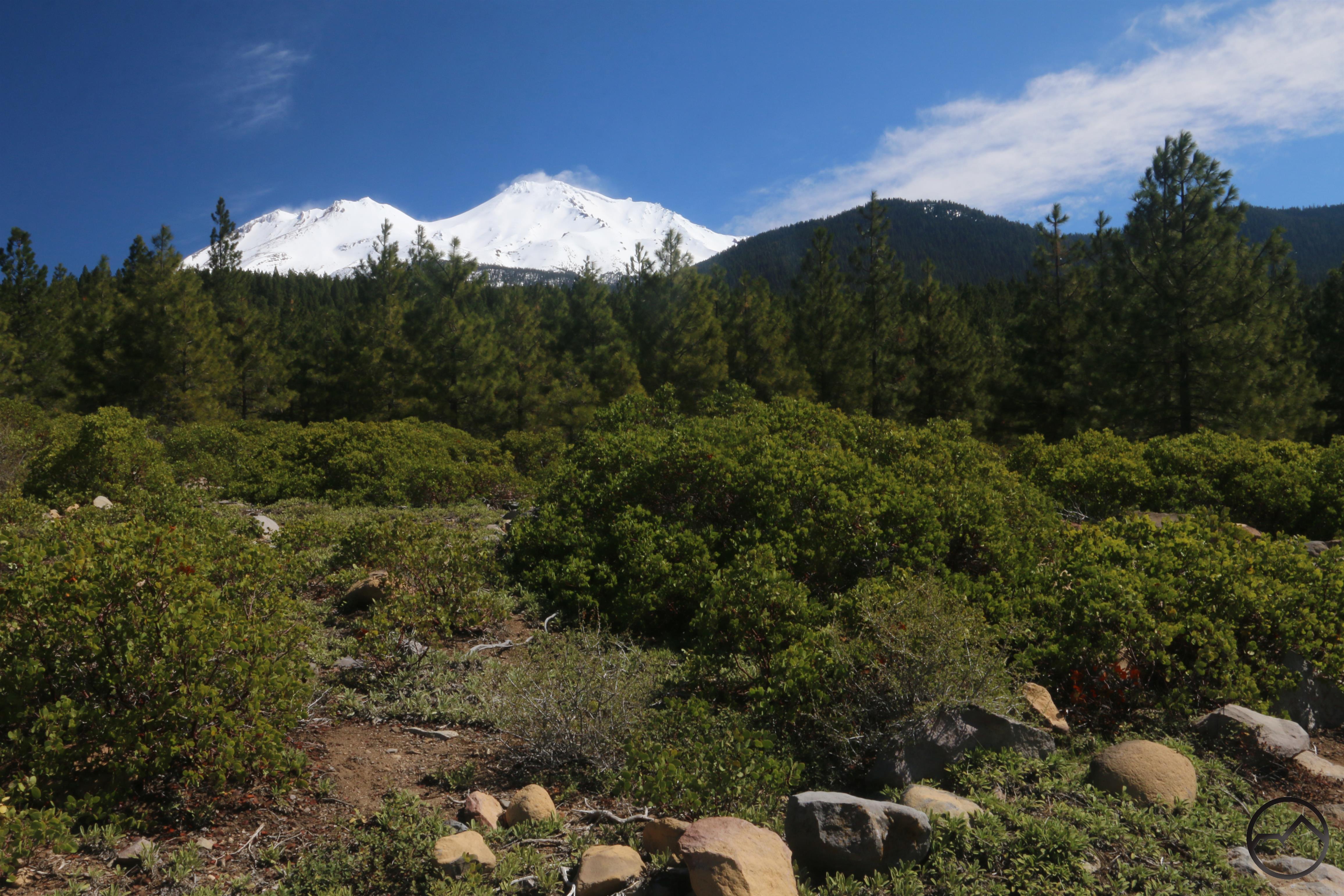
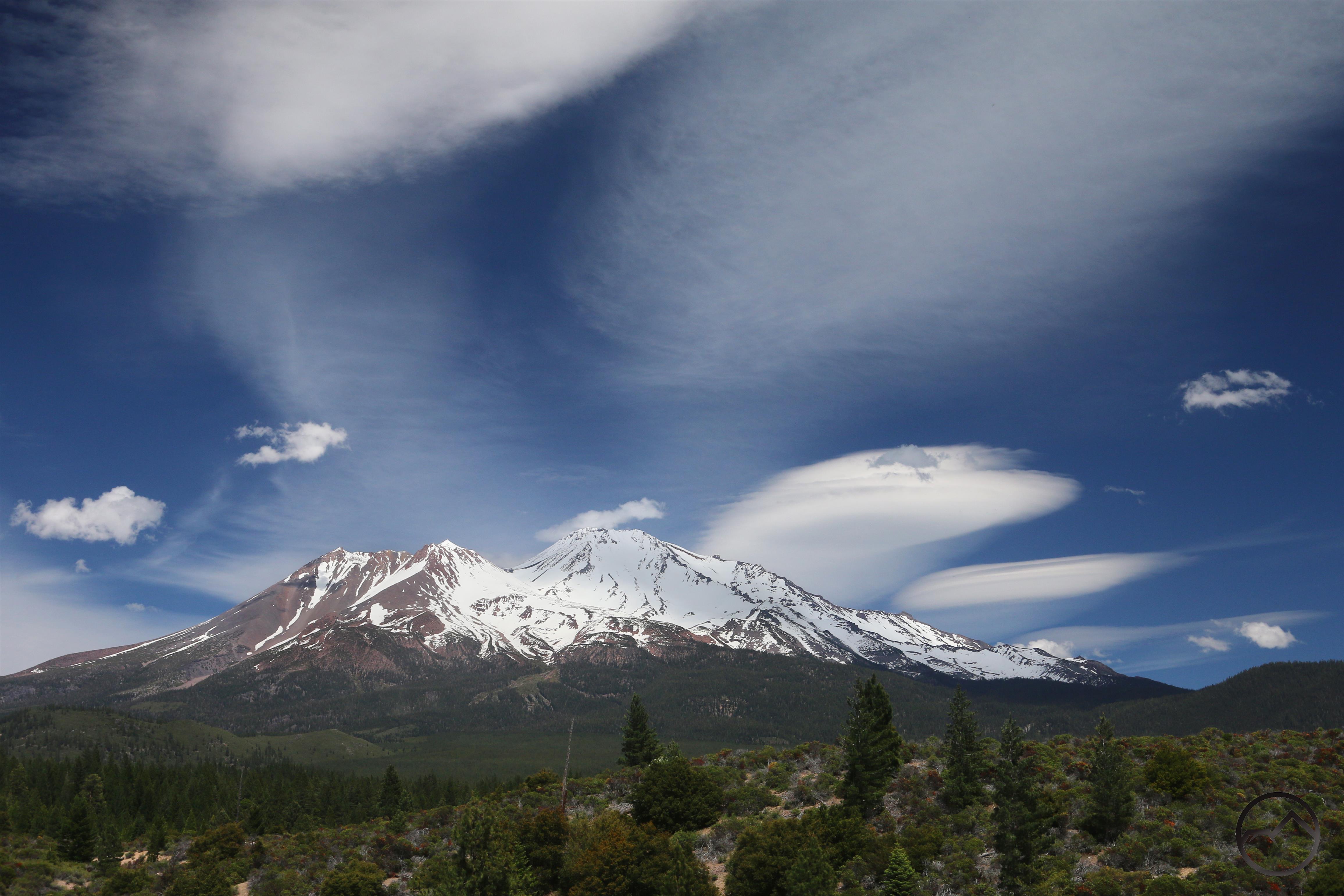
Mount Shasta towers majestically above the Gateway Trail.

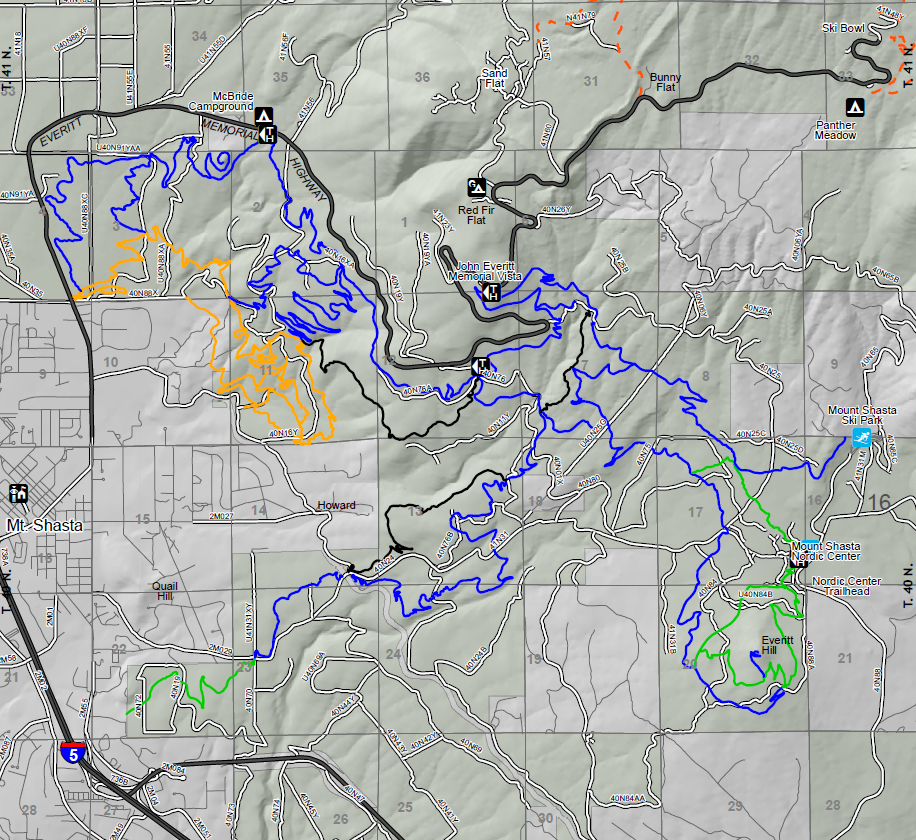
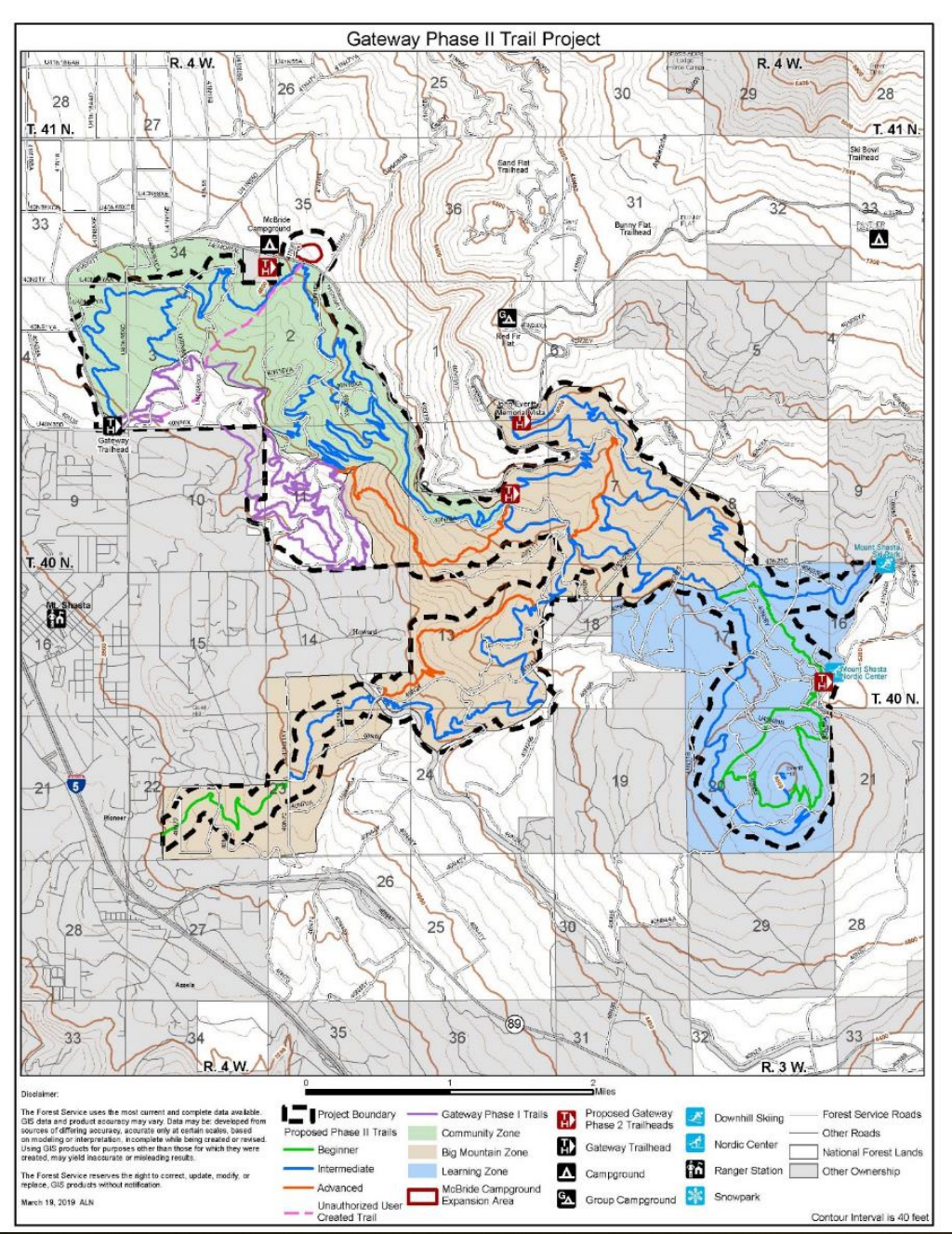
The Gateway Trail Phase II environmental studies are now completed and available for review. This massive project expands the existing Gateway Trail system from 14 miles to approximately 60 miles. Most of the trails are intended to be mixed-use trails, designed for hikers and mountain bikers, though the latter does receive the emphasis in this particular project. Once completed, this trail network will likely put Mount Shasta “on the map” as far as mountain biking is concerned. In addition to the new trail, 4 new trailheads will be established and the McBridge Springs Campground will be expanded. It certainly opens up a host of possibilities for hikers and mountain bikers.

My review of the project can be read here. The original proposal map is below:

You can read the environmental assessment here. All links to the project review are here.

After going over the studies’ findings, it appears the project has not been significantly altered from the form in which it was initially presented though there are two noteworthy changes.

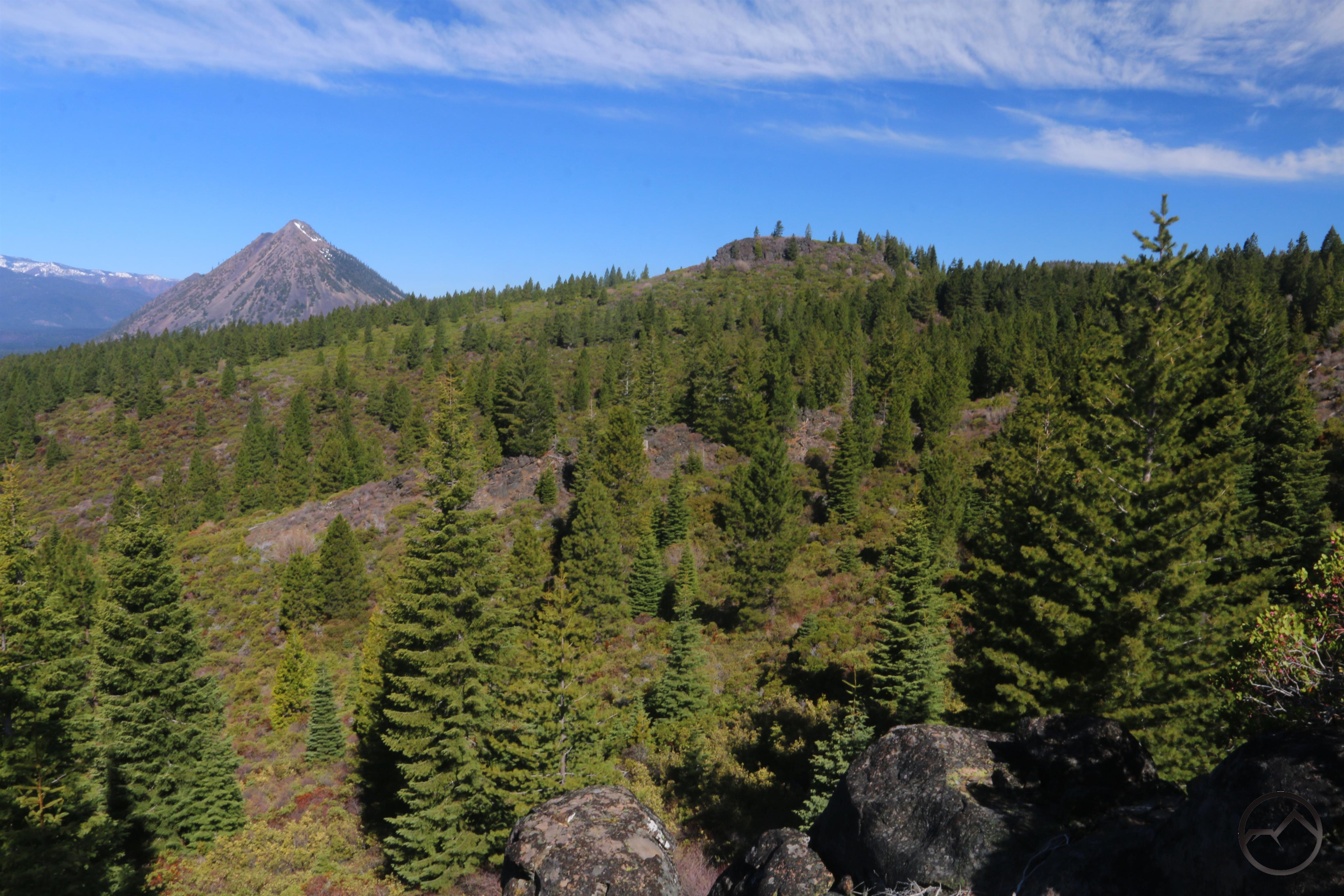
A view of Black Butte and Morning Star Knoll aka Rooster Rock.

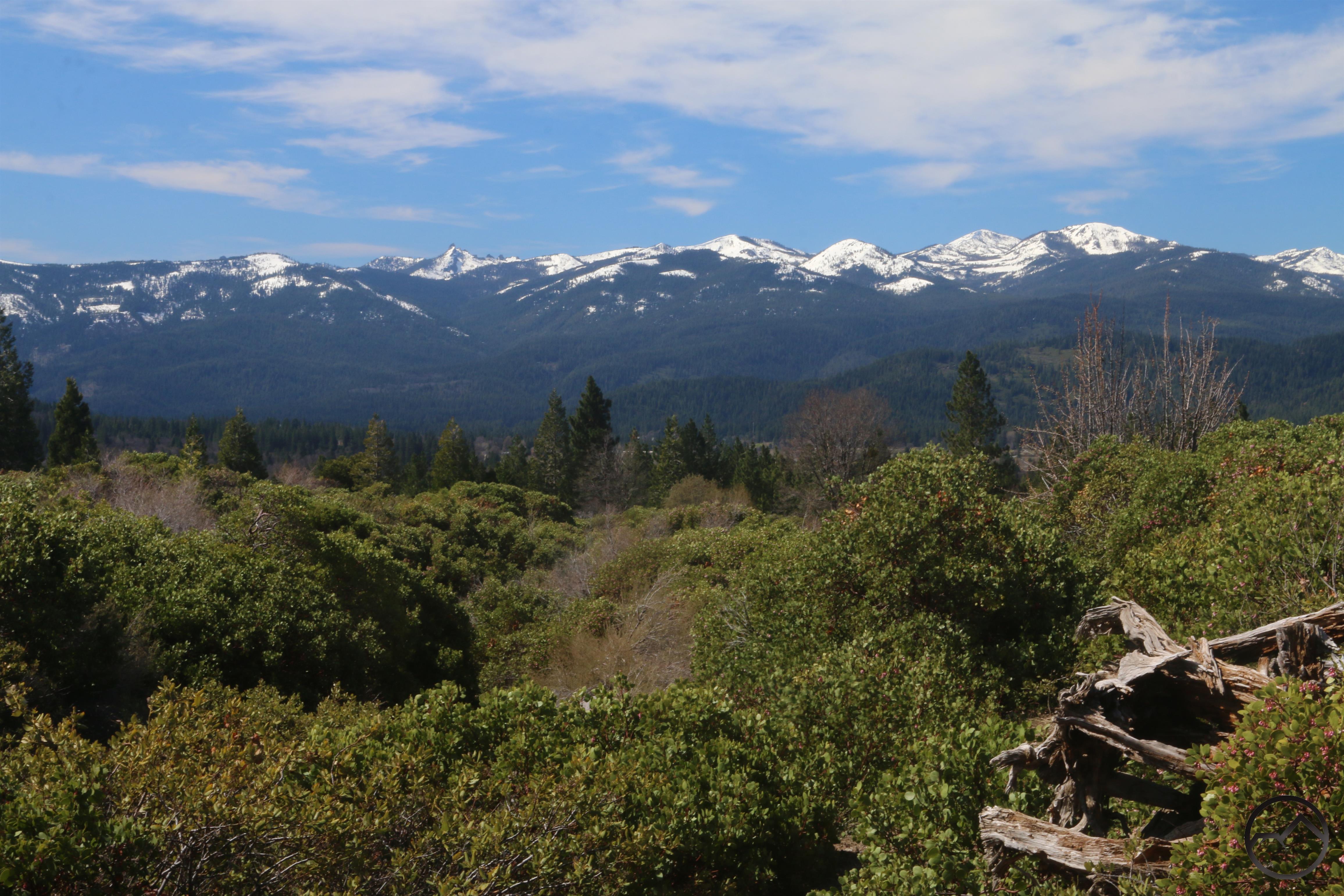
The first is a small omission from the proposed trail route. In northern part of the trail network, the map indicates that a short spur trail ascends a large rock formation known as Morning Star Knoll or Rooster Rock. This short section of trail would lead hikers (it is hard for me to envision bikes making it up the rock) to a spot that would have fantastic views of both the valley and mountains to the west as well as the upper regions of Mount Shasta itself. Unfortunately, directly adjacent to the rock is a small parcel of private land. I am confident there were concerns over privacy and the ability of hikers and bikers being able to look down on the land below. While this is an unfortunate loss for the trail network, it seems like a reasonable alteration.

The altered trail plan can be seen below:

As if to compensate the loss of an interesting section of trail, there is also an addition of a new section of trail designated specifically for hikers. Dubbed the “Sisson Southern Trail”, after the name of the route when it once was used to connect the town of Mount Shasta with Horse Camp, it would offer an alternate hiking route where hikers would not have to contend with the possibility of encountering bikes. The trail would connect the current Gateway trailhead with the McBride Springs campground. This would make an excellent bonus for the entire project.

In the proposal

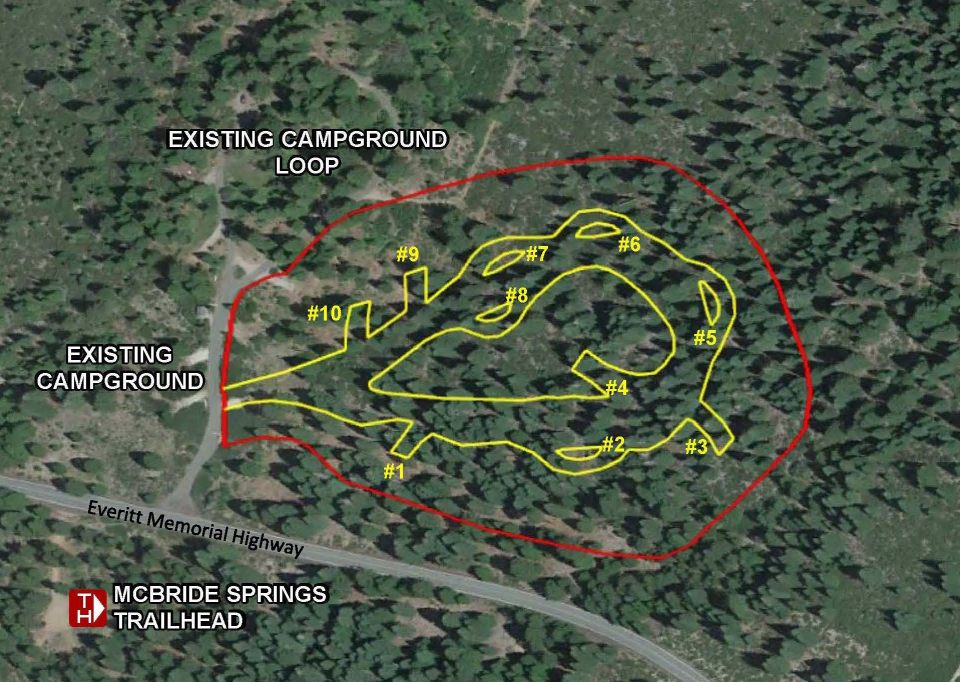
Speaking of the McBride Springs campground, it will indeed be expanded. This is a much needed addition to camping capacity along the Everitt Memorial Highway. With the addition of a new trailhead directly across the road, this campground will no doubt increase in popularity significantly and the additional sites will help absorb this. I think it is likely that demand will outstrip the additional sites rather quickly.

Given the likely increase in popularity, I think even more camping somewhere in the Gateway vicinity would be a good addition. Establishing a new campground in the plantations along the road to the Black Butte Trailhead would be a good idea. This would potentially have the side benefit of increasing the number of eyes in the area and, thereby, hopefully decrease the number encampments that develop in that area.

Overall, I think the project is fantastic. I am excited to see work begin and for the trails to be completed. It’s going to be a blast exploring over the next few years!


Snow On Memorial Day Weekend

Posted by bubbasuess on May 26, 2019
Posted in: Cascade Range, Hiking, Mount Shasta, Pacific Crest Trail. 5 Comments

Mount Shasta around Memorial Day 2018: a lot less snow!

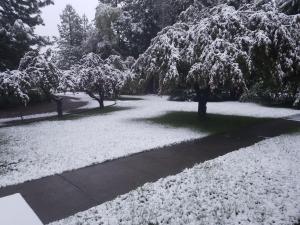
I knew that some rainy weather was in store for Sunday, but I honestly did not anticipate snow at lower elevations. Nonetheless, it happened. I have not been into town and my house is a few hundred feet higher up, so it may not have stuck there. Up on the pass, however, we got about an inch of snow. Thankfully we opted not to plant our tomatoes yesterday, which we had planned to do!


This snow does not really impact the trails around Mount Shasta much. It will melt off quickly, the weather will warm up tomorrow and the snowpack at higher elevations will continue to thaw. What we may see, though, is an early influx of PCT thruhikers. The ones at the front of the pack are approaching the Domeland Wilderness and will soon be at Kennedy Meadows, the last outpost before heading up into the High Sierra. In an average year, the snow will have melted out in most of the High Sierra, leaving the way north open. However, this year, as in 2017, the Sierra Nevada is still deep in snow and will necessitate thruhikers skipping around and doing the trail in segments.

That means that we here in Mount Shasta may start to see thruhikers popping up in town in a few weeks, a month or more earlier than normal. The snow is deep just about everywhere. The only really viable section of trail to hit right now is from Old Station by Hat Creek up to I-5. From there, some of the Trinity Divide, Siskiyous and the Soda Mountain area may be open or opening soon. Other than that, they are going to have to wait out the melting. Of course, further up in Oregon and Washington, things melt out much later so the season is no further along than it is down here. Not the best conditions to be on the PCT this year!

A Mount Shasta Reader – 2019

Posted by bubbasuess on May 25, 2019
Posted in: Cascade Range, Glaciers, Hiking, Klamath Mountains, Mount Shasta, Mount Shasta History, Peaks, Rivers, Trinity Divide. 3 Comments

Sunrise on Mount Shasta.

The Mount Shasta area is vast and varied. It is a delight to all those who love the natural world and yearn to enjoy it. However, exploring Mount Shasta and its environs can be a daunting task, especially to admirers who have not spent much time in the area or have not had the opportunity to dive into the literature that records many of the areas blessings. This reader is intended to pull together several articles and resources that have appeared on Hike Mt Shasta over the years and place them together in an easy-to-access setting. It is my hope that this will be a useful tool for deepening knowledge and appreciation of Mount Shasta, the surrounding mountains and all of Northern California!

Northern California Geography Orientation

California is probably the most geologically diverse state in America. This in part naturally flows from it’s size but there is also an immense amount of diverse geology packed within its borders. The North State, which is the uppermost part of California, maintains this pattern and presents a confusing array of rock types, numerous mountain ranges and a wide variety of geologic forces at work. This series, “Breaking Down The North State”, offers a good introduction on the geography, geology, and various regions that surround Mount Shasta.

  1. Introduction
  2. Seven Major Regions
  3. The California Cascades
  4. The Klamath Mountains Pt. I
  5. The Klamath Mountains Pt. II

Mount Shasta Landmark Locator

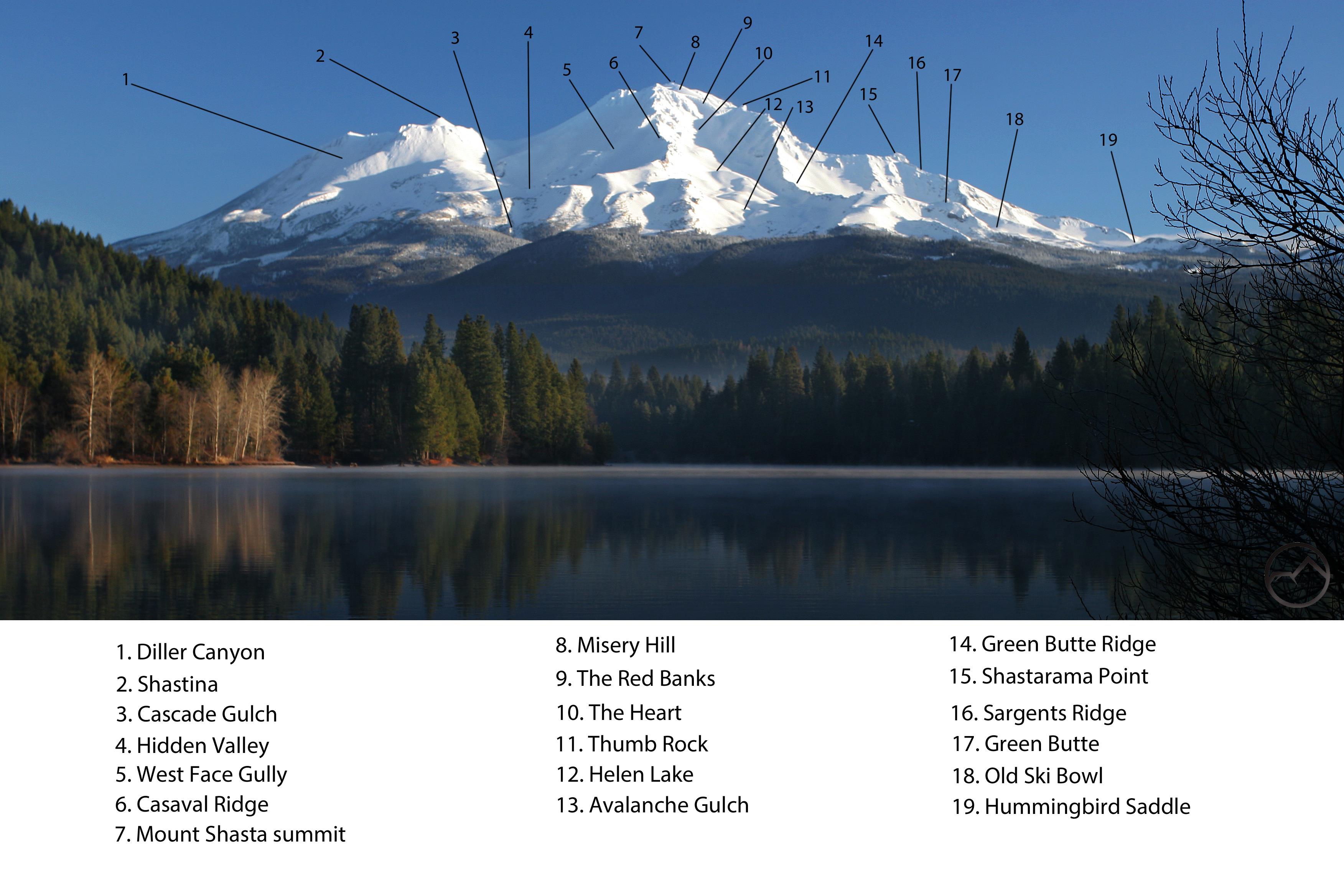
Mount Shasta nearly a mountain range unto itself. There are dozens of landmarks and features waiting to be identified, though there are few easy to use resources to help. The Mount Shasta Landmark Locator can be helpful in learning the mountain’s geography. The Locator has detailed guides to the 4 cardinal orientations of the mountain. This is particularly helpful considering how distinctly different Mount Shasta appears from these perspectives.

The impressive number of landmarks on Mount Shasta is indicative of the mountain’s complex geology. The fact is, Mount Shasta has experienced 4 distinct eruptive epochs, each adding a major quadrant to the volcano’s geography. This has heavily influenced Mount Shasta’s distinct appearance. Read more about these 4 eruption cones here. This article is an excellent companion to the Landmark Locator and helps explain many of the features identified there.

An article that puts Mount Shasta into the broader perspective of Cascade volcanoes does so by comparing the elevations of treeline on numerous mountains found in the range. This emphasizes Mount Shasta’s incredible size.

Another article examines the fossil remains of Mount Shasta’s medial moraine. The Hotlum Glacier once advanced several miles further than it does now, producing a medial moraine, the only one known to have existed in California.

Neighboring Peaks

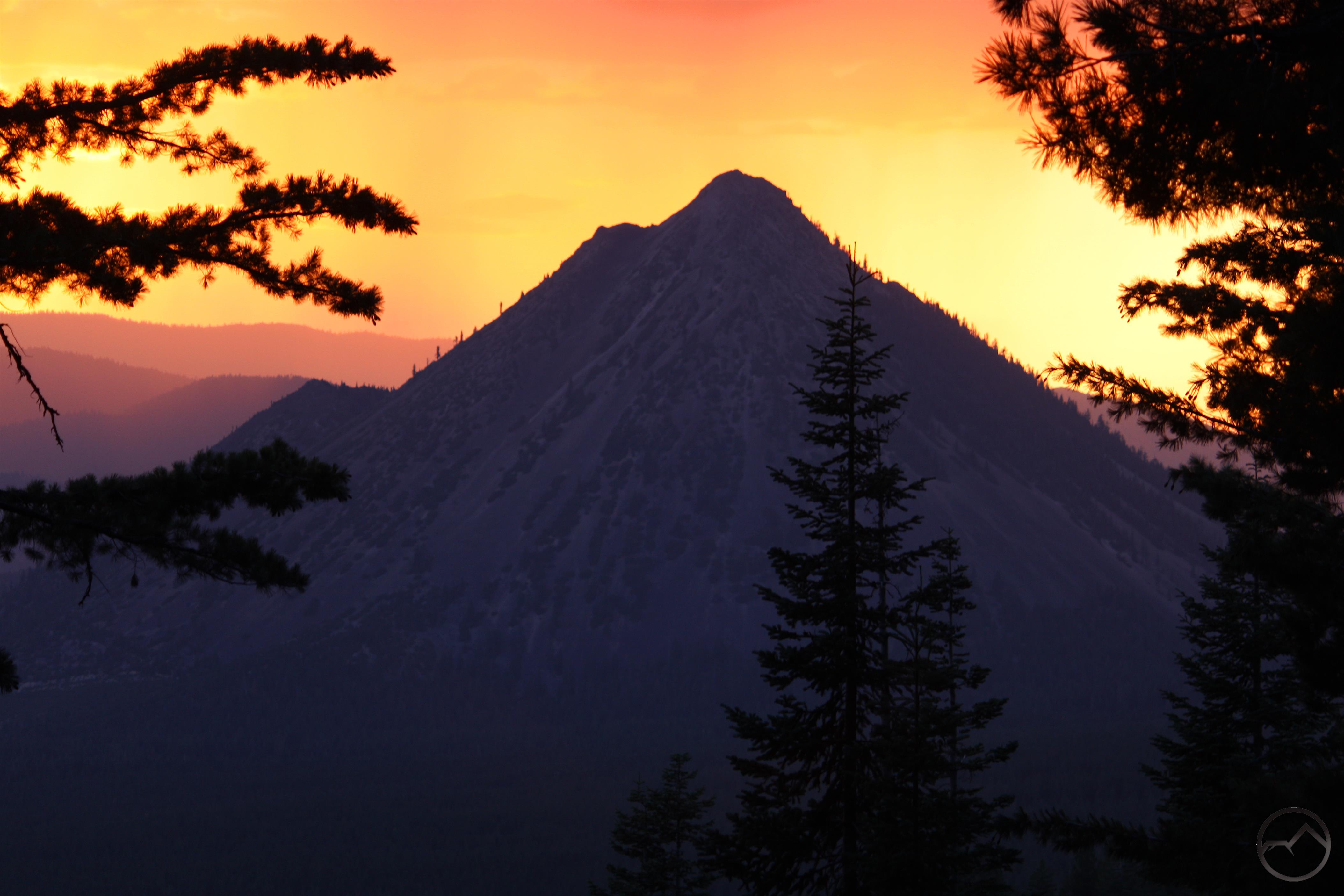
Mount Shasta may be the dominant peak in this corner of the country but there are other noteworthy summits that should not be overlooked. The two most obvious are Mount Eddy and Black Butte. The former is the highest point in the Klamath Mountains and the entire coastal ranges of the coterminous states. Dotted with lake basins and boasting spectacular views, it is a premier destination in its own right. The latter of the two peaks is the westernmost summit of the California Cascades. The distinct shape and prominent position make Black Butte an unmissable presence. The trail to the summit is a Mount Shasta area classic.

Other articles on summits around Mount Shasta are:

–The Five Tallest Peaks Around Mount Shasta

–Five Trails To Peaks Around Mount Shasta

Rivers Around The Mountain

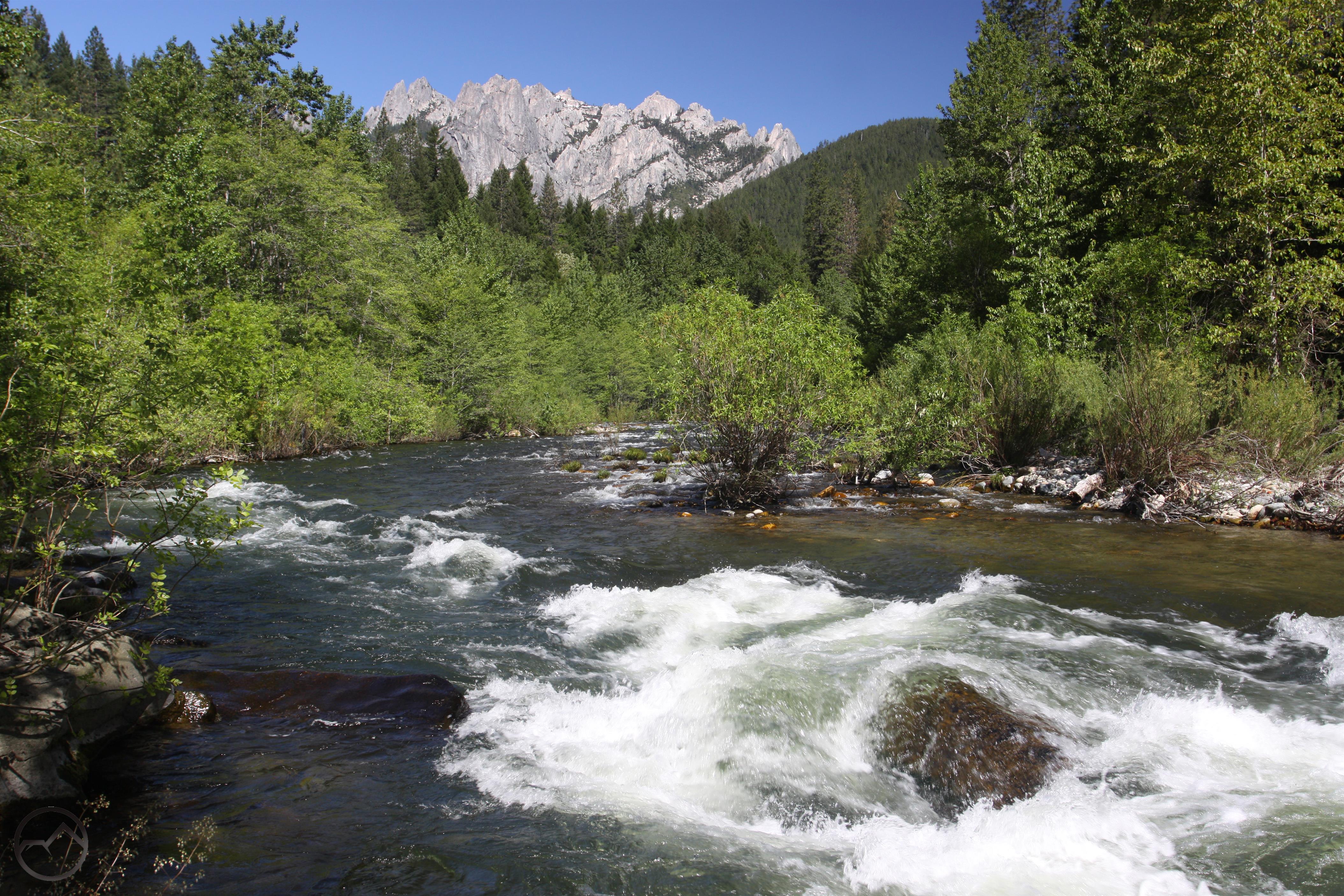
Three rivers flow around the base of Mount Shasta. The Sacramento River, California’s largest and longest river, begins nearby, while the McCloud and Shasta Rivers also begin in the area. Flowing through deep canyons, over large waterfalls and through broad valleys, these rivers are beautiful contrasts to the towering spire of Mount Shasta. They also offer diverse recreational opportunities that include hiking, fishing and kayaking. In addition to the rivers, there are dozens of beautiful creeks flowing through the area. Wagon Creek and Castle Creek are probably the most notable but many others yield beautiful and refreshing destination. For those looking to explore, these are 5 of the best trails along rivers and creeks in the area.

See the Mount Shasta Area Rivers Gallery.

Waterfalls

The Mount Shasta area has a number of fantastic waterfalls. This generally fit into two categories. The first are those that are found in the lowlands around Mount Shasta. Some of these are along the McCloud and Sacramento Rivers, a few others are in the mountains to the west of Mount Shasta. None are particularly high in elevation except Wagon Creek Falls. The river waterfalls flow all year so can be viewed whenever they are accessible. Those a little higher up are best in spring. The other category of waterfalls are those found on Mount Shasta. These are all harder to get to due to rugged access roads and terrain and, in some cases, lack of trails leading to them. Whitney Falls is the easiest to get to but its flow can be fickle. Ash Creek Falls may be the most beautiful of the bunch.

See the gallery of Mount Shasta Area Waterfalls.

Seldom Seen

There are a variety of places around Mount Shasta that don’t see many visitors but still offer spectacular scenery and fascinating geology. The tiny number of people heading to these places is in not indicative of how magnificent they are. This series of articles attempts to pique the reader’s interest and encourage hikers to get out and explore areas beyond the trail.

Fall Color

The Mount Shasta area is not well known for having great fall color. However the area does have some spots where the autumnal foliage can be pretty intense. This is due, in large measure to oak trees and the many trees that line riparian areas. Hiking along the Sacramento River, the McCloud River and Squaw Valley Creek are all places that are good bets to see some great collections of trees turning shades of red and gold. Aside from these areas, look for places with lots of oaks or willows to catch some of fall’s excellent spectacle. For those hungry for aspens, there are a few places to catch them, especially north of Mills Meadow and also a massive grove located near Tennant.

Click here for a sample of some of the area’s fall color.

History

The Mount Shasta vicinity has a long and interesting history. Native Americans lived in the area for millenia before the arrival of Americans. Resource utilization set in early but it was not long before Mount Shasta had gained the attention of many conservation luminaries. Most notable of these was John Muir himself, the father of the modern conservation movement. He had a long and important relationship with Mount Shasta, making several trips to the area. He strongly advocated the mountain be preserved as a national park:

“The Shasta region is still a fresh unspoiled wilderness, accessible and available for travelers of every kind and degree. Would it not be a fine thing to set it apart like the Yellowstone and Yosemite as a National Park for the welfare and benefit of all mankind, preserving its fountains and forests and all its glad life in primeval beauty?”
– John Muir, “Picturesque California”, 1888

Read more about John Muir’s thoughts about Mount Shasta here.

This article collects several other discussions of vintage Mount Shasta subjects.

Visiting Mount Shasta

Hiking is naturally a favorite way of appreciating Mount Shasta. Hundreds of miles of trail course across the mountain’s flanks and through the surrounding ranges. This map shows most of the trails on and around Mount Shasta:

Hiking Conditions

This past winter brought a much deeper snowpack than normal. Consequently, many of the trails that could be hiked this time of year are still buried in snow. While some higher elevations are starting to open up, especially around Castle Lake, for the most part, the spring trails are going to be the best bets for good conditions.

Read about those here.

Other articles that might be helpful:

–The Perfect Weekend: Three Days In Mount Shasta

–Three Spectacular Drive-To Vistas Of Mount Shasta

–An East Side Glacier View

–Sacramento River Scrambling

–Five Fantastic Mount Shasta Vistas


I hope this is a helpful resource to all those looking to enjoy Mount Shasta. Thanks for investing your time in Hike Mt Shasta!


A Quick Look At Conditions At The Lake Siskiyou Inlet

Posted by bubbasuess on May 23, 2019
Posted in: Cascade Range, Hiking, Lakes, Mount Shasta. Tagged: Lake Siskiyou Trail. Leave a comment

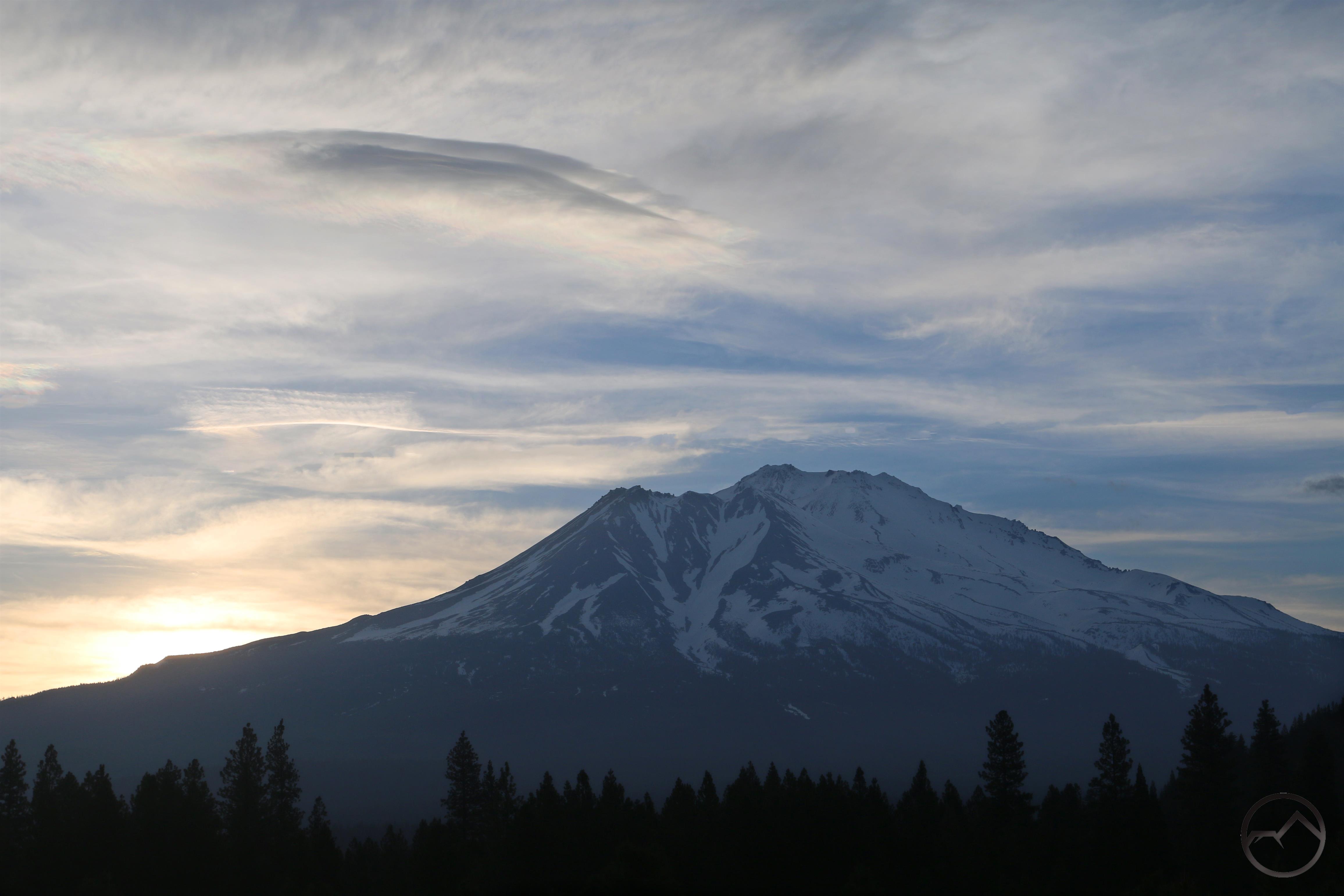
Thursday’s storm clouds clear as the sun sets on Mount Shasta.

It seemed for a time that summer had kicked off in the latter half of April and flower right into May. Despite that, the last couple of weeks here in Mount Shasta have been exceptionally wet. There has been ample rain and even some snow at higher elevations. As we move into Memorial Day weekend, we are thankfully moving out of this stormy weather pattern and into warmer, sunnier weather. The forecast still calls for some rain on Sunday and some thunderstorms next week but the trend is finally moving in the right direction.

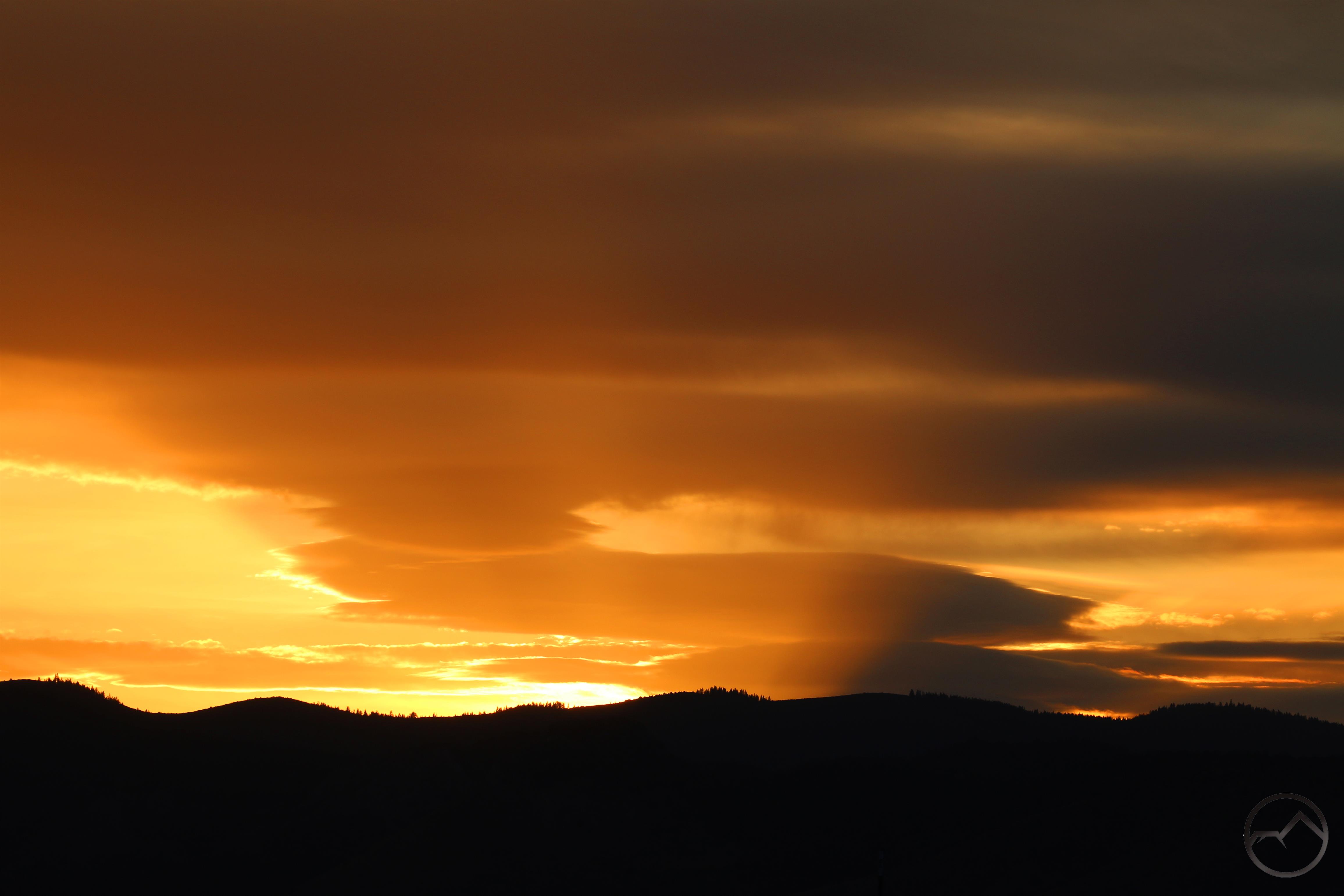
The sunset on Thursday night was a welcome one, the mountain finally being visible, for the most part. It has been a few days since the the sky was clear enough to see the mountain for an extended period of time. Even so, the clearing clouds blocked most of the alpenglow from setting the mountain to color. Fortunately, the clouds themselves captured a lot of the light and made for a spectacular sunset regardless of the mountain’s color.

Now that we are moving into a time that ought to bring consistently good days to get outside, it is time to start looking around at some of the conditions. While my daughter was in her dance classes, I was able to pop over to the Lake Siskiyou inlet, where the Sacramento River enters the lake. Right now the lake is exceedingly full. This is naturally a result of the swollen river flowing into it. The river itself is filled by both rain and melting snow. Based on the current conditions, I suspect it is going to be a while before the seasonal bridges are installed and the loop around the lake is completed. Fortunately, there are still a number of excellent trails to hike while the snow melts and the water level drops a bit.

Click to enlarge:

The Sacramento is wide and full as it flows into Lake Siskiyou.
Looking east down an overflow stream toward Lake Siskiyou.

The view across the river to the usual spot where the seasonal bridge is installed.
The Sacramento River is extremely full right now, swollen by rain and melting snow.

Heavy Winter Means Summer Paradise In The Old Ski Bowl (With A Waterfall)

Posted by bubbasuess on May 22, 2019
Posted in: Cascade Range, Hiking, Mount Shasta. Tagged: Old Ski Bowl. 5 Comments

Deep snow, a waterfall and a host of flowers compliment an idyllic Old Ski Bowl.

Like much of the rest of California, the Mount Shasta area has been blessed with a winter that produced a deep snow pack. On top of that, this has been a wet May and even more snow has been deposited on Mount Shasta and the surrounding mountains. This will likely mean that the road up to the Old Ski Bowl will open later than the traditional date of July 1st. The delayed opening of the gate means that the highest trailheads on the mountain, leading to some of the most beautiful and spectacular destinations on Mount Shasta will not be accessible by car until later in the summer. This includes the Old Ski Bowl Trail, Panther Meadow, Gray Butte and South Gate Meadow as well as numerous excellent destinations that do not have trails leading to them.

Of course, whether or not the gate is open does not mean there is no access to the Old Ski Bowl. From Bunny Flat it is possible to hike up to the end of the road and the upper trailheads via either the road itself of along the unofficial yet well established use trail that connects Bunny Flat to the Old Ski Bowl. Both of these are equally good options to reach the end of the road or push further to some of the spectacular high-elevation destinations.

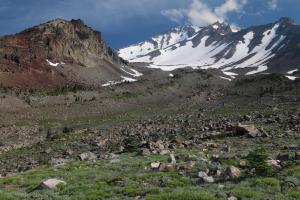
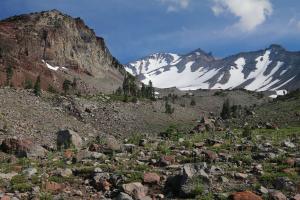
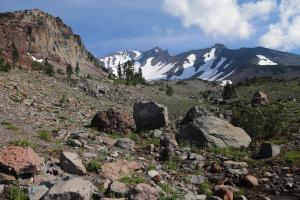
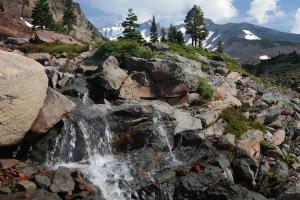
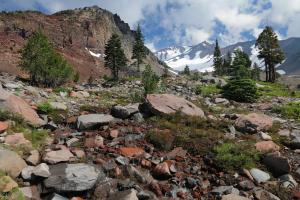
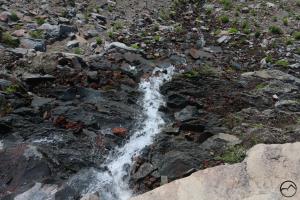
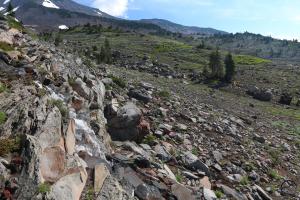
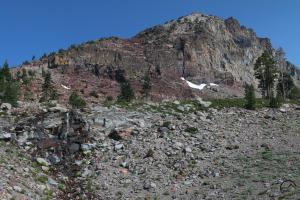
This raises the question as to why one ought to be so impatient to get up to the Old Ski Bowl as soon as possible. The bottom line is that, despite the Old Ski Bowl being spectacular no matter when one is able to get there, spring (whenever that actually reaches that part of the mountain, whether in actual spring or in the summer) is is a magical time on this corner of Mount Shasta. What sets this time apart is twofold: water and color. Most of the summer the Old Ski Bowl is a complex mix of gray and red rock punctuated by the dark green of a few trees scattered around the basin. In the spring, however, it is lush blanketed by green grass, purple lupines and the white flowers and Dr. Seuss-like tufts of the western pasque flowers. The water elevates the scene even further. Small streams flow down from the receding snow, filling the Old Ski Bowl with the sounds of cascading water. The apogee of the scene is a small 30 foot waterfall that forms on the west side of the bowl at the foot of Green Butte. The song of the waterfall can be heard from the picnic area and it is a magical sight, dancing in the wind as the water falls.

In 2017 the winter was heavy, perhaps even more so than this past winter. The road to the Old Ski Bowl did not open until August. When it did, there was a rare chance to drive up and see the bowl in its spring ideal. Whether the road is open or not, this fantastic time in the Old Ski Bowl can be reached by foot. It is absolutely worth the effort!

Click to enlarge:


Sonoma County Trails: A Look At Conditions After The Fires (2nd Edition Of My Book Coming Soon Too!)

Posted by bubbasuess on May 18, 2019
Posted in: Hiking, Mount Shasta, Napa County, Sonoma County. Tagged: Atlas Fire, Nuns Fire. 4 Comments

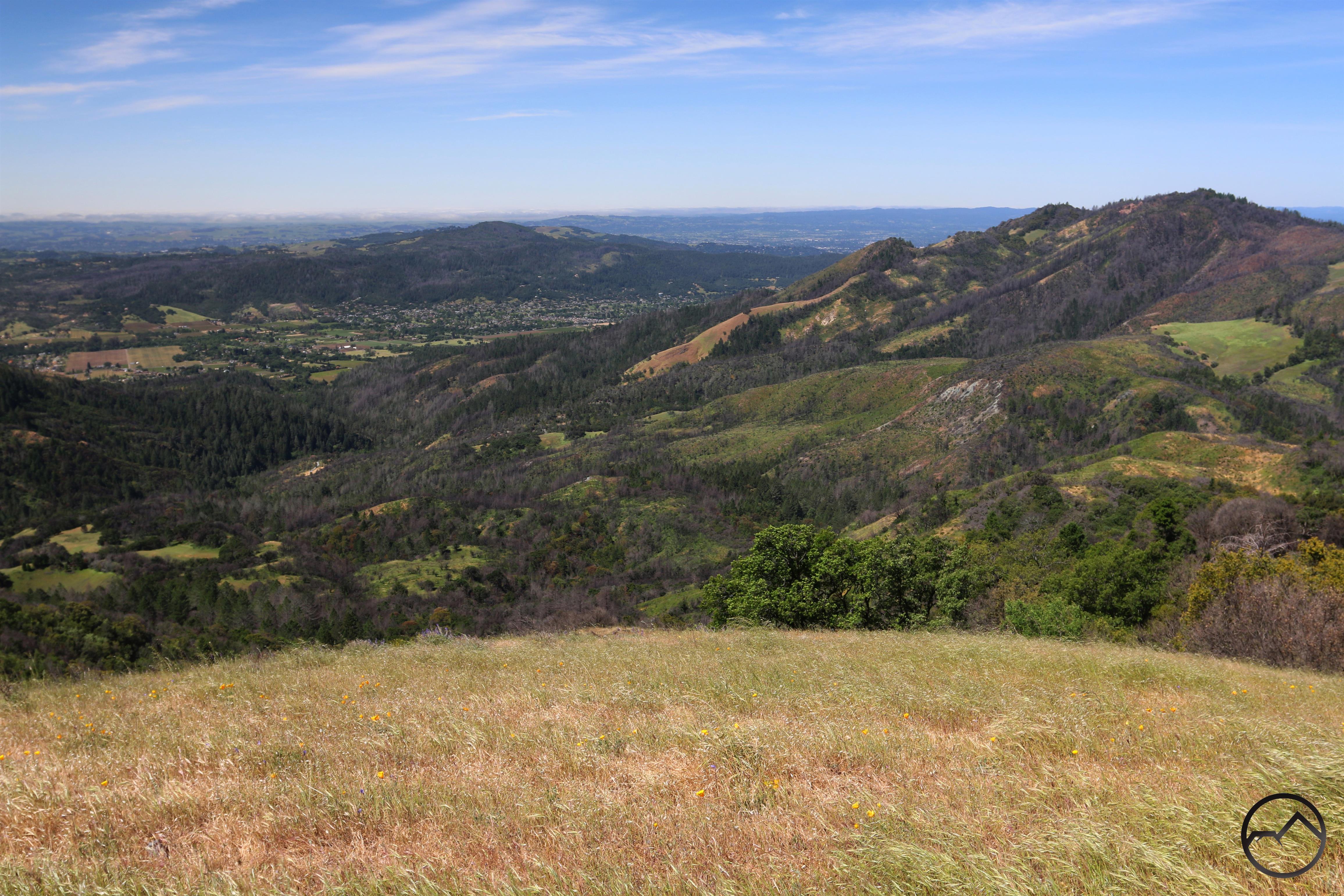
A trail view of the Sonoma Valley.

Over the last couple of months I have begun work on the 2nd edition of my book Hiking California’s Wine Country. While I am excited to have the opportunity to work on a newer version of my book, one of the primary reasons for it is not a happy one at all: the October 2017 fires. Those devastating conflagrations consumed thousands of homes but also burned over thousands of acres of wild and park land. In some ways, this was the more devastating loss at the time of the fire. From a human perspective, I knew my family would recover the loss and this has certainly been the case. However, those lands that burned, the natural beauty incinerated, would be unlikely to recover in my lifetime. It was profoundly discouraging. However, despite the fury of the fires, things are not nearly as bad as I had anticipated. This is due to both nature’s natural generative powers but also a result of nature’s preventative measures built into the landscape.

Two weeks ago I headed south to begin rehiking the trails in Sonoma and Napa Counties. As I noted in my Northern California Review on Sonoma County, Herb Caen once identified heaven as a “place resembling Sonoma County in the spring”. While May is normally slightly outside spring’s peak in that region, due to the wet winter it was still lush and green, the creeks were still flowing vigorously and the wildflowers were rioting all over the hills. The timing for all of this was since I would be able to record the condition of these trails in one of their prettiest seasons. Moreover, since I am doing a 2nd edition, I have the opportunity to add a few new trails that were not in existence when I finished my first version of the book.

It turned out to be a hard but fantastic week of hiking. I knocked out nearly 50 miles in 4 days and climbed about 8,000 feet. Other than out on the coast, I have not hiked a single mile in Sonoma County since the fires, so it was great to spend time with some old friends. The Wine Country really is a gorgeous area to hit the trail!

Click to enlarge:


Skyline Wilderness Park

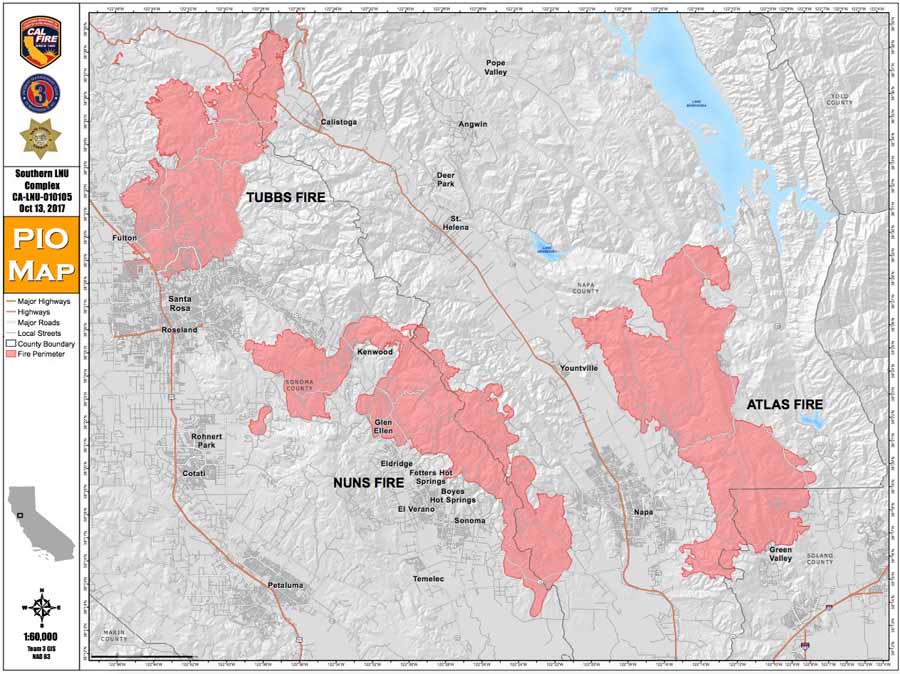
When the fires first erupted in evening of the 8th of October, 2017, there were initially several small fires, nearly a dozen in number. However, over the next week they all combined until there were three massive conflagrations. These were the Tubbs, Atlas and Nuns Fires. The Tubbs and Nuns burned in Sonoma County, the Atlas in Napa County. All of them burned in southern end of the Mayacama Mountains, a range that forms the spine of the Wine County.
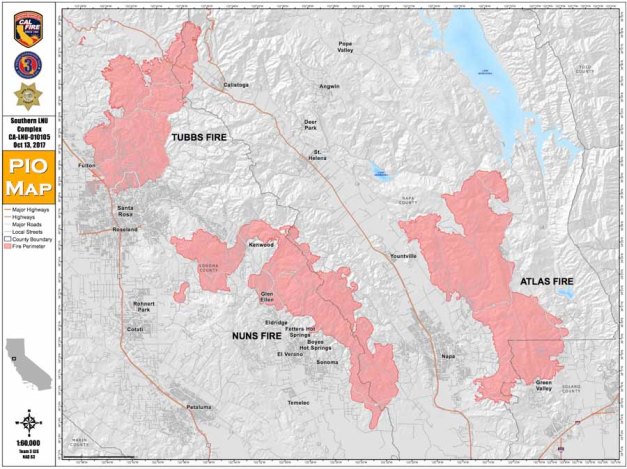
For this trip, I made the decision to focus my attention on the areas affected by the Nuns and Atlas Fires. This is where the majority of trails were affected by the flames. I will rehike trails in the Tubbs Fire later this summer. With regards to the trails in particular, the area hardest hit was the Sonoma Valley. This happens to be the region with the highest concentration of trails in the entire Wine Country. Annadel, Sugarloaf Ridge and Jack London State Parks, all of them large parks, are all found here. Hood Mountain and Sonoma Valley Regional Parks are also located in the Sonoma Valley. These are run by the county and Hood Mountain, like the state parks, is a large, spectacular wilderness park. All of these parks, with the exception of Jack London, were overrun by the Nuns Fire.

I had not been able to bring myself to even drive through the Sonoma Valley since I had little idea how things were going to look. Driving through on my way down from Mount Shasta, the northern half of the valley was obviously altered, but I was encouraged to see that it was not nearly as devastated as I had anticipated. It was obvious that fires had ripped through the area but there were more green trees than I had hoped for and it was not immediately filling with a sense of doom like I thought it would.

Once I started hiking, I was shocked how much of the forests were still intact, despite having been burned through. This is also the case in Napa County as well, where the Atlas Fire ate through parts of Skyline Wilderness Park. I am happy to report that, yes, there is significant damage in some areas, but, for the most part, nature did indeed preserve much of its beauty and is restoring those areas that were totally consumed.

I have set up a few before and after pictures to give some sense of how things look. This was not something I had initially set out to do so please forgive the lack of perfect alignment of the images.

Click to enlarge:

Sonoma Valley Regional Park

Hood Mountain Regional Park

Sugarloaf Ridge State Park

Annadel State Park

Skyline Wilderness Park

Skyline Wilderness Park

Without doubt, there are areas that are completely devastated but as these images show, many of the trees withstood the flames, protected by their bark. The trees’ natural resistance to fire worked as designed. When lower intensity flames passed through the forest, it burned the low brush and lower branches but the bark protected the trunks and the higher canopy survived. Naturally the grasses have returned with great vigor.

Sonoma Valley Regional Park is a microcosm of this. When looking at satellite images of the park just after the fire, I had anticipated complete devastation, yet when I arrived at the park, it looked like nothing had ever happened!


One interesting thing I noticed, and is evident in the before and after images, is that the areas that were most affected by the flames was that which was covered in chaparral. Almost any chaparral that was touched the fire was incinerated down to the ground. It was like a giant fuel blanket, just waiting to be lit. Examine the images closely and it will be obvious that the areas where the fire’s impact is most apparent is where chaparral had once covered the hills.
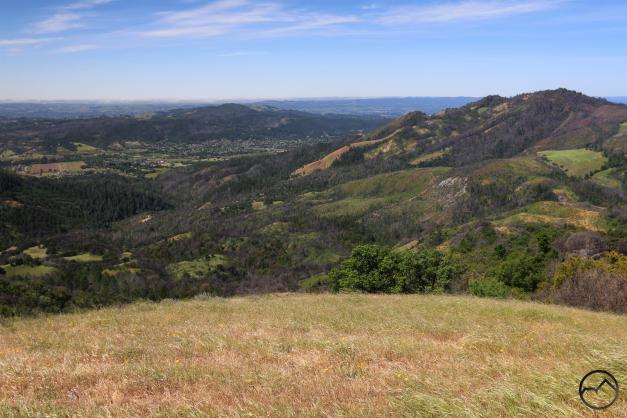
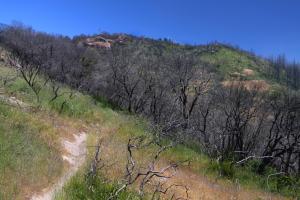
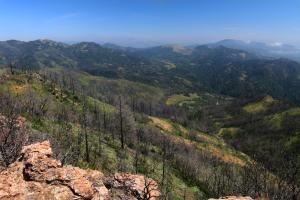
The view from Bald Mountain in Sugarloaf Ridge State Park. The fire damage is obvious.

The Sugarloaf Ridge/Hood Mountain area seemed to be the region hardest hit by the fire. Here large swaths of trees were totally burned, leaving forests of ghostly snags.

Heading toward the Hood Mountain summit.
Looking south from Hood Mountain.

Yet even here, the hardest hit area, restoration is well underway. The grass has returned, wildflowers are exploding all around and the process of breaking down the snags is beginning. Beauty abounds in the midst of the ruins:


While the snags can be discouraging, there is a bonus to the fire having burned through some of these areas. Where brush and dense canopies once obscured what would be otherwise be great views, now those views are wide open and ready to be enjoyed! Hood Mountain once notoriously had no views from its brush-covered summit. This is no longer the case!

The vistas themselves are still spectacular, despite the ravages of the fires. The view from Bald Mountain is an excellent example. Looking down on the worst burned areas, it is hard to argue with the magnificence of the spectacle. Definitely enlarge these to see the detail!

Bald Mountain view looking west.

Bald Mountain view looking east.

As an aside, I took the liberty of annotating the panorama of the view looking west. It is shocking how many things you can see from this one vantage point:

1. Napa  2. Mount Diablo   3. Mount Veeder   4. San Francisco Bay   5. Sonoma   6. San Francisco  7. Tolay Lake        8. Mount Tamalpais  9. Sonoma Valley  10. Sonoma Mountain  11. Jack London State Park  12. Kenwood   13. Petaluma Gap  14. Rohnert Park  15. Adobe Canyon   16. Bennett Mountain   17. Taylor Mountain   18. Sebastopol   19. Annadel State Park   20. Downtown Santa Rosa   21. Gunsight Rock   22. Hood Mountain   23. Mohrhardt Ridge   24. Dry Creek Valley  25. Alexander Valley  26. Geyser Peak  27. The Geysers  28. Cobb Mountain   29. Mount Saint Helena  30. Table Rock  31. The Palisades  32. Snow Mountain  33. Saint John Mountain

In the end, I am quite encouraged by how well the areas affected by the fires are doing. Sonoma and Napa Counties have always been spectacular hiking destinations, if a little underappreciated as such. After the fires, they remain beautiful and spectacular. These areas deserve to be regarded as such. I hope as many people as possible will read this report and head down there. The economies have been struggling since the fires and with fewer people visiting the area, now is the ideal time to explore the trails (and wineries and restaurants etc.) in the Wine Country!

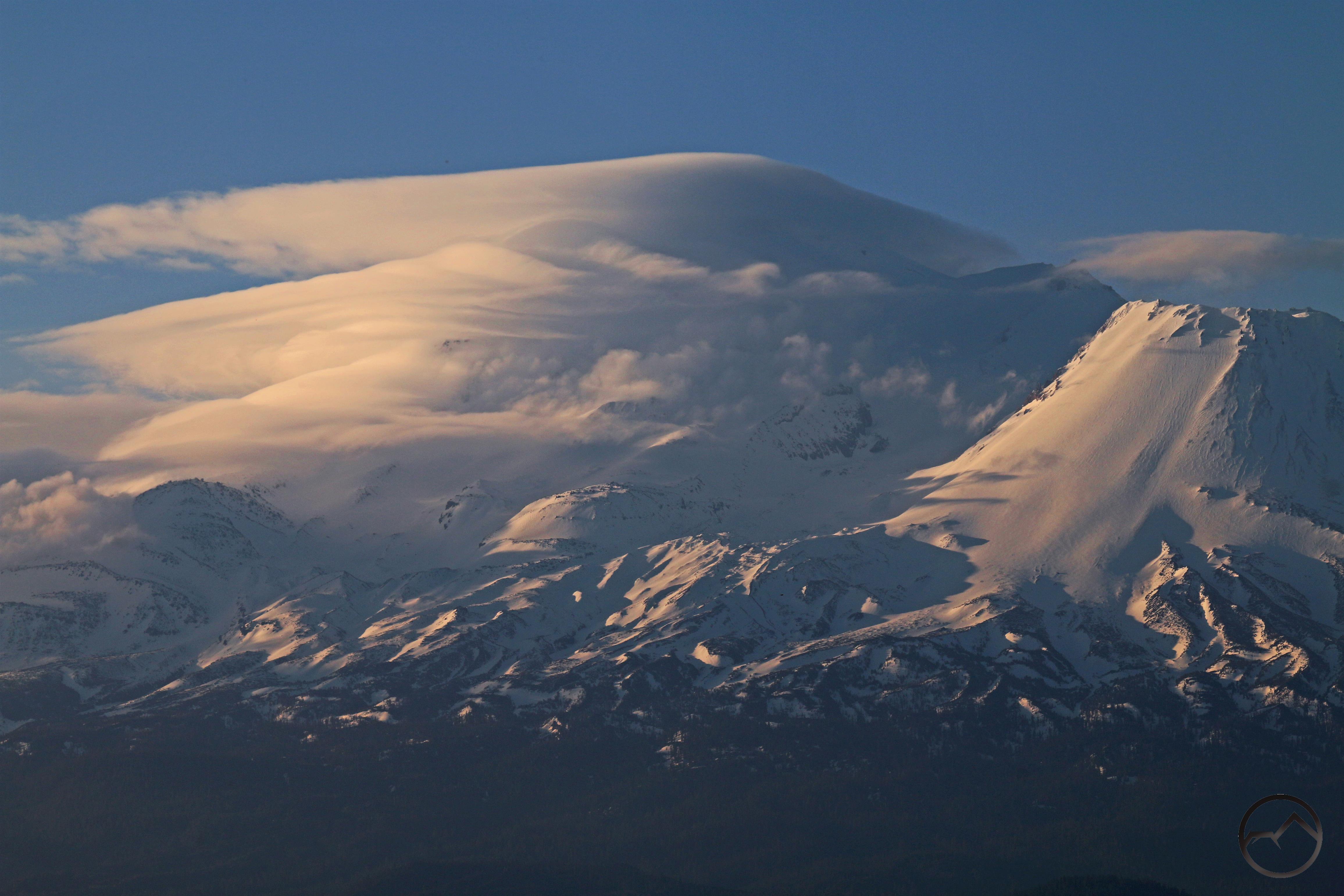
 

Wild Clouds Herald Wet Weather Around Mount Shasta

Posted by bubbasuess on May 13, 2019
Posted in: Cascade Range, Hiking, Lenticular Clouds, Mount Shasta. Leave a comment

Here in Mount Shasta we have had a great run of weather for nearly a month now. April seemed to dive right into summer, with warm temperatures and fantastically sunny weather. Considering it is still spring, this seemed like it was too good to be true and that the excellent conditions were destined to change at some point. That point is upon us. The forecast for the next week and beyond is for rain and significantly colder temperatures, dropping down to near freezing at night. Spring persists here in Mount Shasta.

Of course, a significant shift in weather patterns means a significant change of a lenticular event. This was certainly the case today, where a variety of cloud formations manifested, dissipated and reformed over the mountain through out the day.

The morning started with a small but obvious wave hovering just off Mount Shasta. It wasn’t much but it was an indicator that the systems were indeed in flux:

Throughout the day, disks continued to take shape around Mount Shasta. They ranged from massive waves to tight stacks of small lens shaped disks. I was occupied with various tasks throughout the day and could not get away to capture them. In the early afternoon the entire sky was overcast and the sun was heavily filtered. This eventually burned off in time for the sunset . The clouds looked impressive but their rate of change was swift. I was able to slip away just before the sun went down. Things weren’t quite at their peak but it still made for an interesting scene:


Clouds blocked the light from setting Mount Shasta alight with alpenglow. It was not meant to be but there was still an impressive sunset, especially looking to the west. As the sun went down, other lenticulars were lit up. It was a beautiful sight. Hopefully we get one more good sunset before the clouds really settle in for a week or so.

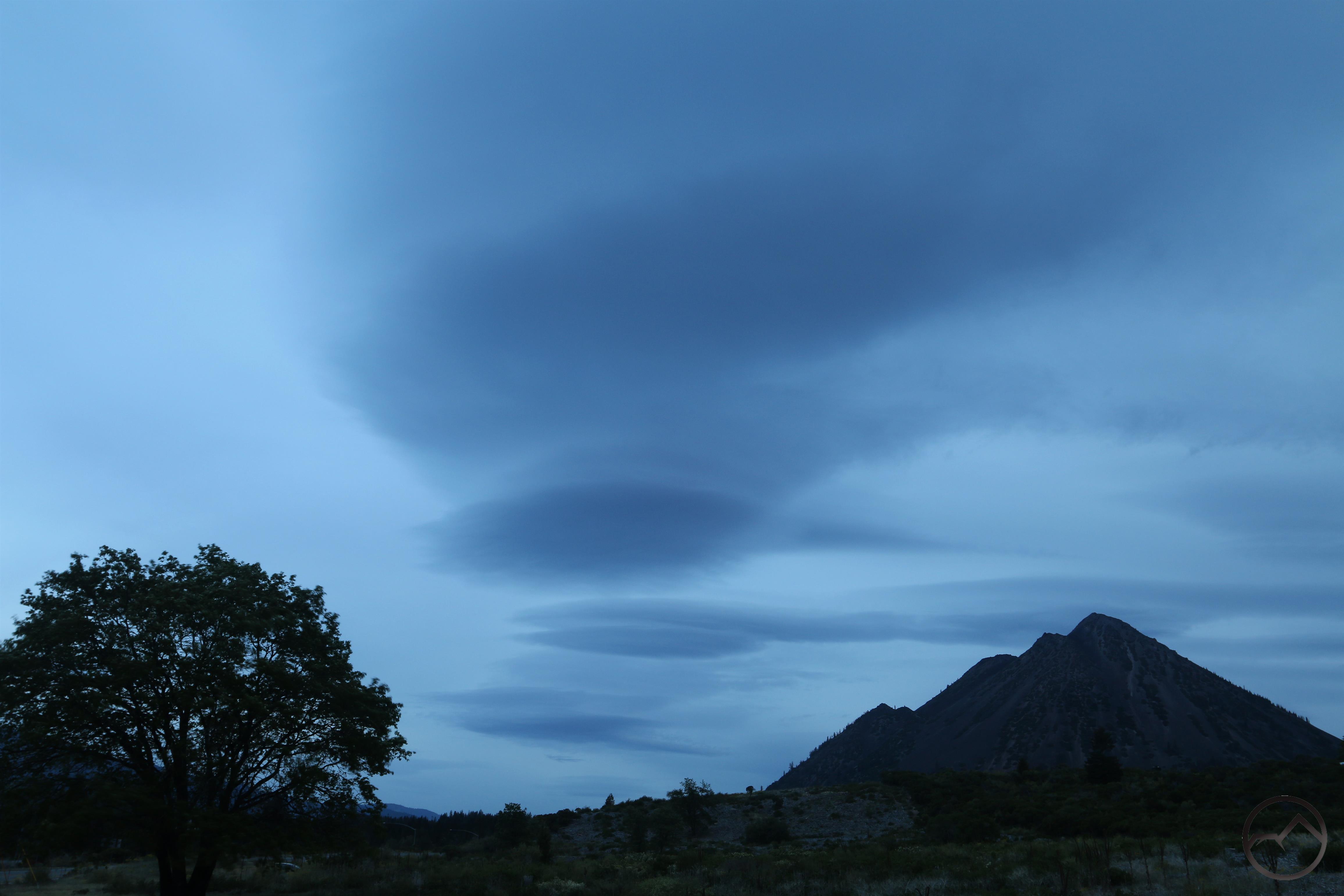
Of course, it remains to be seen whether we get any good sunsets as a result of the incoming storm system but we certainly did get an interesting sunrise. The small cloud that had remained aloft above Mount Shasta at sunset had grown into a massive stack of waves. It was too overcast to allow much color on the clouds but the earliest moments of sunrise did light up the bottom of the stack. It wasn’t much color but it was enough to make things interesting. There were plenty of other formations in the area as well, most notably an impressive stack of disks near Black Butte. I will miss the warm weather for the next few days but the awesome vision in the sky is definitely some compensation!
 

Some Interesting Nuance In A Mount Shasta Sunset

Posted by bubbasuess on May 1, 2019
Posted in: Cascade Range, Hiking, Mount Shasta. 2 Comments

As the sun sets, the summit of Mount Shasta is obscured by clouds.

I had a few things to take care of in town this evening and as I headed home there were some nice, puffy clouds surrounding the mountain. I thought this might be another fine sunset similar to the one from last Thursday. As the sun sank, my kids happily played in their “forts”, thrilled to have a later-than-normal bedtime because dad was going to take pictures again. In the end, the clouds dissipated somewhat and the sunset was not nearly as dramatic as I had hoped.

It isn’t fair to say I was disappointed, since I am keenly aware that having the nightly opportunity to witness even an “average” sunset on Mount Shasta is a blessing. However, the sunset did not live up to my high expectations. Nonetheless, there were some interesting and more subtle features in the sunset that I thought deserved some attention.

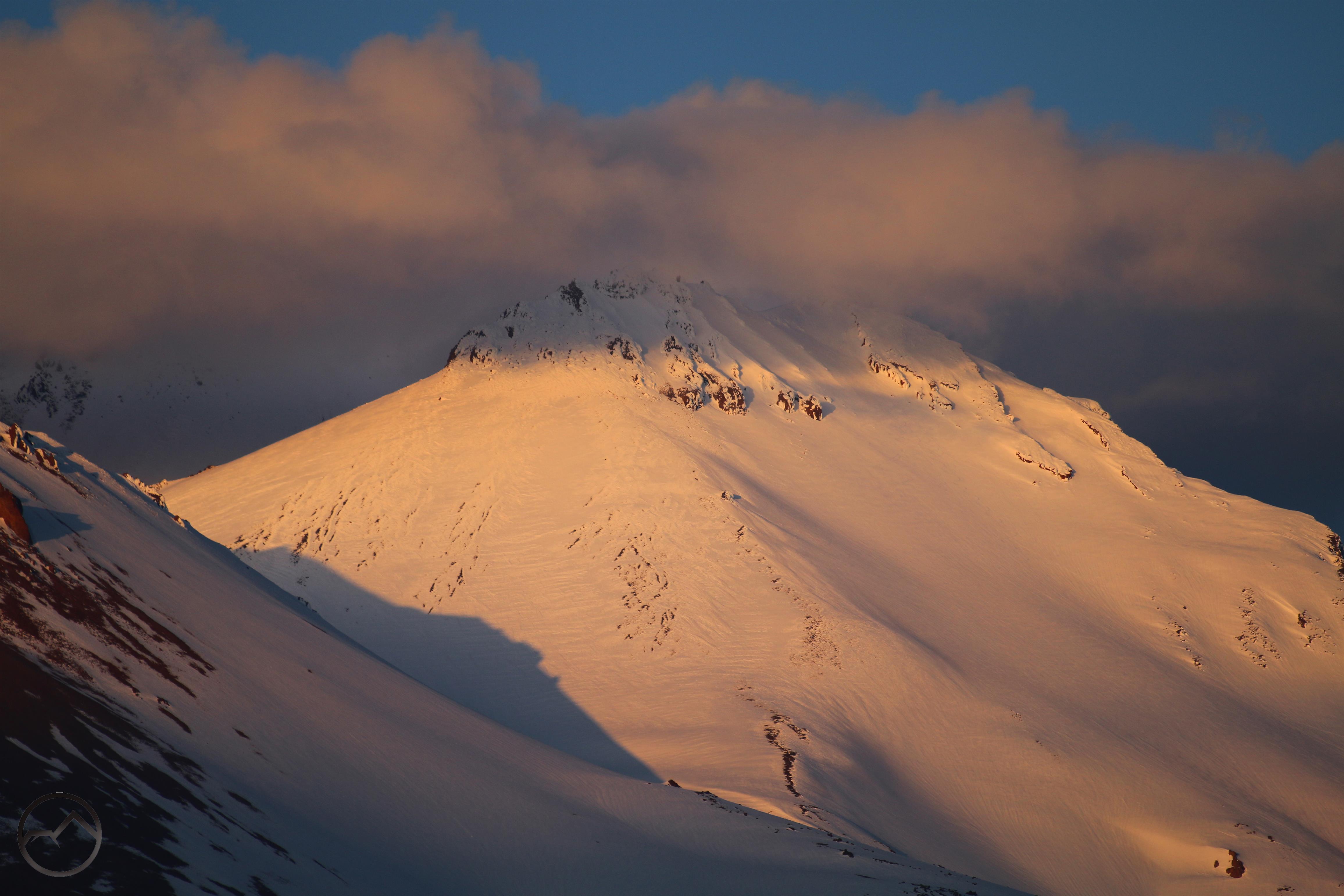
The first of the notable details was how the cloud formed an interesting cup on its interior. In some ways this resembled the doomed lens shape of a lenticular cloud but the exterior of the cloud was an amorphous, puffy formation. The end result was that, for quite some time, the summit of Mount Shasta was not in the clouds but was nonetheless surrounded by the cloud. The snowy summit was partially visible, though in shrouded in shadow. I wondered what it would be like to be have climbed up to the summit area and be within the cloud area and not engulfed by it. I fascinating set of circumstances to experience, no doubt.

The other interesting element occurred when the cloud began to collapse. The pocket where the summit had been obscured for a while fell apart and the top of Mount Shasta was swallowed up into the cloud. Interestingly though, was the sudden prominence of Misery Cone. This peak is one of four major eruption cones that composes Mount Shasta, the second highest after the main summit of the mountain. The effect was the emphasis of this secondary summit, making it look as though the Misery Cone was the highest point on Mount Shasta. Though a bit of an illusion, it presented the answer to the question (which no one is asking, obviously) of what Mount Shasta would look like if only composed of the three smaller volcanic cones.

I am recognize that my musings are not interesting to a lot of readers but it is a reflection of a slightly different approach I am trying to take. Rather than seek the grand panorama or the spectacular vista all the time, I am pushing myself to look at detail and appreciate the subtle side of an overwhelmingly magnificent mountain. It has been edifying discovering these minor features, where so much beauty is evident but has been concealed by my own approach.

Click to enlarge:


Looking Back On The Last Mount Shasta Lenticular Season

Posted by bubbasuess on April 30, 2019
Posted in: Cascade Range, Hiking, Lenticular Clouds, Mount Shasta. Leave a comment

A spectacular lenticular hovers over Mount Shasta and a wave-like cloud.

A quick glance at this post from a couple years ago shows that the majority of lenticular clouds on Mount Shasta occur between October and March. Without doubt, they can occur other times of the year but October through March, with their changing seasons and frequent storm systems, are the months where one is most likely to see major lenticular events. This proved to be the case once again, with December, January and February producing some particularly memorable events. Strangely enough, there were no significant formations in November, a month that historically produced some of the best lenticular clouds on Mount Shasta. Despite meteorological pyrotechnics getting off to a late start, it proved to be an exceptional season.

As summer approaches, the warm weather tends to stabilize the air currents around the mountain and cause the lenticulars to manifest less frequently. From a hiker’s perspective, the emphasis often shifts from looking up at the mountain from the lowlands to exploring its higher reaches. Hiking migrates to the lakes, ridges and peaks of the Trinity Divide. The focus of the season is different and even though the potential for lenticulars is still there, I don’t always head out in the early morning hunting them.

A few of the lenticular events from this past season were in the upper level of ones I have witnessed. Considering their relative frequency in December and January especially, this really was an exceptionally rich season. Even though I am excited for the summer hiking, I am already looking forward to the kinds of unique clouds Mount Shasta is going to produce when autumn arrives.

Click to enlarge:

September
October

December
December
December

December
December

December
January

January

February

February

March
March

April


2019 Mount Shasta Spring Hiking Round Up

Posted by bubbasuess on April 27, 2019
Posted in: Cascade Range, Hiking, Mount Shasta, Off Season Trails, Spring Trails. 3 Comments

Spring thunderheads gather around Mount Shasta at sunset.

This past winter seemed particularly long. Though December and January were spectacular, February and March seemed like one long storm. Fortunately, that means that we got ample precipitation and the drought will not be a factor for the coming year at least. Hopefully that means the fire will season will be less of an issue. Now it seems like the weather has decided to skip spring and move right into summer. The weather is perfect for hiking. However, the strong winter means we will have to wait a while longer before the high country trails are clear of snow. Thankfully the Mount Shasta area is blessed with an abundance of trails at lower elevations, which means that hiking and enjoying the fantastic scenery that surrounds us is in full swing. The best spots to explore this time of year are along the McCloud River and in the Castle Crags. Despite the lower elevation, they still offer great mountain experiences. The Gateway Trail is also a good option for spring hiking, with good views of the mountain and a sense of solitude in the near-town but remote backcountry of the trail. The high desert of the Shasta Valley is another great place to explore right now. Of course, all the other areas usually considered good winter destinations are also fantastic places to hike right now. Summer may be coming but the time to get out and hit the trail is now!
Spring Hiking On The Gateway Trail

Located just outside of Mount Shasta City, the Gateway Trail is an impressive and soon-to-be-expanding network of trails that wind their way through the wooded flanks of Mount Shasta. The first couple miles of the trail, however, are largely in the open, passing through rocky terrain that features great perspectives on the white mountain looming over 10,000 feet overhead. Once the trail plunges into the deep forest, numerous loop options exist, along with a few rocky outcroppings and some good vistas of Trinity Divide. Read more here.

A last view of Mount Shasta before heading into the forest.
The trail also features good perspectives on Mount Eddy and Black Butte.

Spring Hikes In The Castle Crags

The Castle Crags are one of the most majestic mountain features in California. However, their lower elevation means they are often accessible when higher terrain is still smothered in snow. Still, the granite spires and great rock walls stand shoulder to shoulder with some of the most rugged terrain in the state. Though best hiked in spring, when the creeks are gushing and the weather, especially on the south side where most trails are found, is perfect, the winter may still be a good time to get out and enjoy this gorgeous mountain playground. Read more here.

Spires of the Crags
Mount Shasta seen from the Castle Crags

Spring Hikes On The Upper McCloud River

The McCloud River is one of the great attractions of the Mount Shasta area. With great fishing, a trio a awesome waterfalls, and beautiful forest surroundings, it is a popular destination. The waterfall along the river is a great hike and ought to be considered during winter if the access road is open. However, the McCloud River Trail follows the river for 15 miles and any section of this makes a great hike as long as snow is not covering the ground. Read more here.

Basalt gorge on the McCloud River
The McCloud River downstream from Cattle Camp.
McCloud River from the top of Middle Falls
Middle McCloud Falls

Spring Hikes On The Lower McCloud

The Lower McCloud River sees far less activity than the upper section. Separted by Hearst property and the McCloud Reservoir, the two areas are strikingly different. The upper section flows through volcanic terrain while the lower part passes through an outlier of the Klamath Mountain. The terrain is very rugged and can be difficult access during winter. However, when it can be reached, solitude a beautiful scenery await! Read more here.

Large cataract on the McCloud River
The McCloud River from the PCT crossing.
In the McCloud River Canyon
Squaw Valley Creek Falls

Spring Hiking At Orr Lake

The area around Orr Lake is a mix of high desert and ponderosa pine forest, surrounding a large, lush meadow fed by remote Butte Creek. It’s higher in elevation than the high desert of the Shasta Valley, which means it is often not a good place to go in winter. However, in spring, it is ideal. The lake is full, the creek is running strong and Mount Shasta, visible beyond the lake, is white. Other than portions of the trail being closed at times for nesting birds, it is a great place to get outside in the months before summer. Read more here.

Sunrise at Orr Lake.
Mount Shasta rises above Butte Creek
The distant Goosenest seen from Butte Creek.
Orr Mountain seen beyond the Orr Lake meadow.

Spring Hikes In The Shasta Valley

North of Mount Shasta, the desert landscapes of the Shasta Valley offer a strikingly different environment than what is found along most trails in the region. The only conifers here are junipers and sagebrush is ubiquitous. For those that like the desert, the beauty of this area needs no explanation. For those less familiar, there is ample wildlife, beautiful rock formations and magnificent 360 degree views, crowned by some of the best views of Mount Shasta to be found anywhere. Read more here.

Mount Shasta rises above Yellow Butte
Herd Peak, Sheep Rock and Yellow Butte
Pluto Cave
Mount Shasta rises above Pluto Cave

Spring Hikes In The Shasta Valley Wildlife Refuge

At the northern end of the Shasta Valley lies a large parkland administered by the State of California. The Shasta Valley Wildlife Refuge was once a working ranch but is now a haven for a variety of wildlife, especially birds. It is also a refuge for hikers looking for incredible vistas. Though it can be closed at times during winter, there are still opportunities to explore it and once it is reopened completely, it is a place of great beauty, beckoning to be explored! Read more here.

Mount Shasta reflects in a pool by Steamboat Mountain.
Looking north toward the Siskiyous
The Cascade Crest seen from Trout Lake
Mount Shasta looms far beyond Trout Lake

Three Spring Trails Near Mount Shasta City 

Mount Shasta City is blessed with a number of great paths within and just outside of its city limits. Three of the best are the Box Canyon, Ney Springs and Spring Hill Trail. These offer solitude, Mount Shasta Vistas, unique history, spectacular geography and even some excellent waterfalls. These all lie just minutes outside of town. Also, don’t forget that Mount Shasta City has some great short trails right in town! Read more here.

Box Canyon of the Sacramento River.
Inside the Box Canyon of the Sacramento
Faery Falls
Rocky Point on the Spring Hill Trail.

Spring Hikes On The Lake Siskiyou Trail

The Lake Siskiyou Trail is an incredible recreational resource just a couple minutes outside of Mount Shasta City. During the summer and fall, a loop trail encircles the lake. However, in winter the seasonal bridges over the Sacramento River are removed. While the loop can’t be hiked without fording the river (extremely dangerous after storms and during high runoff), several sections of the trail still make great out and back hikes. They feature beautiful forests, the lake itself and incredible views. Due to the relatively light winter, the bridges should be places over the Sacramento sooner rather than later this year. Read more here.

Mount Eddy at the Sacramento River inlet.
Hiking along South Shore
Views from North Shore.

Spring Hikes On The Sacramento River

Most people in California think of the Sacramento River as the wide, winding waterway that lazily flows through the Central Valley. Here just below the headwaters, however, it is a swiftly flowing mountain river. Deep in its canyon, the lower elevation means it is often free of snow and the trails are easily accessed. Hiking along the river in winter is a treat that offers a taste of wild mountains for minimal effort. Read more here.

Hedge Creek Falls
Behind Hedge Creek Falls
Rapids Along the River Trail.
Along the Sacramento River Trail.

Posts navigation

← Older Entries
Newer Entries →
    • Recent Posts

      • Winter Shows Up When It Will
      • January Rolled By With Mud, Then Very Dry
      • Mount Shasta 2025 – A Year In Images
      • Mount Shasta On Either Side Of Christmas
      • Adrift In An Ocean Of Fog
      • December Has Been Spectacular Thus Far Pt. II (A Magnificent Lenticular)
      • December Has Been Spectacular Thus Far Pt. I
      • Lenticular Interrupted
      • A Stormy Wave And A Truchas Sunset
      • Aurora Lenticularis
    • Enter your email address to follow Hike Mt Shasta and receive notifications of new posts by email.

    • Archives

      • February 2026
      • January 2026
      • December 2025
      • November 2025
      • October 2025
      • September 2025
      • August 2025
      • July 2025
      • June 2025
      • May 2025
      • April 2025
      • March 2025
      • February 2025
      • January 2025
      • December 2024
      • November 2024
      • October 2024
      • September 2024
      • August 2024
      • July 2024
      • June 2024
      • May 2024
      • April 2024
      • March 2024
      • February 2024
      • January 2024
      • December 2023
      • November 2023
      • October 2023
      • September 2023
      • August 2023
      • July 2023
      • June 2023
      • May 2023
      • April 2023
      • March 2023
      • February 2023
      • January 2023
      • December 2022
      • November 2022
      • October 2022
      • September 2022
      • August 2022
      • July 2022
      • June 2022
      • May 2022
      • April 2022
      • March 2022
      • February 2022
      • January 2022
      • December 2021
      • November 2021
      • October 2021
      • September 2021
      • August 2021
      • June 2021
      • May 2021
      • April 2021
      • March 2021
      • February 2021
      • January 2021
      • December 2020
      • November 2020
      • October 2020
      • September 2020
      • August 2020
      • July 2020
      • June 2020
      • May 2020
      • April 2020
      • March 2020
      • February 2020
      • January 2020
      • December 2019
      • November 2019
      • October 2019
      • September 2019
      • August 2019
      • July 2019
      • June 2019
      • May 2019
      • April 2019
      • March 2019
      • February 2019
      • January 2019
      • December 2018
      • November 2018
      • October 2018
      • September 2018
      • August 2018
      • July 2018
      • June 2018
      • May 2018
      • April 2018
      • March 2018
      • February 2018
      • January 2018
      • December 2017
      • November 2017
      • October 2017
      • September 2017
      • August 2017
      • July 2017
      • June 2017
      • May 2017
      • April 2017
      • March 2017
      • February 2017
      • January 2017
      • December 2016
      • November 2016
      • September 2016
      • August 2016
      • July 2016
      • June 2016
      • May 2016
      • April 2016
      • March 2016
      • February 2016
      • January 2016
      • December 2015
      • November 2015
      • September 2015
      • August 2015
      • July 2015
      • June 2015
      • May 2015
      • April 2015
      • March 2015
      • February 2015
      • January 2015
      • December 2014
      • November 2014
      • July 2014
      • June 2014
      • May 2014
      • April 2014
      • March 2014
      • February 2014
      • January 2014
      • December 2013
      • November 2013
      • October 2013
      • September 2013
      • August 2013
      • July 2013
      • June 2013
      • May 2013
      • April 2013
      • March 2013
      • February 2013
      • January 2013
    • Categories

      • Boy Scouts
      • Cascade Range
      • Castle Crags
      • Desert
      • Echo Point
      • Glaciers
      • Hiking
      • How things came to be…
      • Klamath Mountains
      • Konwakiton Outdoor Designs
      • Lakes
      • Lenticular Clouds
      • Maps
      • Marble Mountains
      • Meadows
      • Mount Eddy
      • Mount Shasta
      • Mount Shasta History
      • Napa County
      • Off Season Trails
      • Pacific Crest Trail
      • Peaks
      • Rivers
      • Rock Climbing
      • Scott Mountains
      • Seldom Seen
      • Shasta Valley
      • Sierra Nevada
      • Siskiyou Mountains
      • Sonoma County
      • Spring Trails
      • sunrise
      • sunset
      • Trinity Alps
      • Trinity Divide
      • Truchas Ridge
      • Uncategorized
      • Water
      • Waterfalls
      • Wilderness
      • Wildflowers
      • Wine Country
      • Winter Trails
      • Yosemite
    • Meta

      • Create account
      • Log in
      • Entries feed
      • Comments feed
      • WordPress.com
    • Copyright © 2013-2024 by Bubba Suess

      DISCLAIMER: Any use of the information contained in this site by any and all persons is done at their own risk. The operator of this site shall be held harmless from any and all alleged claims, demands, causes of action, liability, loss, damage and/or injury to property or persons whether brought by an individual or other entity. This indemnification applies, without limitation, to all actions by an individual or other entity as a result of their use of information contained in this site.

    Blog at WordPress.com.
    Hike Mt. Shasta
    Blog at WordPress.com.
    • Subscribe Subscribed
      • Hike Mt. Shasta
      • Join 983 other subscribers
      • Already have a WordPress.com account? Log in now.
      • Hike Mt. Shasta
      • Subscribe Subscribed
      • Sign up
      • Log in
      • Report this content
      • View site in Reader
      • Manage subscriptions
      • Collapse this bar
     

    Loading Comments...