Hike Mt. Shasta

Exploring the Mount Shasta Region

  • Home
  • Trails
    • Mount Shasta Trails
      • Brewer Creek Trail
      • Clear Creek Trail
      • Gray Butte Trail
      • Green Butte Ridge Trail
      • Horse Camp Trail
      • North Gate Trail
      • Old Ski Bowl Trail
      • Panther Meadow Trail
      • South Gate/Squaw Meadow Trail
      • Whitney Falls Trail
    • Trinity Divide Trails
      • Blue Divide Trail
      • Castle Lake Trail
      • Castle Lake Shore Trail
      • Cliff Lake Trail
      • Deadfall Lakes Trail
      • Gray Rock Lakes Trail
      • Gumboot Trail
      • Heart Lake Trail
      • Porcupine & Toad Lakes Via Pacific Crest Trail
      • Seven Lakes Basin Via Pacific Crest Trail
      • Sisson-Callahan Trail
      • Soapstone Trail
      • South Mumbo Scramble
      • Tamarack Lake Trail
      • Toad Lake Trail
    • Castle Crags Trails
      • Burstarse Falls Via Pacific Crest Trail
      • Castle Dome Trail
      • Flume Trail
      • Lower Castle Crags Via Pacific Crest Trail
      • Root Creek Trail
    • Scott Mountains Trails
      • Bluff Lake & Cement Bluff via Pacific Crest Trail
      • Caldwell Lakes Trail
      • China Mountain Scramble
      • Cory Peak and Bull Lake via Pacific Crest Trail
    • Cascade Crest
      • Ash Creek Butte Scramble
      • Goosenest Trail
      • Juanita Lake Trail
      • Orr Lake Trail
    • Mount Shasta City Area Trails
      • Black Butte Trail
      • Box Canyon Trail
      • Gateway Trail
      • Lake Siskiyou Trail
      • Mount Shasta City Short Trails
      • Ney Springs Canyon Trail
      • Spring Hill Trail
    • Shasta Valley Trails
      • Black Lava Trail
      • Haystack Trail
      • Lake Shastina Trail
      • Pluto Cave Trail
      • Trout Lake Trail
      • Yellow Butte Trail
    • Sacramento River Trails
      • Dunsmuir Trail
      • Hedge Creek Falls Trail
      • Sacramento River Trail
      • Sims History Trail
    • McCloud River Trails
      • Ash Camp To Ah-Di-Na Via Pacific Crest Trail
      • McCloud River Falls Trail
      • McCloud River Preserve Trail
      • Squaw Valley Creek Trail
      • McCloud River Trail: Algoma Camp to Nitwit Camp
      • McCloud River Trail: Nitwit Camp to Cattle Camp Swimming Hole
      • McCloud River Trail: Cattle Camp Swimming Hole to Camp 4
      • McCloud River Trail: Camp 4 to Upper McCloud Falls
      • McCloud River Trail: Pine Tree Hollow Loop
    • Trails Further Afield
      • Trinity Alps Trails
        • Bear Lakes Trail
        • Billys Peak Trail
        • Boulder Creek Lakes Trail
        • Boulder Lake Trail
        • Canyon Creek Trail
        • Caribou Lakes Trail
        • East Boulder Lake Loop
        • East Weaver Lake Trail
        • Four Lakes Loop
        • Granite Peak Trail
        • Grizzly Creek Trail
        • Gulch Lakes Loop
        • Hidden Lake Trail
        • South Fork Lakes Trail
        • Stoddard Lake Trail
        • Stoney Ridge Trail
        • Tangle Blue Lake Trail
      • Warner Mountains
        • Emerson Creek Trail
        • Highgrade Trail
        • Patterson Lake Via Warner Summit Trail
        • Pine Creek Trail
        • Squaw Peak Trail
  • Articles
    • Trails By Area
      • Mount Shasta
        • Vistas, Meadows And Waterfalls: Three Best Hikes On Mount Shasta
        • The End Of The Road: Three Hikes In The Old Ski Bowl Area
        • Two Trails From Bunny Flat
        • Three Trails On Mount Shasta’s East Side
        • Mount Shasta’s Hummingbirds
      • Trinity Divide
        • Great Lakes: Top Five Lake Basins In The Trinity Divide
        • The Headwaters Of The South Fork Of The Sacramento River
        • Neglected Headwaters: Two Lesser Lake Basins On The South Fork
        • Gumboot Saddle: Two Hikes On The PCT
        • Descent Into Mystery: The Sisson-Callahan Trail
        • Mumbo Basin – Overlooked On The West Side
        • The Headwaters Loop: A Proposed Backpacking Loop In The Trinity Divide
      • The McCloud River
        • The McCloud River Trail
      • Shasta Valley
        • Jewels In The Desert
      • Scott Mountains
        • Great Scott! Two Scott Mountains Hikes On The PCT
      • Trinity Alps
        • Carubou Lakes: Trinity Alps On A Grand Scale
        • Switchbacks To Heaven: The Trinity Alps’ Stoney Ridge Trail and Four Lakes Loop
        • Trinities In Proximity: Two Trinity Alps Trails With Easy Access From Mount Shasta
        • Trails in the Carter Meadows Area
        • Trinity Alps Views of Mount Shasta
        • The Psychological Value Of The Trinity Alps
    • Waterfalls
      • Three Waterfalls On Mount Shasta
      • McCloud River Waterfalls
      • Sacramento River Waterfalls
      • Trinity Divide Waterfalls
      • Trinity Alps Waterfalls
      • Avoiding A Dry Whitney Falls
    • Off Season Trails
      • Three Winter Hikes Near Mount Shasta City
      • Winter Hikes In Shasta Valley
      • Winter Hiking In The Shasta Valley Wildlife Refuge
      • Winter Hikes On The Sacramento River
      • Winter Hikes On The Lake Siskiyou Trail
      • Spring Hikes In The Castle Crags
      • Spring Hikes On the Upper McCloud
      • Spring Hikes On The Lower McCloud River
    • Points Of Interest
      • Mount Eddy: Overshadowed, Underrated
      • Black Butte: Hiding In Plain Sight
      • Castle Dome: Steadfast And Staggering
      • Mount Shasta Hoodoos
      • Sacramento Scrambling
      • The Shasta River
      • The Castle Creek Watershed
      • Mount Shasta East Side Glacier View
      • 5 Fantastic Mount Shasta Vistas
      • 5 Highest Peaks Around Mount Shasta
      • 5 Best Hikes On Creeks And Rivers
      • 5 Interesting Footbridges
      • Three Spectacular Drive-To Sunset Vistas
    • North State Geography
      • Introduction
      • Seven Major Regions
      • The California Cascades
      • Klamath Mountains Pt. I
      • Klamath Mountains Pt. II
      • The Great Canyons Of Mount Shasta
      • Mount Shasta, Timberline, And The Relative Size Of Cascade Volcanos
      • Four Eruption Cones Of Mount Shasta
      • Mount Shasta’s Medial Moraine
    • Northern California Review
      • North Table Mountain
      • Lakes Basin Recreation Area
      • Eastern Sierra Fall Color
      • Sonoma County
      • Central Sierra Nevada
      • Orland Buttes
    • Seldom Seen
      • Ash Creek Falls
      • Mud Creek Canyon
      • Lower Mud Creek Canyon
      • Diller Canyon
      • Lower Cascade Gulch
      • The Grey Rocks
      • Castle Creek
      • Upper Wagon Creek
      • Fawn Creek Canyon
      • Confluence of the Sacramento River and Castle Creek
      • Upper Klamath River Canyon
      • Hole In The Ground Geologic Area
      • Ash Creek Butte Fossil Rock Glacier
    • Mount Shasta History
      • Vantage Lost: The Everitt Memorial Vista
      • A Yosemite-Mount Shasta Connection
      • Whitney – What’s In A Name?
      • Mount Shasta Area and the 1838 Exploring Expedition
      • A 19th Century Engraving Of An Epic Mount Shasta Vista
      • Vintage 1907 Color Photos
      • A Misleading Painting
      • A Mysterious Painting
      • A Mysterious Painting Pt. II
      • Stereographic Mt. Shasta
      • Year One Of Hike Mt Shasta
      • Year Two Of Hike Mt Shasta
      • Year Three Of Hike Mt Shasta
      • Year Four Of Hike Mt Shasta
      • Year Five Of Hike Mt Shasta
      • Year Six Of Hike Mt Shasta
      • Year Seven Of Hike Mt Shasta
    • Image Galleries
      • Mount Shasta Trails Gallery
      • Mount Shasta Sunrise Gallery
      • Mount Shasta Sunset Gallery
      • Lenticular Cloud Gallery
      • Mount Shasta NON-Lenticular Clouds
      • Mount Shasta Reflection Gallery
      • Telephoto Gallery
      • Mount Shasta Area Fall Color
      • Castle Crags Gallery
      • Waterfalls Gallery
      • Trinity Divide Lakes Gallery
      • Mount Shasta Area Rivers Gallery
      • Shasta High Desert Gallery
      • Mount Shasta GIF Gallery
    • Random Notes
      • Revew: Three Mount Shasta Trail Maps
      • A Mount Eddy Wilderness?
      • New Land Additions For The Castle Crags
      • Book Plug: Mount Shasta Area Rock Climbing
      • Exile: How I Came To Love Wilderness
  • Mt. Shasta Trail Map
  • Blog
  • About/Contact
  • Links
  • Truchas Ridge

Mount Shasta Area Waterfalls: Trinity Divide Waterfalls

Posted by bubbasuess on November 6, 2013
Posted in: Castle Crags, Hiking, Klamath Mountains, Mount Shasta, Trinity Divide, Waterfalls. Tagged: Burstarse Falls, Castle Crags, Faery Falls, Mount Shasta, Root Creek Falls. 2 Comments
Trinity Divide, Castle Crags - April2011 050 copy (Custom)

Root Creek Falls and mighty Castle Dome.

The Trinity Divide, the large mountain range directly to the west of Mount Shasta is a treasure trove for outdoor enthusiasts. Blessed with lakes, rivers and spectacular rocky cliffs, the range is also home to some fantastic waterfalls. Though none of the waterfalls in the Trinity Divide are as well-known as their cousins along the Sacramento and McCloud Rivers, they are still gorgeous cataracts. What sets the falls in the Trinity Divide apart from those in the river areas is the grand setting in which they are found. Specifically, the majority of the waterfalls in the Trinity Divide occur in the magnificent granite jumble of the Castle Crags. Just as the erosion resistant granite has contributed to the majestic waterfalls in Yosemite, it has also resulted in some memorable cataracts in the Crags. The biggest difference between the waterfalls in Yosemite and the Castle Crags is the formers vast watersheds that funnel tremendous amounts water over the falls. Though the Crags cataracts may lack volume they are still exquisite examples of plunging water. It is worth mentioning that while there are only a couple of named waterfalls in the Castle Crags, there are many, many more tucked away in the hidden folds of the Crags. Of course, the waterfalls in the Castle Crags are not the only ones in the Trinity Divide. During the thaw there are excellent cascades tumbling down the rocky cliffs that line the numerous cirques scattered around the Divide. Still, outside of the Castle Crags there is only one other named waterfall in the Trinity Divide. Faery Falls is a fine cataract tucked inside Ney Springs Canyon, just north of the Crags. Still, even if the falls of the Trinity Divide are focused in the Castle Crags, they remain some of the most spectacular waterfalls in Northern California and deserve far more attention than they receive.

Lower Burstarse Falls
756083 copy (Custom)

Lower Burstarse Falls.

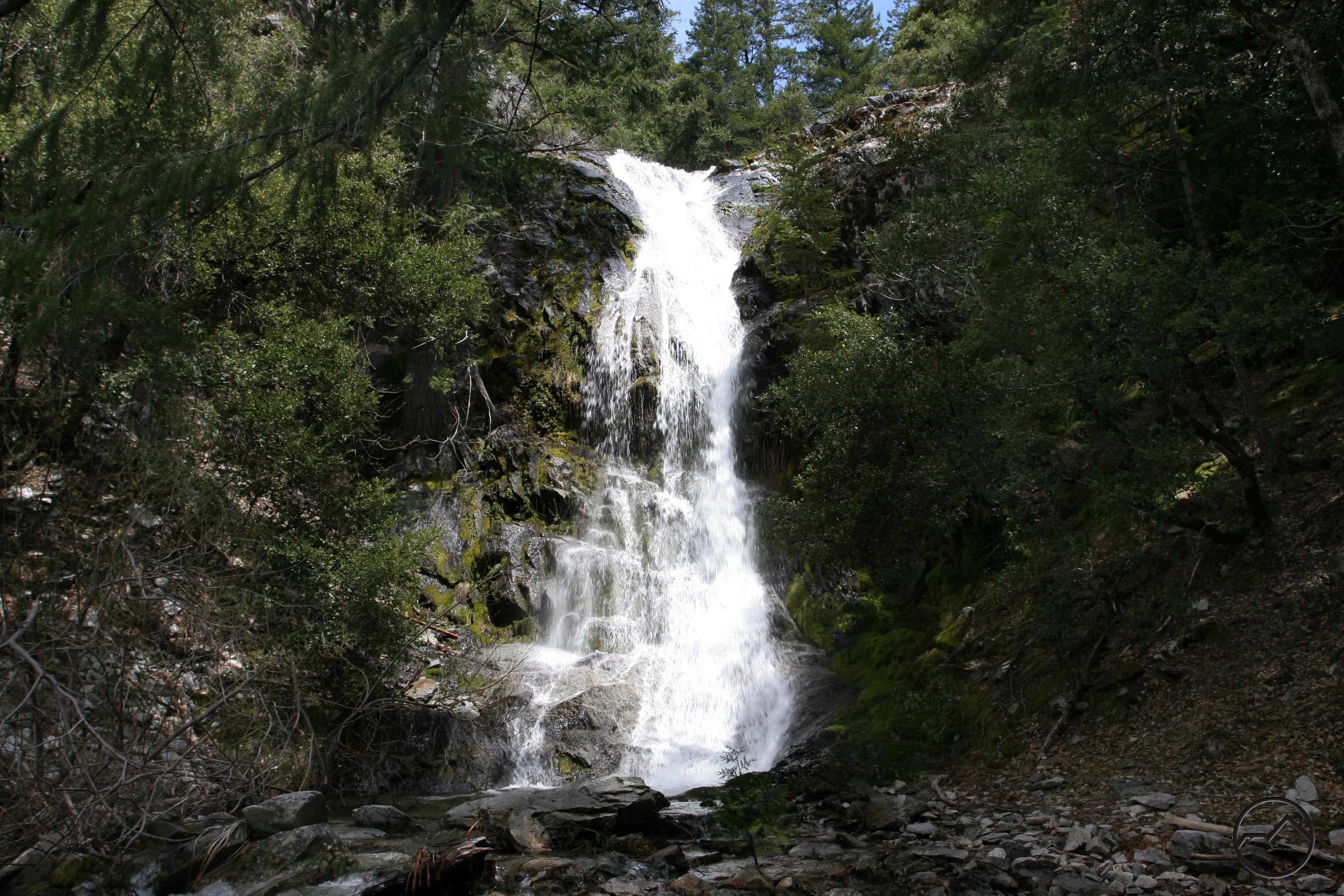
When folks talk about waterfalls in the Castle Crags, Burstarse Falls is naturally a subject of conversation. Yet the large waterfall’s lower sibling somehow fails to garner any mention in its own right. Lower Burstarse Falls (officially this falls has no name but this seems the logical choice) deserves better than this. Nearly 30 feet high, Burstarse Creek rockets itself over a short cliff and falls into classic pool at its base. In some ways it is reminiscent of the waterfalls found in the Appalachians: short, slender, graceful and beautiful. It is a fine sight, worthy of a hike in its own right. However, it is only a part of the greater whole since it must be passed en route to Burstarse Falls. In truth, it is one of many waterfalls that line Burstarse Creek below Burstarse Falls, though it is by far the largest and most obvious. Surprisingly, for all of its anonymity in the shadow of the larger waterfall, a surprising number of people go no further than this cataract, thinking they had found Burstarse Falls!

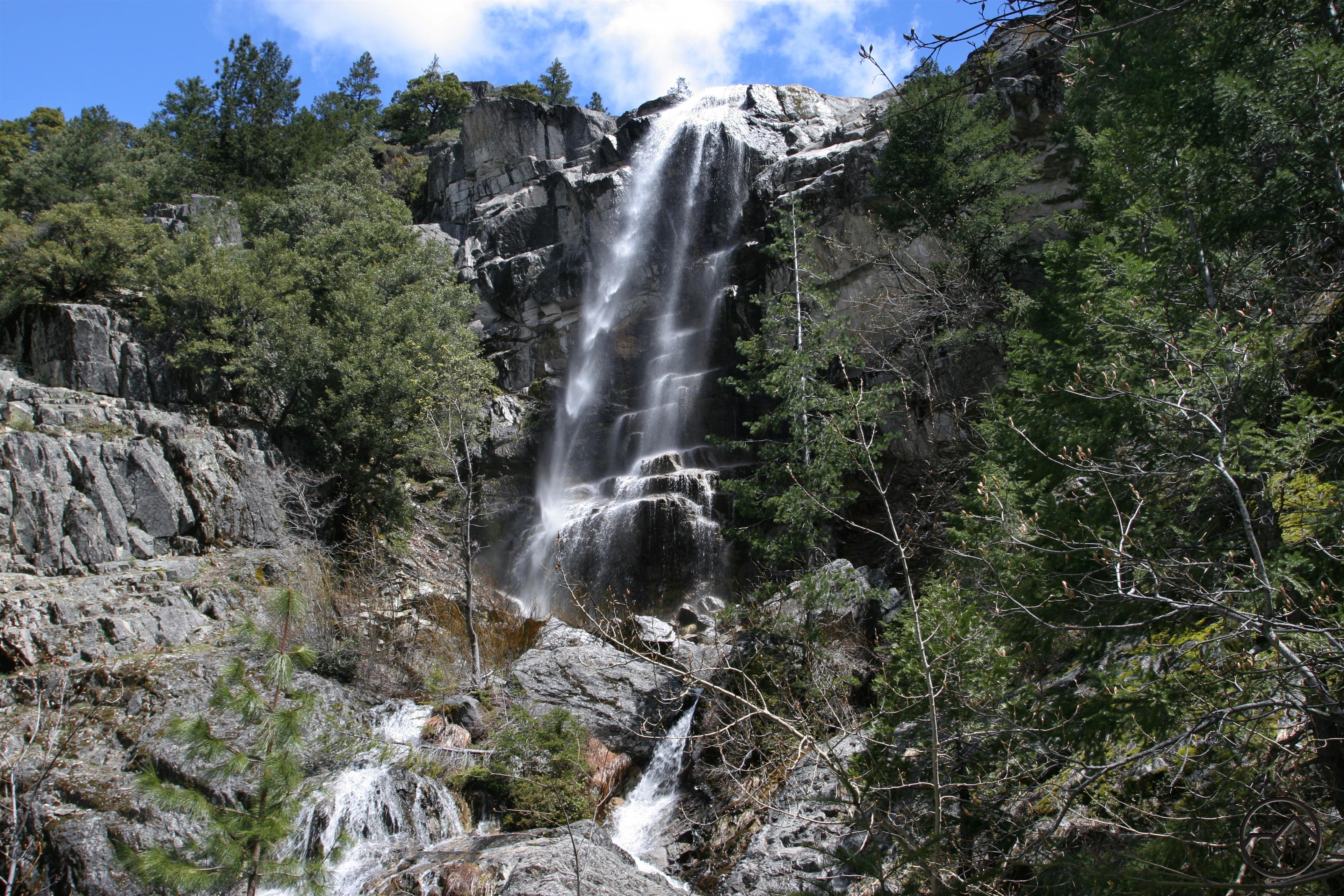
Burstarse Falls
Trinity Divide, Castle Crags - April2011 030 copy (Custom)

Burstarse Falls.

Hidden away in a narrow granite amphitheater, Burstarse Falls is one of the Castle Crags’ finest waterfalls. About 80 feet high, the falls are a slender, rainy cataract. Somehow, despite the seemingly slight nature of the falls they manage to retain a tremendous amount of power. Formed when Burstarse Creek hurtles itself off of a tall granite cliff with great momentum. Rather than cascading down the cliff, Burstarse Falls is a complete free fall. This is what results in the rainy nature of the falls. About three-fourths of the way down the fall, the water crashes into a rocky bench and breaks apart into numerous cascades. There is a bit of a pool at the base of the falls but it is not a great one for soaking in. The tight confines of the amphitheater make viewing Burstarse Falls a more secluded, intimate experience. The cliffs looming so closely overhead magnifies the energy and ferocity of the waterfall. Coupled with the exciting scramble up the narrow canyon to the falls and the many fine cataracts along the way, the hike to Burstarse Falls is possibly the Mount Shasta area’s best spring hike. The route along the Pacific Crest Trail is low enough to be free of snow far earlier than most of the trails in the area. Of course, spring is the best time to view the falls because Burstarse Creek has a very limited watershed. Though it usually has a meager flow throughout the year, the spring thaw is the best time to see the falls at their full fury.

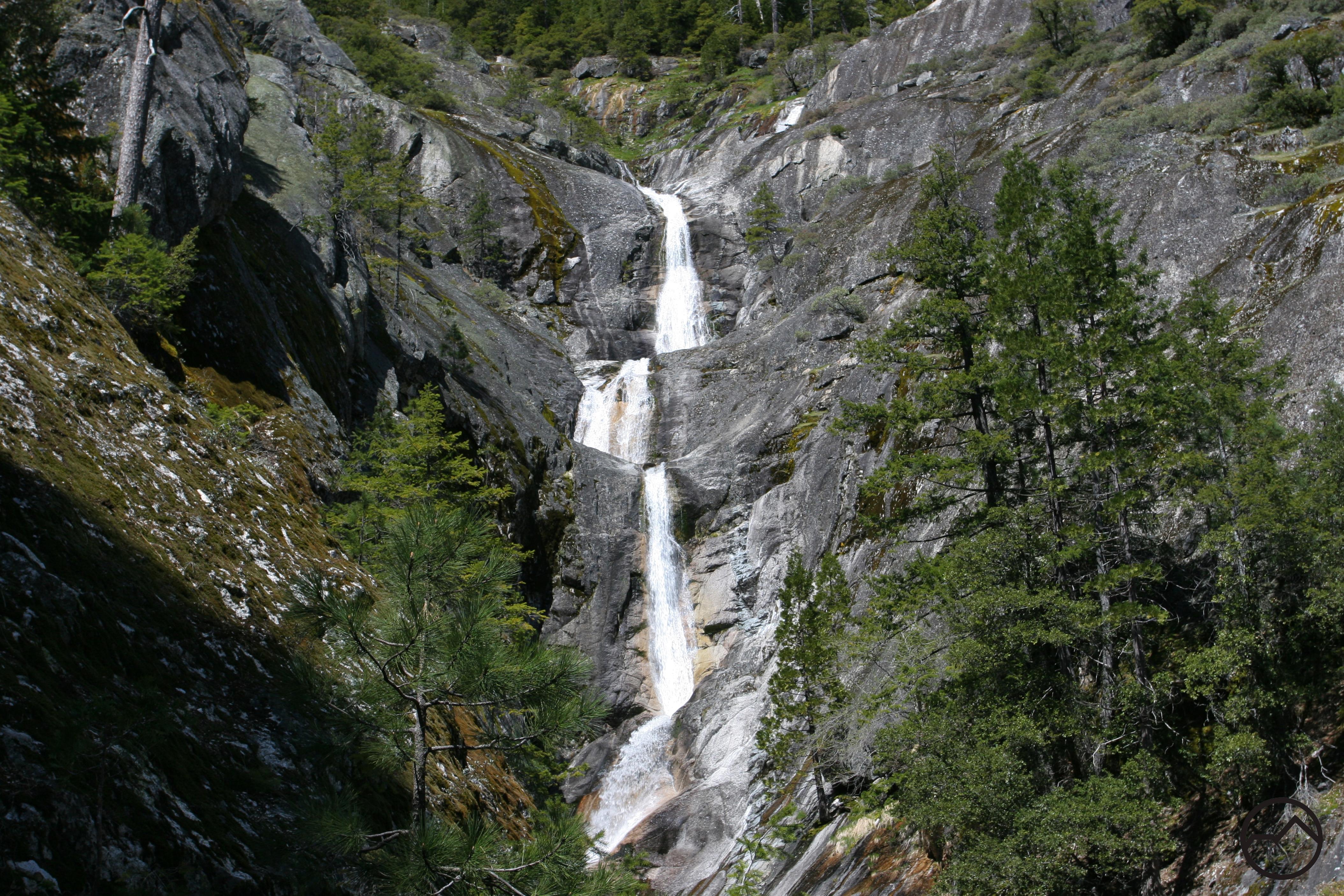
Root Creek Falls
Trinity Divide, Castle Crags - April2011 053 copy (Custom)

Ought-to-be-iconic Root Creek Falls.

Almost totally unknown beyond a few locals until a few years ago, Root Creek Falls still remains a fairly obscure waterfall. It does not get mentioned in any waterfall guidebooks nor does the Root Creek Trail garner a lot of attention. What is passed over though is one of the most spectacular waterfalls in Northern California. Like all the waterfalls in the Castle Crags, it does not have a high volume, instead taking on a graceful, wispy appearance. However, what Root Creek Falls lacks in power it makes up for in form and setting. Composed of a series of cataracts falling over five tiers, the falls charge through a narrow slot. This alone would make the falls a beautiful sight. What sets it apart and makes a truly magnificent waterfall is the presence of mighty Castle Dome looming high overhead. The polished granite dome seems to have been wrenched out of Yosemite and dropped into the Mount Shasta area. It completes a wondrous picture where dome and falls combine together to form what ought to be one of the most iconic images of the North State. Instead it remains largely anonymous, a favorite of locals who make the easy hike to the falls. For those looking for a bit more adventure, it is possible to scramble up to the waterfall and enjoy gorgeous sapphire pools that lie at the base of some of the tiers, again bringing to mind some of the spots in California’s most famous national park.

Faery Falls

694722 (Custom)

Faery Falls.

A little further north from the Castle Crags, Ney Springs Creek begins at Little Castle Lake and races through a remote and wild canyon. The lowest portions of the canyon once hosted a thriving health resort in the 19th century. Closed long ago and reduced to ruins, it is hard to imagine the bustling activity that once surrounded the area. A series of springs give rise to the resort, which was located on the banks of Ney Springs Creek but a short distance up the canyon is beautiful Faery Falls. This was surely one of the great attractions of the resort and most have seen considerable visitation while it was in operation. Today the resort is gone and nature is reclaiming what little of it remains, yet Faery Falls flows as it always has. The falls are easily accessed on an old road that is, like the resort, slowly being taken over by the surrounding forest. About 40 feet high, the waterfall is formed when the creek pours over a rocky cliff band that cuts across the canyon. A little higher up the canyon this band of cliffs is now a popular rock climbing spot. The cataract first falls through a short but very narrow slot. It then hits a broad, rocky bench and breaks apart into two large waterfalls. When the creek is full, it is a powerful sight, amplified by the tight canyon. When the water level is low, one of the two lower sections, typically the one on the left, disappears. Thankfully, given the lake and meadow that feed the creek in the high country, Faery Falls has a much longer season than its neighbors in the Castle Crags and can be enjoyed well into the summer.

Wagon Creek Falls

Wagon Creek Falls

Wagon Creek Falls

Rising from headwaters in remote Eddy Bowl on Mount Eddy, Wagon Creek is a large, beautiful creek. The northernmost tributary of the Sacramento River, it makes a precipitous descent down the east side of Mount Eddy, forming one of the most striking displays of white water in the Mount Shasta area. Wagon Creek Falls is a 50 foot plunge through a notch in a nearly vertical serpentine wall. It is perhaps the most classically formed waterfall in the region. However, it is by no means the only cataract on Wagon Creek. Several other notable falls and cascades are formed on the way down to Mills Meadow. Some of these, though not true waterfalls, are striking in their own right. The drawback to these beautiful cataracts is their remoteness. These are some of the hardest waterfalls to reach in the area and certainly the hardest to reach that are not on Mount Shasta itself. However, for those who make the journey out to Wagon Creek Falls, they will not be dissappointed!

Other cataracts on Wagon Creek:

A section of the surging Wagon Creek cascades.
Lower section of the cascades, just before the upper falls.

Upper Wagon Creek Falls
Wagon Creek flowing toward Mount Shasta.
Seldom Seen: Mud Creek Canyon

Posted by bubbasuess on November 1, 2013
Posted in: Glaciers, Hiking, Mount Shasta, Seldom Seen, Waterfalls, Wilderness. Tagged: Mount Shasta, Mud Creek Canyon. 23 Comments
Cascades, Mt Shasta, Squaw Meadow - Oct2013 046 copy (Custom)

Jaw-dropping view of Mud Creek Canyon on Mount Shasta.

As John Muir once noted, Mount Shasta is the polestar of Northern California. Geographically, the entire region orients around the incredibly massive volcano. It is one of the premier mountains in the U.S. Whether one is considering height, volume, wildness or sheer beauty, Mount Shasta is one of the great treasures of the American West. Though it ranks high in the esteem of mountain lovers, most of the mountain’s geography is shrouded in mystery for the majority of those who admire it. There are many incredible spots on the mountain, places of tremendous beauty and staggering scale, which go almost completely unappreciated. Perhaps there is no truer example of this than the case of Mud Creek Canyon. Easily one of the most dominant features on Mount Shasta, it ranks equally with Shastina and the mountain’s quartet of gigantic glaciers. While Shastina is easily recognized from far below and at least the Whitney and Bolam Glaciers are obvious from the Shasta Valley, Mud Creek Canyon remains unobserved from areas below the mountain. This is a consequence of the canyon’s position above the vast McCLoud Flats, a heavily wooded area with a paucity of good, elevated vantage points from which to observe the mountain. What the canyon lacks in ease of viewing, it makes up for in the enormity of its scale. Considering that it cuts into the flank of a single peak, its 6 mile length and depth of over 1,000 feet is truly imposing. That such a magnificent feature remains so seldom seen is testimony to how wild Mount Shasta really is.

Cascades, Mt Shasta, Squaw Meadow - Oct2013 023 copy (Custom)

The primordial heart of Mount Shasta.

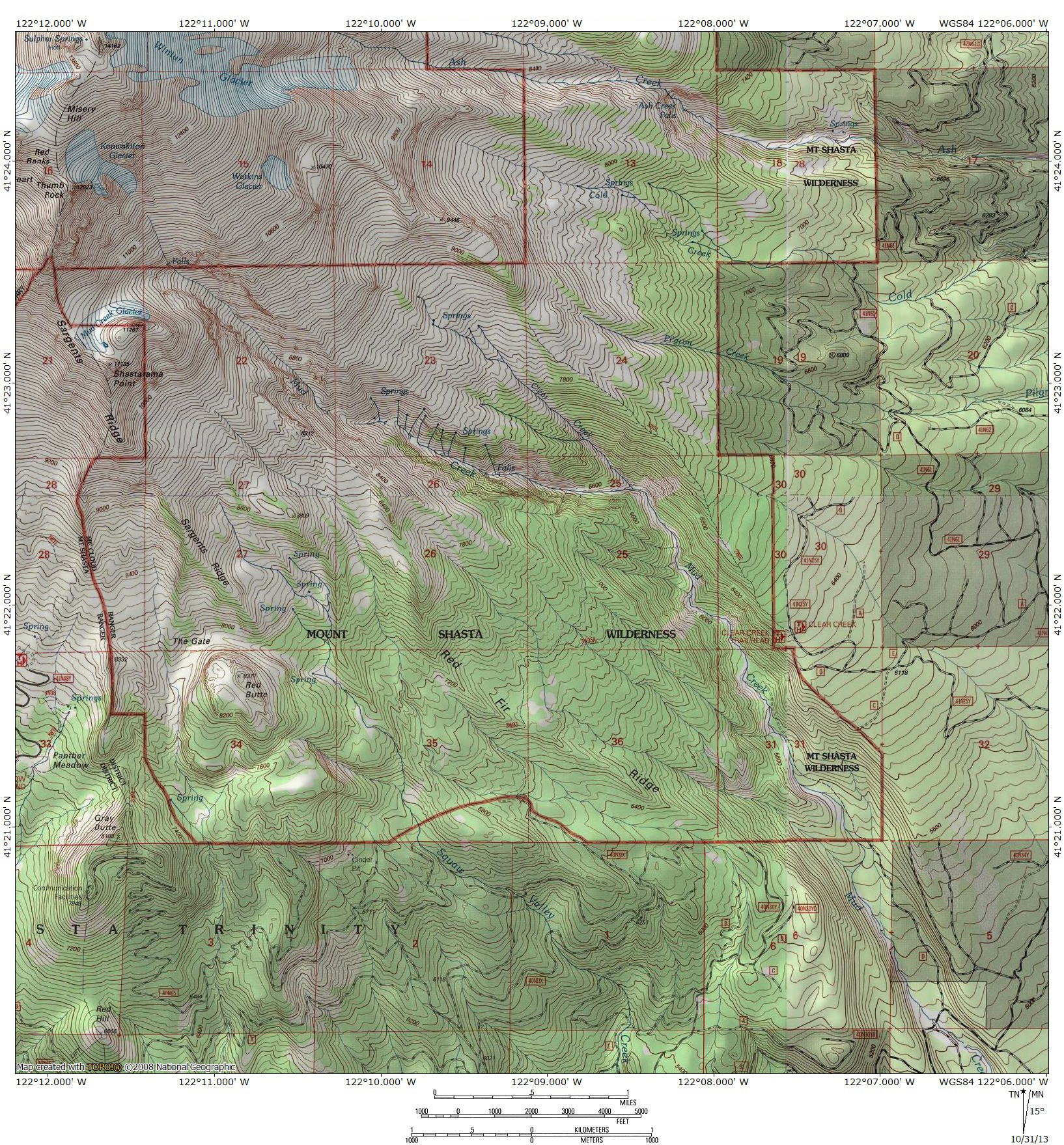
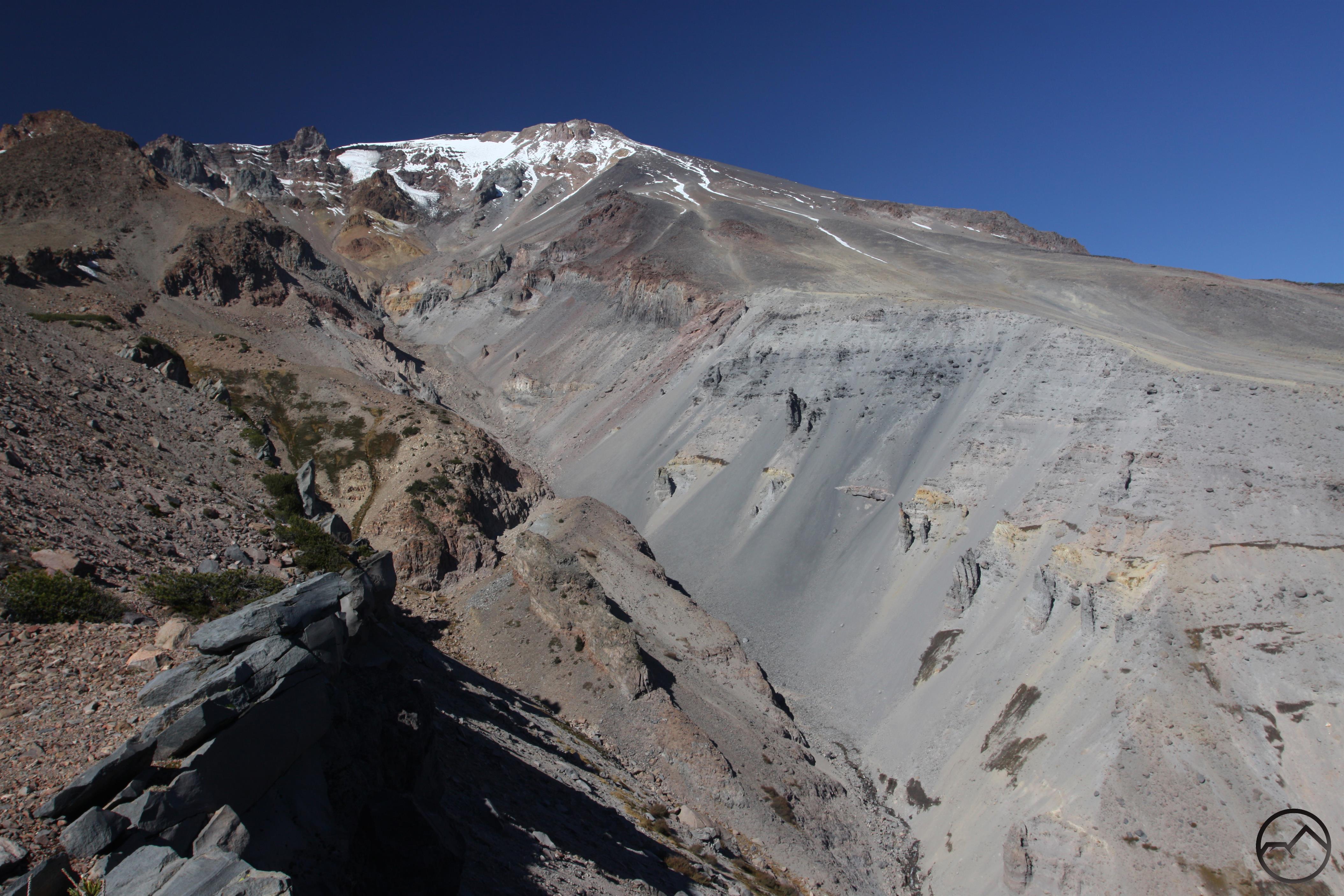
Cutting deeply into Mount Shasta’s southeastern flank, Mud Creek Canyon is a place of wild, hellish beauty. It begins at the foot of the Konwakiton Glacier, one of three small glaciers that are scattered around the south side of the mountain. Of course, these glaciers are only small when compared to the behemoths that cloak the north and east sides of the mountain. The Konwakiton Glacier still manages to cover over 1,500 vertical feet of Mount Shasta. The glacier clings to the upper portion of a vast amphitheater just below the volcano’s summit. In addition to the icy features, this broad bowl is lined with craggy spires and rocky pinnacles, evidence of the fiery past that shaped Mount Shasta. Indeed, this area and Mud Creek Canyon below it are considered to be the oldest exposed areas on Mount Shasta, remnants of a proto-Shasta from prior eruptive periods. At a basic empirical level this seems reasonable. No other area on the mountain exhibits such tortured geology. The amphitheater also gathers meltwater from the Mud Creek Glacier and the large Misery Snowfield. All of the runoff is funneled down into the canyon where it plunges over a tall waterfall that is unnamed but known unofficially as Konwakiton Falls. Though at times wispy, the falls certainly boast one of the grandest settings imaginable for a waterfall.

Cascades, Mt Shasta, Squaw Meadow - Oct2013 028_edited-1 (Custom)

“Thor’s Hammers” in Mud Creek Canyon.

Below Konwakiton Falls the canyon deepens significantly as it gouges its path through the ash and rock that make up the mountain’s flank. This is a truly wild, seldom seen and seldom traveled place. In truth, it is a never-traveled place for the slopes of the canyon are seemingly boundless screefields. When standing on the rim of the canyon, listen for the sound of falling boulders clattering down into the unreachable depths. The sides of Mud Creek Canyon are still in search of their angle of repose. Those who are patient enough may even see small scree slides up near the top of the canyon. While most of the canyon’s walls are loose debris, they are punctuated by giant hoodoos emerging from the scree and towering over 100 feet above the rubble. Indicative of the mountain’s volcanic history, the hoodoos are particularly reminiscent of the Thor’s Hammer hoodoo in Bryce Canyon National Park. I have taken to referring to these twisted towers as Thor’s Hammers in honor of the famous landmark in Utah. Another fascinating feature at the bottom of Mud Creek Canyon is the permanent ice. The ice is nearly completely obscured by layers of talus that has slid over it. Though these patches of ice are not glaciers, they do exhibit some glacial features.

Cascades, Mt Shasta, Squaw Meadow - Oct2013 037 copy (Custom)

Spring-covered Mud Creek Canyon.

Rock and fire are not the only forces that created Mud Creek Canyon. Water has played a tremendous role in the formation of this incredible gash on the side of Mount Shasta. Mud Creek roars through countless rapids at the bottom of the canyon. It is loudly audible from high overhead on the canyon rim. Amazingly, the sides of the canyon are littered with springs, especially the areas further down-canyon from the uppermost section where the hoodoos are located. The layers of material within the mountain are exposed on the sides of the canyon and the aquifers that exist between certain strata are cut open and flow down the sides. One unexpected result of this is the abundance of riparian plant life that clings to the thin margin of water on the otherwise barren slope. However, despite the beautiful and unusual abundance of springs on the side of the canyon, it is Mud Creek Falls that is the most memorable water feature here. The large, powerful waterfall thunders over a cliff that is well over 150 feet high. The cataract is the largest waterfall on Mount Shasta and is second only to Ash Creek Falls in terms of beauty.
Cascades, Mt Shasta, Clear Creek - Aug2012 152 copy (Custom)

Mud Creek Canyon and Falls from the Clear Creek Trail.

It is a wonder that, for all of its size, beauty and fascinating geology, Mud Creek Canyon has remained so seldom seen. Most who do observe it do so from high above while climbing up to the summit of Mount Shasta. It is also viewed by those who hike the Clear Creek Trail. This is actually one of the two trails on Mount Shasta that offer a good opportunity to experience Mud Creek Canyon. The Clear Creek Trail ascends the rim of the lower canyon, which is the area downstream from the confluence of Mud Creek and Clear Creek. The view from the trail is astounding. Mud Creek canyon extends up toward the summit, its deep V-shaped gap incising deep into the mountain. Mud Creek Falls is prominently visible from this perspective and is a particularly memorable highlight. A few intrepid adventurers descend into the canyon and repel down the falls. The other way to get to Mud Creek Canyon to is to hike to beautiful South Gate/Squaw Meadows. From there, one can make a fairly easy cross country scramble to the west rim of the canyon. If one completes the scramble correctly, there is a stunning perch perfectly positioned to get a panoramic view of the most of Mud Creek’s gargantuan gorge. One can trace the course from Konwakiton Glacier, down the eponymously named waterfall, through the hellish, hoodoo lined upper canyon, down the vast spring-lined main part of the canyon and onwards, downstream into the lower canyon. I have dubbed this vista “Grand View Point” in an obvious nod to the point of the same name at the Grand Canyon. Like an observation deck, the vista has a nice wall of rock fencing it off and preventing those fortunate to make it here from sliding into the canyon. While standing here taking in this awe-inspiring but seldom seen view one can hear the roar of Mud Creek mix with the sound of boulders clattering down to the bottom of the canyon, evidence that Mount Shasta is a living mountain still taking shape.

As always, if anyone is curious about details in getting to these places, feel free to send me an email.

The view from the east side across the widest section of Mud Creek Canyon.
Thumb Rock at the head of Mud Creek Canyon.
Konwakiton Falls

Mud Creek Canyon
Looking downstream toward the lower canyon.

Mud Creek Canyon
Scree-covered ice along Mud Creek.
Mud Creek Falls

A look up above Mud Creek Falls into the middle portion of Mud Creek Canyon.
Staggering view of Mount Shasta and Mud Creek Canyon.
The confluence of Mud and Clear Creeks.

Expansive clouds over Mount Shasta and Mud Creek Canyon.

Mud Creek Canyon

Five Fantastic Mount Shasta Vistas

Posted by bubbasuess on October 28, 2013
Posted in: Castle Crags, Glaciers, Hiking, Klamath Mountains, Lakes, Mount Eddy, Mount Shasta, Trinity Divide. Tagged: Grey Rocks, Herd Peak, Little Mount Hoffman, Many Lakes Mountain, Mount Eddy, Mount Shasta. 4 Comments
Cascades, Mt. Shasta - Jan2009 047 copy (Custom)

Herd Peak offers incredible views of Mount Shasta from the north.

Mount Shasta is a lone giant, towering more than a vertical mile above its highest neighbor. Since the massive volcano is so prominent, it is not difficult to enjoy the incredible views of California’s finest mountain. All one has to do is take a drive on I-5 or Highway 97 to find absolutely tremendous scenes of Mount Shasta soaring 10,000 feet overhead. This gives even the casual traveler passing through the area a good sense of the mountain’s majesty. However, one of the great pleasures of exploring the Mount Shasta region is finding those great vistas that offer different perspectives of the mountain and also place it within the broader context of the entire region. The truth is that, as wonderful as Mount Shasta is, there is no shortage of spectacular scenery surrounding the mountain. Whether it is the Trinity Divide and the Castle Crags, the southern Cascades and Lassen Peak, the serrated granite spires of the Trinity Alps, the twisted and beautiful Marble Mountains, or distant Mount McLoughlin in Oregon, there is an abundance of other high country attractions to appreciate. Indeed, Mount Shasta is the crown of a truly stunning mountain region.

Picking the best vistas of the Mount Shasta area is a completely subjective exercise. There is plenty of room for debate as to what constitutes a great view. I tend to lean towards panoramas, where the more that can be seen the better, especially if the breadth of the view does not come at the expense of the essence of the view. That is to say that, particularly in the context of views of Mount Shasta, the overall expansiveness of the view does not detract from the view of the mountain itself. All the other scenery is crowned by the mountain and enhances it rather than obscuring it. Still, by this definition there are many, many great spots from which to appreciate Mount Shasta and the area’s other awesome geography. This is evinced by the exclusion of incredible vistas like the summits of Black Butte and Castle Peak or the iconic view from Heart Lake. The five viewpoints on this list offer great views of Mount Shasta and the rest of the geography of the area. However, what sets them apart from other vistas is the immediate vicinity of the view. It is not just that one can see a lot from these places but that the great beauty of the region surrounds these spots, with memorable sights close at hand. The viewpoints are great for both imminent and panoramic qualities.

As always, if anyone is curious about details in getting to these places, feel free to send me an email.

5. Grey Rocks Summit

Mount Shasta and Castle Crags from the summit.

Mount Shasta and Castle Crags from the Grey Rocks.

This is possibly the most obscure summit of the Mount Shasta area though it does not deserve to be. It certainly is the most difficult vista on this list to reach. The Grey Rocks are a series of craggy towers in the remote southern section of the Trinity Divide. They are accessed via a difficult scramble up the side of the towers and no small amount of “manzaneering” (bushwhacking). However, the view from the summit is one of the most rewarding. The centerpiece is Mount Shasta towering over the length of the magnificent Castle Crags. To the south are the glittering jewels of the Twin Lakes and Tamarack Lake, backed by their tall cliffs. The Trinity Alps unfold to the east while to the south rise Shasta Bally and Bully Choop down by Redding. Lassen Peak and the other high peaks of the southernmost Cascades line the horizon to the east. The Trinity Divide and Mount Eddy extend to the north. Still, it is the great cone of Mount Shasta and the awesome granite chaos of the Castle Crags that makes this vista so memorable.

4. Peak 7,149 “Many Lakes Mountain” Summit

Trinity Divide, Many Lakes Mountain - June2012 048 copy (Custom)

Mount Shasta and the Cliff Lakes.

Though it lacks an official name, Peak 7,149 does not lack a view that will leave an indelible mark on those who make the easy scramble up to its summit. I dubbed the mountain “Many Lakes Mountain” because it lies at the hub of three large lake basins and is surrounded by no less than 14 named lakes and a handful of unnamed tarns. This is far more than any other peak in the area can boast, including the mighty towers in lake filled areas like the Trinity Alps. Of course, these ranges are prominently visible from the top of Many Lakes Mountain, especially the Trinity Alps which lie only a short distance to the west on the far side of the Trinity River Canyon. However, it is the views of the Cliff Lake and Seven Lakes Basin that define this vista. To the south the dark jumble of the jumble of the Gray Rocks looms above the broad Seven Lakes Basin. To the east, the terraced steps of the awesome Cliff Lakes lead down to the South Fork of the Sacramento River, which draws the eye to Mount Shasta, once again presiding regally over everything.

3. Herd Peak Lookout

Cascades, Mt. Shasta - Nov2008 060 copy (Custom)

Mount Shasta and Sheep Rock viewed from Herd Peak.

Not all great views require a hike or difficult climb. Herd Peak Lookout is accessible by car and only requires a climb of about 50 feet up some stairs to enjoy the view. The lookout is situated on a small rock pinnacle north of Mount Shasta, at the southern end of the Cascade Crest. Possibly the best view of the north side of Mount Shasta, it also takes in much of the Trinity Divide, the Marble Mountains and the Siskiyous, including a rare opportunity to observe the enigmatic Red Buttes. The various cinder cones of the cascades pock the landscape to the east and the giant cone of the Goosenest looms ominously to the north. Still, the highlight is the chaotic layers of Sheep Rock in the foreground of Mount Shasta. The awesome Bolam and Whitney Glaciers are prominently visible from this perspective. The lookout is manned in the summer.
2. Little Mount Hoffman Lookout

Cascades, Mt. Shasta - Oct2013 022_edited-1 (Custom)

Mount Shasta and Little Glass Mountain.

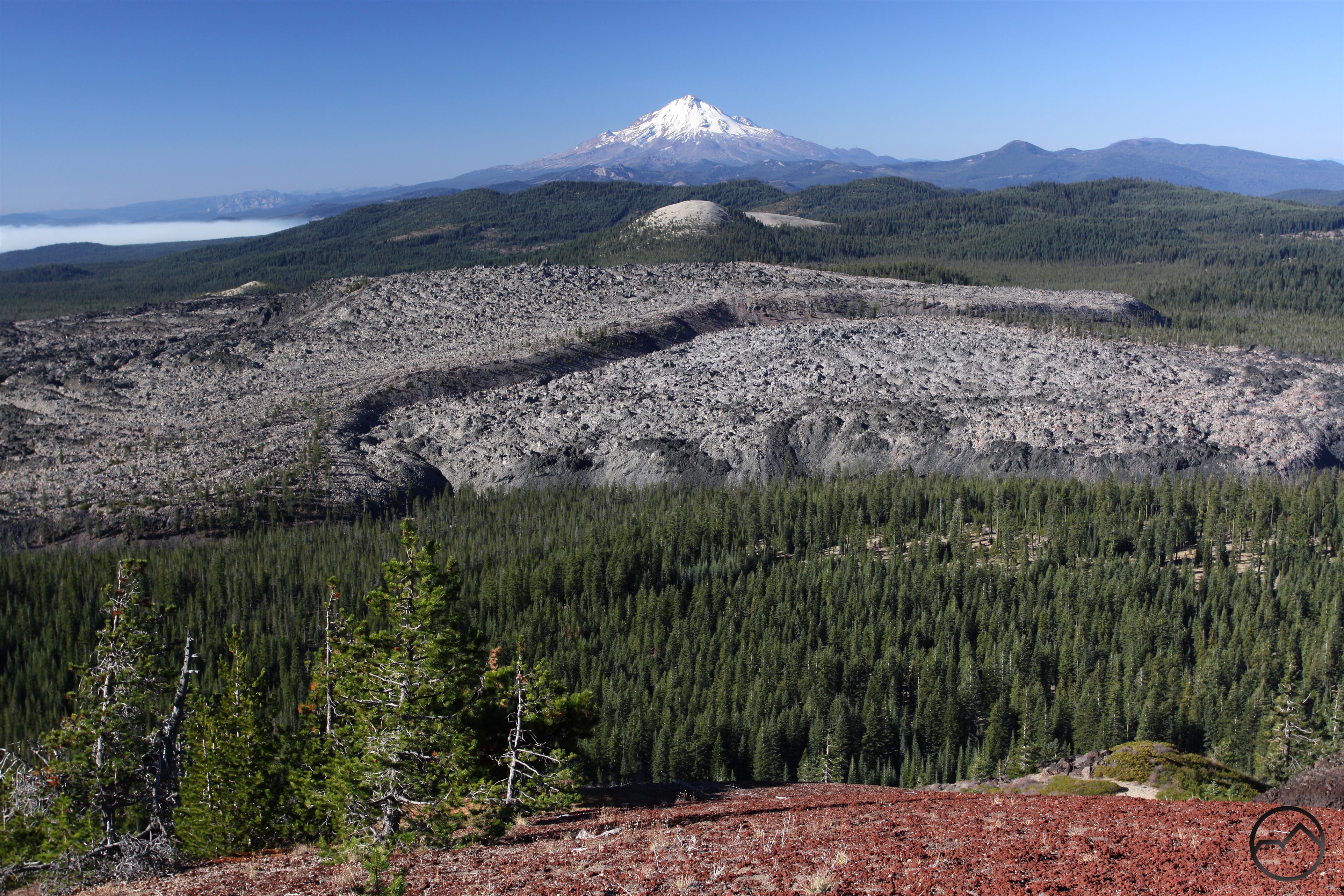
Another drive-to vista, the lookout on Little Mount Hoffman near Medicine Lake just misses the top spot. It is an incredible sight with possibly the most far-reaching vista of any in the Mount Shasta area (excluding the view from on Mount Shasta itself, of course). Beginning in the southeast, one can observe the entirety of Lassen Volcanic National Park, including volcanic cones just to the east in the Caribou Wilerness. Panning west from there, the view includes the vast range of mountains east of the McCloud River, the Yolla Bollies south of Redding, Bully Choop, the Grey Rocks and Castle Crags, the Trinity Alps (notably the Mount Gibson area) and much of the Trinity Divide, all of which leads up to Mount Shasta. North of the mountain lies the Marble Mountains, the Siskiyou and the Cascade Crest, including the Goosenest. Amazingly, the panorama continues. It extends into Oregon and is highlighted by Mount McLoughlin, the rounded summits of the Sky Lakes Wilderness, the old caldera of the Mountain Lakes Wilderness and the rim of Crater Lake, including Mount Scott. Even a bit of Mount Thielsen, far to the north can be observed. As incredible as this all is, it is what lies immediately to the west within the line-of-sight of Mount Shasta that inevitably draws attention. Just below Little Mount Hoffman is the chaotic swirl of the Little Glass Mountain lava flow. A vast amount of obsidian protrudes from the dark mass. Beyond Little Glass Mountain are the mysterious peaks around Ash Creek Butte. Over all of this, as always, towers Mount Shasta. Though the mountain is a bit further away than the other vistas on this list, it still looms large. An added bonus is the chance to see the rarely seen east side, capped by the enormous Wintun and Hotlum Glaciers.
1. Mount Eddy Summit

Trinity Divide, Mt. Eddy - July2010 016 (Custom)

Mount Shasta looms beyond Mount Eddy.

It is difficult to imagine a finer view than the 360 degree view from the top of Mount Eddy. The tallest of Mount Shasta’s neighboring peaks, it still falls more than a mile below the summit of the great volcano. Still, standing as tall as gives it an unparalleled view of the Mount Shasta area. All of the usual suspects are present: the Lassen area, the Yolla Bollies and the Bully Choop area by Redding. To the west nearly every major peak of the Trinity Alps’ high eastern half can be observed in all of their craggy glory. Just below the summit to the northwest are the gorgeous Deadfall Lakes. Beyond the lakes lie the red Scott Mountains, the granite peaks of the Russian Wilderness and the convoluted maze of the excellent Marble Mountains. To the north is the underrated China Mountain, the Siskiyous, Shasta Valley and Mount McLoughlin in Oregon. The Cascade Crest, topped by the Goosenest are also prominent. The entirety of the Trinity Divide lies at the feet of Mount Eddy, each peak able to be inspected with great detail. The spires of the Castle Crags, the jumble of the Grey Rocks and the folded ridges and canyons of that form the headwaters of the Sacramento River all beg to be pointed out. Despite all of the amazing scenery, it is still Mount Shasta, the lone monarch, which demands attention. Only 16 miles to the east, the great mountain seems close enough to reach out and grab.

East Side Glacier View

Posted by bubbasuess on October 23, 2013
Posted in: Glaciers, Hiking, Mount Shasta. Tagged: Bolam Glacier, Hotlum Glaciers, Mount Shasta, the Whaleback, Whitney Glacier, Wintun Glacier. 4 Comments
Cascades, Mt. Shasta - Oct2013 073_edited-1 (Custom)

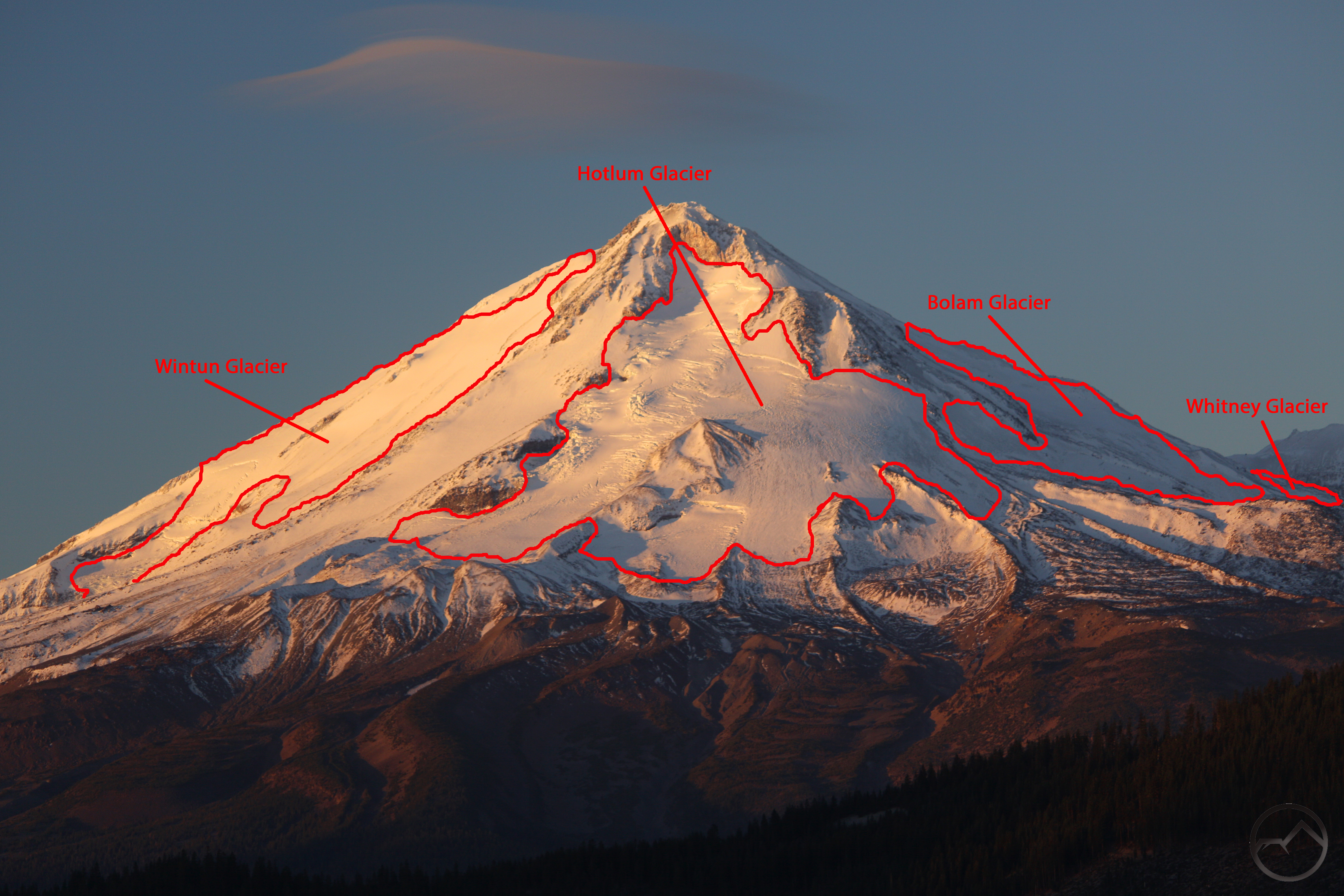
Mount Shasta is a spectacular sight no matter where one views the mighty mountain. Most people who observe it do so from somewhere along the I-5 corridor. The views from the interstate are without doubt exceptional. However, I think that one of the best features on Mount Shasta are the four massive glaciers, the Whitney, Bolam, Hotlum and Wintun, that cloak the volcano’s north and east flanks (there are three small glaciers on the south side but they are tiny compared to their northern and eastern neighbors). Two of these vast sheets of ice, the Whitney and Bolam Glaciers, can be observed while driving south on I-5 through the Shasta Valley. Though this is a tremendous view from a freeway, it still does not take in the Hotlum Glacier (California’s largest glacier) and the nearly-as-large Wintun Glacier. These glaciers are more difficult to observe because they are on the isolated east side of Mount Shasta. No major roads or highways pass this side of the volcano, drastically reducing the number of people who have the opportunity to witness these incredible glaciers. Most people who do set eyes on this lonely side of the mountain do so while climbing Mount Shasta or one of the higher peaks that mark the Cascade Crest as it passes the giant mountain’s eastern flank (worth noting: Mount Shasta does not lie on the main divide of the Cascades, instead it is a massive outlier, falling well west of the crest).
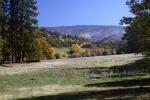
If viewing the Hotlum and Wintun Glaciers while hiking is what you want, the only option, and it is an excellent option, is to hike the Brewer Creek Trail. The beginning of the trail has great views of the Hotlum Glacier, including large icefalls where the glacier is pouring over rocky cliffs beneath the sheet of ice. If hikers continue on to gorgeous Ash Creek Falls, there are great vistas looking up Ash Creek Canyon to the Wintun Glacier. For those not looking to explore Mount Shasta on foot, there are a couple of good places where one need only climb a short distance to get a chance to see the incredible spectacle of Mount Shasta’s east side glaciers. This is particularly true from various points on the Whaleback, a tall volcano northeast of Mount Shasta. Though the Whaleback is one of the highest summits among the peaks that surround Mount Shasta, it still falls nearly 6,000 feet short of great mountain’s towering height. Still, there are spots on the Whaleback where can obtain wondrous views of the glaciers. Some even afford a rare glimpse of all four of Mount Shasta’s giant sheets of flowing ice.
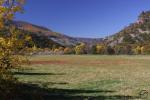
A few weeks ago I posted the image at the top of this blog on Hikemtshasta.com’s Facebook page. It was taken from one of the aforementioned spots on the Whaleback where all four glaciers are in view. Three of the glaciers, the Wintun, Hotlum and Bolam are readily identifiable. Their large crevasses stand out even from a distance. The fourth glacier, the Whitney, is only partially visible. Considering that the Whitney is really a river of ice flowing through the deep canyon formed between the cones of Shasta and Shastina, it is impressive that any portion of the glacier is visible at all. The best time to see the glaciers is late in the summer or during the fall, when all of the winter snow has melted and only the permanent ice of the glaciers themselves remains. Not only does this highlight the extent of the glaciers but it also makes their features, like the icefalls and crevasses, more obvious. The above image has a bit of fresh snow on it so the extent of the four glaciers is outlined here:

Glaciers II

While the outlines may not be precisely correct on every corner of the glaciers, it gives an idea how extensive they are. When years with light winters come and the mountain loses most of its snow on the west side, it is always encouraging to know that a short drive or a great hike can bring us within view of these staggering glaciers. Nowhere else in California boasts glaciers that compare with those on Mount Shasta. Though they are not as large as some of the epic one found further north on peaks like Mount Rainier, Shasta’s glaciers are still among the largest in the Cascades and demand respect.
As always, if interested in finding this spot, send me an email and I will be glad to give directions.

Seldom Seen: Upper Klamath River Canyon

Posted by bubbasuess on October 18, 2013
Posted in: Desert, Hiking, Mount Shasta, Rivers, Seldom Seen. Tagged: Cascade Range, Klamath River, Mount Shasta. 10 Comments
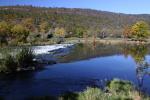
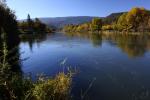
Klamath River - Oct2013 019 copy (Custom)

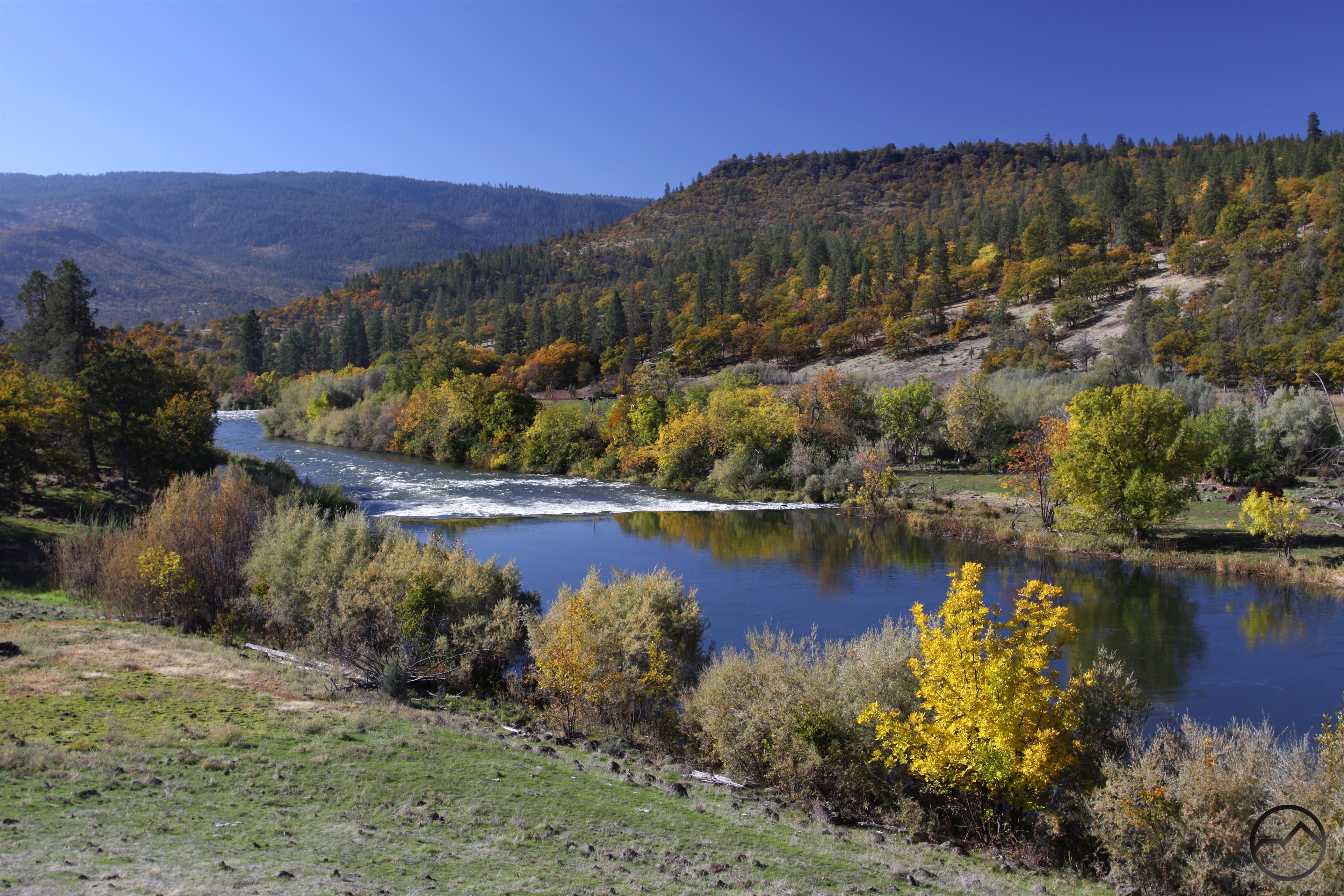
Fall color explodes as the Klamath River flows through the Upper Klamath River Canyon.

The Klamath River is one of the most important features in California’s North State region. It is easily the largest river in the area. The river begins in south central Oregon, counting the rim of Crater Lake among its various headwaters areas, and courses 263 miles through Oregon and California before reaching the sea roughly between Eureka and Crescent City. Along the way the river drains the bulk of the vast Klamath Mountains, collecting the water from other major rivers including the Shasta, Scott, Salmon and the enormous Trinity River. Though the river is large and passes through areas famous for the high and rugged mountains, it is surprising how much of the river’s travels are through arid, high desert terrain. This is particularly evident in the area between Keno, Oregon and the Horse Creek area in California. The sage and juniper covered slopes of tawny mountains pocked by dark rock outcroppings is a stark contrast to the cool, life-giving waters of the rushing river. The contrast is made even more dramatic considering the harsh desert environment is concentrated along the river corridor and just a few short miles away are the lush mountain meadows of the Marble Mountains and the Siskiyous. Of course, these are not the only mountains within easy reach of the Klamath River. Indeed, though not obvious to the casual observer, the Klamath River has an interesting relationship with the mighty Cascade Range. The Klamath is one of three rivers that begin on the east side of the Cascade Crest and then complete a transection of the mountains. The most famous and dramatic example of this is the Columbia River Gorge, where the Columbia River makes a sea level passage through the heart of the Cascades. Less dramatic but still interesting, the Klamath River and the Pit River further south also cut across the Cascades during the journey to the sea. Both rivers have beautiful, if somewhat less monumental canyons during this impressive feat.

Klamath River - Oct2013 040_edited-1 (Custom)

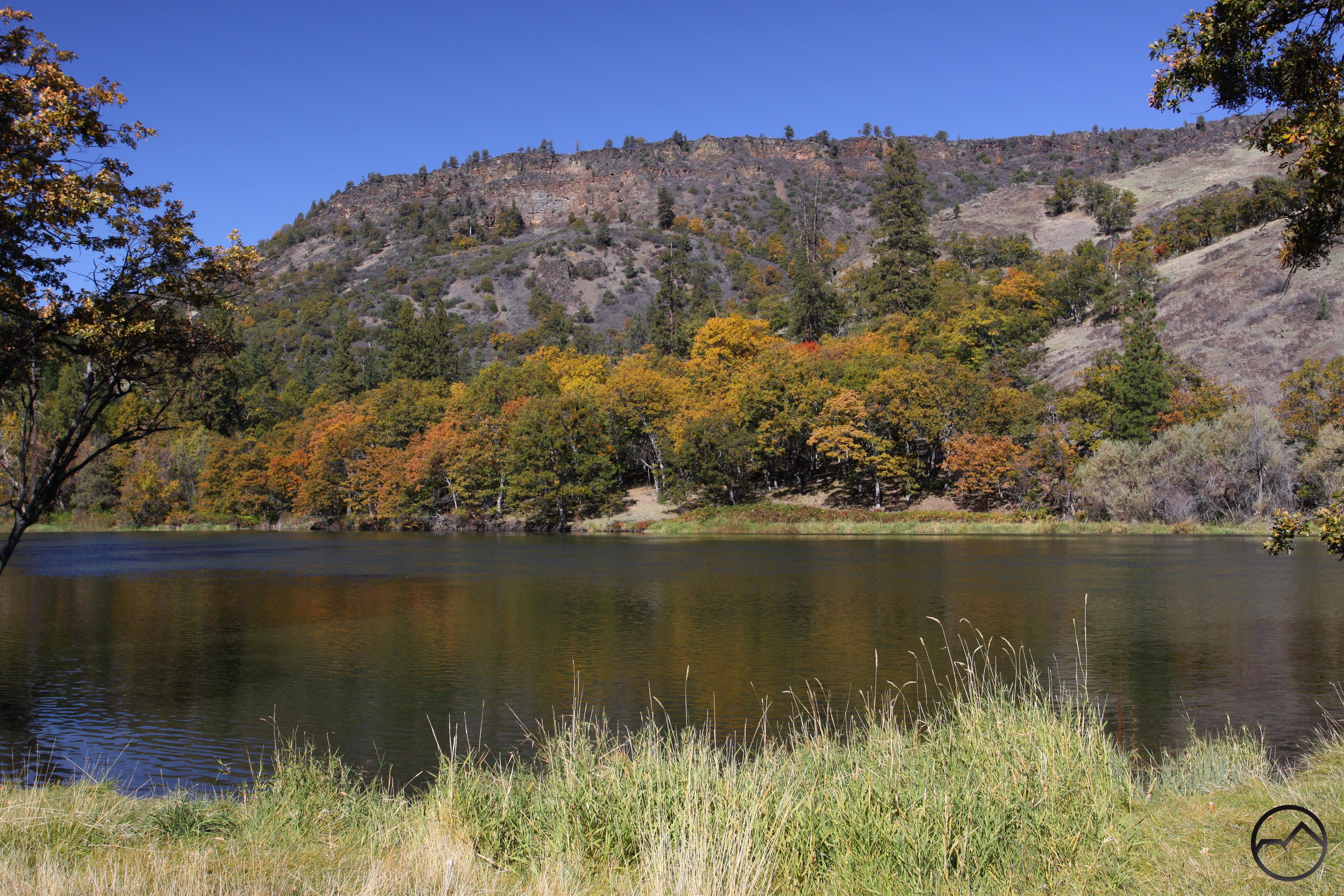
Fall colors below the Klamath Rim.

The canyon through which the Klamath River achieves its traverse of the Cascade Range is one of the most remote corners of Siskiyou County and receives very little visitation, despite the great natural beauty of the area. Few people venture here for a variety of reasons, not the least of which is that it is simply a long way from anywhere and not promoted at all. Add to that the lack of trails and the large blocks of privately owned land and what few people would venture here is pared down to a relative handful of folks. Still, the canyon of the Upper Klamath (the upper section of the river is considered to be that which is up stream of the Irongate and Copco Reservoirs, which begin at the west end of the canyon) is a fascinating and beautiful formation. The river carved its passage across the Cascades at a low saddle in the range’s crest. North of Willow Creek Mountain, the Cascades subside into a high, forested plateau underlayed by lava flows. The river gouged its path out of the southern end of the plateau, near where the crest rises up toward Willow Creek Mountain. This resulted in what is known as the Klamath Rim, a sharp band of cliffs that line the northern side of the Upper Klamath’s canyon. The rim’s elevation above the river varies but it generally maintains a height of about 1,000 feet. The south side of canyon is marked not by a severe edge like the north, but an undulating series of slopes rising up toward the heavily forested high country. The most interesting feature on the river’s south side is large Secret Springs Mountain, which is an ancient volcano that boasts a surprisingly large crater on its north side. Though the canyon does not have a definite rim on the south side it is still marked by steep walls broken intermittently by deep canyons of tributary creeks. The most notable is Shovel Creek, which begins in a large meadow at the divide near Little Shasta meadows, the headwaters of the Little Shasta River.

As noted earlier, the river receives little visitation in part because of the lack of public land. There are no maintained trails along the river. Still, the area is ripe for exploration by those interested in seeing a beautiful place that is seldom seen. A very well maintained gravel road follows the south side of the river through the canyon, eventually passing into Oregon on its way to meeting Highway 66. The land owner along much of the river is Pacific Power and they have established 6 river access points for fishermen to use. Thankfully these offer opportunities to get down close to the river and enjoy short walks along the banks. The sixth one is the most scenic. As one heads north toward Oregon, the last little bit of the river passes through BLM land just below the border. The BLM has established a put in site for rafters with some minor amenities, including a pit toilet. This area is a fantastic and utterly underused camping spot. Solitude in this incredible canyon, along a gorgeous river is practically guaranteed. For those interested in adventure, an ascent up Secret Springs Mountain is excellent and exploring the area along the river is great. Fall is the best time to come, when the autumn colors explode along the river and the temperatures are perfect.


Great Lakes: The Top Five Lake Basins In The Trinity Divide

Posted by bubbasuess on October 4, 2013
Posted in: Hiking, Klamath Mountains, Lakes, Meadows, Mount Shasta, Trinity Divide. Tagged: Castle Lake, Cliff Lake, Deadfall Lake, Gray Rock Lake, Heart Lake, Mount Shasta, Tamarack Lake. 5 Comments
Trinity Divide, Castle Peak - Nov2008 009 copy (Custom)

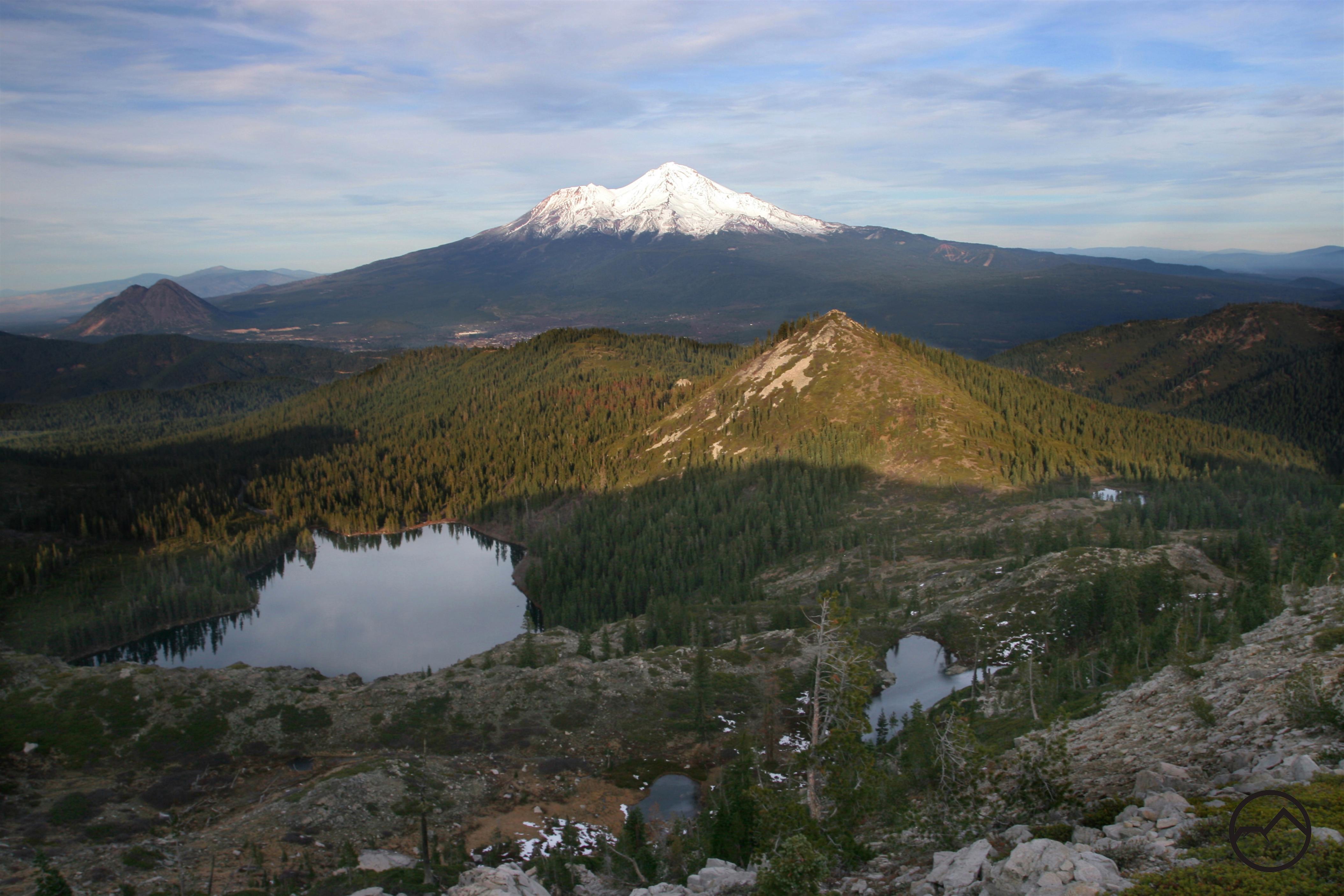
Sunset from the Castle Lake Basin.

Despite being home to three small lakes and a handful of even smaller tarns, Mount Shasta is not a great destination when it comes to trails leading to lakes. Fortunately, the nearby Trinity Divide boasts over 40 named lakes and numerous small, unnamed lakes and ponds. When looking up at the Divide from Mount Shasta City, it is not obvious to the common observer that these mountains contain several spectacular basins. Yet they are there and most of the best hikes in the Trinity Divide lead to glittering lakes set in steep walled cirques. Though there are many lakes and most of them are quite scenic, there are a few that set themselves apart with exceptional scenery. Naturally, these lake basins constitute essential elements of some of the most scenic trails in the Trinity Divide.

This ranking is for lake basins, not individual lakes. There are many, solitary lakes that are incredibly beautiful but did not make the list because of their lonely nature.

5. Gray Rock Lakes Basin

427141 copy (Custom)

Looking down on the Gray Rock Lakes.

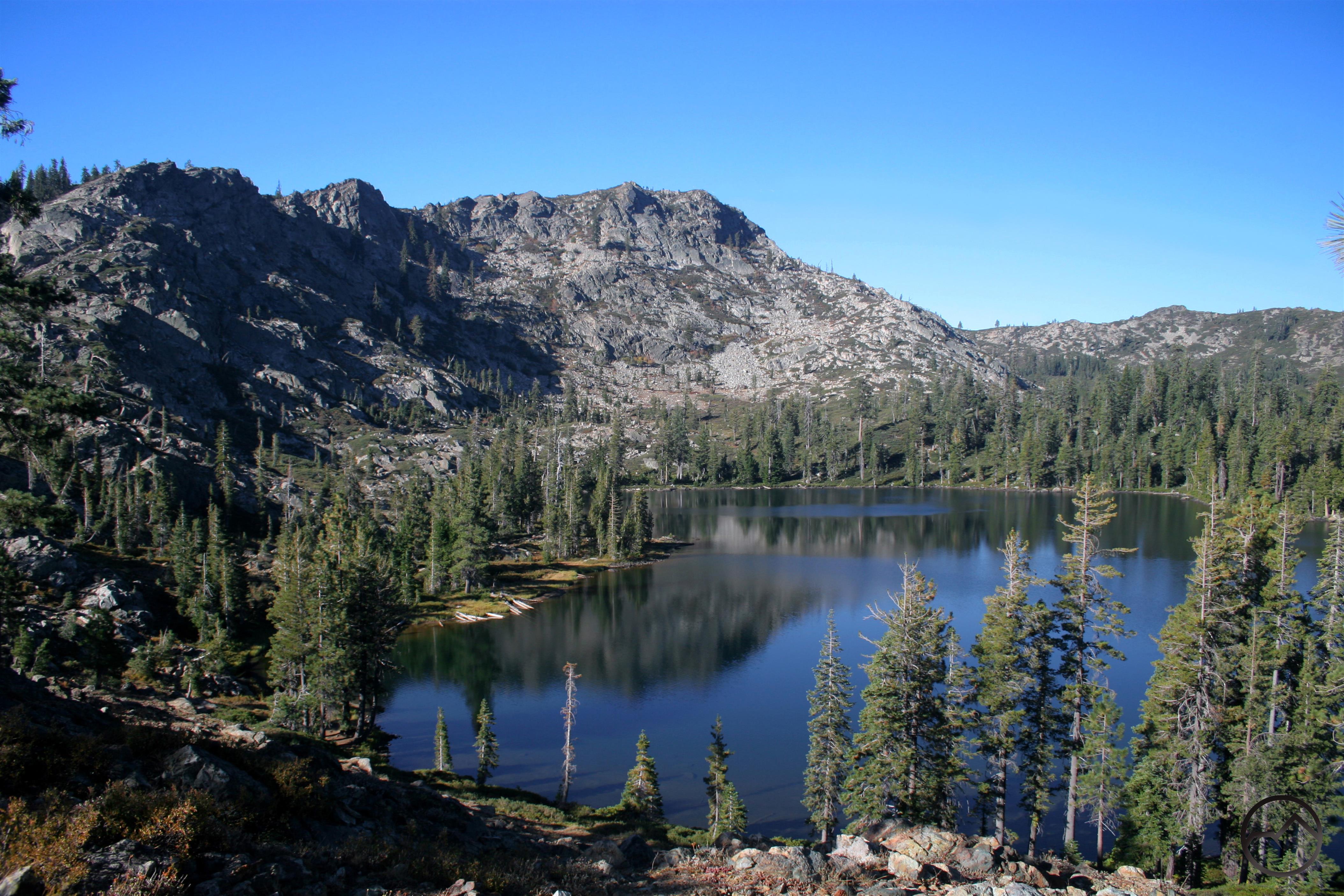
The only lake basin in the Castle Crags Wilderness, the Gray Rock Lakes are a collection of classic alpine lakes. Consisting of three primary lakes, Gray Rock Lake, Upper Gray Rock Lake and Timber Lake, this relatively lightly used area makes a fantastic day hike or an easy overnighter. Gray Rock Lake, the largest of the group, is set against a series of cliffs and has excellent campsites along its north shore. The view of Gray Rock Dome from the lake’s west shore is great. Higher up is Upper Gray Rock Lake, the prettiest lake in the basin. It has all the features of Gray Rock Lake but arranged in a tighter yet taller way, making the overall setting more impressive. Nearby Timber Lake has a lush meadow at its northern end and is backed by a sheer cliff rising out of the water. A few unnamed tarns are scattered throughout the basin, including one high up in the rocky cliffs near the summit of Harry Watkins, the highest peak in the Castle Crags Wilderness. The Gray Rock Lakes Basin is accessed by way of a short, easy trail that is slung on slopes high above Gray Rock Creek. The basin is lightly used because the road is rough and the basin receives surprisingly little notoriety, considering how close to Mount Shasta City it is.

4. Cliff Lake Basin

Trinity Divide, Cliff Lake - July2011 015 copy (Custom)

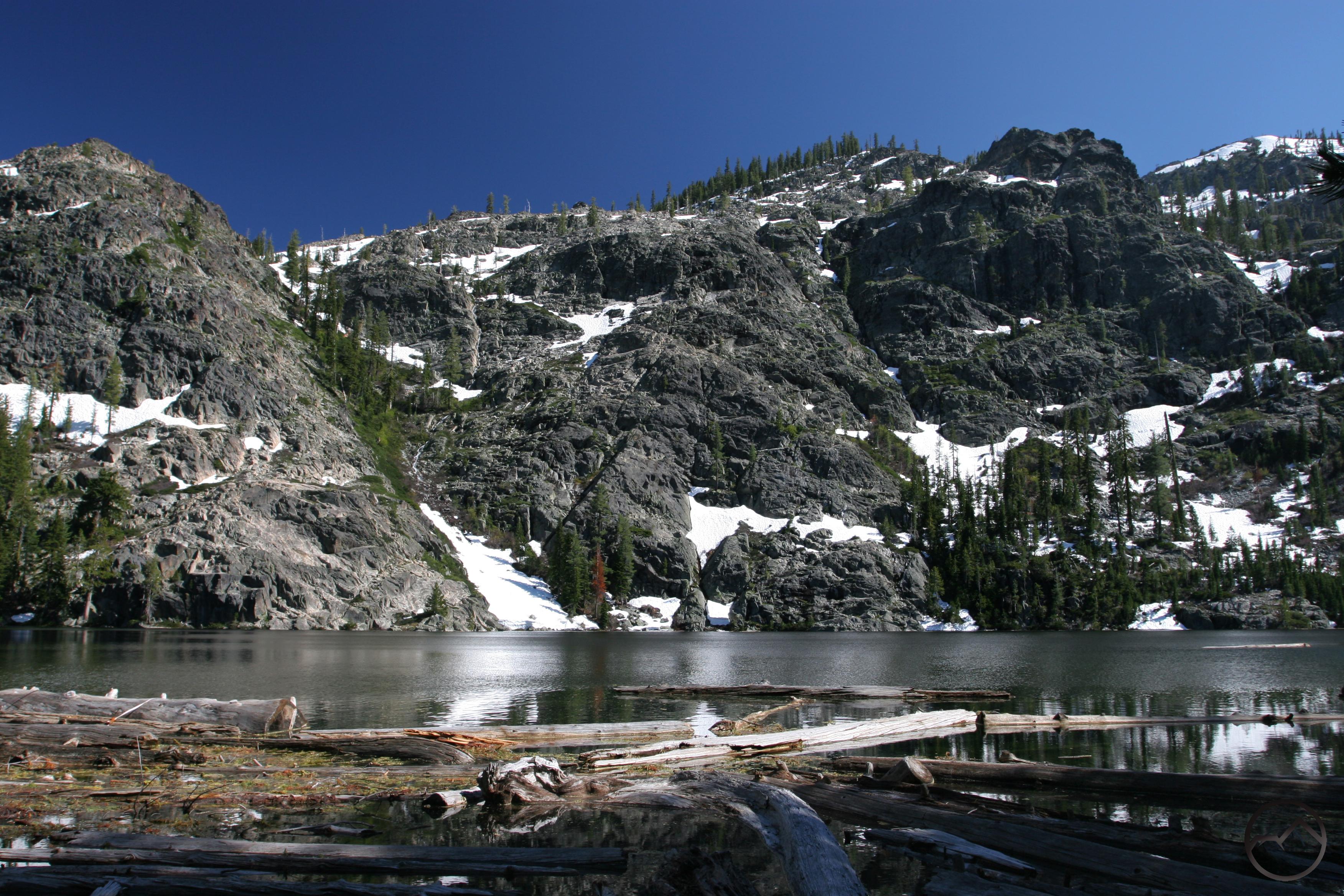
Cliff Lake.

The immensity of the Cliff Lake Basin is difficult to appreciate unless standing on the summit of Many Lakes Mountain. From there one can see how high the cliffs above Cliff Lake are and how broad the basin really is. In spite of the basin’s size, standing at Cliff Lake’s shore can still take on an almost claustrophobic feeling, due in large measure to the imposing rock wall that towers above the lake. There are five named lakes in the basin as well as numerous unnamed lakes set against the basin’s sheer walls. As one approaches, Cedar Lake is the first lake encountered, though it is not particularly inspiring and is surpassed by Lower Cliff Lake, itself, a fairly mundane affair compared to the incredible sights just a short distance to the south. Cliff Lake itself is an amazing body of water with 1,500 foot walls soaring out of the lake’s south shore. Upper Cliff Lake is hidden hundreds of feet overhead in a narrow rock basin. Surprising Terrace Lake is in a secondary basin just east of Cliff Lake. Though in a somewhat separated valley, Terrace Lake and its two subsidiary tarns are still in the greater Cliff Lake basin. Cliff Lake is truly one of the finest lakes in Northern California. It is less well known in part because a portion of the lake is privately owned. In addition, there is not a normal trail leading to the lake but an extremely rough road.

3. Tamarack Lake Basin

Tamarack Lake.

Tamarack Lake.

Located at the southern end of the Trinity Divide, Tamarack Lake is an exceptional alpine pool. Backed by a massive cliff soaring hundreds of feet over the lake, it is a spectacular location. One of the larger lakes in the Trinity Divide, it sees surprisingly little use, a surprise given the beauty of the area. In addition to the stunning setting, Tamarack Lake’s beauty is enhanced by a series of small meadows that are scattered along the lake’s shore. The basin would rank high on Tamarack Lake’s merits alone but it is also home to the Twin Lakes. Both are very attractive but Upper Twin Lake is a first rate destination in its own right and would deserve consideration on its own strength even if Tamarack Lake was not found in the same basin. Not only is it deeper than its twin, Upper Twin Lake is highlighted by the same set of cliffs that rise above Tamarack Lake. Lower Twin Lake lacks the dramatic cliffs of its sibling but it is still a very scenic body of water. In addition to the three main lakes, there are a few unnamed tarns dotting rocky benches in the cliffs above Tamarack Lake. There is also a rather large and surprisingly scenic unnamed lake just north of Tamarack Lake. The basins southern position in the Trinity Divide means it receives fairly low use. Most who travel there are locals who are willing to endure the long, bumpy drive into the lake. They usually bypass the Twin Lakes entirely.

2. Deadfall Lake Basin

Trinity Divide, Mt. Eddy - Oct2008 006 (Custom)

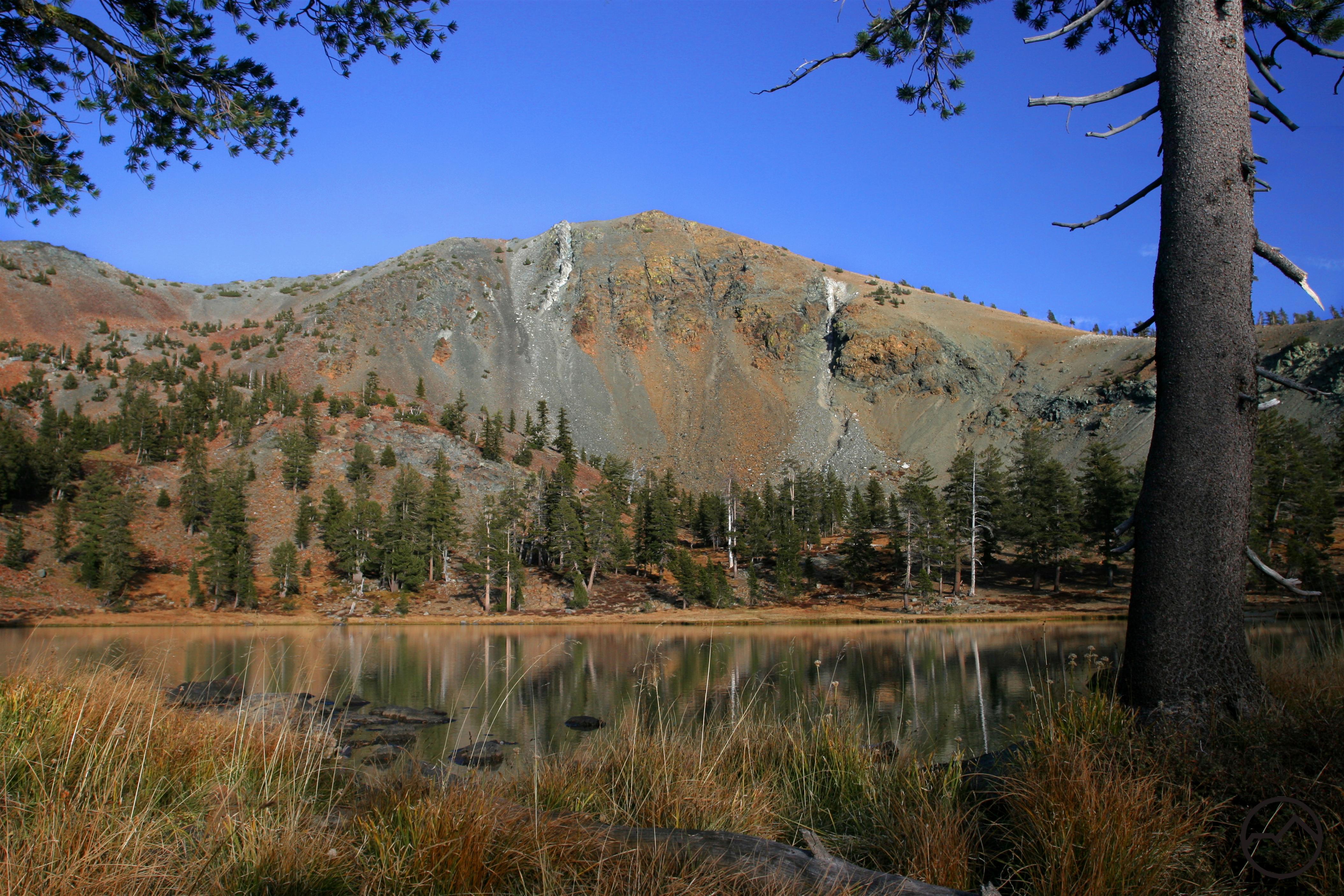
Upper Deadfall Lake.

One of the most beautiful spots in the Mount Shasta area, the Deadfall Basin is an excellent collection of emerald lakes set in a large red bowl on Mount Eddy’s western flank. The basin is populated by Lower, Middle and Upper Deadfall Lakes as well as a handful of small tarns, some of which are surprisingly large, deep and attractive. Lower Deadfall Lake is situated at the bottom of a large talus slope which is traversed by the Pacific Crest Trail. A little higher up in the basin is Middle Deadfall Lake, one of the largest lakes in the Trinity Divide. Encompassing 25 acres, the lake is backed by the tall rim of Deadfall Basin. Seated at the upper end of the basin is Upper Deadfall Lake. Though the smallest of the three lakes, it is by far the prettiest. Rimmed with meadow, the lake abuts the rocky slopes of the basin’s north wall. Soaring overhead is the pyramidal summit of Mount Eddy, rising to a point 1,200 feet overhead. Behind the lake is a small, spring-fed meadow with a creek lazily meandering through the verdant swale. Exploring the small tarns scattered throughout the basin reveals some hidden gems, especially the one hidden in the cliffs high above Upper Deadfall Lake. The best view of the basin comes from the summit of Mount Eddy, where all the lakes can be observed as well as some of the tarns. Of course, the summit of Mount Eddy is the finest vista in northern California and takes in much of the real estate between Southern Oregon and the northern Sierra Nevada.

1. Castle Lake Basin

Trinity Divide, Castle Lake - Aug2008 001 copy (Custom)

Castle Lake.

It probably comes as no surprise that Castle Lake is the best lake basin in the Mount Shasta area. Blessed (or cursed, as some may have it) with a paved road all the way to the lake, it is easy to reach and very, very popular. Of course, the lake is popular for a host of good reasons. Castle Lake is the largest in the Trinity Divide and among the largest in the entire Klamath Mountains. Only massive Caribou Lake in the Trinity Alps and impressive Ukonom Lake in the Marble Mountains are larger. The sapphire waters in Castle Lake are exceptionally pure. The University of California, Davis has established a limnological research station at the lake to monitor the water’s purity. Of course, the size and the water quality are not what causes the lake to rank so high. The bottom line is it is simply spectacular. The craggy cliff of Castle Peak’s north face emerges from the water and soars nearly 1,200 feet to the summit of the mountain. The sheer wall behind the massive lake is an amazing sight. In the spring, the sound of numerous waterfalls can be heard as runoff from the thaw cascades down into the lake. Of course, one can not discuss the Castle Lake Basin without mentioning diminutive Heart Lake. The small lake is tucked onto a bench high in the cliffs above Castle Lake. With an adjacent meadow and small tarn as neighbors, Heart Lake is an incredibly scenic spot. However, it is the lake’s breathtaking view of Mount Shasta that elevates it to one of the most tremendous locations in the region. Heart Lake is among the few lakes (though not the only one) that has a great view of Mount Shasta. Of course, one can follow the Heart Lake Trail to the summit of Castle Peak for an even more expansive view that takes in most of the Trinity Divide, Mount McLoughlin in Southern Oregon and stretching south to Lassen Peak. It has a particularly impressive view of the Castle Crags. All of this scenic firepower, combined with easy access, makes the Castle Lake Basin an extremely popular spot. In spite of this, it is still a magnificent place. Yet those looking for solitude can still find it here and should not let the popularity deter them from enjoying this incredible spot.
Mount Shasta Area Waterfalls: Sacramento River Waterfalls

Posted by bubbasuess on September 27, 2013
Posted in: Hiking, Mount Shasta, Rivers, Trinity Divide, Waterfalls. Tagged: Box Canyon, Hedge Creek Falls, Mossbrae Falls, Mount Shasta, Sacramento River. 9 Comments

Cascades, Harmony Weekend - Nov06 051 (Custom)

Mossbrae Falls

The Sacramento River, California’s longest and largest waterway, begins in the Trinity Divide just west of Mount Shasta. With the exception of the impoundment at Lake Siskiyou, it is a wild, surging river that races over numerous rapids and through deep canyons and narrow gorges. However, unlike its nearby tributary the McCloud River, the Sacramento does not go over any major waterfalls. Where the McCloud has its trio fantastic cataracts, the Sacramento only has a seemingly endless succession of rapids. Yet, what the river itself lacks in plunges, it makes up for in waterfalls pouring into the river and on tributaries just above the Sacramento. These falls lack the volume of those on the McCloud because it is not the river itself going over the precipice. Though they lack thundering power, the waterfalls along the Sacramento River make up for in unusual geology, unique settings and outright grace and beauty. None of the waterfalls along the Sacramento require difficult hikes, though they are all reached via unconnected trails. Nonetheless, they are fairly close together and for those in search of falling water, the Sacramento’s waterfalls make for an excellent afternoon.
Mossbrae Falls

Harmony Weekend - Nov06 053 copy (Custom)

Mossbrae Falls.

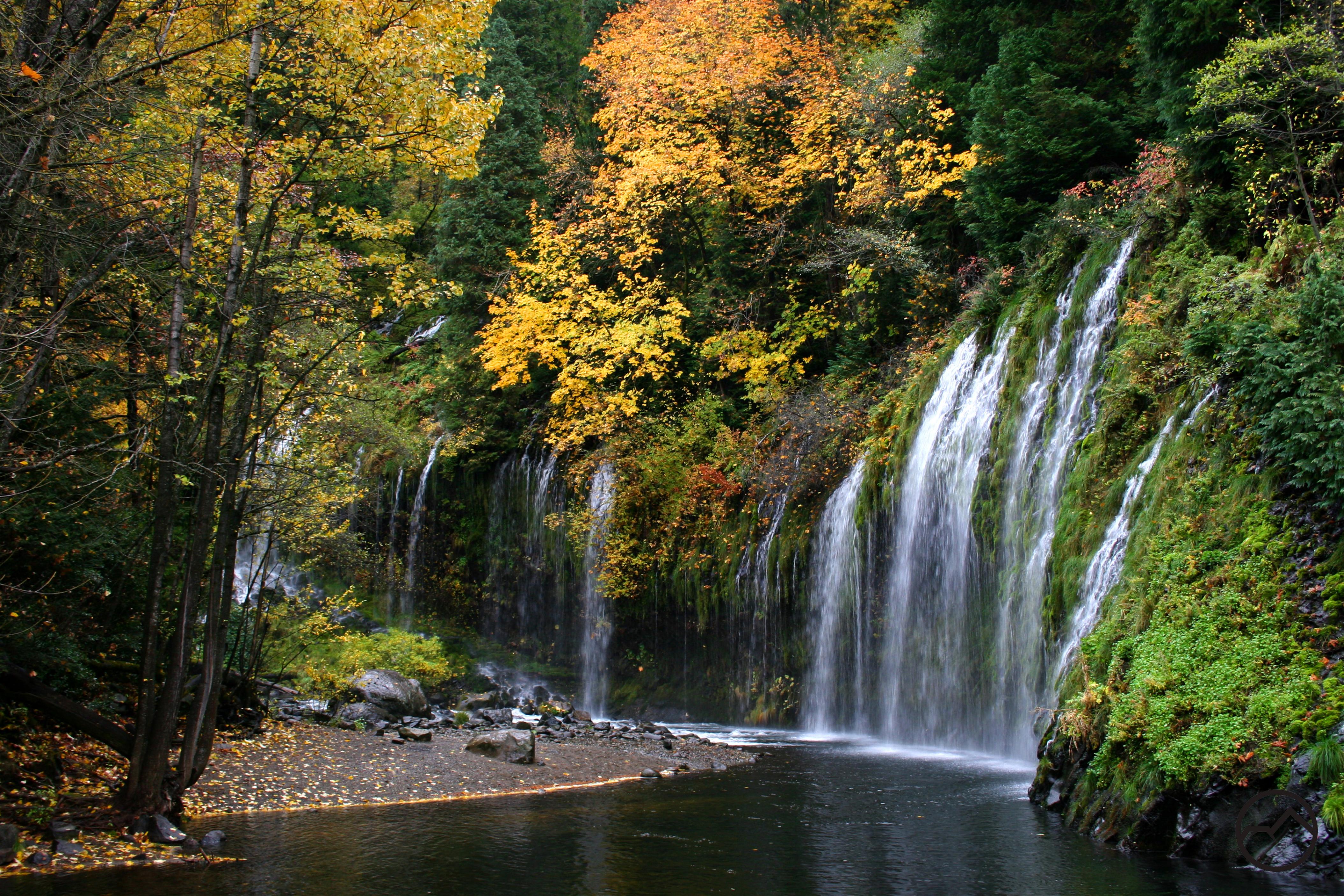
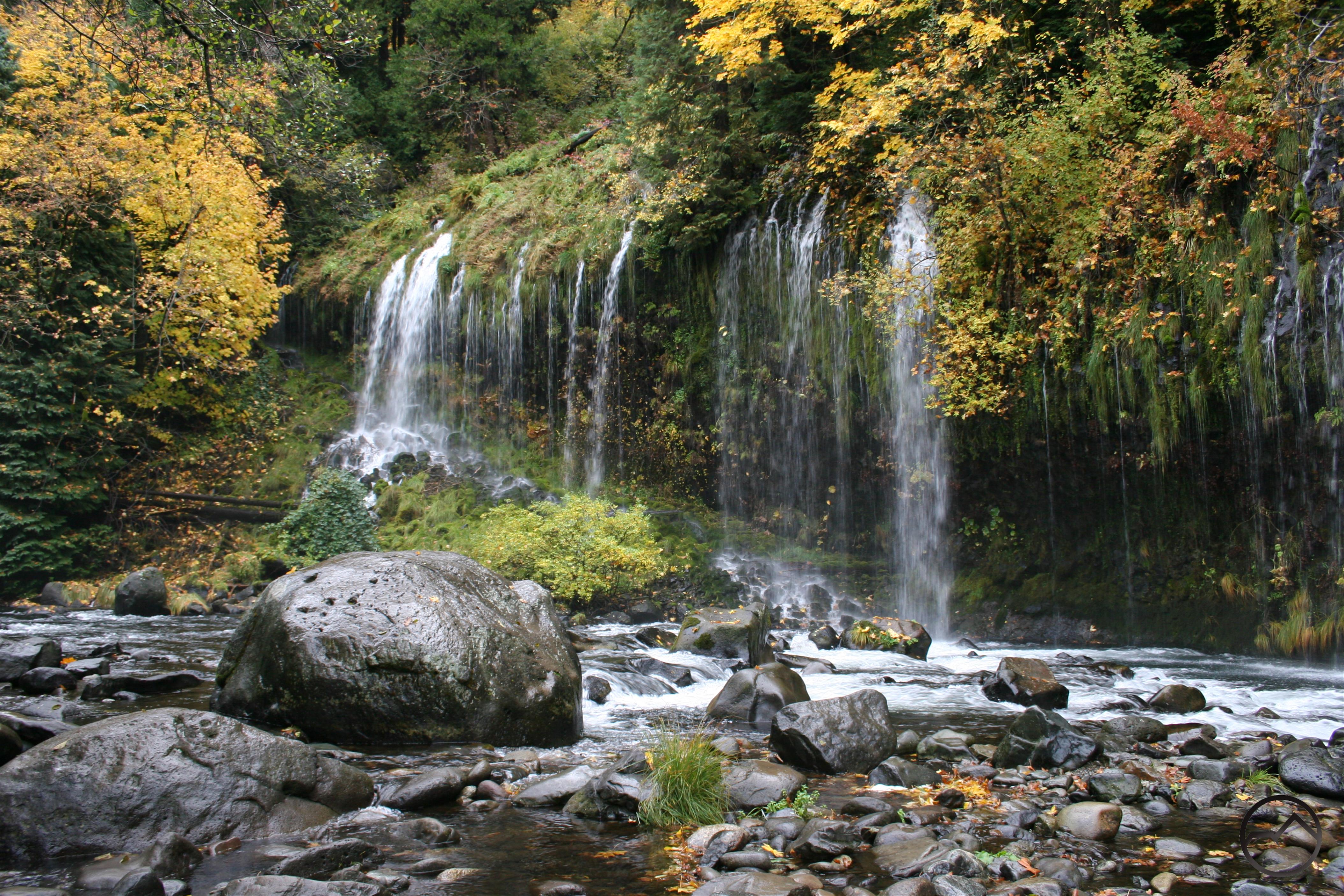
The undisputed monarch of the waterfalls along the Sacramento, Mossbrae Falls is actually a series of springs that burst from the cliffs above the river and then rain down in a glorious cacophony into the water as it flow swiftly by. Though the spring complex is large and small flows can be spotted on the approach to the falls, Mossbrae Falls is composed of two primary clusters of spring-fed waterfalls. These are arranged around an elbow in the river, which gives the falls a sense of depth and complexity that are absent in many other waterfalls. The presence of the river beneath the falls enhances the scene and makes for one of the prettiest sights in the Mount Shasta area. Since the source of Mossbrae Falls are numerous springs, the falls do not flag later in the season like many other waterfalls do. Consequently they are great year-round. The best time to enjoy the falls is in the fall, when the foliage has changed color, making the canyon around the waterfall a glorious explosion of golds and oranges contrasted against the green of the Sacramento River Canyon.

If there is a drawback to Mossbrae Falls, it is access. To reach the falls it is necessary to hike along the railroad tracks that are tucked onto a narrow bench against cliffs above the Sacramento River. Though this was common practice for decades and the falls were a popular destination, this is no longer the case. The Union Pacific blocked off access to the parking area a few years ago, making it difficult to find parking near the tracks. To make the journey now, one must find creative ways to park or be prepared to hike a much longer distance from parking places in Dunsmuir. There has been talk about building a bridge across the Sacramento River and linking to the trail that leads to Hedge Creek Falls. For a time there was a fair amount of momentum for this solution but it seems to have flagged recently. If this vision did come to fruition, the trail would make for an incredibly scenic hike.

Hedge Creek Falls

Cascades, Hedge Creek Falls - March2013 053_edited-1 (Custom)

Hedge Creek Falls.

Located right off of I-5, Hedge Creek Falls is the most easily accessed waterfall in the Mount Shasta area. A slender and graceful waterfall, its best flow is in the spring and early spring, though it usually flows year-round. A classic plunge waterfall, Hedge Creek Falls is about 30 feet high and shoots through a narrow, rocky gorge just before pouring over the edge. The most interesting feature about Hedge Creek Falls is the columnar basalt cliff Hedge Creek goes over. The basalt columns resemble those famously found at Devil’s Postpile in the Sierra Nevada, near Yosemite. Rock climbers have developed routes along the cracks in the basalt. The cliff’s real distinctive is the hollow at its bottom. The basalt columns stop about 10 feet short of the ground, leaving something of a cave at the bottom. The Hedge Creek Falls Trail passes through the cave, allowing hikers to view the falls from behind. Though this is the highlight of the trip down the falls, the trail continues a little further to a great vista of Mount Shasta and the Sacramento River. Along the way, the trail passes a few smaller cataracts along Hedge Creek.

Sweetbriar Falls

Sweetbriar Falls

Sweetbriar Falls

This small waterfall is easily accessed in the small community of Sweetbriar, which straddles the Sacramento River just south of Castella. The fall’s watershed is small, originating on Girard Ridge and only flowing a short distance. Nonetheless, it maintains a decent flow much of the year. The creek flows under a road and then plunges over a short cliff before dropping down a series of cascades into the Sacramento River. The cliff, which vaguely resembles a columnar basalt formation, has blocky outcroppings that cause the creek to dance and deviate as it drops. At about 20 feet high, it is not a spectacular waterfall but it is a pleasant and refreshing sight nonetheless. Be sure to park in the wide parking area on the west side of the railroad tracks to avoid trespassing on private property. From there, walk east, cross over the Sacramento River and then turn right onto a very short trail that leads to the falls. A wooden bridge crosses the creek just below the falls and leads to a nice vantage point of both falls and river.

Other Waterfalls Along The Sacramento River

Trinity Divide, Box Canyon - Jan2012 044 copy

Falls inside the Box Canyon.

There are a few other waterfalls along the Sacramento River. One area that is almost completely overlooked are the waterfalls that pour down the side of the Box Canyon of the Sacramento River. There are two notable waterfalls in the Box Canyon. However, their location along the cliffs of the gorge makes them much more compelling waterfalls. The larger of the two falls is best seen near the beginning of the Box Canyon Trail, along the large rock covered embankment. The other waterfall is best seen by climbing the via ferrata route down into the canyon and heading to the east along the narrow strip of land next to the river. There the falls tumble down the rock wall into the water of the Sacramento River. The falls, though attractive, are part of an overall setting including the river and the sheer, narrow cliffs that is quite impressive.

New Snow On Mount Shasta

Posted by bubbasuess on September 24, 2013
Posted in: Hiking, Mount Shasta, Mount Shasta History, Wilderness. 2 Comments
Cascades, Mt. Shasta - Sept2013 022 copy (Custom)

A new layer of snow blankets Mount Shasta.

In a post back in July I documented how the low snow level from the previous winter had resulted in an increasingly bare Mount Shasta. As the summer progressed the snow continued to dwindle until there were just a few meager patches on the mountain’s west side, the only side that hosts no glaciers. Seeing this side of the mountain without much snow on it is not unusual but it was disconcerting to see that it was just a matter of a week or so before there would be nothing left at all. The last few days we have gotten some rain and as a result our once naked mountain now has a beautiful white mantle of snow on it once again. This seems to have been the best possible combination of conditions. The snow covers most of the mountains’ barren volcanic rock but not quite low enough to make the other mountains around Mount Shasta, particularly in the Trinity Divide, inaccessible. The result is that now is a great time to hike the high country and have a chance to see a snowy mountain once again (assuming the skies are clear, of course). Given the lateness of the season and the already cooling temperatures, it is possible that this new level of snow won’t melt off completely and the mountain will retain some of its icy dignity.

It is interesting to compare the snow levels with the same date in years past. Even though 2013 was the lightest year in the last few years, the mountain has more snow on it now than it did in the heavy years.

2013

2012

2011

2010

If one desires to hike on Mount Shasta right now, the best bet is to head to the Horse Camp Trail. The mountain is covered in snow high above but the snow around Horse Camp is light enough that it makes for easy hiking. These are ideal conditions for this hike. With the seasons changing and the opportunities to enjoy the high country growing fewer, this is a great opportunity to enjoy a hike in the Mount Shasta area.

Cascades, Mt. Shasta - Sept2013 005 copy (Custom)

Fresh snow on Mount Shasta.

Great Scott! Two Scott Mountains Hikes On The PCT

Posted by bubbasuess on September 14, 2013
Posted in: Hiking, Klamath Mountains, Lakes, Meadows, Mount Shasta, Pacific Crest Trail, Scott Mountains. Tagged: Bluff Lake, Bull Lake, Kangaroo Lake, Mount Shasta, Pacific Crest Trail, Scott Mountains, Trinity River. 2 Comments
680815 copy (Custom)

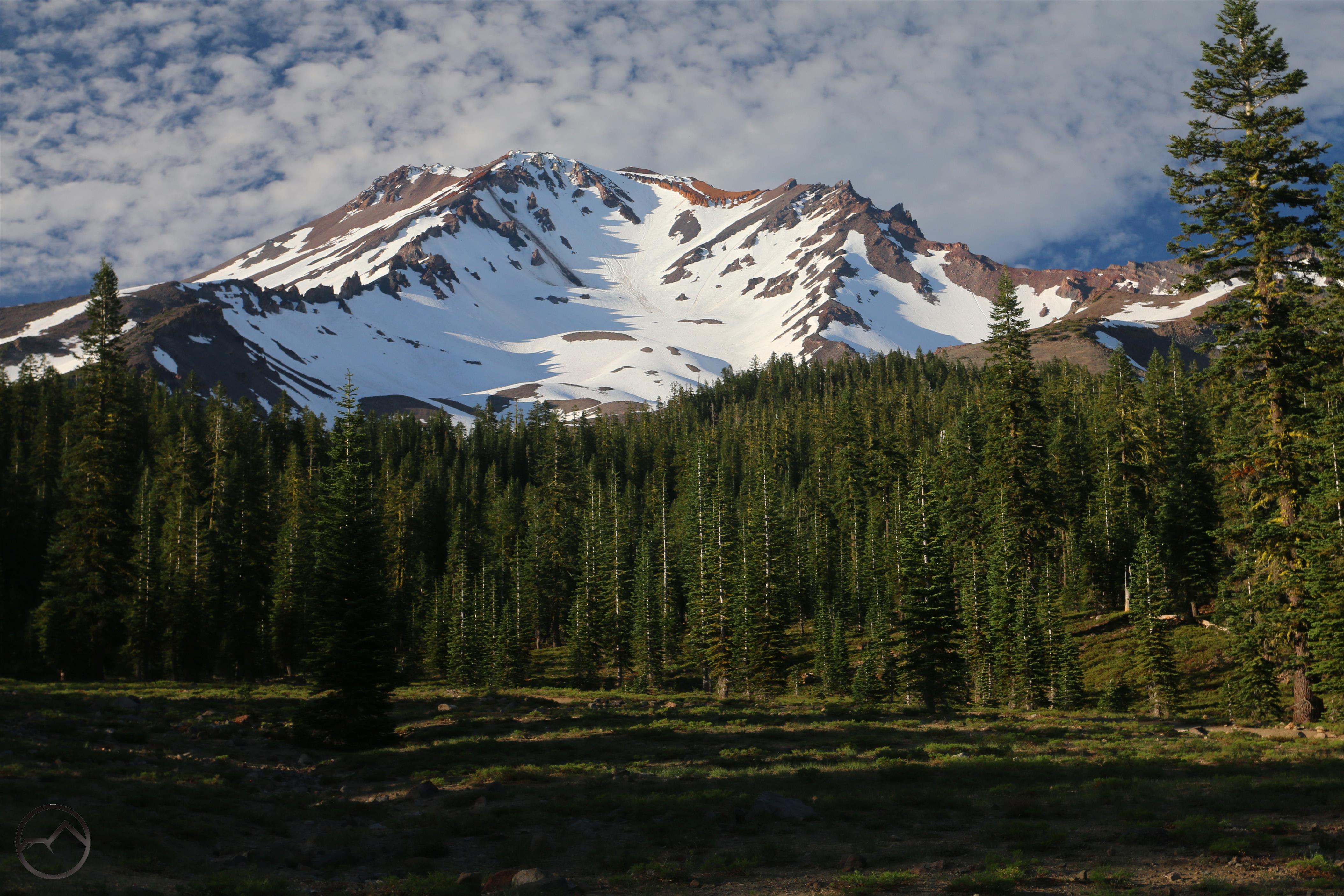
Mount Shasta, Trinity Divide and Scott Mountains from Cory Peak.

Despite being blessed with rugged peaks, unusual but scenic geology, a fine compliment of lakes and meadows and relatively easy access, the Scott Mountains remain one of the lesser known ranges in the Mount Shasta region. The reasons for the range’s obscurity are many, but chief among them are simply being overwhelmed be the presence of Mount Shasta. Add to that the great beauty of the nearby Trinity Divide and the Divide’s exceptionally easy access from I-5 and it is easy to understand how an entire mountain range could go unnoticed. Adding insult to injury, some of the finest portions of the Scotts, located in the mountains’ western half, were added to the Trinity Alps Wilderness, causing many to (understandably) associate them more with that giant wilderness area than with the Scott Mountains as a whole. Even though the Scotts have suffered the indignation of being broken up and overshadowed by the glory of Mount Shasta (really, what isn’t?), the mountains still beckon to hikers. Those in search of alpine beauty and solitude will find these things in the Scott Mountains.

Scott Mountains, Bluff Lake - August2013 066 copy (Custom)

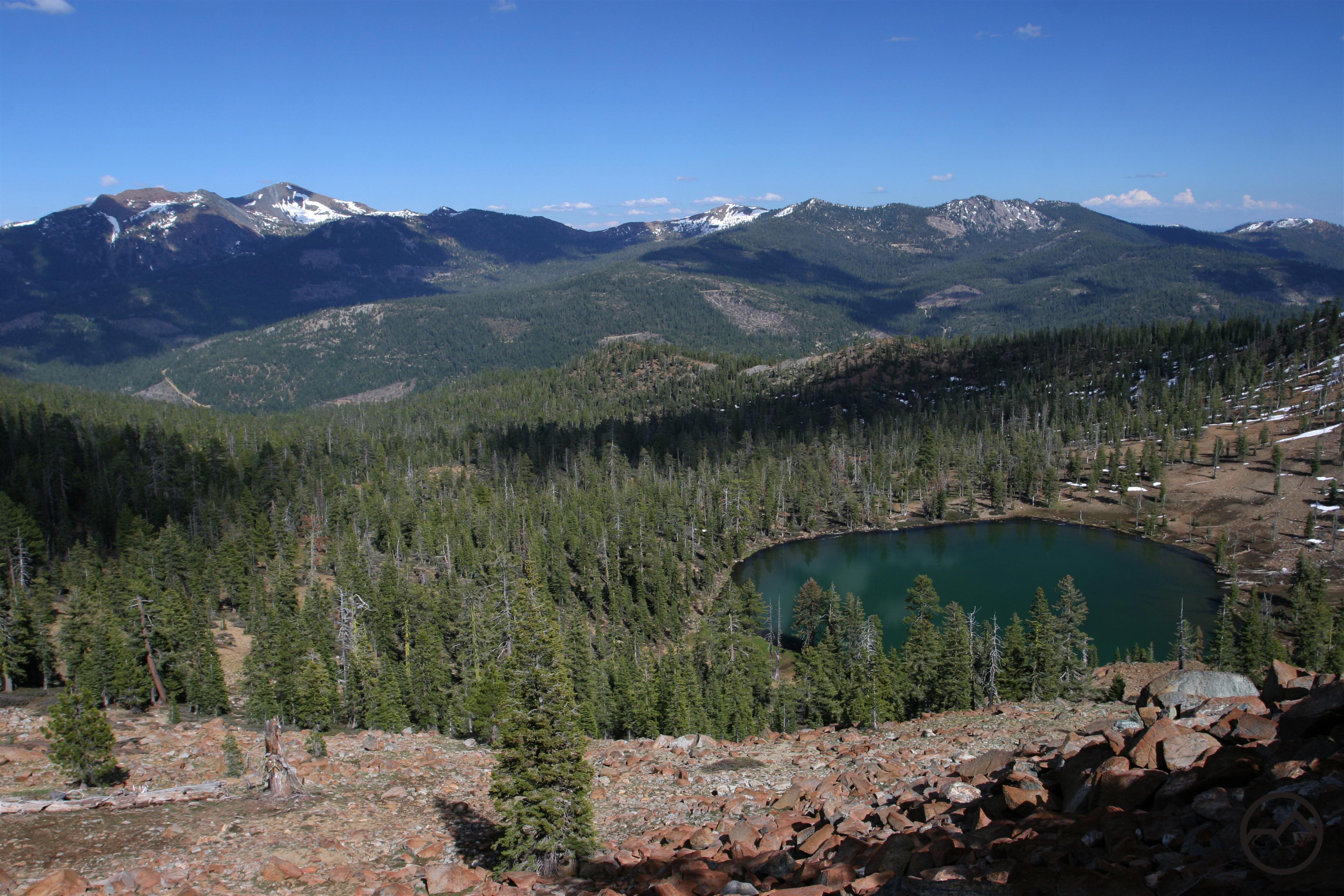
Bluff Lake and High Camp Basin.

The Pacific Crest Trail winds over 100 miles through the mountains to the south and west of magnificent Mount Shasta. While much of the trail passes through remote country with difficult access, a significant amount of the PCT is used by hikers and backpackers on shorter journeys than the one undertaken by through-hikers (those traveling the PCT’s entire length from Mexico to Canada). This is particularly true of the PCT as it passes through the Trinity Divide. Many of the most popular hikes in that area, such as the Deadfall Lakes, the Seven Lakes Basin and Porcupine Lake are all reached via scenic hikes on the PCT. The same potential exists in the Scott Mountains but surprisingly few hikers take advantage of this excellent opportunity. In particular, two sections of the PCT offer wonderfully scenic hikes to two fine lakes. With easier access from Mount Shasta, Bluff Lake is small but very attractive and has the bizarre Cement Bluff looming overhead. In contrast, Bull Lake is nestled in a shallow, barren basin but is much larger than Bluff Lake. Both sections of the PCT are also complimented with great scenery for the duration of the hike, including excellent views, meadows, small tarns, and the ubiquitous red cliffs that are the hallmark of the Scott Mountains. These two segments of the PCT are reached by paved roads, making access incredibly easy.

In spite of the aforementioned causes for the Scott Mountain’s obscurity, it is still a surprise that they continue to go unrecognized by hikers. Perhaps the reason for this is the paucity of developed trails aside from the PCT. What few developed routes there are receive little maintenance and some have faded away entirely. No hikes in the Scott Mountains are mentioned in hiking guide books, burying them deeper in anonymity. Still, they are too beautiful mountains, too unusual and too easily accessed not to be taken advantage of. Hikers who do will enjoy the beautiful lakes, meadows and cliffs alone, seldom intruded upon by others on the trail.

Bluff Lake

Scott Mountains, Bluff Lake - August2013 088 copy (Custom)

Cement Bluff and Bluff Lake.

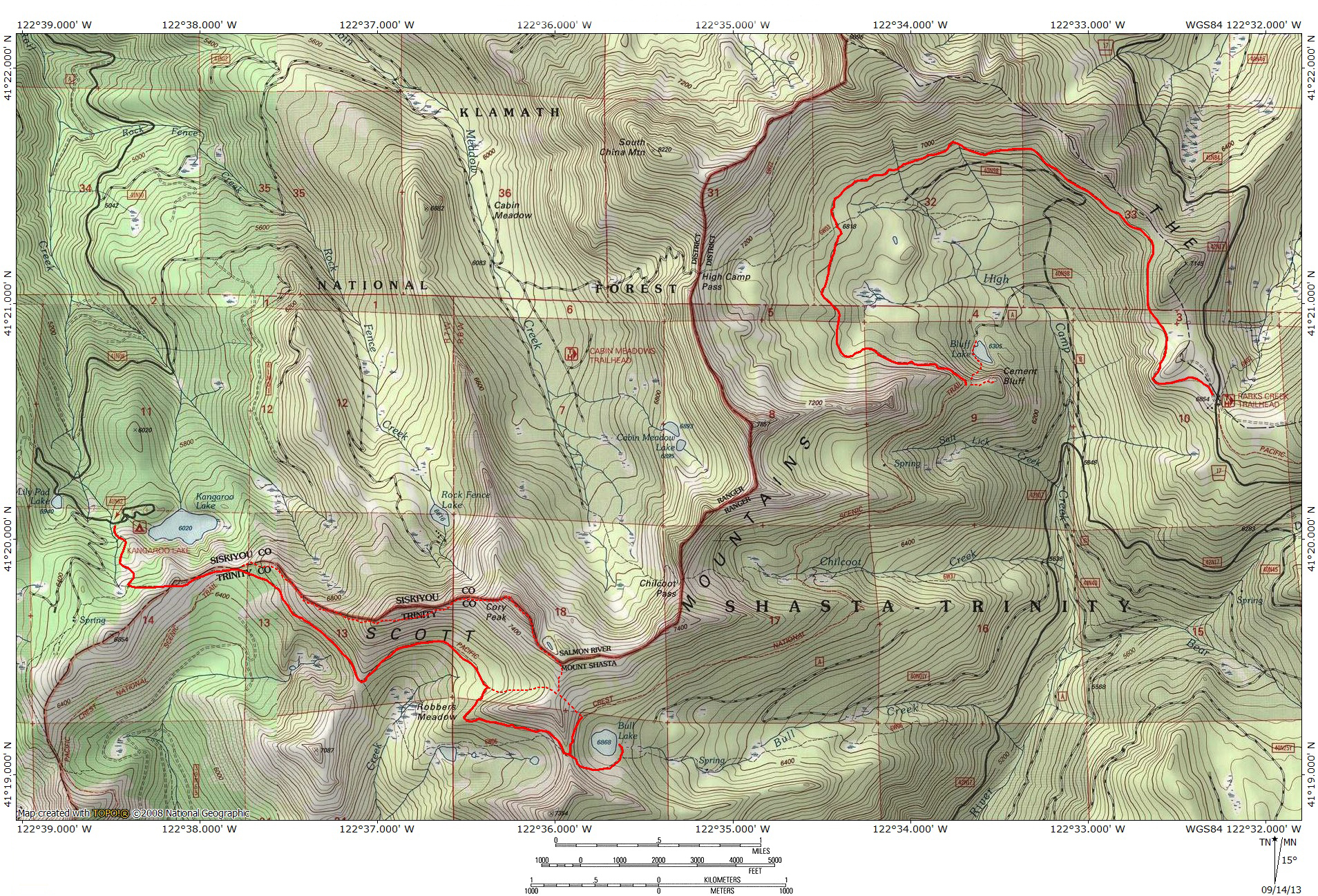
The hike on the PCT to Bluff Lake is as scenic as it is easy. The trail maintains a level course for 4.5 miles as it makes a nearly complete encirclement of remote High Camp Basin. The basin is the northernmost headwaters of the Trinity River and is surrounded by peaks over 8,000 feet and high cliffs composed of stark, red peridotite. The trail initially traverses along a cliff high above the east side of the basin. Views to the west, particularly of rugged High Camp Peak are great. The unusual formation known as the Cement Bluff stands out against the dense forest. Soon the terrain levels out as the PCT rounds to the north side of the basin, beneath China Mountain and South China Mountain. Eventually passing through park-like forests with swaths of meadow, the trail continues to round the basin as it heads to the west side. Here tall cliffs rise high above and Mount Shasta and Mount Eddy are visible to the southeast. Near the end the path passes onto a bright red talus slope, winding its way through large boulders. Great views of Shasta and Eddy are combined with an expansive view of High Camp Basin. Finally the PCT reaches a side trail that leads to the top of the Cement Bluff. There are great views of Mount Eddy and High Camp basin from the summit. Steep use trails lead down to small, meadow fringed Bluff Lake. The view of the unusual, aggregate laden cliff of the Cement Bluff from the north shore of Bluff Lake is not to be missed.

Bull Lake

680824 copy (Custom)

Bull Lake.

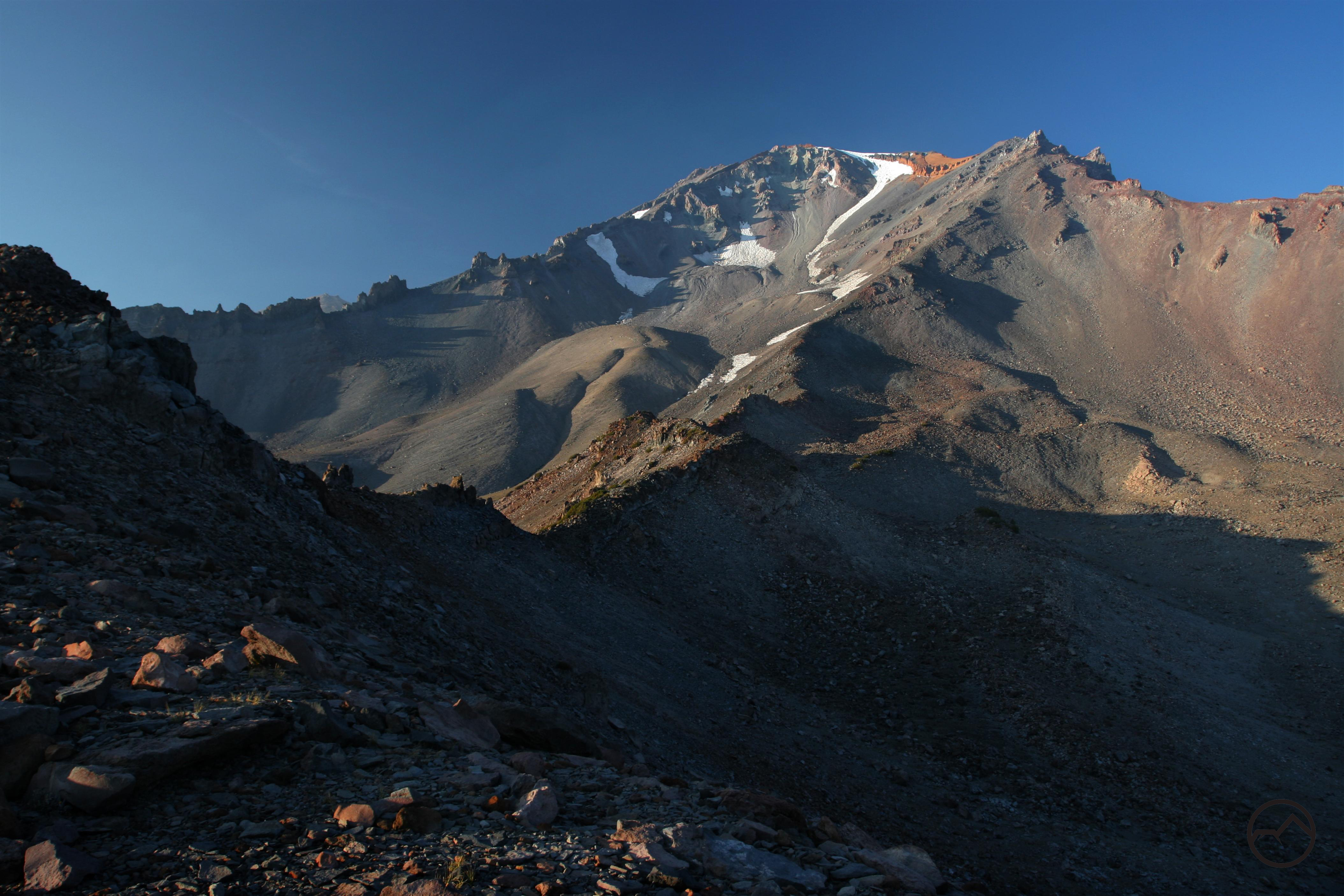
The trip to Bull Lake begins at Kangaroo Lake, the largest body of water in the eastern half of the Scott Mountains. To reach the PCT, one must first climb up the Kangaroo Fen Trail, a short route ascends the cliffs on the west side of the lake. It surmounts the crest of the Scott Mountains and drops a short distance down to the PCT on the range’s south side. The climb takes hikers from the Scott River watershed into the Trinity River watershed. Once on the PCT, it traverses across a small basin with ponds and meadows down below before crossing into Robber Basin, a large bowl that is home to expansive Robber Meadow and small, hidden Robber Lake. Views of the Trinity Alps to the southwest are great. The PCT then crosses a large, red scree field before rounding a broad ridge and entering the basin that is home to large Bull Lake. The area surrounding the lake is surprisingly barren. The highlight of the hike, for those eager for a challenge, is the climb to the summit of Cory Peak and the small tarn near the summit. The small turquoise lake is set against bright red rock, just below the summit of the rugged peak. The view from the top is incredible, taking in Mount Shasta, the Trinity Divide, the Scott Mountains, Russian Mountains, Marble Mountains and the jagged Trinity Alps.

Scott Moutains

Two Trails From Bunny Flat

Posted by bubbasuess on September 7, 2013
Posted in: Hiking, Mount Shasta, Wilderness. Tagged: Avalanche Gulch, Bunny Flat, Everitt Memorial Highway, Green Butte Ridge, Horse Camp, Mount Shasta. 13 Comments

Mount Shasta at Bunny Flat.

Of the nine hiking trails on Mount Shasta, five of them begin on the Everitt Memorial Highway, the only paved road that climbs the giant volcano. The highway climbs high enough to reach just below treeline at the Old Ski Bowl. As documented here, three of the trails set out from this area. The other two trails begin at a site called Bunny Flat, which is 3 miles before the road’s end and 900 feet lower. With great views to the south and the immense bulk of Mount Shasta towering overhead, it is an exceptionally scenic location. The great scenery is not limited to the trailhead at Bunny Flat. The Horse Camp and Green Butte Ridge Trails, climb up the mountain from the trailhead and explore extremely scenic areas on the volcano. The Horse Camp Trail leads to the Shasta Alpine Lodge, which is owned by the Sierra Club. From there, several destinations await, including beautifully barren Hidden Valley. In contrast, the Green Butte Ridge Trail is a straight-forward ascent up a ridge to its namesake butte. Interestingly, these are possibly the best and least-known trails on Mount Shasta. Despite how many people may or may not use the trails, both are worthy hikes that access tremendous scenery.

Cascades, Mt Shasta, Green Butte Ridge - Sept2012 043 (Custom)

Mount Shasta glows above Green Butte Ridge.

One great feature of the two trails setting out from Bunny Flat is the opportunity to combine them into a fantastic loop through Mount Shasta’s epic high country. The loop’s destination is the summit of Green Butte, one of the five color-themed buttes that surround the mountain (the others being Black, Red, Gray and Yellow Buttes). Though the Green Butte Ridge Trail is a straight, steady ascent of the ridge that leads to the butte, the Horse Camp Trail can also be used to access the peak. For those interested in making the loop, it is advisable to make the ascent via the Horse Camp Trail and then descend via the Green Butte Ridge Trail. This means that the extremely pleasant and scenic hiking through Avalanche Gulch is enjoyed earlier in the journey. The grade is also more moderate as it is stretched out over greater distance. The steep ascent of Green Butte Ridge is reversed and is much more manageable as a descent. Of course, it must be noted that much of this loop, especially the connecting scramble from Avalanche Gulch to Green Butte Ridge is cross country and should only be attempted by those prepared to meet the challenges.

Horse Camp Trail

Cascades, Mt Shasta, Horse Camp - Nov2012 011 (Custom)

Looking toward the summit from Avalanche Gulch.

It is possible that the view of the Shasta Alpine Lodge and the mountain towering behind it may be among the most iconic images of Mount Shasta. The lodge is located at Horse Camp, near treeline at 7,900 feet. After departing Bunny Flat, the majority of the 1.6 miles to the lodge pass through forest canopy. The best views, such as they are, are of the Trinity Alps far to the west. Once at the lodge, the forest thins and the ground is covered by wildflowers. A gurgling fountain of water piped in from a spring highlights this restful setting. Beyond Horse Camp there are four good options for hikers looking for a longer journey. Perhaps the best option is the climb up to Hidden Valley. A route also climbs up to Lake Helen but this option is better done with snow on the ground. Those looking for a real mystery can hunt for the hidden spring deep in Avalanche Gulch. The final option, and among the best, is to continue on to Green Butte. Whichever option hikers pursue, the immensity of Avalanche Gulch is an impressive sight.


Green Butte Ridge Trail

Cascades, Mt Shasta, Green Butte Ridge - Sept2012 081 (Custom)

Alpenglow on Mount Shasta, from Green Butte Ridge.

Making a beeline up steep Green Butte Ridge, the Green Butte Ridge Trail is a quick ticket to Mount Shasta’s secluded backcountry waiting above the treeline. Climbing through dense forest initially, the trail eventually breaks out of the forest and onto a rocky ridge with fantastic views in all directions. Although the trail eventually fades away, the route is obvious and easy to follow. During the climb there are rare views of Sun Bowl and Powder Bowl, popular destinations for backcountry skiing during the winter. From here, hikers must continue up the ridge toward a prominent point that has truly exceptional views. From there it is an easy scramble down a narrow neck to the top of Green Butte. Marked by evidence of repeated lighting strikes, it is an amazing summit in its own right, boasting still more incredible views. Particularly inspiring are the views of Sargents Ridge and the Old Ski Bowl.


Posts navigation

← Older Entries
Newer Entries →
    • Recent Posts

      • Winter Shows Up When It Will
      • January Rolled By With Mud, Then Very Dry
      • Mount Shasta 2025 – A Year In Images
      • Mount Shasta On Either Side Of Christmas
      • Adrift In An Ocean Of Fog
      • December Has Been Spectacular Thus Far Pt. II (A Magnificent Lenticular)
      • December Has Been Spectacular Thus Far Pt. I
      • Lenticular Interrupted
      • A Stormy Wave And A Truchas Sunset
      • Aurora Lenticularis
    • Enter your email address to follow Hike Mt Shasta and receive notifications of new posts by email.

    • Archives

      • February 2026
      • January 2026
      • December 2025
      • November 2025
      • October 2025
      • September 2025
      • August 2025
      • July 2025
      • June 2025
      • May 2025
      • April 2025
      • March 2025
      • February 2025
      • January 2025
      • December 2024
      • November 2024
      • October 2024
      • September 2024
      • August 2024
      • July 2024
      • June 2024
      • May 2024
      • April 2024
      • March 2024
      • February 2024
      • January 2024
      • December 2023
      • November 2023
      • October 2023
      • September 2023
      • August 2023
      • July 2023
      • June 2023
      • May 2023
      • April 2023
      • March 2023
      • February 2023
      • January 2023
      • December 2022
      • November 2022
      • October 2022
      • September 2022
      • August 2022
      • July 2022
      • June 2022
      • May 2022
      • April 2022
      • March 2022
      • February 2022
      • January 2022
      • December 2021
      • November 2021
      • October 2021
      • September 2021
      • August 2021
      • June 2021
      • May 2021
      • April 2021
      • March 2021
      • February 2021
      • January 2021
      • December 2020
      • November 2020
      • October 2020
      • September 2020
      • August 2020
      • July 2020
      • June 2020
      • May 2020
      • April 2020
      • March 2020
      • February 2020
      • January 2020
      • December 2019
      • November 2019
      • October 2019
      • September 2019
      • August 2019
      • July 2019
      • June 2019
      • May 2019
      • April 2019
      • March 2019
      • February 2019
      • January 2019
      • December 2018
      • November 2018
      • October 2018
      • September 2018
      • August 2018
      • July 2018
      • June 2018
      • May 2018
      • April 2018
      • March 2018
      • February 2018
      • January 2018
      • December 2017
      • November 2017
      • October 2017
      • September 2017
      • August 2017
      • July 2017
      • June 2017
      • May 2017
      • April 2017
      • March 2017
      • February 2017
      • January 2017
      • December 2016
      • November 2016
      • September 2016
      • August 2016
      • July 2016
      • June 2016
      • May 2016
      • April 2016
      • March 2016
      • February 2016
      • January 2016
      • December 2015
      • November 2015
      • September 2015
      • August 2015
      • July 2015
      • June 2015
      • May 2015
      • April 2015
      • March 2015
      • February 2015
      • January 2015
      • December 2014
      • November 2014
      • July 2014
      • June 2014
      • May 2014
      • April 2014
      • March 2014
      • February 2014
      • January 2014
      • December 2013
      • November 2013
      • October 2013
      • September 2013
      • August 2013
      • July 2013
      • June 2013
      • May 2013
      • April 2013
      • March 2013
      • February 2013
      • January 2013
    • Categories

      • Boy Scouts
      • Cascade Range
      • Castle Crags
      • Desert
      • Echo Point
      • Glaciers
      • Hiking
      • How things came to be…
      • Klamath Mountains
      • Konwakiton Outdoor Designs
      • Lakes
      • Lenticular Clouds
      • Maps
      • Marble Mountains
      • Meadows
      • Mount Eddy
      • Mount Shasta
      • Mount Shasta History
      • Napa County
      • Off Season Trails
      • Pacific Crest Trail
      • Peaks
      • Rivers
      • Rock Climbing
      • Scott Mountains
      • Seldom Seen
      • Shasta Valley
      • Sierra Nevada
      • Siskiyou Mountains
      • Sonoma County
      • Spring Trails
      • sunrise
      • sunset
      • Trinity Alps
      • Trinity Divide
      • Truchas Ridge
      • Uncategorized
      • Water
      • Waterfalls
      • Wilderness
      • Wildflowers
      • Wine Country
      • Winter Trails
      • Yosemite
    • Meta

      • Create account
      • Log in
      • Entries feed
      • Comments feed
      • WordPress.com
    • Copyright © 2013-2024 by Bubba Suess

      DISCLAIMER: Any use of the information contained in this site by any and all persons is done at their own risk. The operator of this site shall be held harmless from any and all alleged claims, demands, causes of action, liability, loss, damage and/or injury to property or persons whether brought by an individual or other entity. This indemnification applies, without limitation, to all actions by an individual or other entity as a result of their use of information contained in this site.

    Blog at WordPress.com.
    Hike Mt. Shasta
    Blog at WordPress.com.
    • Subscribe Subscribed
      • Hike Mt. Shasta
      • Join 985 other subscribers
      • Already have a WordPress.com account? Log in now.
      • Hike Mt. Shasta
      • Subscribe Subscribed
      • Sign up
      • Log in
      • Report this content
      • View site in Reader
      • Manage subscriptions
      • Collapse this bar
     

    Loading Comments...