Hike Mt. Shasta

Exploring the Mount Shasta Region

  • Home
  • Trails
    • Mount Shasta Trails
      • Brewer Creek Trail
      • Clear Creek Trail
      • Gray Butte Trail
      • Green Butte Ridge Trail
      • Horse Camp Trail
      • North Gate Trail
      • Old Ski Bowl Trail
      • Panther Meadow Trail
      • South Gate/Squaw Meadow Trail
      • Whitney Falls Trail
    • Trinity Divide Trails
      • Blue Divide Trail
      • Castle Lake Trail
      • Castle Lake Shore Trail
      • Cliff Lake Trail
      • Deadfall Lakes Trail
      • Gray Rock Lakes Trail
      • Gumboot Trail
      • Heart Lake Trail
      • Porcupine & Toad Lakes Via Pacific Crest Trail
      • Seven Lakes Basin Via Pacific Crest Trail
      • Sisson-Callahan Trail
      • Soapstone Trail
      • South Mumbo Scramble
      • Tamarack Lake Trail
      • Toad Lake Trail
    • Castle Crags Trails
      • Burstarse Falls Via Pacific Crest Trail
      • Castle Dome Trail
      • Flume Trail
      • Lower Castle Crags Via Pacific Crest Trail
      • Root Creek Trail
    • Scott Mountains Trails
      • Bluff Lake & Cement Bluff via Pacific Crest Trail
      • Caldwell Lakes Trail
      • China Mountain Scramble
      • Cory Peak and Bull Lake via Pacific Crest Trail
    • Cascade Crest
      • Ash Creek Butte Scramble
      • Goosenest Trail
      • Juanita Lake Trail
      • Orr Lake Trail
    • Mount Shasta City Area Trails
      • Black Butte Trail
      • Box Canyon Trail
      • Gateway Trail
      • Lake Siskiyou Trail
      • Mount Shasta City Short Trails
      • Ney Springs Canyon Trail
      • Spring Hill Trail
    • Shasta Valley Trails
      • Black Lava Trail
      • Haystack Trail
      • Lake Shastina Trail
      • Pluto Cave Trail
      • Trout Lake Trail
      • Yellow Butte Trail
    • Sacramento River Trails
      • Dunsmuir Trail
      • Hedge Creek Falls Trail
      • Sacramento River Trail
      • Sims History Trail
    • McCloud River Trails
      • Ash Camp To Ah-Di-Na Via Pacific Crest Trail
      • McCloud River Falls Trail
      • McCloud River Preserve Trail
      • Squaw Valley Creek Trail
      • McCloud River Trail: Algoma Camp to Nitwit Camp
      • McCloud River Trail: Nitwit Camp to Cattle Camp Swimming Hole
      • McCloud River Trail: Cattle Camp Swimming Hole to Camp 4
      • McCloud River Trail: Camp 4 to Upper McCloud Falls
      • McCloud River Trail: Pine Tree Hollow Loop
    • Trails Further Afield
      • Trinity Alps Trails
        • Bear Lakes Trail
        • Billys Peak Trail
        • Boulder Creek Lakes Trail
        • Boulder Lake Trail
        • Canyon Creek Trail
        • Caribou Lakes Trail
        • East Boulder Lake Loop
        • East Weaver Lake Trail
        • Four Lakes Loop
        • Granite Peak Trail
        • Grizzly Creek Trail
        • Gulch Lakes Loop
        • Hidden Lake Trail
        • South Fork Lakes Trail
        • Stoddard Lake Trail
        • Stoney Ridge Trail
        • Tangle Blue Lake Trail
      • Warner Mountains
        • Emerson Creek Trail
        • Highgrade Trail
        • Patterson Lake Via Warner Summit Trail
        • Pine Creek Trail
        • Squaw Peak Trail
  • Articles
    • Trails By Area
      • Mount Shasta
        • Vistas, Meadows And Waterfalls: Three Best Hikes On Mount Shasta
        • The End Of The Road: Three Hikes In The Old Ski Bowl Area
        • Two Trails From Bunny Flat
        • Three Trails On Mount Shasta’s East Side
        • Mount Shasta’s Hummingbirds
      • Trinity Divide
        • Great Lakes: Top Five Lake Basins In The Trinity Divide
        • The Headwaters Of The South Fork Of The Sacramento River
        • Neglected Headwaters: Two Lesser Lake Basins On The South Fork
        • Gumboot Saddle: Two Hikes On The PCT
        • Descent Into Mystery: The Sisson-Callahan Trail
        • Mumbo Basin – Overlooked On The West Side
        • The Headwaters Loop: A Proposed Backpacking Loop In The Trinity Divide
      • The McCloud River
        • The McCloud River Trail
      • Shasta Valley
        • Jewels In The Desert
      • Scott Mountains
        • Great Scott! Two Scott Mountains Hikes On The PCT
      • Trinity Alps
        • Carubou Lakes: Trinity Alps On A Grand Scale
        • Switchbacks To Heaven: The Trinity Alps’ Stoney Ridge Trail and Four Lakes Loop
        • Trinities In Proximity: Two Trinity Alps Trails With Easy Access From Mount Shasta
        • Trails in the Carter Meadows Area
        • Trinity Alps Views of Mount Shasta
        • The Psychological Value Of The Trinity Alps
    • Waterfalls
      • Three Waterfalls On Mount Shasta
      • McCloud River Waterfalls
      • Sacramento River Waterfalls
      • Trinity Divide Waterfalls
      • Trinity Alps Waterfalls
      • Avoiding A Dry Whitney Falls
    • Off Season Trails
      • Three Winter Hikes Near Mount Shasta City
      • Winter Hikes In Shasta Valley
      • Winter Hiking In The Shasta Valley Wildlife Refuge
      • Winter Hikes On The Sacramento River
      • Winter Hikes On The Lake Siskiyou Trail
      • Spring Hikes In The Castle Crags
      • Spring Hikes On the Upper McCloud
      • Spring Hikes On The Lower McCloud River
    • Points Of Interest
      • Mount Eddy: Overshadowed, Underrated
      • Black Butte: Hiding In Plain Sight
      • Castle Dome: Steadfast And Staggering
      • Mount Shasta Hoodoos
      • Sacramento Scrambling
      • The Shasta River
      • The Castle Creek Watershed
      • Mount Shasta East Side Glacier View
      • 5 Fantastic Mount Shasta Vistas
      • 5 Highest Peaks Around Mount Shasta
      • 5 Best Hikes On Creeks And Rivers
      • 5 Interesting Footbridges
      • Three Spectacular Drive-To Sunset Vistas
    • North State Geography
      • Introduction
      • Seven Major Regions
      • The California Cascades
      • Klamath Mountains Pt. I
      • Klamath Mountains Pt. II
      • The Great Canyons Of Mount Shasta
      • Mount Shasta, Timberline, And The Relative Size Of Cascade Volcanos
      • Four Eruption Cones Of Mount Shasta
      • Mount Shasta’s Medial Moraine
    • Northern California Review
      • North Table Mountain
      • Lakes Basin Recreation Area
      • Eastern Sierra Fall Color
      • Sonoma County
      • Central Sierra Nevada
      • Orland Buttes
    • Seldom Seen
      • Ash Creek Falls
      • Mud Creek Canyon
      • Lower Mud Creek Canyon
      • Diller Canyon
      • Lower Cascade Gulch
      • The Grey Rocks
      • Castle Creek
      • Upper Wagon Creek
      • Fawn Creek Canyon
      • Confluence of the Sacramento River and Castle Creek
      • Upper Klamath River Canyon
      • Hole In The Ground Geologic Area
      • Ash Creek Butte Fossil Rock Glacier
    • Mount Shasta History
      • Vantage Lost: The Everitt Memorial Vista
      • A Yosemite-Mount Shasta Connection
      • Whitney – What’s In A Name?
      • Mount Shasta Area and the 1838 Exploring Expedition
      • A 19th Century Engraving Of An Epic Mount Shasta Vista
      • Vintage 1907 Color Photos
      • A Misleading Painting
      • A Mysterious Painting
      • A Mysterious Painting Pt. II
      • Stereographic Mt. Shasta
      • Year One Of Hike Mt Shasta
      • Year Two Of Hike Mt Shasta
      • Year Three Of Hike Mt Shasta
      • Year Four Of Hike Mt Shasta
      • Year Five Of Hike Mt Shasta
      • Year Six Of Hike Mt Shasta
      • Year Seven Of Hike Mt Shasta
    • Image Galleries
      • Mount Shasta Trails Gallery
      • Mount Shasta Sunrise Gallery
      • Mount Shasta Sunset Gallery
      • Lenticular Cloud Gallery
      • Mount Shasta NON-Lenticular Clouds
      • Mount Shasta Reflection Gallery
      • Telephoto Gallery
      • Mount Shasta Area Fall Color
      • Castle Crags Gallery
      • Waterfalls Gallery
      • Trinity Divide Lakes Gallery
      • Mount Shasta Area Rivers Gallery
      • Shasta High Desert Gallery
      • Mount Shasta GIF Gallery
    • Random Notes
      • Revew: Three Mount Shasta Trail Maps
      • A Mount Eddy Wilderness?
      • New Land Additions For The Castle Crags
      • Book Plug: Mount Shasta Area Rock Climbing
      • Exile: How I Came To Love Wilderness
  • Mt. Shasta Trail Map
  • Blog
  • About/Contact
  • Links
  • Truchas Ridge

Postcard View Of The Castle Crags?

Posted by bubbasuess on August 1, 2017
Posted in: Castle Crags, Hiking, Klamath Mountains, Mount Shasta, Mount Shasta History, Rivers. Tagged: Sacramento River. 5 Comments

The last few years my brother has been bringing his sons’ cross country team from Carmel up here to Mount Shasta in order to train at some higher elevations. My parents come up too and like to grandparent all the runners and make sure that everyone has a good time. Fortunately our guest cabin is large enough to accommodate 20-25 people fairly comfortably. When my parents showed up a couple of days ago in preparation for my brother’s crew’s arrival, my mom produced a little goodie she thought I might be interested in. Now, my mom is an avid thrift shopper (read: addiction) and every now and then she turns up some pretty amazing stuff. One of the more interesting was a 100 year old painting of Mount Shasta (see details here and here). One of her most recent acquisitions was a brand new, unused one of these.

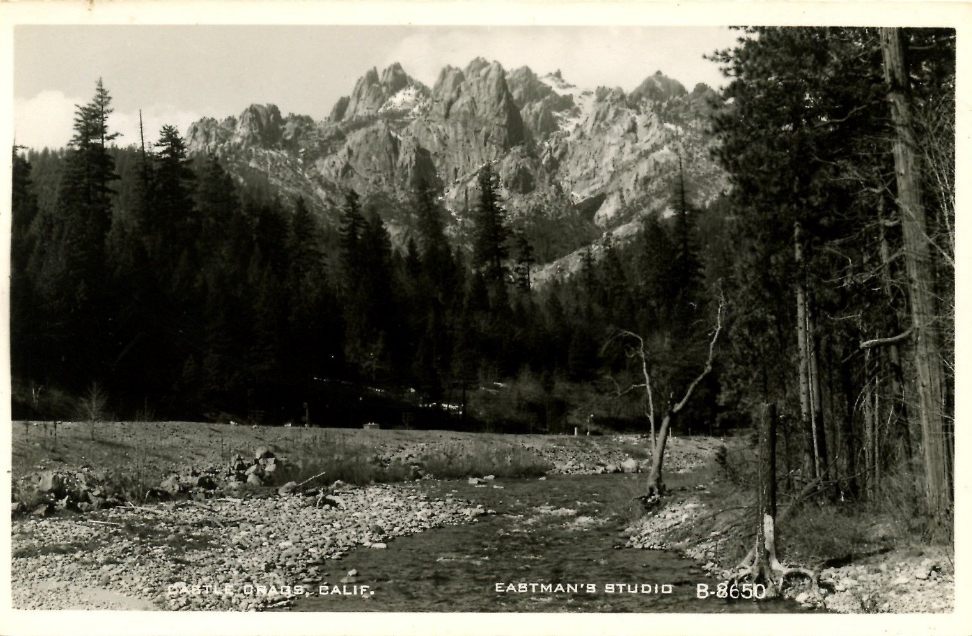
So on this occasion, she handed me a postcard she thought I would be interested in. She was right. The scene on the card was easily recognizable as the Castle Crags and it was a perspective that, while seemingly familiar, was something I had not seen before:

It certainly is a spectacular shot and one that really highlights the rugged nature and massive bulk of the Crags. Set in late fall or winter, the Sacramento River flows around a bend while the Castle Crags loom magnificently in the background. A layer of snow covers the ground, though not the trees. Power lines that run parallel to the railroad tracks can be made out though they are not immediately obvious. Overall, it is a stunning scene, and one that seemingly ought to be more commonly photographed given how impressive it is.

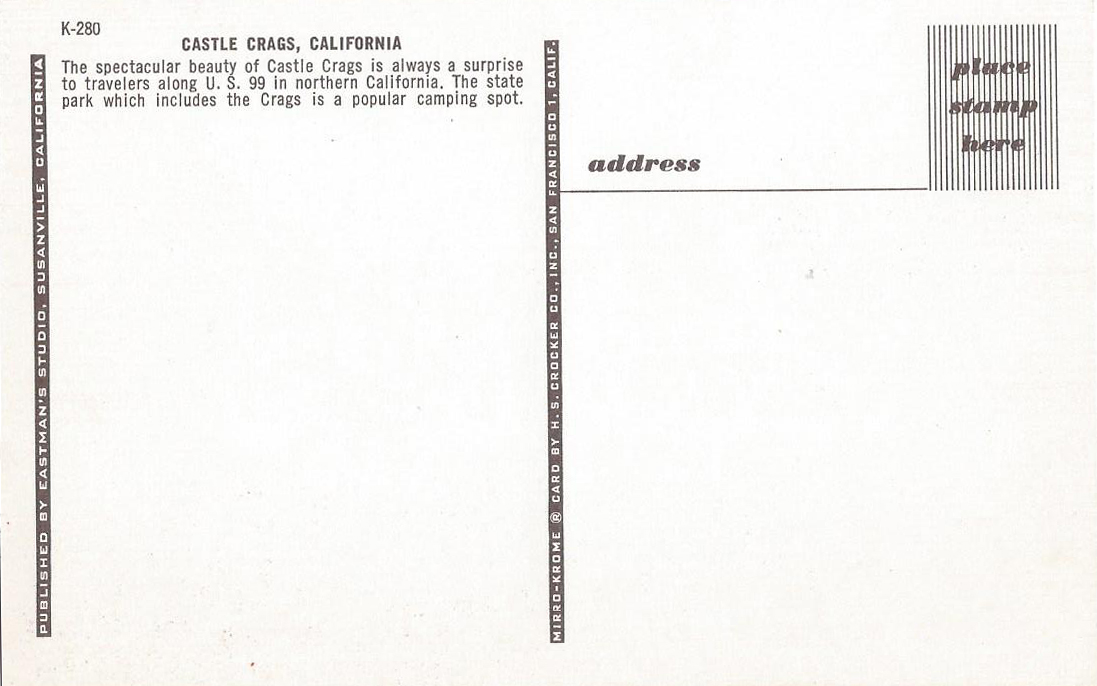
The backside of the postcard notes the Castle Crags and their awesome presence above Highway 99. It further states that travelers on the highway often camp at the state park.

The fact that it refers to Highway 99 rather than Interstate 5 dates this card sometime prior to the mid-1950’s. The mention of Castle Crags State Park dates the card to sometime after 1933, when the park was established. If I had to guess, based on the aesthetics, I would put it somewhere between 1945-1955.

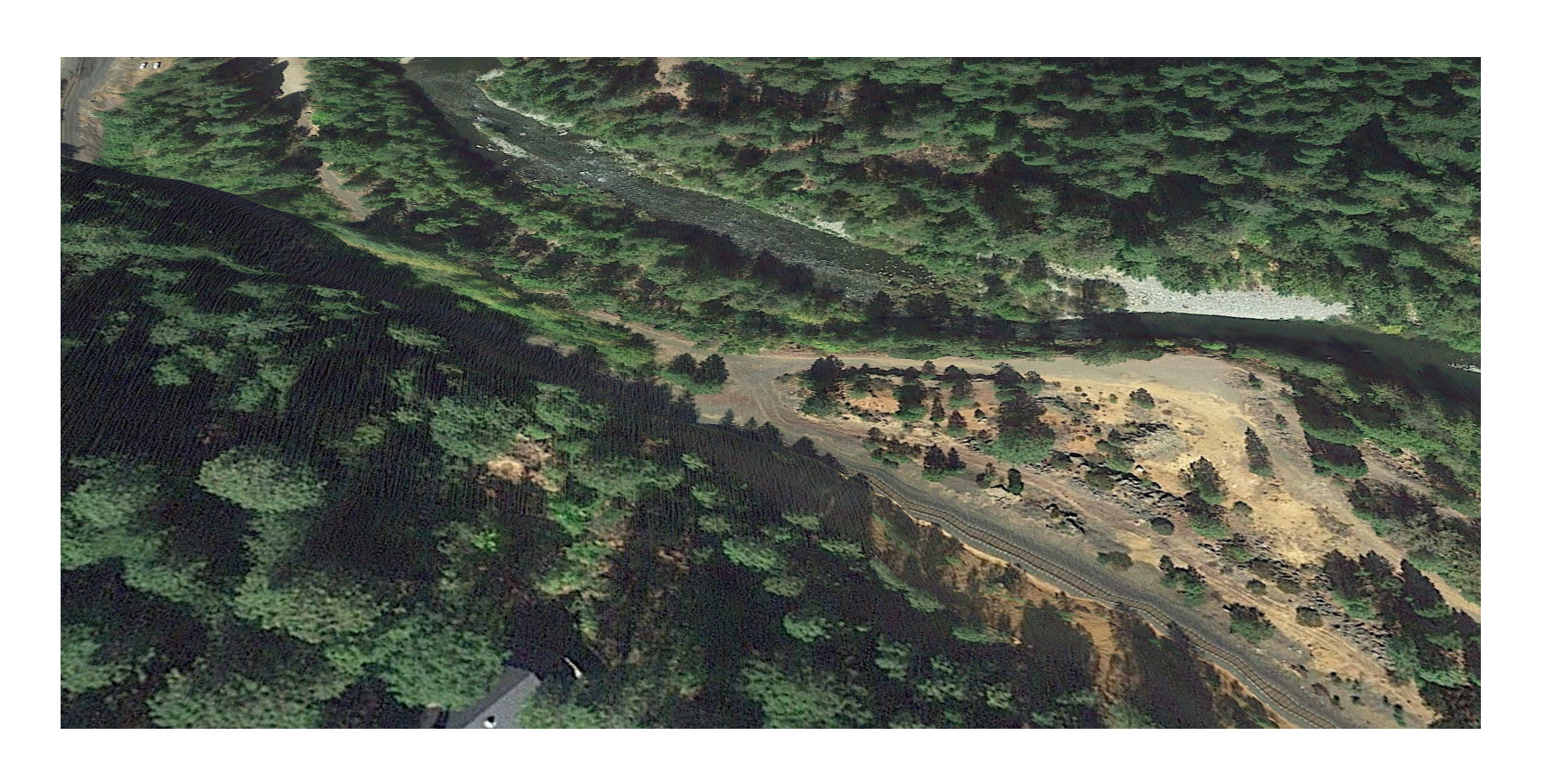
Naturally, with such an astounding view of the Crags, I wanted to locate the spot it was shot from. I figured with the direction of the river’s flow and the presence of the railroad tracks, it would not be too hard to determine where the picture was photographed. I hunted around on Google Earth a little bit before I realized that I had already been to this spot!

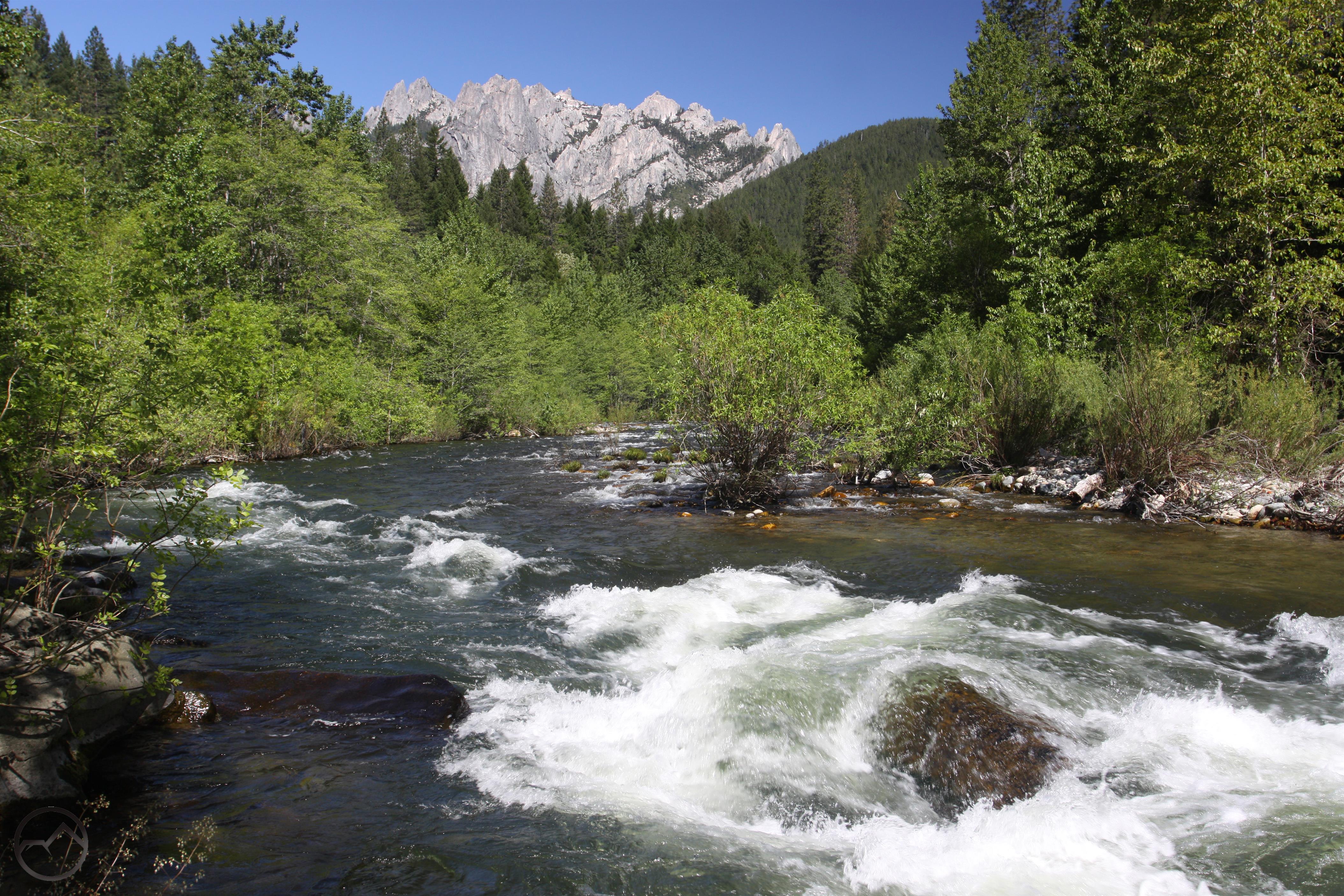
I had initially thought of this location when I first saw the card but I dismissed it as a possibility because of the arrangement of the railroad tracks in relation to the river. They are not visible in this shot, but they are set way back from the water, much further away than they appear on the postcard. Yet the Crags themselves were a dead ringer for what is seen in the card.

I snooped around on Google Earth a little more, looking at the Crags in relation to the orientation of the river. The perspective in the image I had taken of the Castle Crags was so similar to the one on the postcard I knew that if it was not the same spot, it had to at least be close. Nonetheless, there is nowhere else on the river that even comes close to having the same alignment between the Sacramento River and the Crags. It had to be the same spot. Yet the tracks in the postcard were nowhere near where the tracks are now.

I finally concluded that the tracks as they appear now are the result of a realignment and have been moved back, away from the river. My guess is that the old dirt road that follows the river now must be the old railroad bed. Walking that old road leads to the spot where I took my image. The perspective along the road would be very similar to what is on the postcard. Of course, the forest has grown up significantly sine the picture on the postcard was taken, but that is to be expected over the last 60-70 years.

To verify whether I was indeed correct in my assessment of where the postcard picture had  been taken, I tried superimposing the crags in my image over those that appear on the postcard. They were a nearly identical match! The river did not quite line up but that is not a surprise, since my image was taken at the water level while the one in the postcard is obviously taken from the top of the embankment, about 30 feet higher. Furthermore, I took mine during the spring thaw while the postcards is much later in the year when the water level is lower. Despite the slight shift in perspective and difference in volume, it is obvious that the river is rounding the same bend.

Click to enlarge the superimposed images:


I think it is quite conclusive. My image and the postcard were taken at nearly the same spot. The growth of the forest is quite remarkable, even though it is to be expected. Frankly, I prefer the areas appearance in the postcard rather than how it is today. At the very least, there is much less obstruction of the Crags themselves. Also, the lack of significant hardwoods makes the area more attractive, in my opinion. In spite of my preference, the spot remains one of the better views of the Castle Crags from down on the Sacramento River. Only that seen from the confluence with Castle Creek exceeds it.

So what is the takeaway from this exercise? First, it is that I am an unrepentant geography nerd. Second, and more important, there are a lot of great vistas out there that need to be rediscovered. This particular view of the Castle Crags deserves to be appreciated more than it is!

Update:

Reader Jeff Stone notified me that the trademark registration on the card would negate any date prior to 1952 and that the railroad was indeed realigned following the river’s flood of 1955. That would put the postcard’s date to somewhere between 1952 and 1955, which was right in my guess, based on the card’s design. He also linked me to another postcard that was taken in the same area. It must have been right around the same time, since all the trees are exactly the same!

A Mount Shasta Summer Sunset

Posted by bubbasuess on July 24, 2017
Posted in: Cascade Range, Hiking, Mount Shasta. 1 Comment

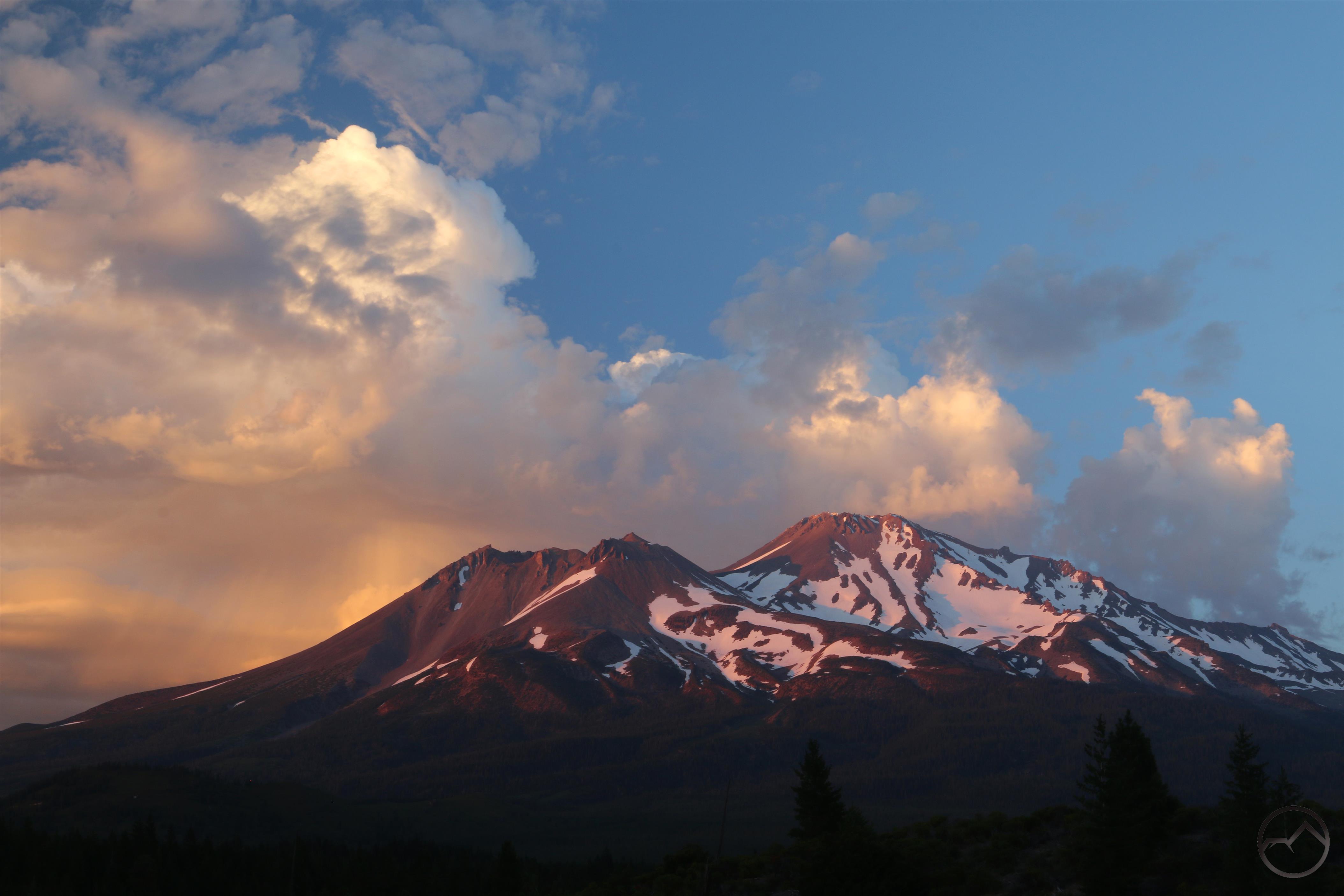
Magnificent alpenglow on Mount Shasta.

It has been a few weeks since Mount Shasta has been embellished by a spectacular cloud display. Last night I even griped about the absence of sunset fireworks around the mountain and sifted through my lenticular cloud gallery as a reminder that, yes, there are great sunset spectaculars around the mountain, even in the heat of the summer. Providentially, the very next evening the mountain was beset by towering thunderheads rising majestically above Mount Shasta. As the sun set, they turned vibrant shades of orange, pink and red. It was a marvelous sight to behold. The show was made even more enjoyable since, while standing behind my tripod capturing the images, I was able to chat on the phone with my brother about his oldest son, who is in the midst of his pleb summer at the U.S. Naval Academy. In my book, that is an excellent and memorable sunset!

Click to enlarge:


Mumbo Basin – Overlooked On The West Side

Posted by bubbasuess on July 21, 2017
Posted in: Hiking, Klamath Mountains, Lakes, Mount Shasta, Trinity Divide, Water. Tagged: Mumbo Basin. 2 Comments

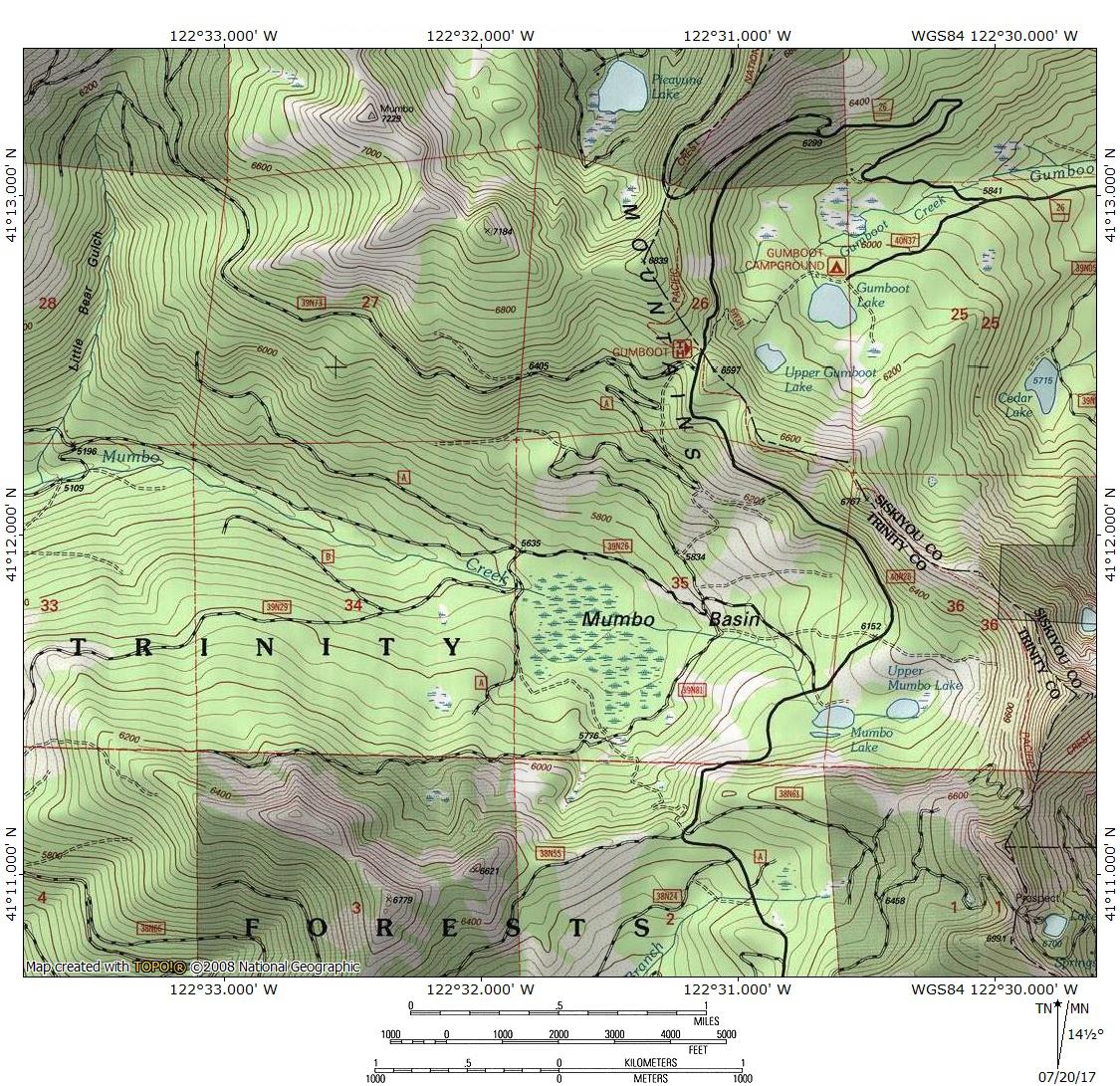
The Mumbo Lakes lie at the head of Mumbo Basin.

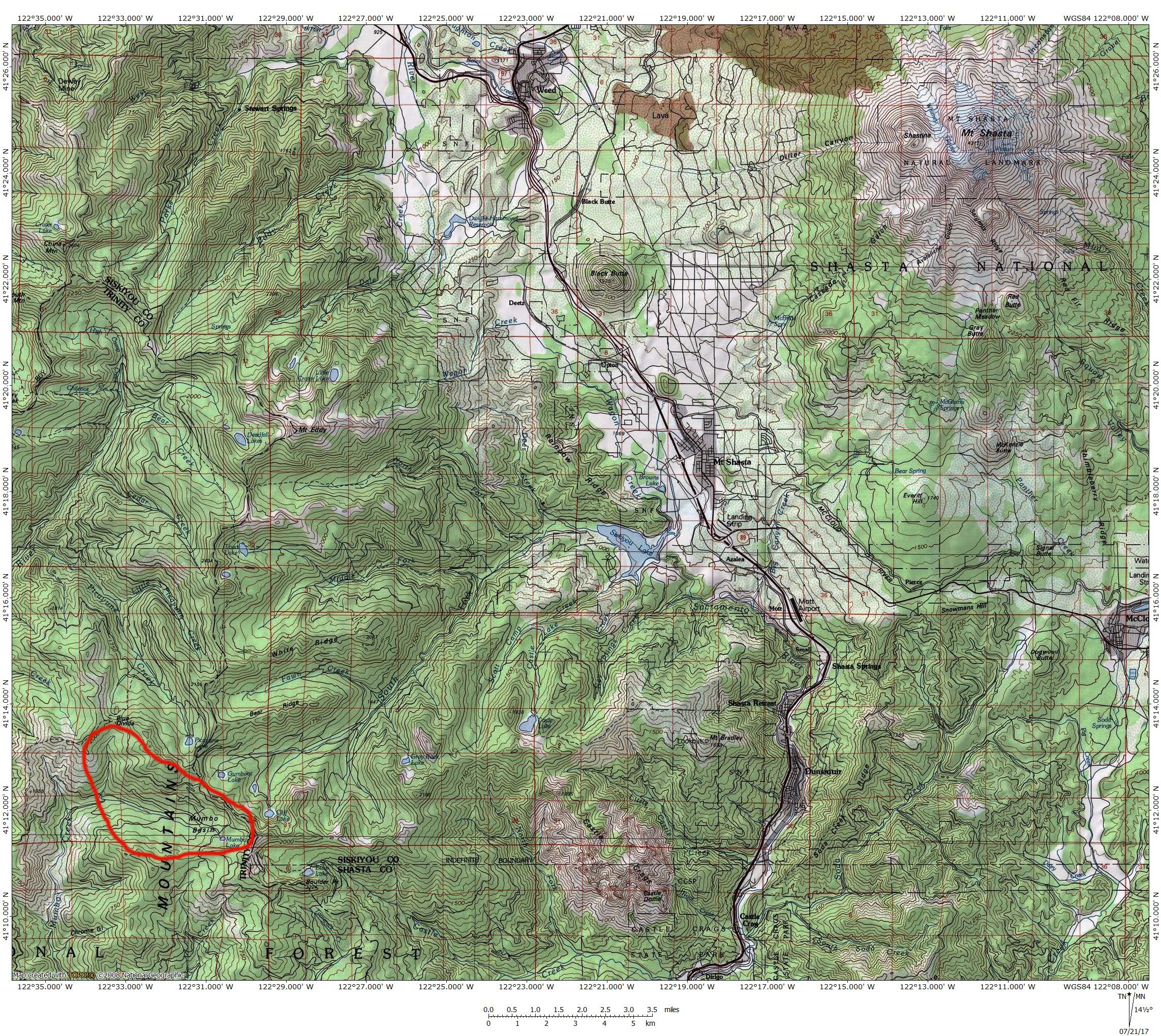
Most of the lakes in the Trinity Divide are found on the range’s east side. Excluding the rarely visited southern third of the range, there are only three lake basins that feed west into the Trinity River. The most heavily visited is Deadfall Basin, which rates among the most well known and beautiful in the entire range. Further south lies solitary Picayune Lake, which, being on private property, is not a destination for hikers. This leaves Mumbo Basin as the only other lake basin on the west side of the Divide. However, the lakes are only a small component of this large mountain bowl. Rugged peaks and ridges, remote forests, lush meadows, lively Mumbo Creek and great views of the Trinity Alps are also highlights of this area. In spite of all these great features and access by way of a good paved road, Mumbo Basin tends to be overlooked as a good destination for exploring.

Mumbo Lake

The lack of attention is due, no doubt, to the lack of established trails in the area. This should not preclude motivated hikers from venturing out to the west side of the Trinity Divide and exploring the ridges and roads that permeate the area. Most people who do head into Mumbo Basin do so to reach Mumbo Lake. It is among the smaller lakes in the Trinity Divide but it is easily accessible via the paved road just a short distance past Gumboot Saddle. It is a good lake for swimming and camping. Hikers comfortable with cross country travel can climb higher into the uppermost section of the basin and find shallow Upper Mumbo Lake. The rocky summit of Peak 7,149, also dubbed Many Lakes Mountain rises above the Mumbo Lakes, giving them a very scenic backdrop. The Pacific Crest Trail cuts across the flanks of this peak, high above the lake, which also offers great views of the basin.

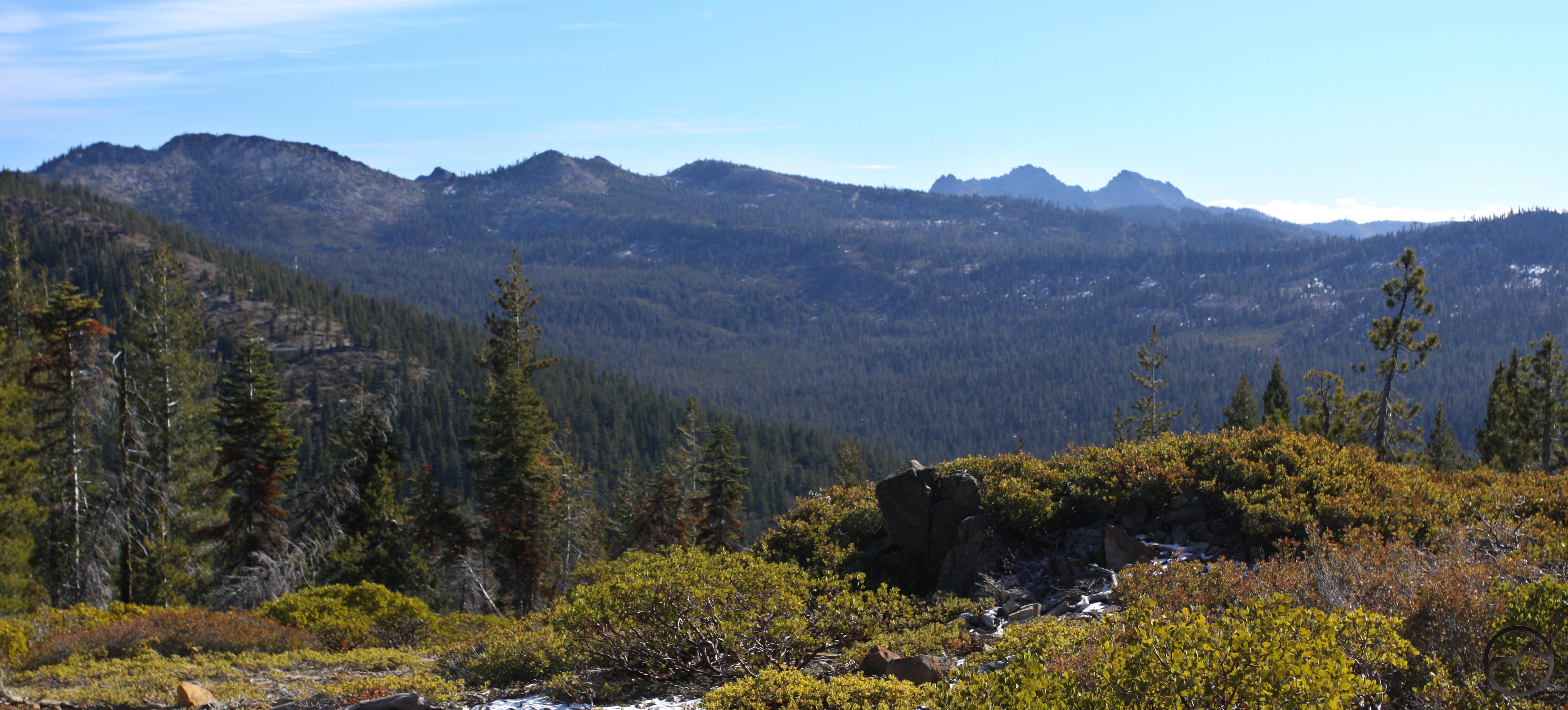
Mounts Shasta and Eddy from the Blue Divide Trail

Though there are no really established trails, there are a few good options for adventurous hikers. The most trail-like option is the remnants of the old Blue Divide Trail. This was once a trail that descended from the crest of the Trinity Divide down to ridges directly above the main branch of the Trinity River. The trail has essentially been abandoned but many sections of the path are still extant and open to hikers. Following roads along the north rim of Mumbo Basin, it is possible to pick up the trail and proceed out to an overlook with spectacular views of the Trinity Alps, the Scott Mountains, Mount Eddy and Mount Shasta, as well as Mumbo Basin itself. The trail continues beyond the vista but the destinations become more ambiguous. Even when the Blue Divide Trail was a maintained path, this was one of the few trails on the western side of the Trinity Divide. Now, other than Deadfall Basin, there are none. Though the area has experienced a lot of logging, it would be nice to see some old trails rehabilitated or new ones built.

Meadows in Mumbo Basin.

The other good option for hikers is the cross country scramble along a ridge on the south side of Mumbo Basin. This route has a very faint use trail at the beginning and then quickly becomes a simple scramble with no trail along the ridge. Fortunately, the terrain is pretty open and easy to follow and does not require much bushwhacking. Small meadows lie immediately below the ridge and hikers have good views of these as well the interior of Mumbo Basin. It also affords the unusual perspective of Mount Shasta rising above the crest of the Trinity Divide. The hike ends at the terminus of the ridge where there are incredible views of the Trinity Alps to the west. The nearest points of the Trinities lie just a few miles distant, on the far side of the Trinity River.  Some of this hike crosses private timber land but passage is OK as long as there is no camping and no fires.

The one consistent feature of the Blue Divide Trail and the South Mumbo Scramble is great views of the Trinity Alps. Being on the west side of the Trinity Divide means that the rugged mountains of the Trinties are more easily observed than from other places in the Trinity Divide.

Blue Divide
Blue Divide

Blue Divide
Blue Divide

South Mumbo
South Mumbo

Now is a great time to head up to Mumbo Basin and experience a somewhat more unusual hiking experience than you normally find in most of the rest of the Trinity Divide!

Mumbo Basin from the Blue Divide Trail.


5 Mount Shasta Area Trails We Need To Build

Posted by bubbasuess on July 18, 2017
Posted in: Hiking, Klamath Mountains, Lakes, Meadows, Mount Eddy, Mount Shasta, Scott Mountains, Trinity Alps, Trinity Divide, Water. Tagged: China Mountain, Mud Creek, Sacramento River. 8 Comments

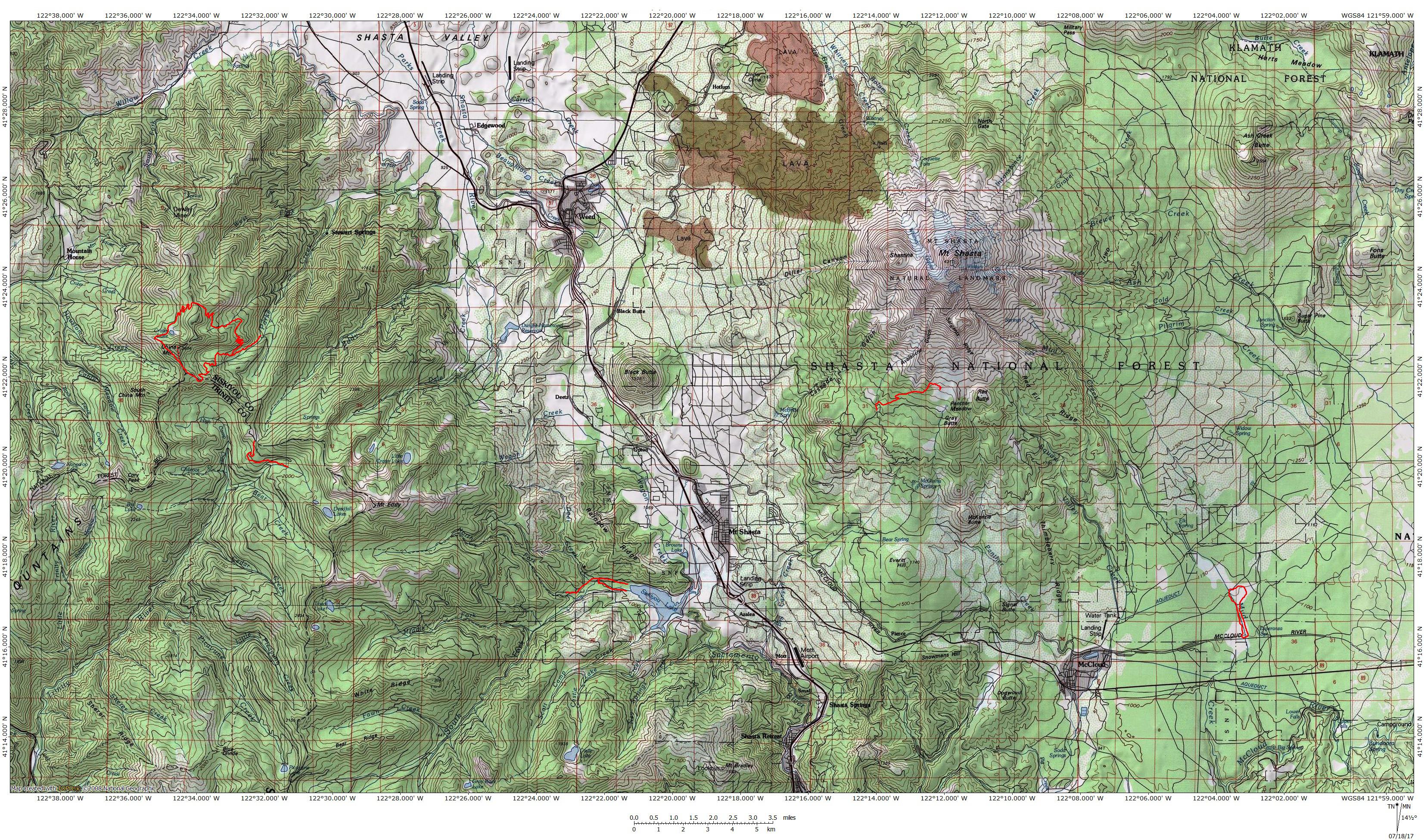
A spectacular morning view of Mount Shasta from the proposed Konwakiton Trail.

For the last several years, I have been highlighting the trails in the Mount Shasta area. We are blessed with a number of great tracks that lead to some truly stunning destinations. However, there remain a host of places that lack trails accessing them or the trail network is incomplete and could be significantly enhanced by the presence of a few more miles of trail. Some of these are in wilderness areas and the approval of construction in the protected land seems unlikely. Others are just not interesting enough to attract the effort necessary for the labor and money to be invested in these projects. This is OK, since it leaves these areas to the motivated and adventurous and promises that these secret spots will remain as they are. That said, there are still some places that I think warrant the effort to build. I believe these trails would instantly become classic Mount Shasta area trails and get significant use. Their addition would make an already great Mount Shasta hiking experience even better than it already is.

Unfortunately, the likelihood of many of these ideas coming to fruition are minimal. The Forest Service suffers from a lack of funding that impairs the possibility of many improvements to the trails. They want to make the hiking experience around Mount Shasta as good as it can be but the obstacles are great. Volunteer contributions are absolutely necessary. This ranges from actual trail construction to the commitment of significant funds to pay for the NEPA process (which is a major problem on its own!). Working through organizations like the Mount Shasta Trails Association is the best way to bring new trails into being.

I may expand on each of my proposals in individual posts. I would be interested in feedback you may have on any of these suggested trails.

5. Trinity Vista Trail

Deadfall Basin and Mount Eddy are classic destinations for hikers in the Mount Shasta area. The basin is filled with gorgeous lakes, awesome wildflowers and fascinating geology. There are two options for reaching the Deadfall area. Most hikers follow the Pacific Crest Trail from the Parks Creek Trailhead while others begin at the Deadfall Meadow Trailhead. The former is longer but requires almost no elevation gain. It has good views of the Scott Mountains and some particularly lush wildflowers as well as refreshing springs. The latter route is shorter but requires more climbing. It ascends into the basin through Deadfall Meadow, which is filled with creeks and even more impressive wildflowers and lush mountain gardens. These two routes each have much to recommend them. Unfortunately, they cannot be combined into a single trip without walking on the steep paved road that connects the trailheads. However, the two trails make up 75% of what could be a really excellent loop hike.

Trinity Vista Trail view of the snowy Trinity Alps.

To complete the loop, it would be necessary to construct about 1.75 of trail across the slopes that lie between Deadfall Creek and the road descending from the Parks Creek Trailhead. The addition of this trail would afford hikers the chance to hike into Deadfall Basin (and continue on to Mount Eddy if desired) by way of either the PCT or the Deadfall Meadow Trail and then return by the other route. This would allow for a much more diverse and scenic trip. What would the addition offer in terms of scenery? The area is mostly wooded but there are opening where vistas would be available. What is most notable is the opportunity to look out to the west where there is a spectacular view of the Trinity Alps. From the trail, the Bear Lake Basin is only 12 miles to the west and presents an grand foreground to the sawtooth-like horizon of the Trinities. This is particularly true near the top of the climb. Not only would the trail allow for the loop option to be employed, but for hikers only looking for a quick outing, the upper section, with its views of the Trinity Alps, would be an excellent easy walk.

4. Upper Sacramento Trail/Lake Siskiyou Trail Extension

For several years now I have been discussing the need to build trail sections that would allow for a backpacking loop that combined the Sisson-Callahan Trail, the Pacific Crest Trail, the Castle Lake Trail and the Lake Siskiyou Trail. I dubbed this proposed circuit the Headwaters Loop since it would completely encircle the three headwaters forks of the Sacramento River. Most of the loop is already built. An unofficial but established loop trail connects the PCT and Castle Lake. Though less than ideal, a dirt road follows much of Castle Lake Creek’s journey down to Lake Siskiyou. The most obvious hole in the loop is the section that would connect the Lake Siskiyou Trail with the Sisson-Callahan Trail at the North Fork of the Sacramento.

Hikers would have great views of Mt. Eddy along the river.

While this section of trail would be a key piece of the Headwaters Loop puzzle, I have a bit of a grander conception of what it offers. I propose building trail 1.75 miles from the inlet at Lake Siskiyou along the Sacramento River to the Sisson-Callahan Trailhead. However, more ambitiously, I propose building  a sturdy wooden bridge (I will elaborate extensively on the bridge when I expand on this trail in a future post) across the Sacramento River and adding a section of trail that loops back to the inlet along the southern side of the river. This would accomplish several things. Naturally it would help complete the bacpacking loop I have suggested. More importantly, it would extend the Lake Siskiyou Trail along a beautiful section of the Sacramento River. This would allow the loop around the lake to be hiked all year when the seasonal bridges are not in place. When the seasonal bridges are in position, it would give hikers the option of doing a beautiful loop hike around a lovely section of the Sacramento River. A new trailhead could be built on South Fork Road at the place where the road makes a sharp turn to the west and begins to parallel the river. This would add more access to the Lake Siskiyou Trail and provide a good starting point for hikers sticking to the shorter river loop. This would have the further benefit of cutting down on vagrant encampments in this area. All in all, this has the potential to become one of the most popular sections of trail in the Mount Shasta City area.

3. Mount Shasta Bowl Trail

View towards the bowls and the area covered by the trail.

The upper reach of Everitt Memorial Highway has several awesome trails. Whether heading to the numerous destinations from Bunny Flat or Panther Meadow or the Old Ski Bowl, hikers are guaranteed spectacular scenery. The area is actually rather dense with trails, though they are generally divided between the lower ones originating at Bunny Flat and the upper trails that begin in the Old Ski Bowl area. The two sets of hikes are not connected by any maintained path. Whats more, the road to the Old Ski Bowl remains closed much of the year and the upper destinations are not accessible. This brings up my third proposed trail, which would run parallel to the Everitt Memorial Highway and connect Bunny Flat to the Old Ski Bowl. It would also be possible to add a spur trail that would split off and reach the road across from the entrance to the Panther Meadow parking area. Up until now, I have dubbed the route the Bowl Trail since it would pass beneath Sun Bowl and Powder Bowl, which lie on the south side of Green Butte Ridge.

This trail would accomplish several things. First, it would allow motivated hikers to reach the upper destinations earlier in the year. Obviously this is contrary to why the road remains closed but I believe the number of people heading up there on foot would be dramatically less than would reach the area in cars. Furthermore, hikers can already simply walk on the road to Panther Meadow. An established trail would be a much more pleasant way to channel people there. In fact, if the path simply went to the Old Ski Bowl without a spur to Panther Meadow, it would probably reduce the number of people who went to the meadow, since that area would be bypassed and lead straight to the Old Ski Bowl. The other benefit would be a fantastic loop that would connect both the Horse Camp Trail and the Green Butte Ridge Trail with the Old Ski Bowl Trail and facilitate a truly fantastic loop hike that would circumnavigate Green Butte. This route would require some rock scrambling over Green Butte Ridge but for those prepared of such a journey, it would be an epic hike.

2. China Basins Loop

Mount Shasta viewed from above Lower Caldwell Lake.

The high point of the Scott Mountains and the 4th highest peak in the Mount Shasta area, China Mountain is a criminally overlooked alpine destination. The tall peak rises at the eastern end of the Scotts, like the prow of a massive ship overlooking the Shasta Valley, which lies a mile below the summit. It is perhaps overlooked since it lakes a distinctive profile and much of its flanks are covered with dense forests. However, this hides the true character of the higher portions of the mountain. The summit of China Mountain is surrounded by three lake basins. While none of them house large lakes, the lakes themselves are still scenic and the rugged terrain that looms above them as very scenic. In many ways, the loop around China Mountain would be similar to the excellent Four Lakes Loop in the Trinity Alps. None of the lakes on China Mountain rise to the spectacular level of beauty as the four that lie around Siligo Peak but they are nonetheless beautiful. What the loop around lakes on China has, though, is eye-in-the-sky vistas that reach for great distances in every direction. These views would take in much of southern Oregon, Mount Shasta and a vast span of the Klamath Mountains including the Trinity Divide, Scott Mountains, Trinity Alps, Russian Wilderness, Marble Mountains and the Siskiyous. Take that Four Lakes Loop!

China Mountain is flanked by three basins that contain lakes as well as a 4th that has some large meadows in place of a lake. A 5th basin, High Camp Basin, lies immediately to the south and the highest corner of it makes the best passage for the trail. Two lake basins, the West Park Lakes and the Caldwell Lakes are headwaters for Parks Creek, which is a major tributary of the Shasta River. Crater Lake has no out let, but along with the meadow-filled basin, is in the Scott River watershed. High Camp Basin is one of the two sources of the mighty Trinity River. The ups and downs of the loop around the mountain, which would include a spur up to the summit of China Mountain would cross through three major watersheds! I think this trail would be destined to become a classic Mount Shasta area adventure!

1. Konwakiton Trail

In many ways, this is the trail that I have the grandest vision for and excites me the most. This trail combines an unusual creek, interesting volcanic and glacial geology, lush meadows and staggering views of one of Mount Shasta’s most beautiful profiles. The genesis of this trail concept began with the frustration over the lack of trails in the McCloud area. Basically all the hikes near the town were along the McCloud River. Squaw Valley Creek is an outlier but offers similar scenery to what is found along the river. Equally frustrating was the near total lack of views of Mount Shasta from any of these trails. I have written about how McCloud is an under-rated hiking destination but the lack of diversity and views of the mountain continued to nag at me. I have hunted around for features and places that would offer some interest to highlight this beautiful area. The one place I kept coming back to was infamous Mud Creek.

Mud Creek

Mud Creek begins high on Mount Shasta and flows through the mountain’s largest canyon. It then flows south through the McCloud Flats before suffering indignity and finally reaching the McCloud River. The creek’s name comes from the silt and glacial till in the water that gives it a muddy or chalky appearance. The name Konwakiton is the Wintu word for “muddy” and the creek’s ultimate source is the Konwakiton Glacier that lies just below Mount Shasta’s summit. The proposed trail would run parallel to the creek until it reaches the Great Shasta Rail Trail. It would then follow back along the creek before veering east. It would cut through forest until it reaches the edge of a large meadow, where hikers are greeted with an incredible view of Mount Shasta. It would then follow much of the meadow’s perimeter before cutting through the grassy fields back to the trailhead. My vision for this area is not limited to trails but also to the development of a new Forest Service campground, picnic area as well as possibly a walk-in campground and a mountain biking area. By way of the Rail Trail, it would also be accessible by foot, horse or bike from McCloud. I see this as possibly becoming a flagship area for Mount Shasta, which I tentatively refer to as the Konwakiton Recreation Area. The amazing thing is that much of the trail already exists…

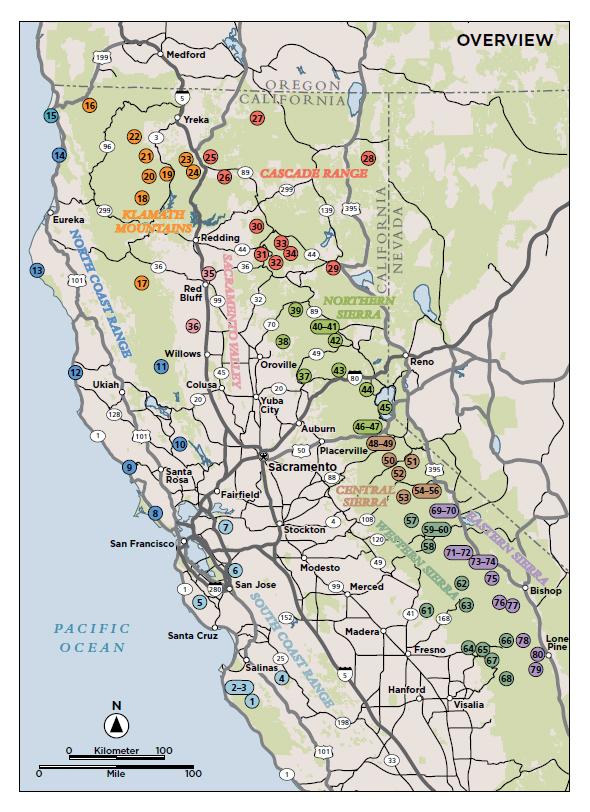
Overview Map (click to enlarge)

Hiking Northern California Released Today!

Posted by bubbasuess on July 1, 2017
Posted in: Cascade Range, Desert, Hiking, Klamath Mountains, Lakes, Maps, Marble Mountains, Meadows, Mount Shasta, Napa County, Peaks, Rivers, Sierra Nevada, Siskiyou Mountains, Sonoma County, Trinity Alps, Trinity Divide, Water, Waterfalls, Wilderness, Wine Country, Yosemite. Tagged: Hiking Northern California. 11 Comments

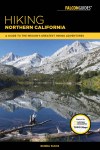
I am excited to announce that my latest book, Hiking Northern California, is officially released today! The book contains 80 of the best hikes throughout Northern California. It is a showcase for the magnificent natural beauty of this part of America and highlights just how diverse the northern part of the Golden State is! I am truly humbled to have been able to write about such an incredible place.

Click to enlarge

Tackling such an immense area, so loaded with exceptional hikes and natural wonders was challenging. How do I narrow down an area so densely packed with excellent trails into only 80 hikes? One significant step in this process was to break down the state into 9 regions. Each area has its own distinct character and exciting trails to be explored. I tried to have somewhere around 10 trails per area, give or take a few, so that there was equal representation of each region. I did include the Sacramento Valley as one of the nine sections but only included two trails there, which allowed me to pad some of the other sections. The Sierra Nevada, California’s quintessential mountains range is so vast that I could not leave it as a single region. Instead, it was broken up into four areas. These divisions were based on geology, use and routes of access. By dividing Northern California in this way, it allowed me to distribute the trails fairly evenly around the state. Though there were many trails in each section I was forced to leave out, I think each region is given a chance to shine brightly.

One great feature of the new editions being produced by Falcon Guides is the maps. In early editions by the publisher, maps were black and white and only gave the vaguest sense of how the trail related to the land. When I began writing for them nearly 4 years ago, the maps had improved significantly. They were multi-colored and based on USGS topo maps. Unfortunately, they lacked topolines. Many natural features were still present so orienting the maps was less difficult but still not ideal. Now, with Hiking Northern California, the maps have evolved into their best possible form by utilizing the topo maps and overlaying the other date typically present on Falcon Guide maps. The final result is both beautiful and especially useful.

Speaking frankly, this is a grand book. At 438 pages, it is much larger than my previous two books. Visually, it is a stunning volume, loaded with nearly 300 color images. More than half the trails have three images per hike. Some even have four images. Coupled with the excellent maps, the book just looks awesome. Though it is loaded with excellent beta, I honestly think it works equally well as a coffee table book. You can set it out and let folks sift through it, seeing the best of Northern California. This is true whether you want to show off the Golden State or dream of getting out here. Indeed, I tried to write it in such a way as it will have lots of accurate beta for hikers, but also in a way where readers can experience and enjoy Northern California vicariously through word and image. Hopefully I was successful.

I am very, very proud of this book. It is gorgeous, but more than that, I was able to write about some of the most beautiful places in the world. It is an honor to be able to publish thoughts about places like Big Sur, Lassen, Lake Tahoe, Yosemite and beyond. Wherever you are in Northern California, there are going to be nearby trails in the book that will be absolutely amazing and exciting journeys through this wonderful land. It is my sincere hope that this book will contribute to many people building lifetime memories while exploring the wild, beauty of the land of Northern California.

Copies can be purchased here. I will also have a few copies available. If anyone is passing through Mount Shasta and wants a signed copy, let me know ahead of time and I can arrange delivery. Thanks for supporting this site and purchasing a copy. You will enjoy it!

The Changing Channel Of Whitney Creek

Posted by bubbasuess on June 30, 2017
Posted in: Glaciers, Hiking, Mount Shasta, Waterfalls. Tagged: Whitney Creek, Whitney Falls. Leave a comment

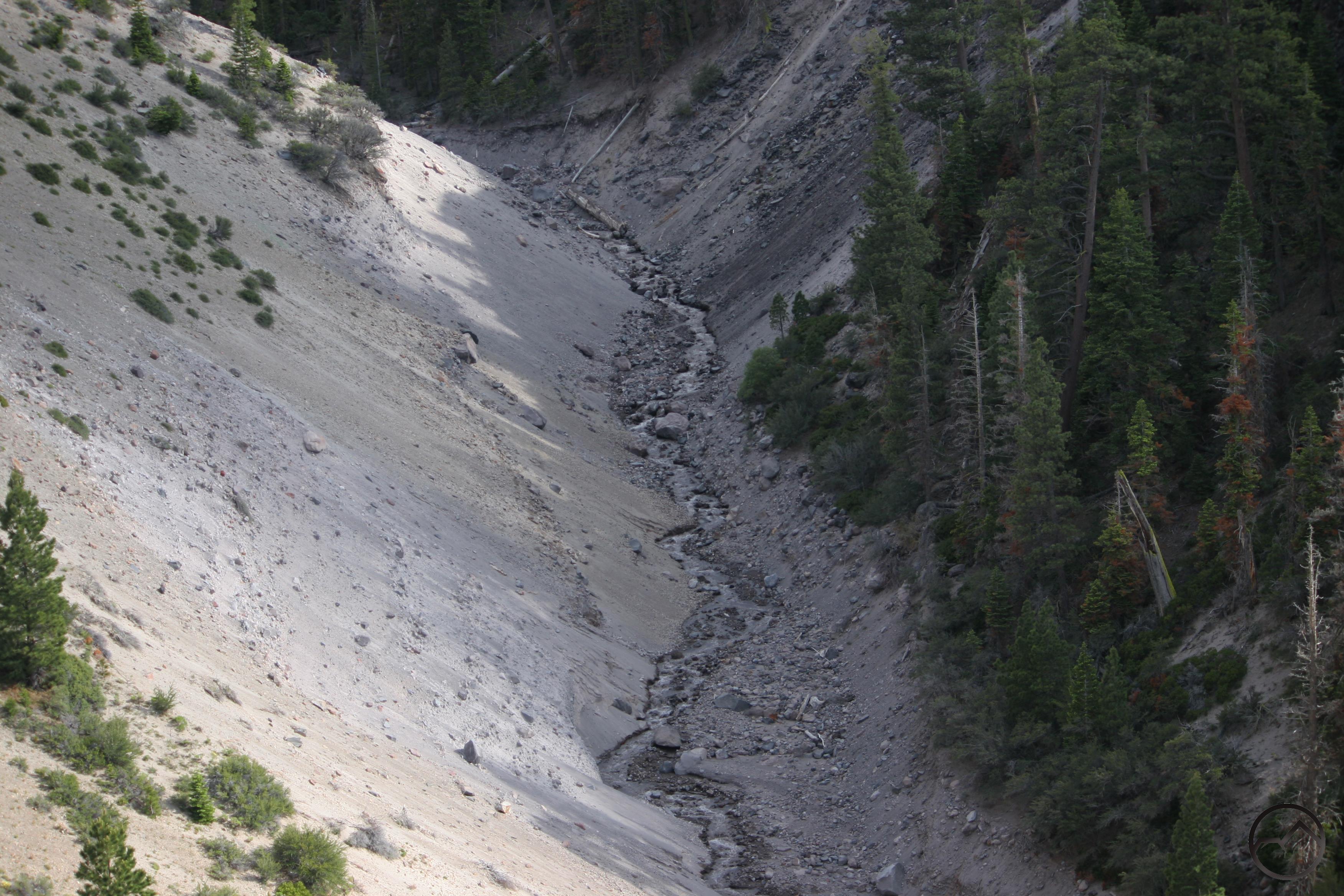
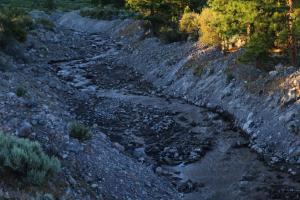
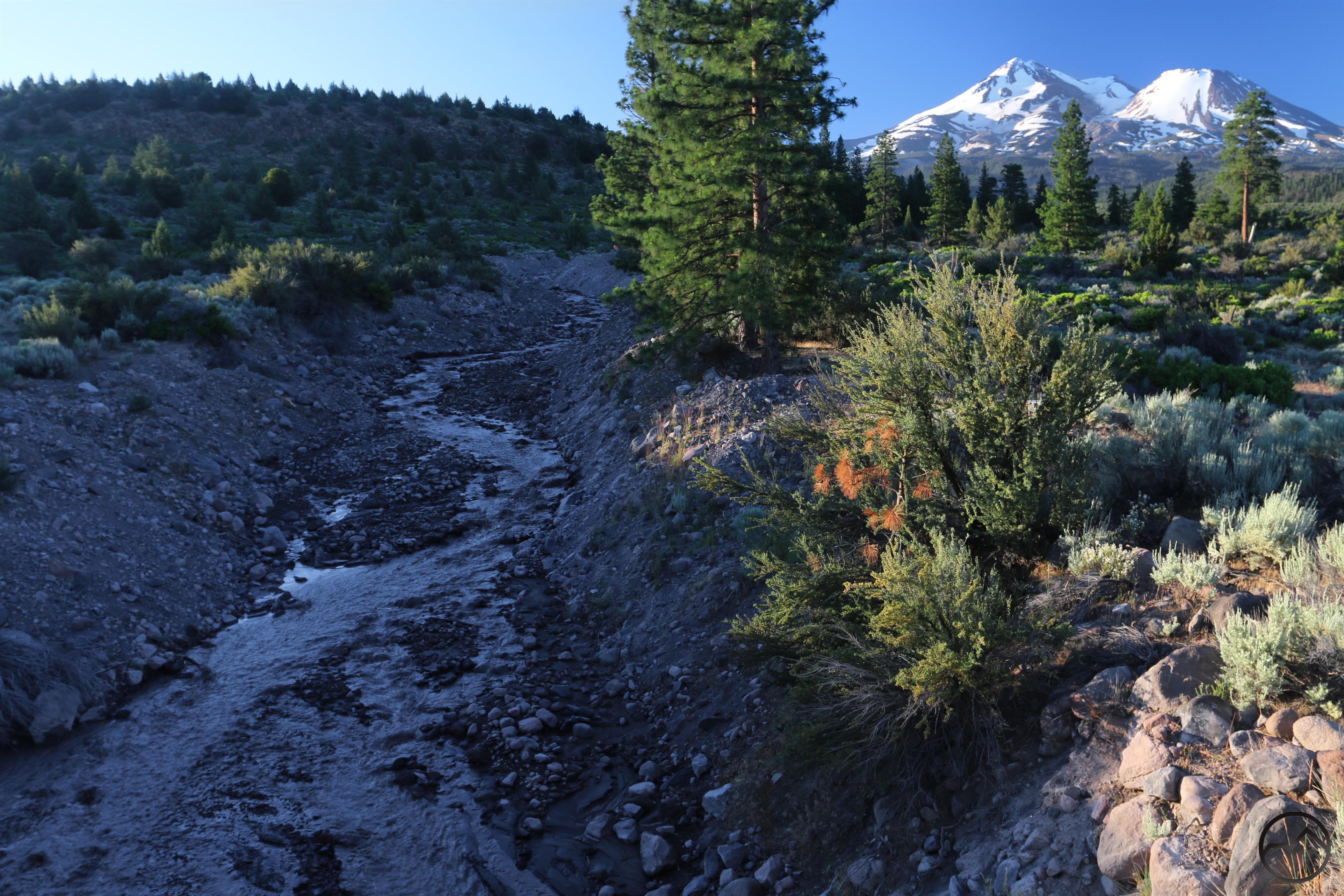
Whitney Creek flows through a canyon of ash and aggregate.

Flowing off the north side of Mount Shasta, Whitney Creek is the largest watershed on this side of the mountain. It originates as meltwater from the Whitney Glacier and flows through a barren volcanic landscape before it plummets off a 200 foot cliff at Whitney Falls. It then races through a deep canyon before being joined by Bolam Creek, the northside’s other significant creek. Other than when the creek passes through lava flows, nearly its entire journey the terrain is composed of ash, loose rock and layers of glacial till. It is an unusual and beautiful landscape to see a water running through.

Something was nagging at me when I posted my recent article on Whitney Creek. Something about the creek just didn’t click in my memory the way it should have. I started sifting through old pictures of the creek until I found what I was looking for. Hidden away in my collection of old images I have taken of Mount Shasta, I knew there were old images that showed Whitney Creek from the same place the pictures in the article were taken. When I found them, I was able to confirm what had been bothering me. I had subconsciously realized that the creek’s channel was significantly different from the way the creek was fixed in my memory.

2013
2017

The images are not from the exact same perspective but they do show the same stretch of the creek. Whitney Creek has cleared away a substantial amount of the debris that fills its channel. I have passed the creek here numerous times and never payed much attention to the fact that its appearance has been altered considerably. I think I recognized this now because I have been tuned into the changing landscape of the Sacramento River at the inlet of Lake Siskiyou. I have written about this subject ad nauseum, but it really has made me more sensitive to how water continues to alter the land that channels it.

Of course, this was not a new phenomenon on Whitney Creek. Not only was there the infamous glacial outburst of 1997, but I have witnessed and written about these changes myself. I suspect the result of the flooding I documented in 2014 was responsible for the same changes I noticed on this stretch last week. These weren’t connected in my mind however and the changing channel went unnoticed. That will be a lesson to me to heighten my observation of these areas even more. To my knowledge, the trail has not been repaired since it was washed out. This unfortunate, since the Whitney Falls Trail has the easiest access of all the trails on Mount Shasta that are not on Everitt Memorial Highway. Perhaps it is time to organize a crew to get out and fix it!

Trinity Divide Trails Open!

Posted by bubbasuess on June 28, 2017
Posted in: Hiking, Klamath Mountains, Lakes, Meadows, Mount Eddy, Mount Shasta, Pacific Crest Trail, Trinity Divide, Water. 2 Comments

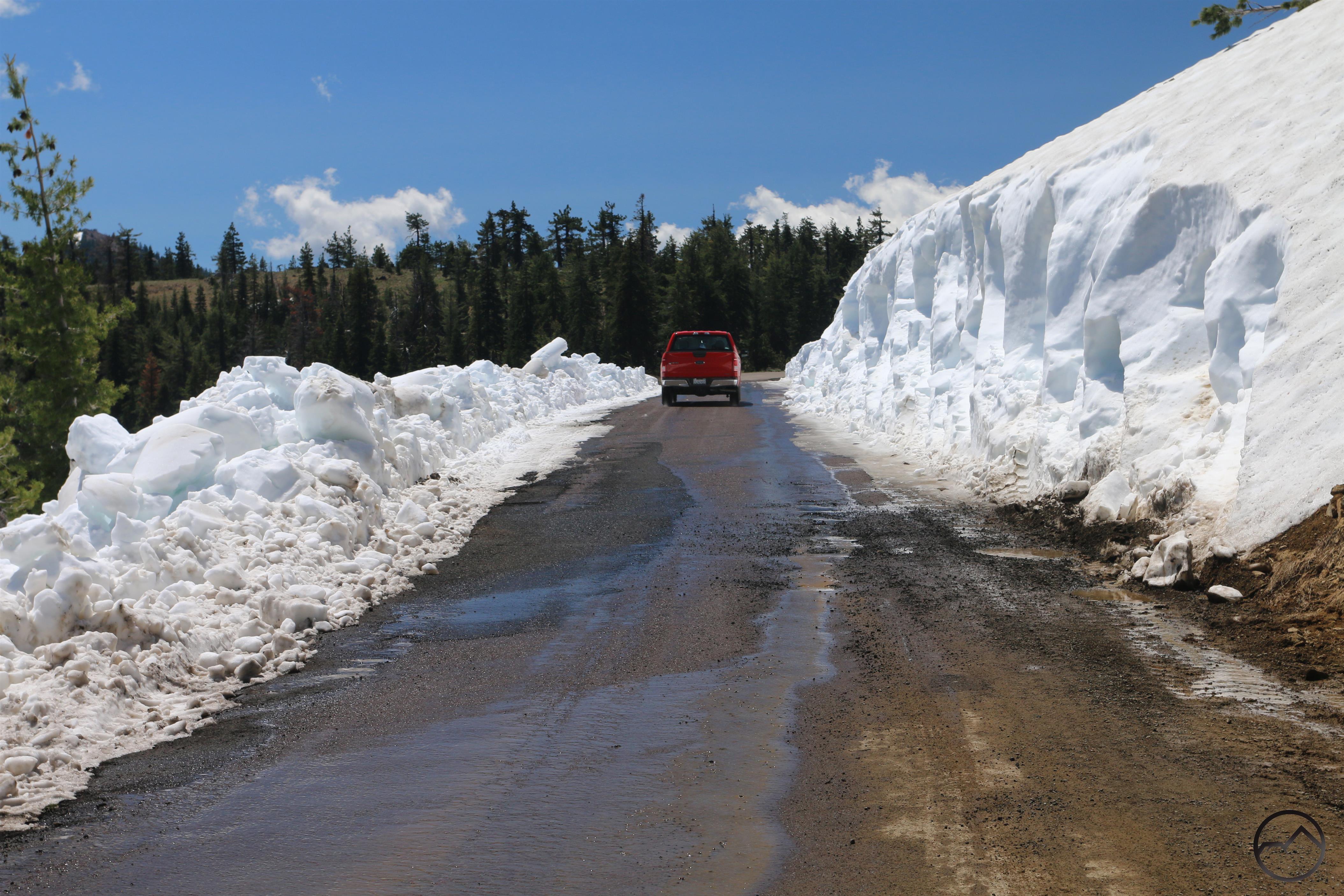
A truck passes through the freshly cleared snow drift at Parks Creek Pass.

June is nearly over and the summer hiking season is upon us! Normally, high country hiking would already be well underway but this year, with the massive snowfall we received during winter, things are slower to open up. With the opening of the Old Ski Bowl pushed back to an anticipated date of July 21st, attention necessarily shifts over to the Trinity Divide. Though there numerous trails in this range, the two critical trailheads are on the Pacific Crest Trail, at Gumboot Saddle and Parks Creek Pass. These trailheads provide access to the PCT as well as other destinations, both in the Trinity Divide and also in the Scott Mountains. While Gumboot was quicker to open up, the traditional large snowdrift at Parks Creek was very persistent this year. Nearly 15 feet high, it posed a serious impediment to getting to the Parks Creek trailhead. However, thanks to the miracle of heavy equipment, the large drift is cleared and the road open. The PCT, as well as direct access to Trinity Alps trails is now available for hiking!

Conditions in the high country are gorgeous right now. The grass is green, the creeks full and wildflowers are erupting everywhere. The Parks Creek area is especially lush! If you do head up to Parks Creek, be aware that roadwork is underway and the narrow road can be congested.

Click to enlarge:

High peaks of the Scott Mountains.
The Scotts can be seen from Deadfall Meadow.
Deadfall Basin is visible from Deadfall Meadow.

China Mountain and the Caldwell Lakes Basin.

As noted, Gumboot Saddle and the trailheads along the South Fork of the Sacramento are also open. The snow tends to melt out of this area sooner than on Parks Creek but the rivers and lakes remains full. This area is also particularly beautiful right now!

Mumbo Lake
Mount Shasta and the Sacramento River.

As an added bonus, the seasonal bridges over the Sacramento River have been installed and the Lake Siskiyou Trail is now complete. The loop is now an excellent option for anyone who wants to get out and hike a surprisingly diverse trail without putting out too much effort. It is also a great running and biking trail. With the way the river has continued to shape the inlet over the last few years, it will be interesting to see if the water can be bridged at the same place in 2018. For now, it is just nice to have a convenient crossing.


Enjoy the trails as we head into the 4th of July! Also, don’t forget my newest book will be released on July 1st! I hope everyone will support this site and purchase a copy. It is a spectacular book and really shows off how amazing Northern California is!

Whitney Creek Flowing Strong

Posted by bubbasuess on June 23, 2017
Posted in: Glaciers, Hiking, Mount Shasta, Water, Waterfalls. Tagged: Whitney Creek, Whitney Falls. 2 Comments

Whitney Creek, which flows out of the Whitney Glacier, races below Mount Shasta.

On Friday morning I got up and headed out to Orr Lake to catch the sunrise on Mount Shasta. The east side of mountain has phenomenal, though rarely seen, sunrises:


Driving out to Orr Lake necessitates crossing over Whitney Creek on Highway 97. This always presents an opportunity to check on the status of this frustratingly fickle stream. While nearly all the creeks on Mount Shasta are fed by springs, Whitney Creek is one of the few that derives the bulk of its flow from glacial melt. This means that there is likely nothing flowing during the spring thaw and during the cold winter months. It is only when temperatures rise and the glacier begins to melt that there is a chance of finding water in the creek. Of course, the main reason this is of interest to hikers is because the water in the creek means Whitney Falls, the most easily accessible waterfall on Mount Shasta (though it is an increasingly difficult proposition to get there) is flowing.

So, when I crossed the creek on the way back from watching the sun rise from Orr Lake, I stopped to check the flow on Whitney Creek. I was impressed with just how much water was flowing, even early in the morning before the temperatures had risen.

2017

I have not seen that much water in Whitney Creek along Highway 97 in a long time. This current heat wave, though hot, is presenting an excellent opportunity to head up to the north side of the mountain and see the 200 foot waterfall thundering down into the canyon. Of course, it is worth mentioning, that the trail conditions at Whitney Creek are questionable. The creek has resisted efforts to allow a well-built trail to be maintained. Sections have been washed out and older parts of the trail are getting overgrown. I think it is time to revisit the possibility of organizing an effort to clear the overgrown section of trail and increase access to the falls overlook. That will no doubt have to wait for cooler weather. In the meantime, head up to the falls, if you are willing to brave the heat and the deteriorating trail conditions!

A Major Milestone For Hike Mt Shasta

Posted by bubbasuess on June 10, 2017
Posted in: Hiking, How things came to be..., Mount Shasta, Yosemite. 13 Comments


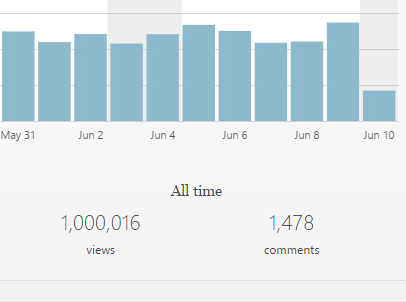
I started Hike Mt Shasta 4.5 years ago, and it has been an exciting adventure to bring it to where it is now. Though it matters little in the big scheme of things, Hike Mt Shasta has reached a notable milestone. On June 10th, my little website received its millionth view. I am not certain what the actual significance of this is, but it seems like something important enough to memorialize. This also provides me an opportunity to say thank you to everyone who has helped get the site to where it is today. I deeply appreciate all the support and encouragement that has been tendered. While it is always edifying to get feedback on how Hike Mt Shasta has been a useful tool, it is also fulfilling to know that it has been employed to help people decide how and where to invest their time. Indeed, drawing attention to the incredible slice of creation that is Mount Shasta and the mountains that surround it is the essence of what this endeavor has been about. Again, a deep thanks to everyone who has found value and enrichment here. Most of all, however, I offer a deep and humble thanks to my wonderful wife, who is patient with her odd map- and taxonomy-obsessed husband. Thanks Beautiful!

It seems to me to be a good time to look back and consider some of the notable moments from the past 4.5 years. I hope everyone may find some interesting tidbits from the dark recesses of Hike Mt Shasta. The backwaters of the site are kind of murky and don’t often see the light of day!

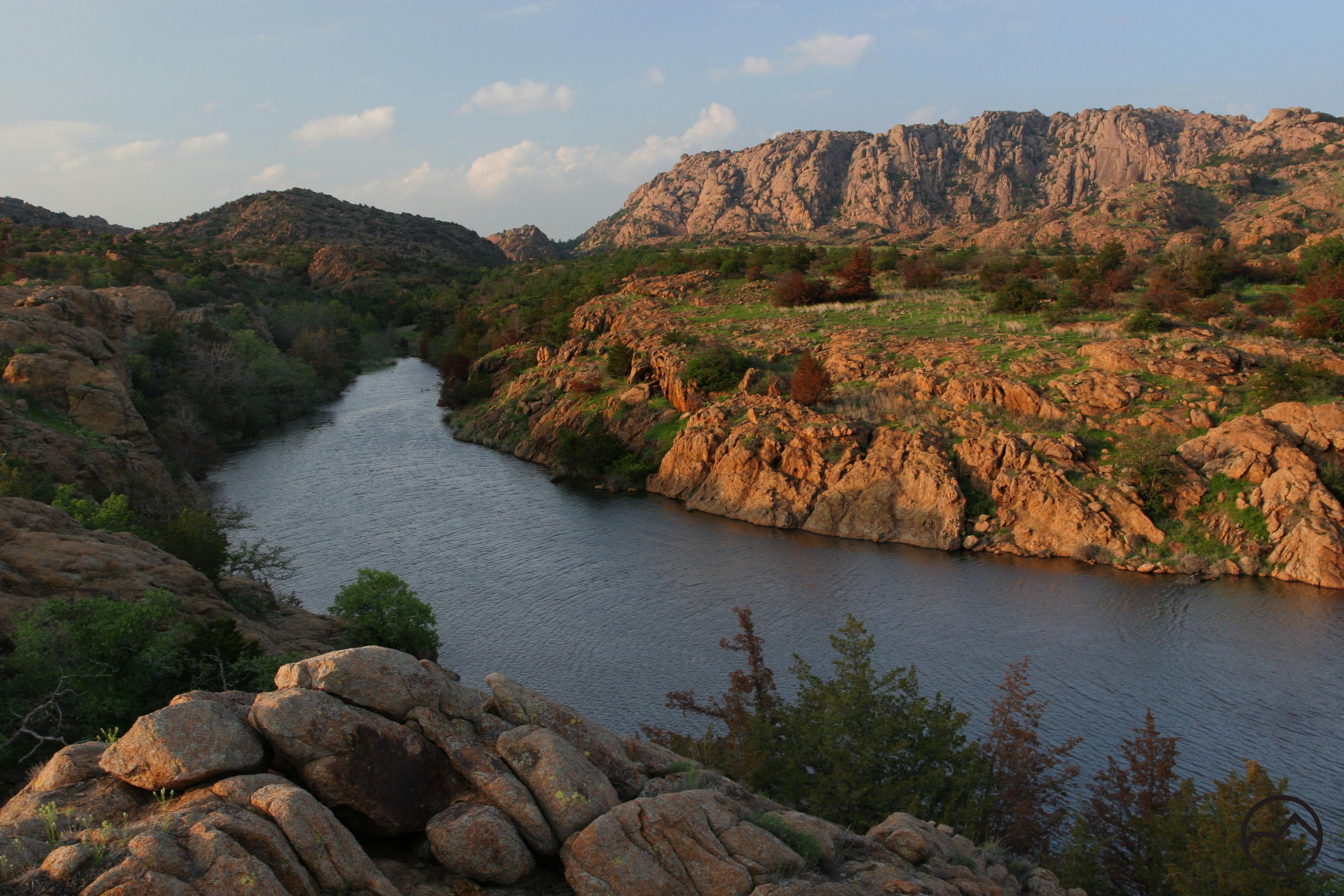
Perhaps a good place to start a brief retrospective is with my very first post on the blog. I knew from the outset that I wanted content on the site to be focused more on the land and the trails and less (or not at all) on myself and my own experiences. Yet I was new to blogging and not sure what I was supposed to write about on an ongoing basis. So, I began at the beginning and recounted my own journey from Sonoma County to Texas and back to California, where I ended up in Mount Shasta. My time in the Lone Star State altered my perceptions of beauty and really began my development as both a writer and a (wannabe) wilderness philosopher. Some of the pockets of wild land where I found refuge while in Texas, places like the Wichita Mountains and the Caprock canyons, remain precious to me.

Of course, once I got into the blogging, it wasn’t long before I broke down and began looking for connections between Mount Shasta and Yosemite, between my home and my most cherished place. This wasn’t hard, since John Muir was forthright in his love and admiration for California’s most magnificent mountain. It also gave rise to what amounts to my only trip report on Hike Mt Shasta. Until I wrote a series of reports on the trips I took during the summer of 2016, this was the only time I have written a post discussing what I have been up to. However, I feel like documenting trips that are undertaken for my books is essentially different to recounting what I am doing for pure recreation. As always, it is my preference to keep focus on the mountains.

Despite wanting the mountains to be the center of attention, every now and then I can’t resist putting up pictures of my kids. They are a challenging bunch but they are always up for an adventure and are a lot of fun. It has been a blessing watching them grow up in this beautiful place.

Yes, we hauled them in to Tangle Blue Lake.


The biggest impact that Hike Mt Shasta has directly had on my life has been the opportunity to parlay the work on the website into the chance to write hiking guidebooks for Falcon Guides. Falcon had been my favorite publisher since my time in Texas. The format and style of the books fit right in with my own way of organizing beta. I had often entertained the possibility of writing for them (or anyone else) and as providence would have it, Falcon arrived unlooked-for on my rhetorical doorstep and invited me to join their team. I have already published two books with them and a third will be officially released in a couple of weeks. The latest, Hiking Northern California, is truly my opus. I believe it will be one of the most visually stunning and informative guidebooks on the market. Of course, I am a bit partial.


Visit my Amazon store to purchase the books (and support the site)!

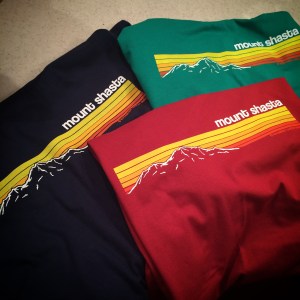
Writing books was not the only foray I made into selling products. I did venture into merchandising a little bit in the year between working on books. I made hats and a friend and I made some really cool shirts. The opportunity to write my third book came up and that put the apparel business on the back burner but I may start selling the hats and shirts through my Amazon store if there is interest in my doing so. I think these things look pretty good!


Incidentally, the Hike Mt Shasta logo is intended to call back to the classic Yosemite logo that was first used back in the days of the Yosemite Park & Curry Company. It is one more connection between Yosemite and Mount Shasta:


While all of that is interesting, in the end I always come back to the mountains, and it is there that the real focus should be. It is the wilderness, the mountains, and ultimately Mount Shasta that is the purpose of this project and that is where the spotlight must be directed.

In writing for Hike Mt Shasta, I have always worked to draw attention to a variety of aspects of the mountain and the surrounding area. My favorite series of posts is, by far, the Seldom Seen series. It is my passion to ferret out those secret spots where the beauty is immense, the views sublime, and the location seemingly lost to the public mind. I always try to shed a little light on these but still leave some mystery as to the location. It is my belief that there ought to be a balance of access to information about many places but that some places should be left for people to have a journey of discovery of their own. I think it sweetens the accomplishment of having found something or somewhere of great value on your own. In a small way, it is keeping our pioneer spirit alive. I think I think about this too much.

My single favorite post I have put up is my lenticular cloud gallery. Obviously I am interested in the fantastic clouds. I think their beauty, ranging from staggering to subtle, as well as their wild unpredictability, add a great deal of mystery and spectacle to a mountain that is already mysterious and spectacular. It has been a blast chasing them down.

Some of my other personal favorite posts are:

Mount Shasta Hoodoos – I love hoodoos wherever they are found. The ones on Mount Shasta are rarely seen and quite large.

Three Waterfalls On Mount Shasta – Waterfalls are easily my favorite thing in nature. Mount Shasta has some great ones!

A Sign Of The Wild – Naturally I have to collect pictures of wilderness signs. I am still fixin’ to write a series of meditations on wilderness one of these days.

5 Interesting Footbridges – Trail engineering is another interest of mine (we’ve long established I am…eccentric. I am not a one trick pony though!). Bridges are a big part of that fascination.

Though the articles keep Hike Mt Shasta from getting stale, it is the trails that are the real bedrock of the site. The trails around Mount Shasta are exceptionally diverse in both character and difficulty but they all highlight the magnificent beauty of the area. We are truly blessed to have so many different types of terrain and environments around Mount Shasta. It is a year-round wonderland.

Some of my favorite trails are:

Brewer Creek

South Gate Meadow

Deadfall Basin

Heart Lake

Ash Creek Butte

A few other interesting statistics:

The page on the McCloud River Falls Trail has received the most hits of any of the pages other than the site’s front page. The Heart Lake Trail is a distant second.

My blog post on hiking the Stoney Ridge Trail to the Four Lakes Loop in the Trinity Alps is my most popular article. There isn’t even one I could call a distant second here. I am not sure why this one resonated so much.

I am not going to try to add up how many countries I have gotten hits from but you can see the map. The top ten countries (aside from the U.S.) that have visited Hike Mt Shasta are:

  1. Canada
  2. Germany
  3. United Kingdom
  4. France
  5. Japan
  6. Australia
  7. Brazil
  8. Netherlands
  9. South Korea
  10. Russia
  11. Belarus

OK, that’s 11 countries, but it has been endlessly fascinating to me that someone in Belarus really likes Mount Shasta. I have gotten nearly 1,000 hits from that country.

The question I get the most is about where to camp. Most of the time it is about dispersed camping specifically, but campgrounds also come into play frequently. While I am happy to field questions on anything in Mount Shasta, it is always a little deflating to talk about camping rather than hiking.

Over the years, I have been quoted and linked by several websites. An article on my site appeared in the Record Searchlight in August 2013. This mention was responsible for the site’s first 1,000 view day. Nowadays I blow past the record set then on a daily basis. How things have grown. I have also (dis)graced the pages of Backpacker as a local expert.

In some ways, reaching a million views has come at the end of an era. My trusty old Canon 50D met its demise earlier this week. That camera has been with me from the beginning of the site and on numerous adventures. It also photographed 3 books. It was a real workhorse and will be greatly missed. Fortunately, a new camera is already on its way. It’s images will begin popping up on this site soon. Perhaps it is fitting to close this little retrospective with the final image taken with my old camera. It was, like so many others, a beautiful morning. Thanks again to everyone who has made this journey with me!

Breaking Down The North State: The Klamath Mountains Pt. II

Posted by bubbasuess on June 2, 2017
Posted in: Hiking, Klamath Mountains, Lakes, Marble Mountains, Meadows, Mount Shasta, Peaks, Rivers, Scott Mountains, Siskiyou Mountains, Trinity Alps, Trinity Divide, Water, Wilderness. Tagged: Little Scott Mountains, North Yolla Bolly Mountains, Salmon Mountains, Trinity Mountains. 3 Comments


The grandeur of the Klamath Mountains can be seen at Diamond Lake in the Trinity Alps.

This is a continuation of the the article examining California’s magnificent Klamath Mountains. Part I can be found here. This took an overview approach to the whole range and looked at the wildlands that are scattered throughout it. The Klamath Mountains are vast and it is much easier to appreciate the range by examining the various subranges in order to get a better idea of just how diverse and magnificent these mountains are. This article will break the range down by its numerous subranges and note some of the characteristics of each. It will only address the California portion of the Klamaths. The Oregon portion, notably the Siskiyous, the Kalmiopsis Wilderness and lower Rogue River area are outside the scope of this article and are best treated as a separate entity (and subject of a later article).
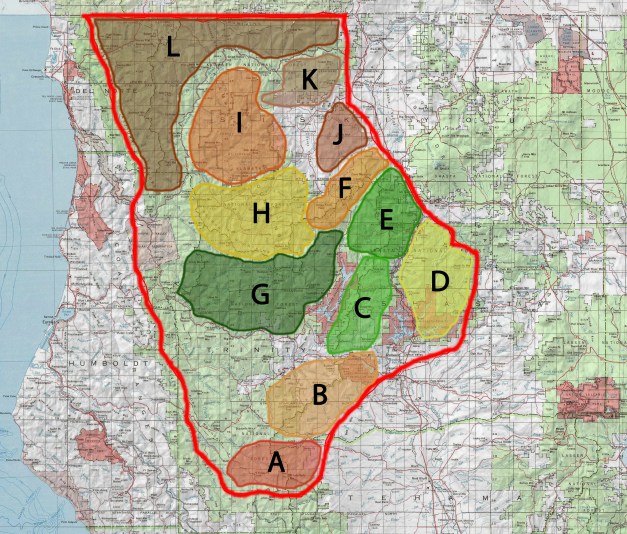
Klamath Mountains subranges: A. North Yolla Bolly Mountains, B. Southern Klamaths, C. Trinity Mountains, D. McCloud Range, E. Trinity Divide, F. Scott Mountains, G. Trinity Alps, H. Salmon Mountains, I. Marble Mountains, J. Little Scott Mountains, K. Scott Bar Mountains, L. Siskiyou Mountains

*Note that this map is only approximate and does not accurately represent the precise limits of each subrange of the Klamath Mountains.

North Yolla Bolly Mountains
North Yolla Bolly Mountain

Occupying the northern section of the Yolla Bolly-Middle Eel Wilderness, the North Yolla Bolly Mountains are an isolate block of high elevation peaks. The North Yolla Bollys lies right on the transition zone between the Klamath Mountains and the North Coast Range. Geologically they are an island of metavolcanic rock surrounded by sedimentary and ulrtramafic rocks. Though they are distinct from the rock types of both the Coast Range and the Klamaths, their position within the latter range is secured by the presence of the South Fork of the Trinity River. This river’s headwaters lie immediately north and south of the North Yolla Bollies and then flows to the northwest for 92 miles before joining the Trinity River.

The North Yolla Bollys consist of a long ridge that towers over the surrounding mountains. The ridge is capped by the high peaks of North Yolla Bolly and Black Rock Mountain. These are the second highest points in the Yolla Bollys, after South Yolla Bolly, the highest point in the North Coast Range. Each of the two high peaks in the North Yolla Bollys host a single, small lake in north facing cirques. Along with the mountain summits, these are the most popular destinations in the range. Most of the North Yolla Bollys are protected in the Yolla Bolly-Middle Eel Wilderness. Part of the freshmen class of wilderness areas established by the 1964 Wilderness Act, it is one of the least visited wild areas in California. Despite this, there is a well-developed trail network that accesses both the north side of the range and the wilderness’ remote interior. The trail passes through Petijohn Basin, with spurs leading to the small lakes and mountain summits before penetrating into the wildlands further south.

Southern Klamath Mountains
Inside the Massacre Natural Bridge.

Lying between the North Yolla Bollys and the main fork of the Trinity River is a large block of low to mid-elevation mountains. This area is covered with expansive forests and vast swaths of chaparral. There is no formal distinction for this region but its size demands its inclusion here. Drained by the South Fork of the Trinity River and Hayfork Creek on the west and Cottonwood Creek on the west, this area is the generally the lowest elevation region in the Klamath Mountains. The only significant upland area rises on the east side. Here, a ridge dotted with tall peaks climbs to elevations over 6,000 feet. The highest point, Bully Choop, stops just short of 7,000 feet. Two other notable peaks are part of this long ridge. Anchoring the western end is Chanchelulla Peak, protected by the tiny Chanchelulla Wilderness. At the eastern end is Shasta Bally, which is prominently visible from Redding. This peak is the highest point in Whiskeytown National Recreation Area. This park is the most well-developed area in terms of recreational amenities and attracts the most attention from hikers. Few other destinations are present in this part of the Klamath Mountains, the most worthwhile of which is the fascinating Massacre Natural Bridge, which is home to a short trail and loads of interesting geology.

Some maps identify this area as part of the Trinity Mountains. This seems like an unnecessary confusion. The Trinity Mountains lie further north, on the other side of Highway 299. The ranges are quite distinct from each other. The Shasta Bally/Bully Choop ridge is part of a granite batholith and forms the divide between the Trinity River and Cottonwood Creek. On the other hand, the Trinity Mountains are composed of sedimentary rocks and form part of the divide between the Trinity and Sacramento Rivers.

Trinity Mountains

Another one of the little known set of mountains within the Klamath Mountains, the Trinity Mountains are a collection of mid-elevation ridges and peaks that form the divide between the Trinity River and the Sacramento River. Blanketed by dense forest and some forbidding chaparral, the mountains here are generally sedimentary in nature. Though the Trinity Mountains forms the southern half of the divide between the Trinity and Sacramento Rivers, it also produces a significant watershed of its own. Clear Creek rises at the north end of the range and flows south for over 40 miles before it joins the North Fork of Cottonwood Creek. Clear Creek is impounded to form Whiskeytown Lake. The Trinity Mountains are one of the least developed parts of the Klamaths in terms of recreational infrastructure. There are no trails and only a lone, primitive campground near the headwaters of Clear Creek offers any sort of amenities.

“The McCloud Mountains”
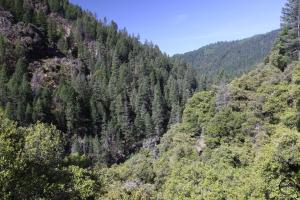
McCloud River Canyon, the heart of the McCloud Range.

East of the Sacramento River and Interstate 5 lies the most forgotten and anonymous part of the Klamath Mountains. Lacking a name or any other sort of designation, these mountains present a rugged, impenetrable visage to those who take an interest in them.  Though there are no trails or campgrounds in this remote region, there is one major recreation attraction. Major sections of these mountains are composed of marine sediment and in many cases this manifests as large limestone peaks. Typical of this kind of rock, caves have formed and the Shasta Caverns have become a popular destination. Though there are some major peaks, notably North Gray Rock (home of Shasta Caverns), Tombstone Mountain and Grizzly Peak, the most dominant feature in these mountains is the McCloud River. It rises far to the northeast but cleaves these mountains in two as it flows south toward the Pit River Arm of Shasta Lake. Its canyon is deep, narrow and remote. Though the range has no official name, the McCloud Mountains seems like a good choice, given its relationship to the river. Indeed, old maps from the 19th century identify these mountains accordingly, though the name never caught on.

The Trinity Divide

Despite being fairly unknown as a singular entity, the Trinity Divide is one of the most notable subranges of the Klamath Mountains. Its stature is ranked alongside the Trinity Alps, Salmon Mountains and Marble Mountains, the other tall, lake-filled subranges that make up the heart of Klamaths. The Trinity Divide has dozens of glacial lakes, large river valleys, high peaks and rugged terrain, just as those other mountain blocks do. What the Trinity Divide lacks is a large, federally recognized wilderness. It seems that without formal protections to alert hikers and backpackers, the Divide has kept just off the radar as a destination. Despite formal wilderness, much of this beautiful set of mountains retains its primeval character. Those very meager few who have entered Grey Rocks Basin at the head of the South Fork of Castle Creek or explored the small lakes atop the Castle Crags can attest to intact nature of the Trinity Divide’s wilderness.
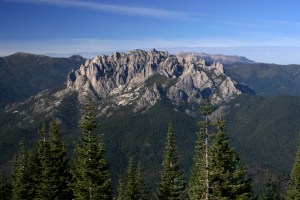
Mount Eddy peeks over the mighty Castle Crags.

While there is not a large chunk of wildlands in the Trinity Divide, there is one small wilderness area. Though it is not large in area, in terms of scenic qualities, the Castle Crags Wilderness is a superlative destination. The obvious highlight is the mighty cluster of granite spire that make up the Castle Crags. Unlike the rest of the Trinity Divide, the Castle Crags are moderately well known and have their own devoted following of fans. Despite not being well known like the Castle Crags, the Trinity Divide has other landmarks that continue to shine brightly. Among these excellent features is Mount Eddy, the highest peak in the entire Klamath Mountain Range. This large mountain is not as magnificent as nearby Mount Shasta but it remains a massive mountain in its own right and is home to several glacial lake basins. Among the other lakes in the Trinity Divide is Castle Lake, one of the largest in the Klamaths.

The Trinity Divide is so named because it forms the divide between the headwaters of the Trinity and Sacramento Rivers. The Trinity is the largest of the rivers that rise in the Klamath Mountains and flow into the Klamath River. The Sacramento River is the longest and largest river in California. The Pacific Crest Trail follows the crest of the range, threading the needle between the waters that empty into the Pacific near amongst the North State redwoods and those waters that flow into San Francisco Bay.

Scott Mountains
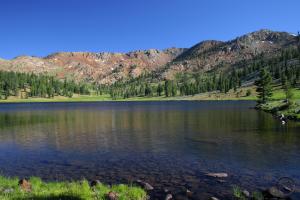
East Boulder Lake in the Scott Mountains.

If the Trinity Divide is an obscure mountain range then the Scott Mountains are utterly forgotten. These beautiful mountains consist of a single long crest that runs for over 20 miles east to west. Much of the range is composed of reddish peridotite, giving it a distinct appearance. This rock is prominent in other parts of the Klamath Mountains but nowhere does it seem to be as ubiquitous as in the Scott Mountains. In many ways the Scotts seem like an extension of the Trinity Divide. The highest peak, China Mountain, is often considered the northernmost peak of the Divide rather than the most prominent summit of the Scott Mountains. Like the Trinity Divide, the Scott Mountains are named because they divide the headwaters of two rivers. The southern slope the range flows into the Trinity River. The northern slope is the headwaters of the Scott River, one of the major waterways of the Klamath Mountains. Several lakes are found in these mountains, many of which are accessed via a well-developed trail system. This is particularly true of the western half of the range, which is protected within the Trinity Alps Wilderness. The eastern half, with fewer (though there are still several notable lakes) and no wilderness protection, is a largely untapped resource for hikers. Worth noting, however, is Lover’s Leap, a set of crags which are home to a rapidly expanding rock climbing area.

Trinity Alps
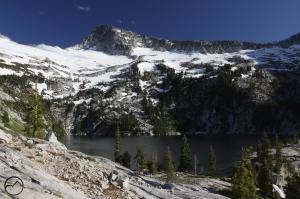
Grizzly Lake in the Trinity Alps.

Although Mount Eddy may be the tallest point in the Klamath Mountains, the Trinity Alps are really the heart of the range. It is here that one finds the most expansive wilderness, the most spectacular mountains, the grandest scenery and the sense of limitless vastness that is a hallmark of the Klamath Mountains. It is in the Trinity Alps that hikers will most readily find the stunning landscapes that make the Klamath Mountains such an incredible, mysterious jewel of the North State. Towering, jagged towers composed of granite and other, more exotic rocks abound here. Gorgeous alpine lakes are set like glittering jewels beneath tall cliffs. Thundering waterfalls hammer against dense rocks and vast expanses of lush, beautiful forests blanket deep canyons and a seemingly numberless set of tall ridges. This truly is the heart of the Klamaths.

It is necessary to draw a distinction between the Trinity Alps Wilderness and the Trinity Alps as a subrange of the Klamath Mountains. The former is massive, totaling 560,000 acres. Its size is swelled by including portions of the adjacent Scott and Salmon Mountains. These sections of neighboring ranges lie on the divide between the Trinity River and the Salmon and Scott Rivers so are a natural fit within the wilderness area. Due to their inclusion in the large, protected wildlands, these sections are often thought of as part of the “Trinity Alps”, which is a natural, consequent association. The Trinity Alps proper, on the other hand, are somewhat smaller in area and lie wholly within the watershed of the Trinity River. For the purposes of this article, the sections of the Salmon and Scott Mountains that lie in the wilderness area have been separated out and addressed with their respective mountain ranges.
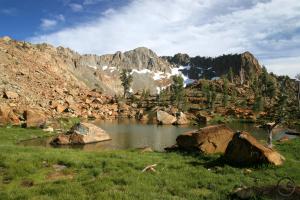
Classic beauty of the Trinity Alps.

The Trinity Alps can be divided into three general areas. In the west, there is a vast expanse of forested ridges and deep canyons. Drained by the North Fork of the Trinity River and the New River, this area has a few small lakes and a scattering of rocky peaks that punctuate the sea of green trees. On the east side of the Trinity Alps, butting against the upper Trinity River, there is a collection of tall peaks, deep lakes and vast expanses of meadow. The peaks here are rugged, rocky and beautiful. Geologically, this area is a mixture of granite and red and yellow peridotite. It has a striking appearance. Sandwiched between these two areas is the epicenter of the Trinity Alps. Composed of stark white granite, this area has the highest peaks, most rugged terrain and largest lakes. This is the area that truly supplies the “Alps” moniker to the entire range.

The entire range drains into the Trinity River. Some creeks flow west and join the river upstream from the impounded Trinity Lake while the rest flow south and join the river during its long journey west to join the Klamath River. Water is abundant within these mountains. The lakes and vast stretches of meadow feed the waterways well into summer and beyond. Several waterfalls, most notably in Canyon Creek and at Grizzly Lake, grace these mountains. Other smaller falls dot the area. Significant creeks include Canyon, Coffee, Swift, Deer, and Granite Creeks.

Trails course through the Trinity Alps and it is possible to string together paths to create trips that would last weeks. It is in the Trinity Alps that the great sense of remote expansiveness of the Klamath Mountains is most evident. Here hikers and backpackers can see for dozens of miles to the horizon knowing that civilization still lies even further away and the world around them is truly primitive.

Salmon Mountains
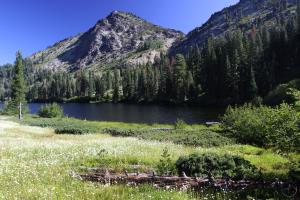
Taylor Lake in the Salmon Mountains.

In some ways, the Salmon Mountains are the great lost range of the Klamath Mountains. This is not because they are utterly lost and forgotten, but because the administrative nature of the national forest has broken up the range’s cohesion. The Salmon Mountains are those parts of the Klamaths that are drained by the Salmon River (often called the Cal Salmon, to distinguish it from the magnificent Salmon River in Idaho, the famed “River of No Return”). Geologically, these mountains are fairly homogenous. However, the administration of these lands has led to something of a disassociation of the range. Specifically, it is the wilderness areas themselves that have led to the demise of the Salmon Mountains. The southern part of the range is included in the Trinity Alps Wilderness. The northern corner is joined with the Marble Mountains Wilderness. The high country at the east end of the Salmon Mountains is contained in the small but spectacular Russian Wilderness. The northern and southern parts are consequently thought of as parts of their adjacent ranges while the Russian Wilderness is left as an entity unto itself.

Despite being broken up, these areas are thankfully preserved in their wild state and they are beautiful areas indeed. Granite towers, gorgeous lakes and lush meadows are found in these mountains, especially in the areas with the wilderness boundaries. Outside these protected areas, the range consists of lower, drier ridges that rise above the Salmon River. Trails are found throughout the area and hiking is easily the best way to experience this lost mountain range.

Marble Mountains
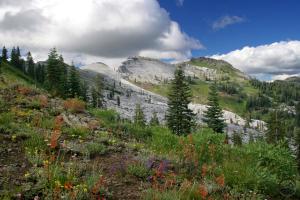
The Marble Mountain

Wild and expansive, the Marble Mountains are second in stature only to the Trinity Alps. Like the Trinities, they offer a high concentration of the best of the Klamath Mountains, with a few unique twists of their own. Occupying the high country between the Salmon River and the Klamath River, the Marbles are protected within the 250,000 acre Marble Mountains Wilderness. Here there are dozens of lakes, towering summits and large, swift flowing creeks. Numerous meadows abound. Geologically, the Marbles are diverse. Granite plutons, especially around English Peak in the south and the Cuddihy Lakes in the north, are found on the outskirts of the Marble Mountains. The interior has classic Klamath Mountains geology consisting of peridotite and serpentine as well as sedimentary rocks. The crown jewel of the range, however, is the presence of large blocks of marble. The most notable are found on Marble Mountain itself and at Kings Castle, rising above Paradise Lake. The former is the larger of the two is one of the most unique wilderness mountains to be found in the country. Composed of a long, sweeping slope of bright white marble, Marble Mountain is a striking, fascinating formation. Its northern side, however is a steep cliff that drops off sharply into the headwaters of the Elk Creek drainage. Sitting atop the eastern corner of this incredible formation is Black Marble Mountain, a roof pendant left over from the mountains formation.

The Marble Mountains are drained by the North Fork of the Salmon River as well as several other notable creeks. The largest creek in the range is Wooley Creek, which is the biggest tributary of the Salmon River. The eastern section of the range is part of the Scott River drainage. Notable creeks including Shakleford, Kidder and Canyon Creeks all contribute significant amounts of water to the Scott River. The northern section of the Marbles is part of the Klamath River’s immediate watershed and is empties into the river by way of large creeks like Elk and Grider Creeks.

Like other parts of the Klamath Mountains, there is an extensive network of trails that are reasonably well maintained. Weeklong backpacking trips are easily possible here. Unfortunately the Marble Mountains, especially the northern part, have experienced significant fire damage in the last few years. They remain beautiful and recovery has already commenced but hikers must anticipate snags and some trails in need of post-fire maintenance, especially in the more remote corners.

Little Scott Mountains and the Scott Bar Mountains
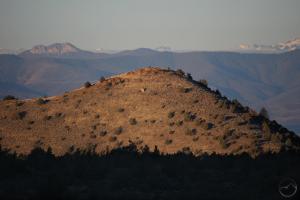
Duzel Rock seen in the upper left.

These two, small, ranges are in the far northeast corner of the Klamath Mountains. Neither climbs very high and has a strong high desert influence, especially along their lower flanks. The Little Scott Mountains’ southern boundary begins along the East Fork of the Scott River and Willow Creek. The latter is part of the Shasta River watershed. The northern boundary is where the small range meets the Scott Bar Mountains just west of Yreka. They form the divide between the Scott and Shasta Valleys. Though the Little Scott Mountains lack the rugged character of most of the Klamath Mountains, they do contain a couple notable features. First is Scarface Ridge and Antelope Mountain. These constitute the crest of the range. The other notable landmark is Duzel Rock. This massive rock protrusion is home to a Calfire lookout.

The Scott Bar Mountains rise higher than the Little Scott Mountains. Consequently, they do have more forest cover than the Little Scott Mountains. These mountains form the divide between the Scott Klamath Rivers. Running east to west, they join with the Little Scott Mountains just west of Yreka. Neither of these mountain ranges is in anyway developed for recreation. The only destination of note is Greenhorn Park in Yreka. This attractive park is on the very eastern fringe of the Scott Bar Mountains and has a well-developed trail system as well as a lake, playgrounds and other recreational facilities. Lack of significant blocks of public land further impair recreational potential of these small mountain ranges.

Siskiyou Mountains
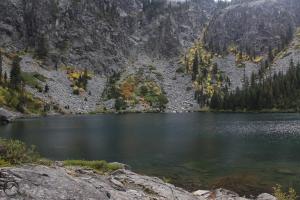
Devils Punchbowl in the Siskiyou Mountains.

Forming the great northern bulwark of the Klamath Mountains, the Siskiyous form the great divide between the Klamath River and Rogue River watersheds. Forming a vast crescent, the Siskiyous stretch from Siskiyou Summit, where the Klamaths and Cascade Range meet, to the low hills near the confluence of the Klamath and Salmon Rivers. This long arc includes some magnificently rugged terrain and gives rise to several large creeks that feed into the Klamath River. The Illinois and Applegate Rivers, the two main tributaries of the Rogue River, also form on the northern slope of the Siskiyou Mountains. The range can roughly be divided into two sections. The most heavily used is the long east-west ridge that runs from Siskiyou Summit west toward Thompson Ridge. A significant portion of this half of the Siskiyous lies in Oregon. Mount Ashland, the highest peak in the Siskiyous is found here. The other part of the Siskiyous is almost entirely in California as it dips south along the Klamath River. This area is much more rugged with numerous large lakes and craggy peaks. It is crowned by epic Preston Peak, which is only slightly shorter than Mount Ashland but far more prominent and rugged.

Two wilderness areas are found in the Siskiyous. The Red Buttes Wilderness is the smaller of the two and receives somewhat heavier use due to its easy access from Oregon and relative proximity to population centers. Several small lakes are found in this wilderness, many of which form the headwaters of the Applegate River. The Red Buttes themselves are the centerpiece of the wilderness. Composed of bright red peridotite, they are classic Klamath Mountains peaks. In contrast to the diminutive size of the Red Buttes, the Siskiyou Wilderness is the third largest wildlands in the Klamath Mountains with over 170,000 acres. This vast land is not as tall as the other major subranges of the Klamath Mountains but it has extremely rugged, rocky terrain, several notable peaks and a number or large, deep lakes. Sinuous Clear Creek drains the interior of this exceptional wilderness.

The Klamath Mountains In Oregon

The somewhat arbitrary line that marks the border between California and Oregon also divides the Klamath Mountains. A significant chunk of the range lies north of the border in the Beaver State. Much of this is part of the Siskiyou Mountains. However, there are other areas that are noteworthy. In particular is the amorphous block of mountains that is centered on the Kalmiopsis Wilderness. These mountains were devastated by the 2004 Biscuit Fire but they remain beautiful and are well down the road to recovery already. These mountains exhibit typical Klamath Mountains geography. Nowhere it this more evident than around Vulcan Peak and small Vulcan Lake, where the red peridotite that is so common in the Klamaths is quite evident. However, geology only makes up half of the metrics by which the Klamaths are determined. Watersheds are also important and the fact that these mountains are drained by the Illinois and Chetco, the former of which feeds into the Rogue River, makes this area feel like a region apart from the main block of the Klamath Mountains. Even much of the Siskiyous, though part of the divide between the Rogue and the Klamath, feel like they are once removed from the Klamath Mountains as well. Perhaps in time they will receive their own treatment in this geography series.

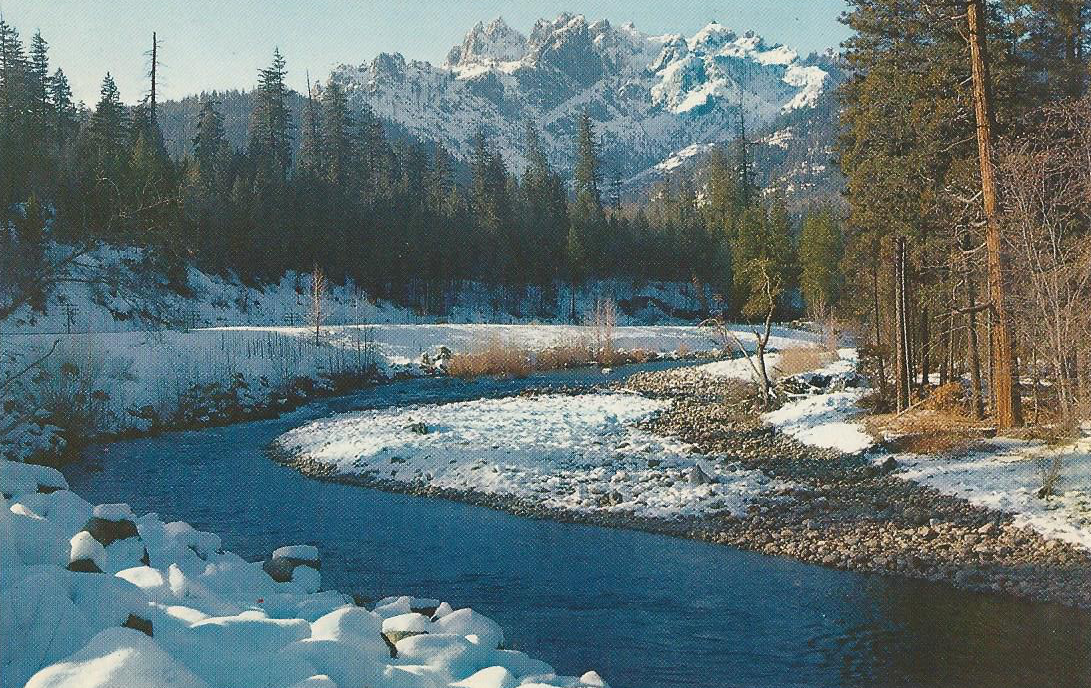
Posts navigation

← Older Entries
Newer Entries →
    • Recent Posts

      • Winter Shows Up When It Will
      • January Rolled By With Mud, Then Very Dry
      • Mount Shasta 2025 – A Year In Images
      • Mount Shasta On Either Side Of Christmas
      • Adrift In An Ocean Of Fog
      • December Has Been Spectacular Thus Far Pt. II (A Magnificent Lenticular)
      • December Has Been Spectacular Thus Far Pt. I
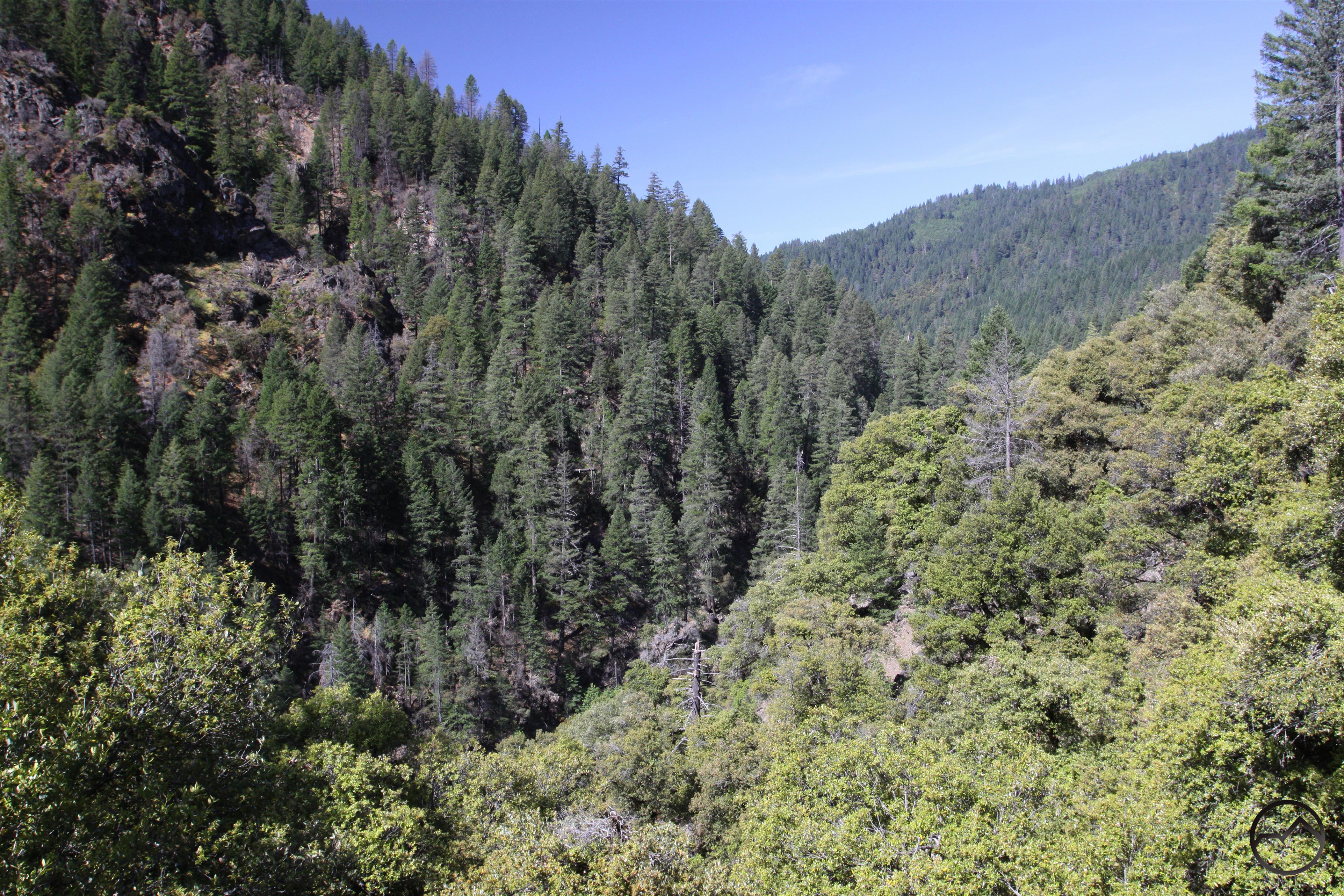
      • Lenticular Interrupted
      • A Stormy Wave And A Truchas Sunset
      • Aurora Lenticularis
    • Enter your email address to follow Hike Mt Shasta and receive notifications of new posts by email.

    • Archives

      • February 2026
      • January 2026
      • December 2025
      • November 2025
      • October 2025
      • September 2025
      • August 2025
      • July 2025
      • June 2025
      • May 2025
      • April 2025
      • March 2025
      • February 2025
      • January 2025
      • December 2024
      • November 2024
      • October 2024
      • September 2024
      • August 2024
      • July 2024
      • June 2024
      • May 2024
      • April 2024
      • March 2024
      • February 2024
      • January 2024
      • December 2023
      • November 2023
      • October 2023
      • September 2023
      • August 2023
      • July 2023
      • June 2023
      • May 2023
      • April 2023
      • March 2023
      • February 2023
      • January 2023
      • December 2022
      • November 2022
      • October 2022
      • September 2022
      • August 2022
      • July 2022
      • June 2022
      • May 2022
      • April 2022
      • March 2022
      • February 2022
      • January 2022
      • December 2021
      • November 2021
      • October 2021
      • September 2021
      • August 2021
      • June 2021
      • May 2021
      • April 2021
      • March 2021
      • February 2021
      • January 2021
      • December 2020
      • November 2020
      • October 2020
      • September 2020
      • August 2020
      • July 2020
      • June 2020
      • May 2020
      • April 2020
      • March 2020
      • February 2020
      • January 2020
      • December 2019
      • November 2019
      • October 2019
      • September 2019
      • August 2019
      • July 2019
      • June 2019
      • May 2019
      • April 2019
      • March 2019
      • February 2019
      • January 2019
      • December 2018
      • November 2018
      • October 2018
      • September 2018
      • August 2018
      • July 2018
      • June 2018
      • May 2018
      • April 2018
      • March 2018
      • February 2018
      • January 2018
      • December 2017
      • November 2017
      • October 2017
      • September 2017
      • August 2017
      • July 2017
      • June 2017
      • May 2017
      • April 2017
      • March 2017
      • February 2017
      • January 2017
      • December 2016
      • November 2016
      • September 2016
      • August 2016
      • July 2016
      • June 2016
      • May 2016
      • April 2016
      • March 2016
      • February 2016
      • January 2016
      • December 2015
      • November 2015
      • September 2015
      • August 2015
      • July 2015
      • June 2015
      • May 2015
      • April 2015
      • March 2015
      • February 2015
      • January 2015
      • December 2014
      • November 2014
      • July 2014
      • June 2014
      • May 2014
      • April 2014
      • March 2014
      • February 2014
      • January 2014
      • December 2013
      • November 2013
      • October 2013
      • September 2013
      • August 2013
      • July 2013
      • June 2013
      • May 2013
      • April 2013
      • March 2013
      • February 2013
      • January 2013
    • Categories

      • Boy Scouts
      • Cascade Range
      • Castle Crags
      • Desert
      • Echo Point
      • Glaciers
      • Hiking
      • How things came to be…
      • Klamath Mountains
      • Konwakiton Outdoor Designs
      • Lakes
      • Lenticular Clouds
      • Maps
      • Marble Mountains
      • Meadows
      • Mount Eddy
      • Mount Shasta
      • Mount Shasta History
      • Napa County
      • Off Season Trails
      • Pacific Crest Trail
      • Peaks
      • Rivers
      • Rock Climbing
      • Scott Mountains
      • Seldom Seen
      • Shasta Valley
      • Sierra Nevada
      • Siskiyou Mountains
      • Sonoma County
      • Spring Trails
      • sunrise
      • sunset
      • Trinity Alps
      • Trinity Divide
      • Truchas Ridge
      • Uncategorized
      • Water
      • Waterfalls
      • Wilderness
      • Wildflowers
      • Wine Country
      • Winter Trails
      • Yosemite
    • Meta

      • Create account
      • Log in
      • Entries feed
      • Comments feed
      • WordPress.com
    • Copyright © 2013-2024 by Bubba Suess

      DISCLAIMER: Any use of the information contained in this site by any and all persons is done at their own risk. The operator of this site shall be held harmless from any and all alleged claims, demands, causes of action, liability, loss, damage and/or injury to property or persons whether brought by an individual or other entity. This indemnification applies, without limitation, to all actions by an individual or other entity as a result of their use of information contained in this site.

    Blog at WordPress.com.
    Hike Mt. Shasta
    Blog at WordPress.com.
    • Subscribe Subscribed
      • Hike Mt. Shasta
      • Join 983 other subscribers
      • Already have a WordPress.com account? Log in now.
      • Hike Mt. Shasta
      • Subscribe Subscribed
      • Sign up
      • Log in
      • Report this content
      • View site in Reader
      • Manage subscriptions
      • Collapse this bar
     

    Loading Comments...